
SLIDE 1
The European Spallation Source
John Womersley, Director General February 2017
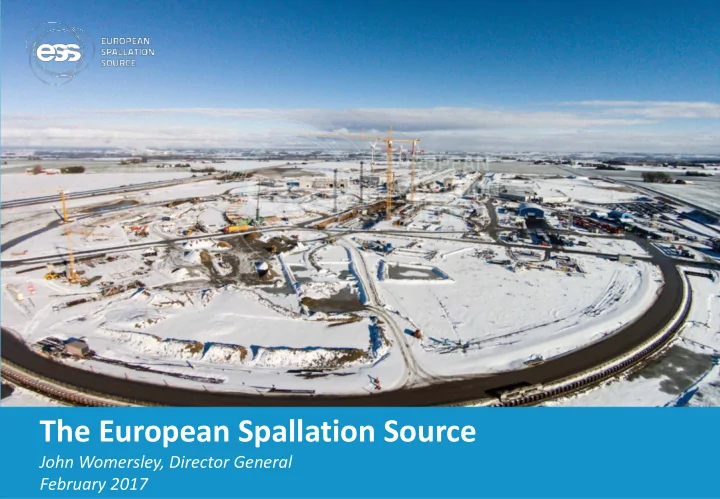
The European Spallation Source John Womersley, Director General - - PowerPoint PPT Presentation
The European Spallation Source John Womersley, Director General February 2017 Neutrons are special Electrically neutral - deeply penetrating ... except for some isotopes Nuclear interaction : cross section depending on isotope (not
John Womersley, Director General February 2017
2
except for some isotopes
and water
properties
non-relativistic velocities E = 293K = 25 meV, λ = 1.8 Å v = 2 km/s
3
2013-10-11 STC16 Agenda Item 9
In Operandi Advanced Energy Devices
1960 1970 1980 1990 2000’s 2020+
4
Greater complexity Need for more precision Wider range of application areas
Berkeley 37-inch cyclotron 350 mCi Ra-Be source Chadwick
1930 1970 1980 1990 2000 2010 2020 105 1010 1015 1020 1
ISIS
Particle driven pulsed
ZING-P ZING-P’ KENS WNR IPNS ILL X-10 CP-2
Fission reactors
HFBR HFIR NRU MTR NRX CP-1
1940 1950 1960 Effective thermal neutron flux n/cm2-s
(Updated from Neutron Scattering, K. Skold and D. L. Price, eds., Academic Press, 1986)
FRM-II SINQ SNS J-PARC LANSCE OPAL PIK
2030
CARR CSNS Dhruva IBR-II NIST RSG LVR JRR-3
Particle driven steady state Pulsed reactor
HANARO HIFAR SAFARI-1 SALAM ETERR-2 MARIA HOR JEEP II ORPHEE
Reactor Sources Spallation Sources
Year
ESS
5
ISIS ILL Effective thermal neutron flux n/cm2-s FRM-II SNS J-PARC LANSCE NIST Year ESS
50 100 150 200 250 300 1960 1970 1980 1990 2000 2010 2020 2030
Reactor sources Accelerator-driven sources CSNS
Possibilities of pulse shaping
time (ms) Brightness (n/cm2/s/ster/Å) 7 5 x10¹⁴
UK TS1 128 kW UK TS2 32 kW US 1.4 MW Japan 300 kW ILL 57 MW ESS 5 MW 2015 design thermal moderator
1 2 3 3 4 1 2 6 λ=1.5 Å
ESS 5 MW 2012 design (TDR)
4 8
7
8
Host Countries Sweden and Denmark
Construction 47.5% Cash Investment ~ 97% Operations 15%
Non Host Member Countries Construction
52.5% In-kind Deliverables ~ 70% Operations 85%
Sweden Denmark Germany United Kingdom France Italy Spain Switzerland Norway Poland Czech Republic Hungary Estonia To be determined
CURRENT Sweden (member) 35.0 % Denmark (member) * 12.5 % Germany (member) * 11.0 % United Kingdom (member) 10.0 % France (member) 8.0 % Italy (member) 6.0 % Spain (founding observer) * 5.0 % Switzerland (member) 3.5 % Norway (member) 2.5 % Poland (member) 2.0 % Czech Republic (member) 2.0 % Hungary (member) 0.95 % Estonia (member) 0.25 % Total * ~98.7 % FUTURE Belgium (founding observer) tbd Netherlands (founding observer) tbd
* Includes Pre-construction Costs, Current Construction Commitment
9
10
Aarhus University Atomki - Institute for Nuclear Research Bergen University CEA Saclay, Paris Centre for Energy Research, Budapest Centre for Nuclear Research, Poland, (NCBJ) CNR, Rome CNRS Orsay, Paris Cockcroft Institute, Daresbury Elettra – Sincrotrone Trieste ESS Bilbao Forschungszentrum Jülich Helmholtz-Zentrum Geesthacht Huddersfield University IFJ PAN, Krakow INFN, Catania INFN, Legnaro INFN, Milan Institute for Energy Research (IFE) Rutherford-Appleton Laboratory, Oxford(ISIS) Copenhagen University Laboratoire Léon Brilouin (LLB) Lund University Nuclear Physics Institute of the ASCR Oslo University Paul Scherrer Institute (PSI) Polish Electronic Group (NCBJ, TU Warsaw, TU Lodz) Roskilde University Tallinn Technical University Technical University of Denmark Technical University Munich Science and Technology Facilities Council University of Tartu Uppsala University WIGNER Research Centre for Physics Wroclaw University of technology Warsaw University of Technology Zurich University of Applied Sciences (ZHAW)
Employees
Nationalities
Collaborating Institutions
Target LINAC Central Utilities Building (CUB) Instruments Site Offices
ESS Instrument Layout (June 2016)
ODIN DREAM NMX MIRACLES BEER C-SPEC T-REX MAGIC BIFROST HEIMDAL FREIA LoKI SKADI VESPA ESTIA VOR
50 m 100 m 150 m
1 8
ESS Lead Partners for instrument construction +
Nuclear Physics Institute
Multi-Purpose Imaging ODIN General-Purpose SANS SKADI Broadband SANS LOKI Surface Scattering Horizontal Reflectometer FREIA Vertical Reflectometer ESTIA Thermal Powder Diffractometer HEIMDAL Bispectral Powder Diffractometer DREAM Monochromatic Powder Diffractometer Materials Science Diffractometer BEER Extreme Conditions Diffractometer Single-Crystal Magnetism Diffractometer MAGIC Macromolecular Diffractometer NMX Cold Direct Geometry Spectrometer C-SPEC Wide Bandwidth Direct
Bispectral Direct Geometry Spectrometer TREX Cold Crystal-Analyser Spectrometer CAMEA Vibrational Spectrometer VESPA Backscattering Spectrometer MIRACLES High-Resolution Spin-Echo Wide-Angle Spin-Echo Fundamental & Particle Physics life sciences magnetism & superconductivity soft condensed matter engineering & geo-sciences chemistry of materials archeology & heritage conservation energy research fundamental & particle physics
Large-Scale Structures Diffraction Spectroscopy
COBIS, Copenhagen University North Campus
Provide world leading scientific software and scientific computing support for neutron scattering at ESS
Scientific Software
ESS experiment control system, Data acquisition, Data correction software, visualization, and software to model and analyze experimental data sets.
Data center operations
Store and catalogue ESS datasets, provide ESS users remote access to their data, computing for live data correction, and analysis software during and after experiments.
User support
Support ESS users with data treatment and analysis.
21
22* DMSC Staff now 60
(*20 FTEs and 2 part time)
22
2014
Construction Starts on Green Field Site
2009
Decision to Site ESS in Lund
2025
ESS Construction Phase Complete
2003
European Design of ESS Completed
2012
ESS Design Update Phase Complete
2019-20
Machine Ready for 1st Beam on Target
2023
ESS Starts User Program
23
24
27
28
29
Construction Budget: Instruments 1-15 Initial Operation Budget (2019-2025): instruments 16-22, scope upgrades for instruments 1-15 Steady State Operation
Pessimistic scenario: ILL operates at reduced output until 2023, ESS with 22 instruments beyond 2028. Earlier closer and/reduced operations for a number
Optimistic scenario: ILL operates until 2030, ESS with 35 instruments beyond 2035.
Pessimistic scenario: ILL operates at reduced output until 2023, ESS with 22 instruments beyond 2028. Earlier closer and/reduced operations for a number
Optimistic scenario: ILL operates until 2030, ESS with 35 instruments beyond 2035.
32