The Forest of Leisures in Fleurus & the hall of - - PDF document

the forest of leisures in fleurus
SMART_READER_LITE
LIVE PREVIEW

The Forest of Leisures in Fleurus & the hall of - - PDF document

The Forest of Leisures in Fleurus & the hall of Vieux-Campinaire Tourist Information Center Rue de la Virginette, 2 - 6220 Fleurus Tl./Fax : 0032(0)71/88.50.72 The name of the city itself is probably a heritage of this time.


slide-1
SLIDE 1

Tourist Information Center Rue de la Virginette, 2 - 6220 Fleurus Tél./Fax : 0032(0)71/88.50.72

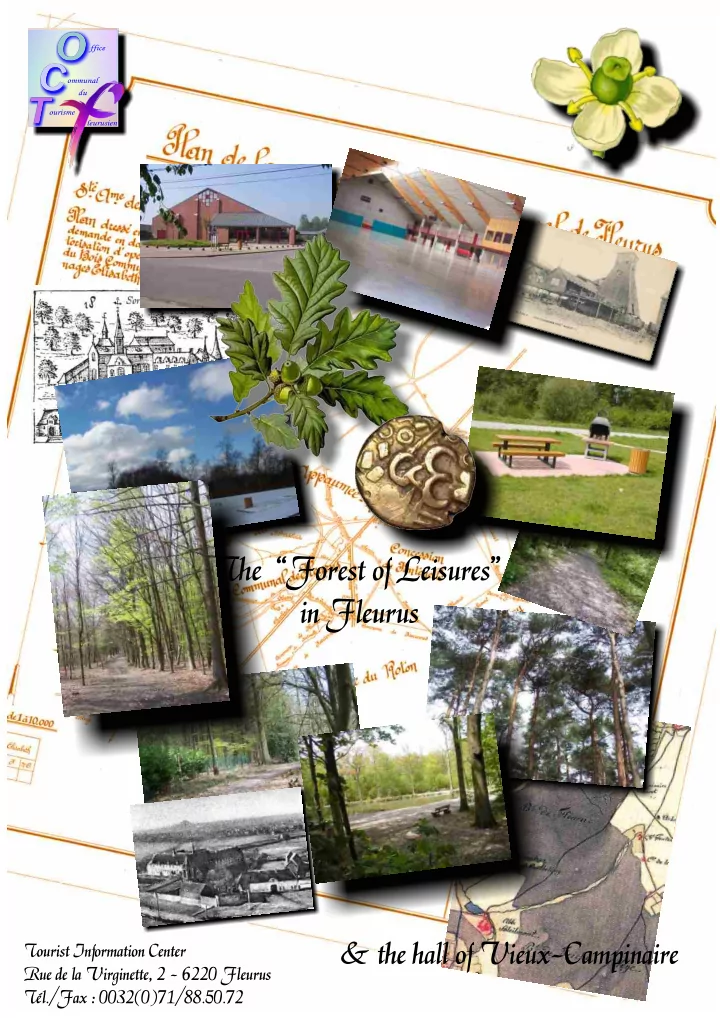
The “Forest of Leisures” in Fleurus

& the hall of Vieux-Campinaire
slide-2
SLIDE 2

Fleurus, or the obvious example

istory, as it is taught to children, seems to be a permanent, unchanging thing.

H

A precise and objective measuring instrument of the
  • past. Reality is different. History, like any human reality,
is fluctuating. The enemies of yesterday are the allies of today and the friends of tomorrow. The history of our Europe is the most obvious evidence of this; the history of Fleurus, an obvious example. The history of the city and the villages around it begins some millenium before our era. Located on one of these ways of migration which made it possible for our ancestors to conquer little by little the European space, the entity of Fleurus was probably inhabited as soon as 5.000 years BC. But the oldest signs of occupation are to be found in the first century BC, at the time of the Roman invasion carried out by Cesar and the roman influence on the territory. The roman highway, which borders the city on its northern part, and several roman buildings. To name a few, the farms of “Martinrou” and the “Baraque” which were probably founded at that time. Roman antiquities that were discovered nearby allow this assumption. The name of the city itself is probably a heritage of this
  • time. According to former writers, Fleurus would draw
its name from the fertility of its ground and its laughing campaigns (Floridum rus, flowered fields). If these invasions were dramatic for our ancestors, they nevertheless provided the basis on which a new world was going to be built. From that time on, the city of Fleurus gains an importance which the christianization of the country will not contradict. It becomes a center for evangelization and is elected chief town of a vast deanery. The first historical quote of the city dates back from March the 28th 977. The chronicles of a close abbey report that the founder
  • f this monastery passed away on that date in Fleurus.
In the course of the Middle-Ages, Fleurus keeps on developing. A quiet and commercial city, it obtained from its lord the rare privilege usually only granted to larger cities, to become a frank city. The resulting development of the trade often causes the greediness of the soldiers passing by but the city does not find it necessary to protect itself with walls. During centuries to come, it will pay a high price for this decision. Between 1333 and 1707, the city is plundered, burned down and its population slaughtered almost 20 times. Why is it so ? The city is very well located; at the beginning of the valley of Sambre, on a way of natural penetration while coming from the south, the city occupies a key frontier
  • position. One therefore often prefers to destroy it rather
than to leave it intact in the hands of the enemy. The origin of the numerous cellars and underground passages running under the town centre is to be found in these events. What better way to protect its own goods than by hiding them underground out of sight? During the 17th century, the appearance of France in the foreground of the European powers will have a deep influence on the local history. Fleurus is not any longer an average city. While the fortified town of Charleroi is meant to forbid the access to the brabançonnes plains in a direction and the North of France in the other. Fleurus and its surroundings are the only right place for fightings on a large scale. In 1690, 1794 and 1815, our plains will see France play some of the most dramatic acts of its history.

... two fundamental elements of the local richness: the “Forest of Leisures” and the historical inheritance.

If the geographical and geological chances did, all at the same time, the fortune and the misfortune of Fleurus ...

slide-3
SLIDE 3 a e L F ux y R e n L ig a L L n ig e a L L n g e a i L A r Ry m d’ u
  • r
R d V u ss d an u a u x i e u G a au e d s u s M i
  • u
u l R i n C h ass ar t s
  • B
r u G i s s u
  • n
d u a e s s i u R t n
  • m
i a l r e B e d u a e s s i u R x u
  • r
n i t r a M e d u a e s s i u R e l l e r u t u
  • C
e d u a e s s i u R x u a V d n a r G e d u a e s s i u R x u
  • r
n i m
  • G
e d u a e s s i u R é r P
  • s
i l l i a T e d u a e s s i u R SOMBREFFE VILLERS-LA-VILLE MARBAIS VILLERS-PERWIN LES BONS VILLERS RANSART LIGNY BOIGNEE KEUMIEE MOIGNELEE FARCIENNES PIRONCHAMPS GILLY Heppignies Wangenies Saint Amand Brye Wagnelée Wanfercée Baulet Lambusart Les Trois Burettes Le Happeau Le Vénérable La Croisette Longpré Chassart Bûr Les Deux Wés Baraque Zidore La Grosse Borne Petit Coutelié Bon Dieu de Pitié La Maladrée Capillone Le Bosquet La Marcelle Bois de Soleilmont Forêt des Loisirs Martinroux Les Amoudries Parc industriel d’Heppignies Le Bierau Parc industriel d’Heppignies Parc industriel de Martinrou Parc industriel de Fleurus-Farciennes Moulin de Gominroux Taille Gueule Le Spinois Champ des Oiseaux La Baraque Au Rompi Couturelles Le Fond de Boignée Plomcot Bonsecours Château Posson Bois du Monia Les Ebans Camp Dandois Cinq Bonniers Chapelle St Hubert Château et fermes de Chassart 1690 1690 1794 1794 1794 1815 u C h a s s é e d e C h a r l e r
  • i
N 2 9 t 42 Autorou e E Place de Brye e R u e P h i l i p p b
  • u
r g N 9 3 d Route e Namur N912 e a g in a W u d e u R 2 1 9 N e g a in a W u d e u R l Chaussée de Gil y N29 Chaussée de Charleroi 1 5 N ° e rt i So 2 E4 te
  • u
tor Au ue des Eb ans R C s e C i N haus é de harlero 29 e d e t u
  • R
s a B a l a S e s e r b m 9 N Vers Brussel South Charleroi Airport m N R u e P l
  • c
  • t
2 9 N R u e F l a m i n e t t e 2 9 Usines Chassart Chapelle Ste Adèle Levrette Fosse Chapelle St Pierre Chapelle Man’zelle Philippebourg Le Croix Benoit Les Fontaines Bosquet Mahaux Potale St Ghislain Chapelle St Bernard Chapelle St Jacques Chapelle N.D. des Sept Douleurs Chapelle Emanuelle Dumont de Chassart Le Font de Ligny La Tombe Les Tiennes Les Flaminettes Villa carrée Wache Le Laid Trou Vers Gembloux Vers Brussel South Charleroi Airport Le Fayt Le Garion Le Casino Chapelle St Pierre Le Chêne Chapelle
  • N. D. des
Affligés La Barrière Trieu Benoît Trieu Gossiaux Cité de la Drève Trieu Bernard Ferme du Fayt La Cache Fleurjoux Les Champs Elyssées Les Moulins des amours Chapelle Ste Anne Rue Vénérable N93 Ferme de Martinroux Ferme de l’Appaumée La Croix Fontenelle Petit Try Bois du Corbeau
  • Anc. Fosse
Ste Marie
  • Anc. Charb.
de Bonne Espérance Carajoly R u
  • e
t e d N m a r u Chateau de la Paix Campagne du Fayt Cité Anciaux La Butte Autoroute E42 Sortie N° 14 Vers Namur V rs Mons e Aire de epo d’He pignies r s p Vers Charleroi 3 R 3 R R3 Vers Fc i nes N90 are n & 15 18 a Gi d r r C s haus ée Brunehault MELLET

Fleurus

Grand Coutelié Ferme du Gros Buisson La Maison Carréee Bosquet Chenoi Chapelle St Fiacre Chapelle Ste Adèle Chapelle du Bosquet Chenoi Trou à la Vigne Ferme des Quatre Chemins Chapelle Dieu de Pitié 1794 Chapelle St Roch 1815 1815 1815 1815 1815 1815 1815 1815 1815 Ancienne abbaye de Soleilmont Nouvelle abbaye de Soleilmont 1815 1815 15 18 a Gi d r r 1690 1794 1690 1794 1794 1815 1815 Vieux-Campinaire The marshal of Luxembourg for the account of King Louis XIV at the top of his power, general Jourdan who will save the French revolution here, and finally Napoleon Bonaparte who will gain here the last victory
  • f his transitory empire.
Although all these wars were terrible and brought pains and sorrows to our ancestors, they also had an unexpected effect on our populations. Each new wave of invaders or liberators left behind "remains" of its passage. Abandoned wounded soldiers, deserters, children born of momentary loves. Some french, german, austrian, spanish, italian, english and american blood runs in the veins of all of us. A ground hit in its flesh by the violent struggles, rich in coal, the city will become almost naturally, at the end of th the 19 century, one of the “fish ponds” of the international Socialism and social dispute aiming at obtaining better living conditions for the workers. It is from cabarets and guinguettes of Fleurus that the columns of strikers, who destroyed several factories of the area before being violently stopped at the doors of Charleroi by the civic guard militia, departed in 1886. Lots of men, women and even children were wounded or killed at the time of these fightings. But nothing would stop afterwards the course of the changes they started. The first and second World Wars merely affected our populations, because war has changed. Fighting for the control of a city, even symbolic, does not make sense anymore. The huge motorized armies involved in fightings on the scale of continents aim at destroying the vital economical centers of the adversary. The small city of Fleurus is consequently of little interest. At the end of WWII, the world has changed and the globalisation of the economies is on its way. In the sixties, the exploitation and trade of coal on which the first "European Union” and a great part of the Wallonnia richness were built are already disappearing. In the eighties, the last walloon coal mining site "Roton", which employed many local workers , is closed down. Deeply weakened by the disappearance of heavy industries of Wallonia, our city then knows one of the darkest periods of its history. The slow rebirth of our economy will be made possible, throughout the nineties, by what made the misfortune of
  • ur region across centuries: its location at the
crossroads of Europe. Fleurus has created numerous industrial areas, as an ideal location for advanced technology industries; the city accepted on its territory the extension of the Brussels South Charleroi Airport, on its way to become the largest regional airport of Wallonia; Fleurus also encouraged the development of fast transportation routes, be it by rail
  • r road and
also it was integrated in the process of longterm development resulting from the plan Objectif 1 of the European Commission through its project of "Forest
  • f Leisures".
Thanks to this equipment, the Communal Office of Tourism Fleurusien (OCTF) could anchor its action on two fundamental elements
  • f the local richness:
the “Forest of Leisures”
  • f the woods of the Vieux-
Campinaire and the valorization of the historical heritage. Even if the geographical and geological chances did, all at the same time, the fortune and the misfortune of Fleurus. The birth of Europe, the reconciliation between the nations, the awakening of the major problem of ecology
  • ffers our city the opportunity to communicate on its
example and its experience. At the beginning of this millenium where the future of our planet is at hand, Fleurus, formerly martyrdom ground of the European construction and industrialization, has the
  • pportunity to commit itself in the challenge for a better
understanding between individuals of different horizons and for the saving of the natural inheritance.
slide-4
SLIDE 4

The “Forest of Leisures” area

Vieux-Campinaire’s hall

with pedestrian, equestrian and bikes ways (all public access)

slide-5
SLIDE 5 a br a se S s
  • e
R e R e a m
  • u
d
  • 3
t l B
  • a
br a se S s
  • e
R e R e a m
  • u
d
  • 3
t l B 50 m r h rl s e C C i us e a e h a d é
  • r
h rl s e C C i us e a e h a d é
  • l u
  • e
N2 h roi G r 9 C
  • l
x e a b m
  • l u
  • e
N2 h roi G r 9 C
  • l
x e a b m i A a e l s u
  • l
t
  • i
  • r
s h u t B C r S h p s r r
  • e
r i A a e l s u
  • l
t
  • i
r s h u t B C r S h p s r r
  • e
r

Terril Saint-Auguste Terril Saint-Auguste

The equipment of Vieux-Campinaire

L L O A N W I E A . L . L E A R C V I H V A L E E D U R Avec le soutien du Commissariat général au Tourisme de la Région wallonne OCTF OCTF Départ des circuits pédestres et VTT Hall d’exposition Hall d’exposition i u l e G h s C a e d l é y s i u l e G h s C a e d l é y s Le projet de la “Forêt des Loisirs” a été développé avec l’aide du Fonds Européen de Développement Régional FEDER The history of the Vieux-Campinaire and the wood of Soleilmont is extremely rich. Around the 1st century BC, a gallic oppidum (strengthened village) was drawn up at the junction of two rivers in the southern part of the woods, probably at the current spot of the exchanger with R3. Later on, a Cistercian abbey was founded in 1236, at the edge of the wood. Here is the description that was made of it two centuries ago: A prosperous abbey, Soleilmont was also a place
  • f intense faith. A hermitage, a blessed fountain
and a tree with nails were known there. " the abbey of Soleilmont is located in a small valley surrounded by hills on almost every part. Its main sight is on sunset side, from where you discover the village of Gilly, whose houses surrounded by orchards offer a charming point of view. A pond of an extraordinary size is on the northern part, separated from the walls of the abbey by a small passage only. Beyond it, you may see the countryside ending in a wood which shelters a small hermitage " On Christmas Eve 1963, this abbey, one of the few that had survived the French revolution, was almost completely destroyed by fire. The congregation survived this tragedy. It now
  • ccupies modern style buildings in the center
  • f the wood.
Let us also remember that the site of the “Forest of Leisures” was the background for workers' riots on 25, 26 and 27 march 1886. During these dramatic events, the army shot at the strikers coming from the Marie-Henriette coal well. The rioters had burned down the glassmaking factories Baudoux of Jumet-Hamende. Slaughter took place at Roux-Plomcot near Charleroi. 24 people on the whole were killed but many more would die of their wounds afterwards. The beginning of the labour movement fighting against misery due to poor living conditions (low wages, etc.) and the creation of the P.O.B (the first socialist movement in Belgium) took place at these times. After experiencing so many ups and downs throughout its history, the site is now dedicated to relaxation.

Did you know ? We wish you a pleasant stay with us !

slide-6
SLIDE 6

At your disposal !

For a few years now, the Town of Fleurus, following the example of other areas in Wallonia, has been trying to develop a touristic activity on its territory. Rich of a glorious past but p o o r i n s p e c i f i c infrastructures, the municipal

  • fficials decided to bring a

complete answer through the multi-purpose hall of Vieux- Campinaire. Built on the spot of industrial waste lands of a former coal mine, the site offers several touristic equipments, that will be broadened in a near future. Started in 1996 and completed by 1999, this work allows us to offer our fellow-citizens and our visitors an original space. The hall of the Vieux-Campinaire is: * Nearly 1000 m² of indoor space which can be used as well for touristic activities, sports

  • r specific exhibitions or

events. * A tourist house run by by the Communal Office

  • f Tourism where our

visitors can find all the necessary information and booklets regarding the touristic activities.

See by yourself !

The hall of Vieux-Campinaire in his ” festivity” display; 1000 sq meter
slide-7
SLIDE 7

* A fully equipped barbecue area and a nearby playgrond allowing the parents to have a meal while keeping an eye on their children. * A huge green zone in forest, several tens of hectares, accessible all year long and providing 7 circuits for horseriding, pedestrians and bikes. * An ideal location to discover the whole region and the history and the patrimonial richnesses of Fleurus. Aware of the limited current

  • ffer, the city

has wanted to adapt it to its human resources. Eventually, innovating solutions were applied... where flexibility is the key word.

New, extremely well kept clean, the hall has a large cafeteria, many toilets and secure stocking places.
slide-8
SLIDE 8 Bar Stage

Cafeteria

zone petit bar Exhib. zone A Exhib. zone B Exhibition zone C
  • Exhib. zone D

Entrance

extension of the cafeteria

Vieux-Campinaire’s exhibition hall

technical room echnical t room lavatory lady lavatory men technical room 10 m Showers men
  • r storage
closed room reserved to exhibitors technical room individual shower individual shower Showers women
  • r storage
The room has on the whole : 400 chairs, 124 metallic mouldings on wheels (80 on wheels and 44 “go between”), 20 metallic mouldings (postal type), 120 tables, 7 wheeled screens to divide the room (5 m x 2,25 m). Stage parts (2m x 1m, from 30cm to 1 m height) can also be reserved (40 max.). closed room reserved to exhibitors lavatory men lavatory lady lavatory Han. s a y
  • e
i 1 t floor g ller - extension f th cafeter a Typical space use 87 metallic mouldings on wheels of 2 meters height x 1 meter width 58 tables of 1,2 meters long x 0,8 meter width 1 stage of 6 x 4 meters
slide-9
SLIDE 9 The wood of Soleilmont in Fleurus is undoubtedly the last true survivor of the huge wooded belt which formerly bordered the south of the region of Fleurus. Broad band of trees which ran from Ransart to Wanfercée and further, and from Gilly to Martinroux. The constant extension of these cities reduced this splendid space little by little. Formerly intensively exploited , we do not find any tree older than 150 years. This can be easily understood, when you know that another resource made the richness and the misfortune of the site: coal. Located at the side of the valley, the carboniferous layer of Soleilmont is one of the oldest in the region of Charleroi, its exploitation being mentioned since 1699 on the level of communal wood and 1746 on the ground of the “18 bonniers” belonging to the sisters of the abbey of Soleilmont. Initially based on the exploitation of open sky layers; the mine will dig little by little in the hill, its deepest wells diving more than 670 meters below the surface. At the climax of its activity, the production reached 170.600 tons
  • f coal every year.
Two obvious traces of this intensive exploitation can still be seen; the spoil heap of Saint-Auguste and the very impressive spoil heap of the 18 bonniers. In the course of repurchase by the town of Fleurus which would wish to add it to the space of the “Forest of Leisures”, the Saint- Auguste Spoil heap should be in the long term decorated of a view-point which will offer an amazing sight on the valley of the Sambre. The spoil heap of the “18 Bonniers” shelters today the contemporary buildings of the new abbey of Soleilmont. Indeed, after more than nine centuries spent in the same place,
  • n the evening of Christmas 1963, a fire destroyed the greatest
part of the ancient buildings, reducing to ashes a multitude of treasures accumulated during centuries. e l t-A s L terri Sain ugu te

The wood of Soleilmont

h n So l ey an l m t s b
  • t r
et T l n ’ ab
  • F
e ew ei
  • Ph
  • z Ca
...a ound 190 r 3

Some Google Earth co-ordinates

E42 freeway exit 15 : 50° 28' 14,05'' N 4° 32' 27,12'' E Old Soleilmont's abbey : 50° 26' 14,41'' N 4° 30' 8,14'' E New Soleilmont's abbey : 50° 26' 42,59'' N 4° 30' 19,55'' E 18 Bonniers spoil heap : 50° 26' 29,85'' N 4° 30' 2,75'' E Saint-Auguste spoil heap : 50° 27' 29,38'' N 4° 31' 8,95'' E Tourist Information Center : 50° 27' 25,73'' N 4° 31' 30,08'' E Forest of Leisures exhibition hall : 50° 27' 25,20'' N 4° 31' 31,90'' E Brussel South Charleroi Airport (old airport) : 50° 27' 38,35'' N 4° 27' 13,07'' E Brussel South Charleroi Airport (new airport) : 50° 28' 10,06'' N 4° 28' 13,52'' E e e r r T e ld b t n g ft b y h mo a e h o a in t t v 1 h f e f h is ma e 6 i C e e r o r s 9 3 m p ion s re. V
  • ic
f r s ti s e g 1 n a e h 8 a a e 8 r z Im pud p m ine b i 6
  • p
a a li n i u s l g e h a f ri rs t u a t k t e
  • T
f
  • u
x s c ry h e p ire B d t t u
  • p
im d 8 6 g u h b in e e 8 a l 1 is
slide-10
SLIDE 10

Touristic installations include traced and nicely kept ways, surfaces of relaxation and plays. The bio diversity of the wood will soon be emphasized through an "arboretum” type course.

slide-11
SLIDE 11

he s al p ces par in e ded T m l 50 la k g lot can b exten u n e a ab e space a th f t of si g th vail l t e oo S n A gust sp h p ai t- u e

  • il ea

The metallic mouldings can be mou ted n with no limit of ize. s i Cha rs and stages parts are usually available on the spot. T e p a c e c a f e t r i a h 5 l s e d a b e t r e h n l a s . e x t e n l

  • m
  • t

a 1 p c e

Ex it ll, u d Wa ie le hib ion ha r e e ngen s - F urus

  • u is I f r
t n C n e T r t n o ma io e t r r e de a V g t 2 - 6 2 l u u u l ir ine te, 2 0 F e r s l. x : 0 2( 7 / 8 5 . 2 Té /Fa 0 3 0) 1 8 . 0 7
slide-12
SLIDE 12

september 15 & 16 2007

Lifes ...

and flavors of Europe

Fleurus Fleurus

50th anniversary of Rome’s Treaties