The fracture patterns of the Tin Tin anticline: Fracturing process - - PowerPoint PPT Presentation

the fracture patterns of the tin tin anticline fracturing
SMART_READER_LITE
LIVE PREVIEW

The fracture patterns of the Tin Tin anticline: Fracturing process - - PowerPoint PPT Presentation

The fracture patterns of the Tin Tin anticline: Fracturing process during the foreland evolution in the Calchaqu Valley, northwestern Argentina Mariano Hernandez*, Juan R. Franzese PRESENTED BY: CHARL D. DU TOIT GEOL.5200: STRUCTURAL GEOLOGY


slide-1
SLIDE 1

The fracture patterns of the Tin Tin anticline: Fracturing process during the foreland evolution in the Calchaquí Valley, northwestern Argentina

PRESENTED BY: CHARL D. DU TOIT GEOL.5200: STRUCTURAL GEOLOGY

Mariano Hernandez*, Juan R. Franzese

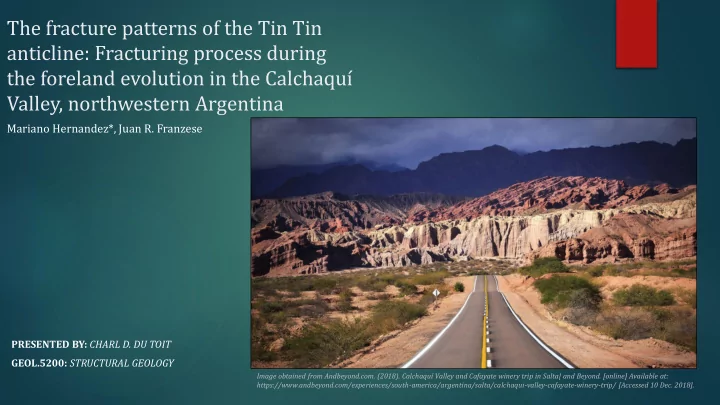
Image obtained from Andbeyond.com. (2018). Calchaquí Valley and Cafayate winery trip in Salta| and Beyond. [online] Available at: https://www.andbeyond.com/experiences/south-america/argentina/salta/calchaqui-valley-cafayate-winery-trip/ [Accessed 10 Dec. 2018].

slide-2
SLIDE 2

Introduction

Structural Stratigraphy

Data collection

Results

Extension fractures

Other mesostructures

Conclusions

slide-3
SLIDE 3

Introduction

 Study focused on the fracture

patterns of the carbonate- silicoclastic Yacoraite Fm. In the Tin Tin anticline – a fault- related fold in southern part

  • f the Eastern Cordillera in

northwestern Argentina.

 Study of small-scale

structures emphasize the importance of managing the naturally fractured reservoirs

  • f folds and thrust belts

 In NW Argentina much of the

hydrocarbon is trapped in the naturally fractured rocks of the Yacoraite fm. → economic potential

slide-4
SLIDE 4
slide-5
SLIDE 5

 The Calchaqui Valley consist of

a series of N-S-oriented valleys that extends between the Puna and the Eastern Cordillera.

 Area characterized by broadly

N-S-striking and west vergent fault-related folds surrounded by basement blocks

 This framework is extensively

assigned to the tectonic inversions of the Salta Group basin → resulted from Cenozoic Andean contraction

Structural history and Stratigraphy

Figures 1d and 1b, modified from (Hernández and Franzese, 2017)

slide-6
SLIDE 6

Structural history and Stratigraphy

 Salta group basin → Rift-related  Extensional phase during lower-Cretaceous and Paleogene  Resulted in isolated grabens and sub-basins  These sub-basins were then placed around a structural

basement high → Salto - Jujeno High

 Pirgua subgroup (synrift) overlain by Balbuena subgroup

(postrift)

 Late postrift stage of basin (Santa Barbara subgroup) also

related to thermal subsidence, but during drier climate

 Andean contraction during Paleogene → resulted in

foreland basin filled by Payogastilla Group in the Calchaqui valley

 Finally tectonic inversion of the Salta Basin

In response to decreased tectonic subsidence and relative sea-level rise → shallow Atlantic marine ingression

Figures 1c, modified from (Hernández and Franzese, 2017)

slide-7
SLIDE 7

 NNE-SSW striking, double-

plunging, west-vergent anticlinal fold

 Fault propagated fold in

response to the Tin Tin thrust

Structural history and Stratigraphy

Figures 2, modified from (Hernández and Franzese, 2017)

slide-8
SLIDE 8

Western limb: More isolated and highly strained Backlimb and southern nose of the fold: Sedimentary cover more exposed Sedimentary cover was internally deformed shortly before and during Uplift. Precambrian-Cambrian basement core: Metamorphic Rift-related Phanerozoic sedimentary rocks

slide-9
SLIDE 9

 The study will focus on the early post-rift Yacoraite sequence of the Salta Group.  Santa Barbara subgroup also included due to similar mechanical behavior

Structural history and Stratigraphy

Yacoraite Formation

  • Thickly bedded alternating sedimentary sequence of

carbonate – siliciclastic rocks

  • Contains cm to 1.5m thick beds of:
  • Limestone
  • Sandstone
  • Stromatolitic boundstones (mainly in upper sections)
  • Pelites
  • Entire sequence is 57 meters thick at the Tin Tin anticline
  • HOWEVER, thrust faulting thickened the unit up to 90 meters

(only some parts of Backlimb)

Diffuse bedding caused by high brittle strain

slide-10
SLIDE 10

Data collection

 Field approach to:

 Measure small-scale fractures in

  • utcrops and grouping them in

different sets based on

1.

Fracture types

2.

Orientation

3.

Relationship to other fractures and structural features  Most data was obtained from the

Backlimb where scan lines were performed

 Measured over 800 fractures  Fractures data was back-tilted

around a horizontal axis parallel to the local strike of bedding

Fracture Faults

  • Shear fractures
  • En echelon fractures

Ex Extensi sion Fractures

  • Joints
  • Veins
slide-11
SLIDE 11

Results

A: Present orientation (folded) B: Bedding dip removal (unfolded data – considering each dip domain) C: Representative outcrop with common fracture sets

  • Most fractures

perpendicular to beds or disposed at high angle to bedding

  • Two high-frequency groups observed, forming

a broadly oblique or ladder pattern

  • At high angle to bedding
slide-12
SLIDE 12

Extension Fractures: Joints, veins and normal faults

  • Cm- to –meter long, bed-perpendicular and planar

joints with plumose structure on the surface

  • Exhibit ladder pattern
  • Strikes from ENE to ESE
  • Generally they bordered by shorter NNW to NNE

cross-joints

  • Distributed evenly along the anticline

N-S-trending fractures are absent at hinge zone, which is what one would expect in a folded layer. E-W striking, high angle to bedding fractures with normal displacement are also present

slide-13
SLIDE 13

Shear Fractures: Mesoscale strike-slip and thrust faults

  • Strike-slip faults composed of bed-

perpendicular, cm-m scale, roughly planar fractures and en echelon vein arrays (to lesser extent)

  • A: Dextral & Sinistral strike-slips

represented by shear fractures and en echelon vein arrays

  • B: Conjugate en echelon vein array
  • C & D: ENE-striking dextral fault

(fracture array and vein array)

  • E: ESE-striking Sinistral en echelon vein

array

slide-14
SLIDE 14
slide-15
SLIDE 15

Conclusion

 Mesoscale fractures in the Yacoraite Fm. in the Tin

Tin anticline = joints, veins, small-scale strike-slip faults + less significant stylolites and normal faults

 These features are related to thrust belt-foreland

basin system that was constructed during Eocene times at the onset of the Andean contraction.

 Extension fractures developed in response to N-S

directed stretching

 Small-scale faults and stylolites formed during

succeeding ESE-WNE layer-parallel shortening

 All fractures formed prior or during the infant

stages of folding and faulting which led to the tectonic inversion of the Calchaquí Valley

slide-16
SLIDE 16

Conclusion

 Naturally fractured reservoirs are often related to anticlinal formation  However, this study revealed that not all fractures found in folded strata

are a consequence of the folding events

 Thus, fractures were present prior to folding.  The study also high-lighted that pre-folding fractures may play a vital role

in secondary fracture development during the fold evolution → changing or inhibiting classical folding-related deformation patterns

“This statement must be taken into account regarding the potential implications of the hydrocarbon exploration and production, focusing on the naturally fractured reservoirs

  • f NW Argentina.” - Hernández and Franzese, (2017)
slide-17
SLIDE 17

 Hernández, M. and Franzese, J. (2017). The fracture patterns of the Tin Tin anticline:

Fracturing process during the foreland evolution in the Calchaquí Valley, northwestern

  • Argentina. Journal of Structural Geology, 96, pp.54-64.