SLIDE 1
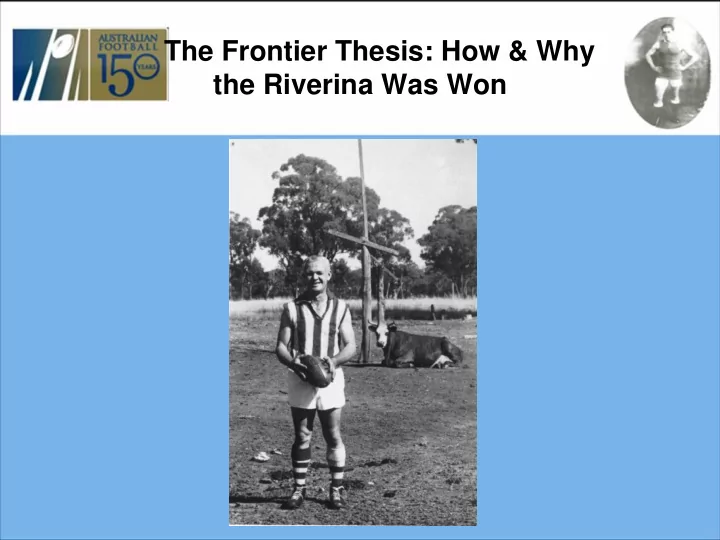
The Frontier Thesis: How & Why the Riverina Was Won
SLIDE 2
The Frontier Thesis The Frontier Thesis: How & Why the Riverina Was Won
Dr Rodney Gillett AFL 150th History Conference July 2008 Victoria University Melbourne
SLIDE 3
- F. J. Turner, a 19th century American historian
developed the “frontier thesis” to explain the emergence of a unique American identity as settlement moved further west – European institutions (e.g. established churches, established aristocracies, intrusive government, and class-based land distribution) were not adopted on the frontier In the same way the people who settled the Riverina developed an identity of their own – folklore, popular literature, political and social movements Most outstanding characteristic – close social and economic links with Victoria not Sydney
The Frontier Thesis
SLIDE 4
- G. L. Buxton, The Riverina 1861-1891 took the Riverina
to be “the area enclosed by the Murray and Murrumbidgee Rivers eastwards from their junction to a line adjoining Albury and Wagga Wagga”. (p.3) According to Buxton, every man defined the Riverina to suit his own purpose. For 19th century writers like Furphy and Lawson the problem did not exist because everybody knew where the Riverina was!
Where is the Riverina?
SLIDE 5
Map of Riverina
SLIDE 6
Enormous influence of the colony of Victoria came to exert over the economy of the Riverina can be seen in relation to transport, trade, land settlement, and regional migration patterns Strong and determined rivalry for the Riverina trade between Victoria & NSW has been the major feature of relations between the colonies
Economic Links with Victoria
SLIDE 7
Immigration in the Riverina
SLIDE 8
The football game adopted in the Riverina was the game invented in Melbourne First game played in Wagga in 1881 Started in Narrandera & Hay in 1882 Development of the game in the Riverina followed the same pattern as Victoria – scratch matches then formation of competition Football in the Riverina became a community game whereas in Melbourne it became a form of mass entertainment
Victorian Rules
SLIDE 9
First match in Wagga was against Albury Inter-town matches and local scratch matches New teams formed – Mechanics, Commercials First competition started in 1887 – Hely Cup – includes teams from North Wagga & Junee Early 1890s teams formed throughout region 1895 – Ganmain Association formed 1898 – Narrandera Association started 1899 – Lockhart & District Association
Early Years
SLIDE 10 ‘On Saturday, the little town of Coolamon was alive with excitement…in anticipation of the special train and the powerful team (Narrandera) that was to meet our local “invincibles”… The train arrived, bringing the team, a contingent of the Buffalo Order to give entertainment in the hall, and many visitors. The whole at once retired to Kindra Park, where Greek met Greek, in a grand display of science so far as football can contribute to such’
- Coolamon-Ganmain Farmers’ Review. 22 August,
1895
Inter-District Fixtures
SLIDE 11
1879 – Main Southern Line – Sydney to Albury 1881 – South West Line – Junee to Hay 1890 to 1910 – Branch-line development – railway sidings & silo every ten miles 1905 – Passenger rail services introduced Competitions developed along the line and took their name from the name of the line, e.g. South West Districts
Importance of Railways
SLIDE 12 ‘It was decided to run a special train from Yanco to Ganmain for the purpose of conveying Leeton, Narrandera and Matong to their destinations and it was agreed that Grong Grong should travel by the ordinary mail returning by goods train that night’.
- Narrandera Argus, 23 August, 1913
Football Trains
SLIDE 13 Competitions - 1914
Wagga Association
- Oldtown
- Newtown
- Federals
- North Wagga
- Lake Albert
- The Rock
South West League
- Junee
- Coolamon
- Matong
- Grong Grong
- Narrandera
- Leeton
SLIDE 14
Alonzo S. “Poddy” Slade First game for Coolamon in1908 at age of 14 Played senior football for 23 years Described as a “wonder footballer” no one could approach him for fitness and sheer brilliance Lead Coolamon’s 1920 & 1922 premiership teams Captained South-West against Collingwood at Narrandera in 1925
Poddy Slade
SLIDE 15 Competitions - 1914
Ariah Park & District
- Ariah Park
- Methul
- Linton
- Mirrool
- Tara
Barellan & District
- Barellan
- Moombooldool
- Ardlethan
- Yalgogrin
SLIDE 16
Mirrool Men
SLIDE 17 Competitions - 1914
Culcairn & District
- Culcairn
- Henty
- Mangoplah
- Cookardinia
- Yerong Creek
- Holbrook
Lockhart & District
- Lockhart
- Osborne
- Boree Creek
- Milbrulong
- Napier
- Pleasant Hills
SLIDE 18
Henty 1913
SLIDE 19
Mangoplah Medals
SLIDE 20
Various Football Associations in the Riverina had by 1914 developed stable administrative structures as basis for organisation of their competitions Clubs had become well organised, conducted regular meetings, arranged social functions, & had become an integral part of the social and sporting fabric of the community
State of Play by 1914
SLIDE 21 Current Leagues
Riverina Football League
- Coolamon
- Turvey Park
- Narrandera
- Wagga Tigers
- East Wagga
- North Wagga
- Leeton-Whitton
- Griffith
- Ganmain Grong Grong
Matong
Farrer Football League
- The Rock-Yerong Creek
- Marrar
- Collingullie-Ashmont-
Kapooka
Mirrool
SLIDE 22 Hume Football League 2008
Burrumbuttock
- Billabong Crows
- Coleambally
- Coreen Daysdale
Hopefield Buraja
- Culcairn
- Henty
- Holbrook
- Howlong
- Jindera
- Lockhart
- Osborne
- Rand-Walbundrie
- Rennie
- Walla Walla
SLIDE 23
Ian Turner noted in 1971 that whereas football became a mass spectator sport in Melbourne, rural communities developed their own capacity for self-entertainment. In the Riverina, football became a community game in the sense that football became totally integrated within the society, i.e., embraced people from the whole range of occupations, religions, and districts within the region
Community Game
SLIDE 24 “…as regards football we are Victorians in as much as we play the same game as our cousins across the border, and despite the efforts that have from time to time been made to foster the Rugby game, we still cling to the old game in years gone by provided so many brilliant struggles on the racecourse”.
- Wagga Wagga Advertiser, 20 June 1905
Victoria Rules
SLIDE 25 B: R.Gleeson (Lockhart/SM), A. Daniher (Ungarie/TP/SM/Ess), F. Gumbleton (Ganmain/NM) HB: N. Daniher (Ungarie/Ess),T. O’Neill (Narr./SM/Fitz), D. Carroll (Lockhart/Syd) C: C. Hounsell (Collingullie/SM), G. Smith (Ardelthan/SM/Coll), D. Murphy (Turvey Park/Syd) HF: J. Pitura (Wagga/SM/Rich), W. Carey (North Wagga/NM), T. Daniher (Ungarie/APM/SM/Ess) F: W. Carroll (Ganmain/MCU/Syd), T. Carroll (Ganmain/Carlton),
- P. Hawke (Wagga/ Syd/Coll.)
R: T. Quade (APM/NM), R. Quade (APM/SM), P. Kelly (Wagga/Syd) IC: C. Daniher (Ungarie/Coolamon/Ess) J. Prentice (APM/SM), D.Honybun (Coleambly/Car/Rich), M. Kruse (Leeton/SM)
Team of Riverina Players to Play VFL/AFL Since WWII
SLIDE 26
Football Doubles