The gentle growth of high-z (>6) monsters: An application of - - PowerPoint PPT Presentation

the gentle growth of high z 6
SMART_READER_LITE
LIVE PREVIEW

The gentle growth of high-z (>6) monsters: An application of - - PowerPoint PPT Presentation

The gentle growth of high-z (>6) monsters: An application of Constraint Realizations (ApJL 2014, arXiv1411.2626Y) Emilio Romano-Diaz Isaac Shlosman Jun-Hwan Choi Raphael Saudon Yehuda Hoffman Hidenobu Yajima Kentaro Nagamine 1 Galaxy


slide-1
SLIDE 1

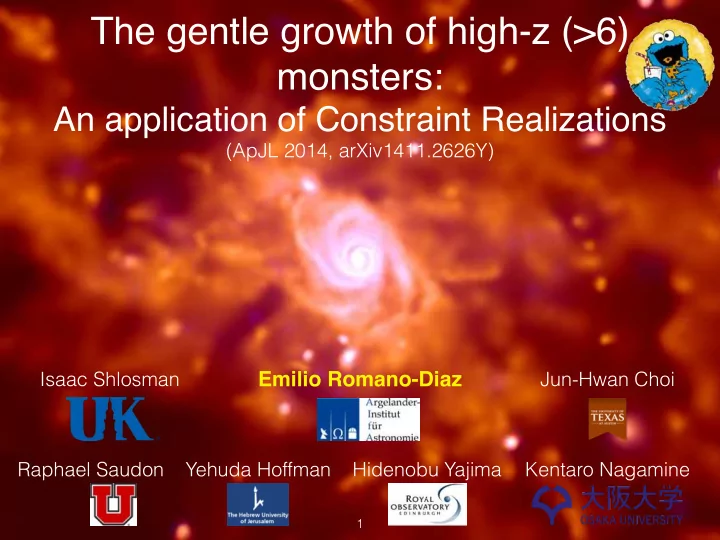
The gentle growth of high-z (>6) monsters:

An application of Constraint Realizations

Emilio Romano-Diaz

Isaac Shlosman Jun-Hwan Choi Raphael Saudon Kentaro Nagamine Hidenobu Yajima (ApJL 2014, arXiv1411.2626Y)

1

Yehuda Hoffman
slide-2
SLIDE 2

Galaxy formation

Spiral galaxies form via gas accretion (White & Rees 1978) + mergers = spherical systems (Toomre & Toomre 1972) Quiescent SF => disks Starburst are the result of mergers

2

slide-3
SLIDE 3

Galaxy formation

  • Observations of Gunn-Peterson trough in QSO suggest reionization ended

by z ~ 6.

  • Possible sources are high-z “normal” and dwarf galaxies which are very

numerous and energetic enough to reionize the Universe (Stiavelli+04; Yan &

Windhorst 04).

  • There are > 100 galaxies in 6.5 < z < 9 (Finkelstein+10; McLure+11; Bouwens+11;

Lorenzoni+11; McCracken+12)

  • Galaxies even z~10!!! (?) (Bouwens+11)
  • Protocluster of galaxies z~8 (Trenti+12)

3

slide-4
SLIDE 4

Galaxy formation

  • Discovery of QSOs z~6-8

=> SMBH M~109M⊙ (Stiavelli+05,Kim+09,Maselli+09,Utsumi+10,Mortlock+11)

=> MDM~1012M⊙

=> ρco~2.2±0.73 h3 Gpc−3 (Fan+04,Springel+05,Li+07,Overzier+09)

=> Formation clues ? (>60% mass from major mergers, Li+07)

  • Great diversity of environments (Kim+09, Utsumi+10, Trenti+12)
  • Recent high-z theoretical modeling indicate that major mergers are

not the main mode of growth in galaxy formation nor responsible for the intense star formation (Dayal+13; Ryan+14)

4

slide-5
SLIDE 5

Galaxy formation

  • Discovery of QSOs z~6-8

=> SMBH M~109M⊙ (Stiavelli+05,Kim+09,Maselli+09,Utsumi+10,Mortlock+11) => MDM~1012M⊙ => ρco~2.2±0.73 h3 Gpc−3 (Fan+04,Springel+05,Li+07,Overzier+09) => Formation clues ? (>60% mass from major mergers, Li+07)

  • Great diversity of environments (Kim+09, Utsumi+10, Trenti+12)
  • Recent high-z theoretical modeling indicate that major mergers are

not the main mode of growth in galaxy formation nor responsible for the intense star formation (Dayal+13; Ryan+14)

5

slide-6
SLIDE 6

So, how do galaxies grow at high-z?

6

slide-7
SLIDE 7

7

  • Perform simulations in large volumes: (Millenium...)

I.find your most attractive guy II.Check halo characteristics (virial quantities) III.Extrapolate back in time & resimulate at higher resolution

  • r

use

Constrained Realizations

(Bertschinger 86, Hoffman & Ribak 91)

How & where can we find such monsters?

slide-8
SLIDE 8

Our approach

  • We compare the growth of galaxies in a high-density region

against galaxies in a “normal” environment from z~6 up to z~14.

  • The growth is characterized by smooth accretion and mergers.
  • We use CR/UCR baryonic cosmological numerical simulations to

address this issue.

8

slide-9
SLIDE 9

Simulations: IC

  • CR formalism (Bertschinger 86, Hoffman & Ribak 91)
  • WMAP5 Cosmology: ΩM=0.234, Ωb=0.045, ΩΛ=0.721, h0=0.701, σ8=0.817
  • Halo M~1012 M⊙/h
  • Collapse z~6

9

slide-10
SLIDE 10

Simulations

  • Gadget3: Nbody+SPH
  • SF: Pressure Model ρSF=1.5X10⁻²M⊙pc−3 (nH,SF=1cm−3) (Schaye & dalla Vecchia 08, C&N 10)
  • Cooling: H, He, metals
  • Feedback: SNe, Winds (S&H 03, C&N11)
  • Multi-zoom (H-R baryons: CR: r~3.5Mpc/h; UCR: r~7Mpc/h)
  • M => 4X10⁵M⊙ (DM), 105M⊙ (gas), 5X10⁴M⊙ (stars)
  • ε ~ 40 pc (physical)
  • 140 output files

10

slide-11
SLIDE 11

11

slide-12
SLIDE 12

12

slide-13
SLIDE 13

HOP group finder (Eisenstein & Hut 98): ρcrit(z) Halo: DM-only & All matter (DM+gas+*) Galaxy: a baryonic HOP-defined isodensity region with 1) ρcut = ρ0.01SFT 2) M* > 3X10⁷M⊙ (Ryan+14) => MDM > 2X10⁸ M⊙ Halos & galaxies traced back in time, merger history

Halos & Galaxies

13

slide-14
SLIDE 14

Galaxies

14

slide-15
SLIDE 15

Mergers

15

slide-16
SLIDE 16

MAH: CR

16

slide-17
SLIDE 17

MAH: UCR

17

slide-18
SLIDE 18

Accretion

Mergers:

  • A. Major: 1:3
  • B. Intermediate: 4:10
  • C. Minor: 10:…
  • Smooth:

Matter that does not belong to any halo

Metallicity:

A. Pristine: (10-3<) B. Supsolar: [10-3,0.5] C. Solar: [0.5,1.1] D. Suprasolar: (>1.1)

Temperature:

A. Cold: (<3X10⁴) B. Warm: [3X104,105] C. Hot: (>105)

18

slide-19
SLIDE 19

Gas Accretion

19

slide-20
SLIDE 20

Gas Accretion

20

slide-21
SLIDE 21

Gas Accretion

1. Smooth acc. dominates 2. Minor & intermediate mergers 2nd largest cont.

Independent

  • f density

environment

21

slide-22
SLIDE 22

Stellar accretion

22

slide-23
SLIDE 23

Stellar accretion

1. Local SF dominates growth 2. Major Mergers relevant earlier

23

slide-24
SLIDE 24

Metallicity

  • Galaxies “well-defined” get most of gas semi-recycled
  • Supra-solar Z indication of intense SF in neighborhood
  • Minimal pristine Z accretion

24

slide-25
SLIDE 25

vs Observations (RT)

25 Yajima+14

Luminosity Function mm detection

slide-26
SLIDE 26

Conclusions… (so far)

  • CR offer a unique laboratory to address peculiar environments (high-z)
  • Halos possibly precursors of QSO (z~6) harbor well defined gaseous & stellar disks.
  • Our simulated disk galaxies in the over-dense regions appear consistent with the presence of

extended morphologies in bright z~7 galaxies observed by HST (Oesch+10, Ryan+14)

  • Halos (independent of M) host more than 1 galaxy
  • Galaxies (independently of mass) mostly grow via smooth gas accretion & in-situ SF
  • Mergers deposit more stellar material than gas content (this might be dependent on feedback

mechanisms)

  • Most of the gas-accreted is cold and semi-recycled.
  • Small galaxies grow (as well) via smooth accretion, although they acquire more stellar content via

mergers than the one formed in-situ.

26

slide-27
SLIDE 27

future…

  • Cold vs hot accretion in Galaxies
  • the usual suspect: feedback -> AGN, early feedback…
  • Evolving U-V background…
  • Different SF mechanisms…

27