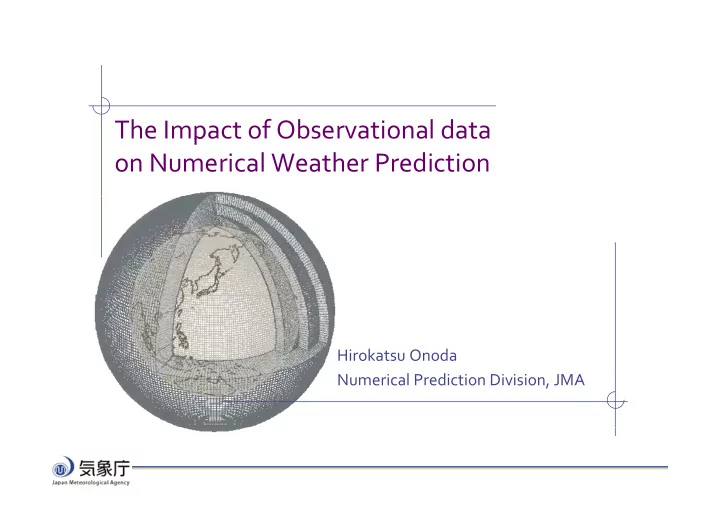
The Impact of Observational data p on Numerical Weather Prediction - - PowerPoint PPT Presentation

the impact of observational data p on numerical weather
SMART_READER_LITE
LIVE PREVIEW

The Impact of Observational data p on Numerical Weather Prediction - - PowerPoint PPT Presentation

The Impact of Observational data p on Numerical Weather Prediction Hirokatsu Onoda Numerical Prediction Division, JMA Outline Data Analysis system of JMA in Global Spectral Model (GSM) and Meso-Scale Model (MSM) p ( ) ( )


slide-1
SLIDE 1

The Impact of Observational data p

  • n Numerical Weather Prediction

Hirokatsu Onoda Numerical Prediction Division, JMA

slide-2
SLIDE 2

Outline

  • Data Analysis system of JMA

in Global Spectral Model (GSM) and Meso-Scale Model (MSM) p ( ) ( )

  • The impact of assimilated observations
  • The impact of assimilated observations

global view of the impact of observations on the quality of the forecast

  • Quality Control and inappropriate observation for

NWP system NWP system Gl b l D t M it i R t

  • Global Data Monitoring Report

27-30 July, 2010 JMA/WMO Workshop on Quality Management in Surface, Climate and Upper-air Observations in RA II

slide-3
SLIDE 3

Specification of NWP Models

JMA operates the following NWP deterministic models: 1) Th Gl b l S l M d l (GSM) f h h d di f 1) The Global Spectral Model (GSM) for the short and medium range forecast up to nine days ahead to cover the entire globe, 2) The Mesoscale Model (MSM) for warnings and the very short-range forecast of precipitation to cover Japan and its surrounding areas.

Domains and topography Grid size and/or number of grid, Vertical levels/top Forecast hours (Initial time) Initial condition Vertical levels/top

0.1875 deg. (TL959) 84 hours

(00 06 18 UTC)

4D Var

GSM

Globe

(TL959), 60 / 0.1hPa

(00,06,18 UTC)

216 hours

(12 UTC)

4D-Var analysis

Globe

5km / 721x577, 15 hours

(00,06,12,18

MSM

Japan and its surrounding

5km / 721x577, 50 / 21,800m

UTC)

33 hours

(03 09 15 21

4D-Var analysis

27-30 July, 2010 JMA/WMO Workshop on Quality Management in Surface, Climate and Upper-air Observations in RA II

surrounding areas

(03,09,15,21 UTC)

slide-4
SLIDE 4

Details of data use on NWP system

Ob ti Observation type I nstrument Global Analysis Mesoscale Analysis

SYNOP Pressure Pressure

650,000 820,000

Conventional AMeDAS* Rain (Analyzed Rain) Ship, Buoy Pressure Pressure RAOB Pressure, Wind, Temperature, Pressure, Wind, Temperature,

20%

Importance is still high

RAOB Relative Humidity Relative Humidity Aircraft Wind, Temperature Wind, Temperature Wind profiler Wind Wind Ground based remote sensing Radar Radar reflectivity (Analyzed Rain), Doppler velocity GPS Total precipitable water GPS Total precipitable water VIS IR radiometer AMV , Radiance (clear sky) AMV IR MW sounder Radiance (clear sky) Radiance (Temperature)

80%

Satellite MW imager Radiance (clear sky) Radiance (TPW, Rain rate) Scattrometer Surface wind Surface wind GPS-RO* * Refractivity

27-30 July, 2010 JMA/WMO Workshop on Quality Management in Surface, Climate and Upper-air Observations in RA II

GPS RO Refractivity

* Automated Meteorological Data Acquisition System * * GPS radio occultation

slide-5
SLIDE 5

Outline

  • Data Analysis system of JMA

in Global Spectral Model (GSM) and Meso-Scale Model (MSM) p ( ) ( )

  • The impact of assimilated observations
  • The impact of assimilated observations

global view of the impact of observations on the quality of the forecast

  • Quality Control and inappropriate observation for

NWP system NWP system Gl b l D t M it i R t

  • Global Data Monitoring Report

27-30 July, 2010 JMA/WMO Workshop on Quality Management in Surface, Climate and Upper-air Observations in RA II

slide-6
SLIDE 6

Departure of observation and background

Definition of words Background : forecast from previous analysis

i.e. in GSM, 12UTC’s background is 06UTC’s 6 hour forecast 12UTCs background is 06UTCs 6-hour forecast.

O‐B : (Observation) – (Background) ( ) ( g ) usable for an index of the precision

  • f the forecast or the observation

27-30 July, 2010 JMA/WMO Workshop on Quality Management in Surface, Climate and Upper-air Observations in RA II

slide-7
SLIDE 7

Basis of Data Analysis system

Schematic view of data analysis system (mean sea-level pressure) In data analysis system In data analysis system,

  • bservation revise the

White line : Background (input)

Time sequence of observation

error of the model based on departure of

White line : Background (input) Red point : Observation (input) Red line : Analysis (output) Colored area : Increment (output)

  • bservation and

background (O-B).

27-30 July, 2010 JMA/WMO Workshop on Quality Management in Surface, Climate and Upper-air Observations in RA II

Colored area : Increment (output)

*quantity of revision by analysis

slide-8
SLIDE 8

Experiment without ground‐based conventional

  • bservation (SYNOP, Radiosonde) #1

OPERATIONAL

Mean Sea-Level

( , )

pressure O-B at SYNOP stations. T f i t Term of experiment: from 20th Dec 2009 to 09th Feb 2010

1 day 7 days later

Difference of O‐B increased through the analysis‐forecast cycle. Continuous observation Continuous observation is important for forecast field.

27-30 July, 2010 JMA/WMO Workshop on Quality Management in Surface, Climate and Upper-air Observations in RA II

EXPERIMENT

slide-9
SLIDE 9

Experiment without ground‐based conventional

  • bservation (SYNOP, Radiosonde) #2

Large difference b t

( , )

between OPERATIONAL and EXPERIMENT Small difference between OPERATIONAL and EXPERIMENT

27-30 July, 2010 JMA/WMO Workshop on Quality Management in Surface, Climate and Upper-air Observations in RA II

slide-10
SLIDE 10

Experiment without ground‐based conventional

  • bservation (SYNOP, Radiosonde) #3

( , ) 3

  • Density of the observation point

may be important may be important.

  • Satellite observation makes the

27-30 July, 2010 JMA/WMO Workshop on Quality Management in Surface, Climate and Upper-air Observations in RA II

Satellite observation makes the land a weak point.

slide-11
SLIDE 11

Which type of data had the greater influence?

DFS (Degrees of Freedom for Signal)

Which type of data had the greater influence?

Langland and Baker suggest to estimate the observation impact

All conventional Scatterometer

Investigated by JMA

to estimate the observation impact.

Scatterometer AMV Aircraft RAOB

Large DFS means large impact to forecast

RAOB All radiance Imager AMSR

impact to forecast. Small DFS means small impact to forecast.

AMSR TMI SSM/I AMSU B

Conventional data still plays important roll

AMSU-B AMSU-A

plays important roll.

27-30 July, 2010 JMA/WMO Workshop on Quality Management in Surface, Climate and Upper-air Observations in RA II

DFS values of each observation type (%)

slide-12
SLIDE 12

Outline

  • Data Analysis system of JMA

in Global Spectral Model (GSM) and Meso-Scale Model (MSM) p ( ) ( )

  • The impact of assimilated observations
  • The impact of assimilated observations

global view of the impact of observations on the quality of the forecast

  • Quality Control system and inappropriate observation

for NWP system for NWP system Gl b l D t M it i R t

  • Global Data Monitoring Report

27-30 July, 2010 JMA/WMO Workshop on Quality Management in Surface, Climate and Upper-air Observations in RA II

slide-13
SLIDE 13

Quality Control (QC) of observational data

Observational data includes false report or deviating from a background.

Used N t d Not used

Δu for Wind Profilers, 1 ~ 10 October 2009, 900~800hPa

To reject these data, JMA perform Quality Control (QC).

Real-time QC (automatic) Non real-time QC (manual)

27-30 July, 2010 JMA/WMO Workshop on Quality Management in Surface, Climate and Upper-air Observations in RA II

slide-14
SLIDE 14

Real‐time QC

  • climatologically check
  • Gross error check

First Step Second Step

  • ship/flight path check
  • bias correction
  • ind correction
  • Gross error check

Reject rough error human error l lf

  • wind correction
  • T lapse rate
  • interpolation (T,RH,wind)

instrumental malfunction communication error etc.

interpolation (T,RH,wind)

  • hydrostatic check
  • ice (freezing)
  • Spatial consistency check

Compare with surrounding

  • wind shear
  • sea‐level correction

Compare with surrounding

  • bservations

Etc. Etc.

27-30 July, 2010 JMA/WMO Workshop on Quality Management in Surface, Climate and Upper-air Observations in RA II

slide-15
SLIDE 15

Non real‐time QC

Sometimes, data of low quality pass real–time QC. → real‐time QC is not perfect. p

Blacklist is managed for these case.

  • Blacklist needs careful monitoring, and is updated when

[ add ] [ add ] Platforms (stations, airplanes, ships, etc.) found to report biased or erratic observations [ remove ] The quality has returned to an accepted standard

  • Blacklisted observations are rejected

before real‐time QC procedures.

27-30 July, 2010 JMA/WMO Workshop on Quality Management in Surface, Climate and Upper-air Observations in RA II

p

slide-16
SLIDE 16

Examples SYNOP,SHIP,BUOY : trouble of instrumentation

Observation, Background Observation, Background

continuously large difference

O-B O-B: used passed rejected

blacklisted

Time sequence of Mean Sea-Level pressure of SYNOP (WMO-ID:38944) Time sequence of Mean Sea-Level pressure of Buoy (Call sign:17525) from

O-B: used, passed, rejected

from January to June 2010. Easy case to reject in real-time QC. 22nd June to 8th July 2010. Difficult case to reject in real-time QC.

27-30 July, 2010 JMA/WMO Workshop on Quality Management in Surface, Climate and Upper-air Observations in RA II

Inappropriate data were used in

  • perational.
slide-17
SLIDE 17

Radiosonde : Quality of Indian Radiosonde observations has improved

Improved Some other stations already Term of blacklisted Some other stations already unlisted.

Time sequence of temperature O-B vertical profile e seque ce o te pe atu e O e t ca p o e from Jan 2008 to Dec 2009 at WMO-ID:43192 .

At spring 2009, O-B became small suddenly. S li f i t t h h d

27-30 July, 2010 JMA/WMO Workshop on Quality Management in Surface, Climate and Upper-air Observations in RA II

Supplier of instrument has changed.

slide-18
SLIDE 18

Radiosonde : Moving bias of US radiosonde observations

[ K ]

Aug 2009 Sep 2009 Oct 2009

Seems to be an error of Radiation Correction method

Under investigation

Nov 2009 Dec 2009 Jan 2010

Monthly average of T200 O-B from Aug 2009 to Jan 2010. Negative values (lower observations) moving westward.

27-30 July, 2010 JMA/WMO Workshop on Quality Management in Surface, Climate and Upper-air Observations in RA II

slide-19
SLIDE 19

Aircraft : Mistake of the report format

B th l t i ti ti Wind speed O‐B profile of CNxxxx (xxxx : number) at China. There is negative bias in upper air. By the later investigation: Convert unit of wind speed g pp Term: 4th – 12th Nov 2009 from [m/s] to [Knot]. (Suppose that reported unit were “m/s”.) Large biased observation was rejected p ↓ Negative bias is disappeared. The guess might be right. g j Small biased observation was used in operational system.

27-30 July, 2010 JMA/WMO Workshop on Quality Management in Surface, Climate and Upper-air Observations in RA II

The guess might be right.

slide-20
SLIDE 20

Aircraft : The change of correction method by airline

S th t Ai li (SWA USA) h d th th d

Change the T correction method

Southwest Airline (SWA; USA) changed the method

  • f temperature correction from 10th Mar 2010.

86 airplanes correspond to this case.

27-30 July, 2010 JMA/WMO Workshop on Quality Management in Surface, Climate and Upper-air Observations in RA II

Improvement of O-B is found especially High and Middle(Mid) altitude.

slide-21
SLIDE 21

Is it Observation error or Model error ? #1

Inter-comparison of T850 at North Temperature O-B scatter plot at 9th Inter comparison of T850 at North America for forecast time 24h. JMA (red line) may have lower bias

  • f temperature

Temperature O B scatter plot at 9 and 10th March 2010. Many points came to gather in the graph center

  • f temperature.

graph center.

There are not many changes l l i d

27-30 July, 2010 JMA/WMO Workshop on Quality Management in Surface, Climate and Upper-air Observations in RA II

at lower altitude.

slide-22
SLIDE 22

Is it Observation error or Model error ? #2

00UTC 06UTC

Increment (quantity of revision by analysis) map of Mean Sea-Level pressure on Mean Sea Level pressure on Antarctica at 00,06,12,18 UTC analysis, 30th Nov 2009. It seems to be a model error, because some stations

18UTC 12UTC

suggest similar O-B.

18UTC 12UTC

A t ti i d t i Antarctica is data sparse region, real-time QC hard to reject data with large difference from background

27-30 July, 2010 JMA/WMO Workshop on Quality Management in Surface, Climate and Upper-air Observations in RA II

background.

slide-23
SLIDE 23

Summary

  • The ratio of conventional data has become small
  • The ratio of conventional data has become small,

but the importance is still high.

  • Continuous observation and the maintenance of the network are

necessary.

  • QC plays an essential part in maintaining the quality of the initial value

and forecast field.

  • QC is composed real‐time and non real‐time QC.

Blacklist is kept for non real‐time QC. p Important to be careful to the changes of the data tendency. The correct format and unbiased reporting is needed.

  • Difficult to discriminate

whether errors are related to observation or to the model.

27-30 July, 2010 JMA/WMO Workshop on Quality Management in Surface, Climate and Upper-air Observations in RA II

slide-24
SLIDE 24

G d d t f th f ti d d l i

Request to Observation from NWP system

Good product of weather forecasting needs good analysis. Good analysis needs good observation. Good observation needs the cooperation of many people

  • We need to keep high quality observation for NWP system.

Continuous observation

Good observation needs the cooperation of many people.

Maintenance of the dense observation network Recovery from instrumental malfunction (as soon as possible) The correct format reporting The correct format reporting Unbiased observation Information when the station changes ( latitude, altitude, height …) * information of position is extremely important. Information of the instrumental changes

  • High quality observation enables to be better forecast.

enables to make good analysis

27-30 July, 2010 JMA/WMO Workshop on Quality Management in Surface, Climate and Upper-air Observations in RA II

enables to use inspection of models

slide-25
SLIDE 25

Outline

  • Data Analysis system of JMA

in Global Spectral Model (GSM) and Meso-Scale Model (MSM) p ( ) ( )

  • The impact of assimilated observations
  • The impact of assimilated observations

global view of the impact of observations on the quality of the forecast

  • Quality Control and inappropriate observation for

NWP system NWP system Gl b l D t M it i R t

  • Global Data Monitoring Report

27-30 July, 2010 JMA/WMO Workshop on Quality Management in Surface, Climate and Upper-air Observations in RA II

slide-26
SLIDE 26

Data monitoring report

JMA publishes following reports ;

  • Monthly Global Monitoring Report

JMA reports suspected observations of low quality h h NWP h through our NWP system once a month.

  • Report on the Quality of Land Surface
  • Report on the Quality of Land Surface

Observations in Region II (Asia)

RSMC Tokyo publishes it in a half year RSMC Tokyo publishes it in a half year as a lead center for monitoring the quality of land surface observations.

Using these reports Using these reports, we want you to make use for maintenance of the high quality observation.

27-30 July, 2010 JMA/WMO Workshop on Quality Management in Surface, Climate and Upper-air Observations in RA II

g

slide-27
SLIDE 27

website

These reports are shown in following Website. Anyone can access without a password. http://qc kishou go jp http://qc.kishou.go.jp

27-30 July, 2010 JMA/WMO Workshop on Quality Management in Surface, Climate and Upper-air Observations in RA II

slide-28
SLIDE 28

Thank you for your attention.

Please be careful to avoid heat strokes.

Contact us l k h E‐mail : qc@naps.kishou.go.jp

slide-29
SLIDE 29

Additional slides Additional slides

27-30 July, 2010 JMA/WMO Workshop on Quality Management in Surface, Climate and Upper-air Observations in RA II

slide-30
SLIDE 30

Four‐Dimensional Variational Analysis (4D‐Var)

Assimilate data within 3 hours before and after each analysis time

First guess Analysis Observation data 00UTC 06UTC 12UTC

Forecast from previous analysis is used as a first guess. Departure between model trajectory and observations over 6-hour Departure between model trajectory and observations over 6-hour assimilation window are measured (cost function). Then, model trajectory that minimizes the departure is sought. Analyzed

27-30 July, 2010 JMA/WMO Workshop on Quality Management in Surface, Climate and Upper-air Observations in RA II

j y p g y field at target analysis time is obtained as forecast field at that time.

slide-31
SLIDE 31

Observation Impact Methodology (Langland and Baker, 2004) (Langland and Baker, 2004)

Observations are assimilated in a 6-h update cycle. If there are no observations t 00UTC 72 ill b l t 78 at 00UTC, e72 will be equal to e78. The difference in forecast error norms, (e78 e72) is due to the combined impact (e78- e72), is due to the combined impact

  • f all observations assimilated at 00UTC

Using sensitivity gradients from two Using sensitivity gradients from two forecast trajectories, we can estimate the forecast error difference, ef = e72 - e78, using following equation using following equation. The quantity (y – Hxb) is the observation departure from the background state, and H is an operator that performs spatial

27-30 July, 2010 JMA/WMO Workshop on Quality Management in Surface, Climate and Upper-air Observations in RA II

interpolation of the background into

  • bservation space.
slide-32
SLIDE 32

DFS (Degrees of Freedom for Signal)

The global observation impact can be considered as the sum of contributions made by all individual observations.

Best Linear Unbiased Estimator (BLUE) approach ;

  • Define a linear estimator
  • Impose the condition to be unbiased

All conventional Scatterometer AMV Aircraft RAOB All radiance Imager AMSR TMI SSM/I AMSU-B

These results were investigated in JMA

AMSU-A

DFS values per obstype (%) per one report (‰)

(Ishibashi, JMA)

27-30 July, 2010 JMA/WMO Workshop on Quality Management in Surface, Climate and Upper-air Observations in RA II

slide-33
SLIDE 33

Data coverage map (global)

27-30 July, 2010 JMA/WMO Workshop on Quality Management in Surface, Climate and Upper-air Observations in RA II

slide-34
SLIDE 34

Data coverage map (regional)

27-30 July, 2010 JMA/WMO Workshop on Quality Management in Surface, Climate and Upper-air Observations in RA II

slide-35
SLIDE 35

O-B are checked

Check each obs

Gross error check, Spatial consistency check

O B are checked.

|(O B) (O B)|

Surrounded by large Check each obs

REJECT |(O-B)- mean(O-B)|

First guess (B)

Surrounded by large O-B: BAD first guess likely (not rejected)

|O-B| Cs PASS REJECT REJECT Cr SUSPECT PASS Cp

Use mean of O-B

  • f surrounding
  • bservations

PASS

Gross error check

Surrounded by small O-B:

27-30 July, 2010 JMA/WMO Workshop on Quality Management in Surface, Climate and Upper-air Observations in RA II

Gross error check Spatial consistency check

Surrounded by small O B BAD observation likely (rejected)

slide-36
SLIDE 36

Recent status of Indian Recent status of Indian Radiosonde use.

27-30 July, 2010 JMA/WMO Workshop on Quality Management in Surface, Climate and Upper-air Observations in RA II

slide-37
SLIDE 37

Track-check error of Aircraft observation. T O B fil f Temperature O-B profile of HLxxxx (xxxx : number).

27-30 July, 2010 JMA/WMO Workshop on Quality Management in Surface, Climate and Upper-air Observations in RA II

slide-38
SLIDE 38

27-30 July, 2010 JMA/WMO Workshop on Quality Management in Surface, Climate and Upper-air Observations in RA II