THE INCREMENTAL DAMAGE THEORY OF PARTICULATE- REINFORCED COMPOSITES - - PDF document

the incremental damage theory of particulate reinforced
SMART_READER_LITE
LIVE PREVIEW

THE INCREMENTAL DAMAGE THEORY OF PARTICULATE- REINFORCED COMPOSITES - - PDF document

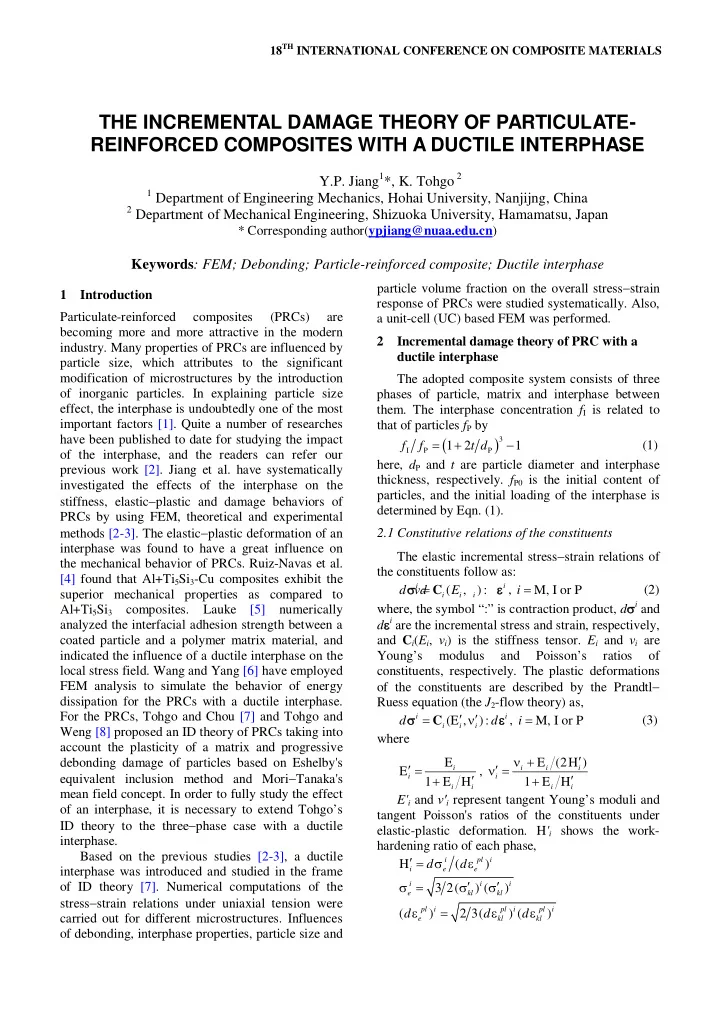
18 TH INTERNATIONAL CONFERENCE ON COMPOSITE MATERIALS THE INCREMENTAL DAMAGE THEORY OF PARTICULATE- REINFORCED COMPOSITES WITH A DUCTILE INTERPHASE Y.P. Jiang 1 *, K. Tohgo 2 1 Department of Engineering Mechanics, Hohai University, Nanjijng, China


slide-1
SLIDE 1

18TH INTERNATIONAL CONFERENCE ON COMPOSITE MATERIALS

1 Introduction Particulate-reinforced composites (PRCs) are becoming more and more attractive in the modern

  • industry. Many properties of PRCs are influenced by

particle size, which attributes to the significant modification of microstructures by the introduction

  • f inorganic particles. In explaining particle size

effect, the interphase is undoubtedly one of the most important factors [1]. Quite a number of researches have been published to date for studying the impact

  • f the interphase, and the readers can refer our

previous work [2]. Jiang et al. have systematically investigated the effects of the interphase on the stiffness, elastic−plastic and damage behaviors of PRCs by using FEM, theoretical and experimental methods [2-3]. The elastic−plastic deformation of an interphase was found to have a great influence on the mechanical behavior of PRCs. Ruiz-Navas et al. [4] found that Al+Ti5Si3-Cu composites exhibit the superior mechanical properties as compared to Al+Ti5Si3 composites. Lauke [5] numerically analyzed the interfacial adhesion strength between a coated particle and a polymer matrix material, and indicated the influence of a ductile interphase on the local stress field. Wang and Yang [6] have employed FEM analysis to simulate the behavior of energy dissipation for the PRCs with a ductile interphase. For the PRCs, Tohgo and Chou [7] and Tohgo and Weng [8] proposed an ID theory of PRCs taking into account the plasticity of a matrix and progressive debonding damage of particles based on Eshelby's equivalent inclusion method and Mori−Tanaka's mean field concept. In order to fully study the effect

  • f an interphase, it is necessary to extend Tohgo’s

ID theory to the three−phase case with a ductile interphase. Based on the previous studies [2-3], a ductile interphase was introduced and studied in the frame

  • f ID theory [7]. Numerical computations of the

stress−strain relations under uniaxial tension were carried out for different microstructures. Influences

  • f debonding, interphase properties, particle size and

particle volume fraction on the overall stress−strain response of PRCs were studied systematically. Also, a unit-cell (UC) based FEM was performed. 2 Incremental damage theory of PRC with a ductile interphase The adopted composite system consists of three phases of particle, matrix and interphase between

  • them. The interphase concentration fI is related to

that of particles fP by

( )

3 I P P

1 2 1 f f t d = + − (1) here, dP and t are particle diameter and interphase thickness, respectively. fP0 is the initial content of particles, and the initial loading of the interphase is determined by Eqn. (1). 2.1 Constitutive relations of the constituents The elastic incremental stress−strain relations of the constituents follow as: ( , ):

i i i i i

d E νd = C σ ε , M, I or P i = (2) where, the symbol “:” is contraction product, dσi and dεi are the incremental stress and strain, respectively, and Ci(Ei, νi) is the stiffness tensor. Ei and νi are Young’s modulus and Poisson’s ratios

  • f

constituents, respectively. The plastic deformations

  • f the constituents are described by the Prandtl−

Ruess equation (the J2-flow theory) as, (E , ):

i i i i i

d d ′ ′ = ν C σ ε , M, I or P i = (3) where E E 1 E H

i i i i

′ = ′ + , E (2H ) 1 E H

i i i i i i

′ ν + ′ ν = ′ + E'i and ν'i represent tangent Young’s moduli and tangent Poisson's ratios of the constituents under elastic-plastic deformation. H'i shows the work- hardening ratio of each phase, H ( )

i pl i i e e

d d ′ = σ ε 3 2( ) ( )

i i i e kl kl

′ ′ σ = σ σ ( ) 2 3( ) ( )

pl i pl i pl i e kl kl

d d d ε = ε ε

THE INCREMENTAL DAMAGE THEORY OF PARTICULATE- REINFORCED COMPOSITES WITH A DUCTILE INTERPHASE

Y.P. Jiang1*, K. Tohgo 2

1 Department of Engineering Mechanics, Hohai University, Nanjijng, China 2 Department of Mechanical Engineering, Shizuoka University, Hamamatsu, Japan

* Corresponding author(ypjiang@nuaa.edu.cn)

Keywords: FEM; Debonding; Particle-reinforced composite; Ductile interphase

slide-2
SLIDE 2

Here, σe

i and (dεe pl)i are the von Mises equivalent

stress and incremental equivalent plastic strain,

  • respectively. (σ'kl)i the deviatoric stress component,

and (dεkl

pl)i the incremental plastic strain. Eqn. (3) is

strictly valid in the case of monotonic proportional

  • loading. In the composite system, the stress and

strain of particles, interphase and matrix are denoted with superscripts "P", "I" and "M", respectively, and without any superscripts for the composite. 2.2 Incremental damage theory with a ductile interphase

  • Fig. 1 The states of composite undergoing damage

process before and after incremental deformation, dfP is a volume fraction of the reinforcements damaged in the incremental deformation.

  • Fig. 1 shows the states before and after an

incremental deformation of a representative volume element during the damage process, where a constant macroscopic stress σ and its increment dσ are applied on the boundary of RVE. All the debonding damage is supposed to occur between particle and interphase. The states before the incremental deformation are described in terms of the intact particle content fP and damaged particle content fP

  • d. The initial damaged particle content fP

d

=0, and fP = fP0. dfP denotes the content of particles debonded in an incremental deformation. The states after the deformation can expressed by the intact particles loading fP−dfP and damaged particles loading fP

d+dfP. Some necessary assumptions are

firstly given: (1) All the constituents and composites are isotropic. (2) The debonding damage is controlled by the critical stress of particles. (3) After the damage, particle stress reduces to zero. (4) The progressive damage is described by a decrease in the intact particle content and an increase in the debonded particle concentration. The constitutive equations of an isotropic PRC are expressed in the form of the hydrostatic (dεkk−dσkk) and deviatoric parts (dε'ij−dσ'ij). So, the incremental strain dε(dεkk, dε'ij)−stress dσ(dσkk, dσ'ij) relation of the composite is given by,

P P

1 1 εσσ 3 3

kk kk kk t d

d d df κ κ = + ,

P P

1 1 εσσ 2 2

ij ij ij t d

d d df µ µ ′ ′ = + (4) where

[ ]

Mκκ1

(1 )

t

κ κ γ αγ = − +

[ ]

Mκ(1

) 1 (1 )

d

κ κ α α γ = − − −

Mμμ1

(1 )

t

µ µ γ βγ   = − +  

(1 ) 1 (1 )

d

µ µ β β γ   = − − −   and

p p m p I0 I m κ m p m M I m

( ) ( ) ( ) ( ) (1 )

d

f f f κ κ κ κ γ κ κ κ α κ κ κ α α − − = − − + + − + − −

p p m p I0 I m μ m p m m I m

( ) ( ) ( ) ( ) (1 )

d

f f f µ µ µ µ γ µ µ µ β µ µ µ β β − − = − − + + − + − −

M M M M

1 4 5 1 2 , 31 15 1 ν ν α β ν ν + − = = − − Here, κi and μi are bulk and shear modulus of three constituents, respectively, which are related to Young’s modulus Ei and Poisson’s ratio νi by

E 3(1 2 )

i i i

κ ν = −

,

E 2(1 )

i i i

µ ν = +

(5) The incremental stresses of the three phases dσP, dσM and dσI are expressed by

[ ]

p p p p κm p m

(σσ) σ 1 (1 ) ( )

kk kk kk

d df d κ α γ κ κ κ α + =   − − + −  

p p p p μm p m

(σσ) σ 1 (1 ) ( )

ij ij ij

d df d µ β γ µ µ µ β ′ ′ + ′ =     − − + −    

M P P κ

1 σ(σσ)1 (1 )

kk kk kk

d d df α γ = + − −

M P P μ

1 σ(σσ) 1 (1 )

ij ij ij

d d df β γ ′ ′ ′ = + − −

[ ][ ]

p I I P κm I m

(σσ) σ 1 (1 ) ( )

kk kk kk

d df d κ α γ κ κ κ α + = − − + −

[ ]

p I p I μm I m

(σσ) σ 1 (1 ) ( )

ij ij ij

d df d µ β γ µ µ µ β ′ ′ + ′ =   − − + −  

(6)

I I

Interphase , σ ε

P P

Intact Particle , σ ε Damaged Particle

M M

Matrix , σ ε

P P

Intact Particle Volume Fraction: Damaged Particle Volume Fraction: (a) State before the incremental deformation

d

f f

P P P P

Intact Particle Volume Fraction: Damaged Particle Volume Fraction: (b) State after the incremental deformation

d

f df f df − + σ d + σ σ

slide-3
SLIDE 3

3 PAPER TITLE

2.3 The critical stress of debonding damage The particle encounters debonding damage when the microscopic stress of particle reaches a critical value

P

σcr as

P C P

σcr K d = (7) Γ or KC is uniquely given for a combination of constituent materials in composites, and they would be basically obtained by fracture toughness tests for the interface between constituent materials. Eqn. (7) describes the dependence of the critical stress on particle size. 2.4 Equivalent stress of the constituents 0.02 0.04 0.06 0.08 0.1 100 200 300

Debonding Ⅲ: Porous Ⅱ: Ⅰ: Composites

Stress σ

xx (MPa)

Strain εxx

  • Fig. 2 The stress−strain relation of PRC is classified into

three pieces І, ІІ and ІІІ.

The equivalent stress can be used to indicate the elastic-plastic state of a ductile material, and Tohgo et al. determined the equivalent stress of the matrix by the energy method in the ID theory. For the present problem, the equivalent stresses of two phases need to be given simultaneously, and unfortunately they combined in the same equation. So, field fluctuation (FF) method [9] should be adopted here to solve this dilemma. As known from the previous study [2], the microstructure under study will experience three stages during the damage

  • progression. They are the composite, debonding and

porous material, respectively. Therefore, the uniaxial stress−strain relation of a composite shown in Fig. 2 can be classified into І, Π and Ш stages. “І” represents the composites, “Π” the debonding process and “Ш” the porous material. The equivalent stresses of the matrix and interphase are separately determined in the three stages. For the first stage, the composite contains particles, matrix and interphase. An initial equivalent stress σe

r (r=I, M) of the constituents

before plastic deformation and damage is given by

2 2 2 2

3σ E (σ) E

r r xx e r r

f µ δ δµ = , I, M r = and their increments are given by

2 2

3 E σσ(σ) σE

r r e xx xx r r e r

d d f µ δ δµ = , I, M r = For the third stage, the composite reduces to a porous material, and contains voids, matrix and

  • interphase. The increments of the equivalent stress

can be also determined by the above formula, but the

  • verall modulus E must reduce to a porous material.

For the second stage, the composite contains voids, particles, matrix and interphase, and the boundary conditions continuously changes since the stress incrementally decreases induced by the debonding damage. Therefore, the prerequisite to use field fluctuation method does not strictly hold. According to Tohgo’s energy method [8], the combined energy equation is given as,

M M I I M M I I M I M M I I P P P P M I P P M I

E E σσσσ 6(1 ) 6(1 ) 1 σσσσ 2

e e e e m m m m

f f dU dR d d f f d d f d df ν ν κ κ ′ ′ − = + ′ ′ + + + + + − σ ε σ ε (8) where, σi

m(i=M, I) denotes the hydrostatic stress of

the constituents, dU is the incremental energy of composites and dR is the energy released by debonding damage 1 , 2

d

dU = d dR= d σ ε σ ε (9) Following Qiu and Weng’s definition [10] of the equivalent stress,

( ) 2 ( ) ( )

1 3 ( ) ( ) ( ) 2

r

r r r e ij ij V r

dV V ′ ′ σ = σ σ

x x

( ) ( )

( ) ( ) 2 ( ) ( ) ( ) ( )

1 3 ( ) ( ) ( ) 2 ( ) ( ) , I, M

r

r r r r e e ij ij V r r r ij ij

d d V d dV r ′ ′ σ + σ = σ + σ ′ ′ σ + σ =

x x x x

(10) Neglecting the higher order terms of the increments, one obtains

( ) ( ) ( ) ( ) ( ) ( )

3 1 3 2 2

r

r r r r pt r pt r e e ij ij ij ij V r

d d d dV f   ′ ′ ′ ′ σ σ = σ σ + σ σ    

(11) where, σ'ij

(r) is the average deviatoric stress of the

r−th phase, which is defined by Eqn. (10). It is very difficult to know the distribution of σ'ij

pt(r) in the

  • materials. An approximation method is adopted here,

and a ratio ζ is defined by

I M

σσ

e e

d d ζ =

slide-4
SLIDE 4

( )( )

( ) ( ) ( ) ( ) ( ) ( ) ( )

σ

r r r r r e ij ij ij ij r r ij ij

d d d 3 ′ ′ ′ ′ = σ + σ σ + σ 2 3 ′ ′ − σ σ 2

(12) Based on the above relation, the equivalent stresses of the ductile constituents can be solved. Since the detailed microscopic stress σij(x) in the composites fluctuates over its mean value defined by

  • Eqn. (10), the above equation shows that the

perturbed stress fields σij

pt(x) over the constituents

should change with the same ratio as the average

  • stresses. This strategy partially accounts for the

fluctuation effect by the inhomogeneity from Eqn. (12), and the following equation is reached,

M M I M M I I M I

σ E E σσ 6(1 ) 6(1 )

e e e

d f f ζ ν ν Ψ = ′ ′   +   ′ ′ + +  

P P M M M P M I I P P I P I

1 σσ 2 σσ

m m m m

f dU dR df d f d f d κ κ Ψ = − + − − − σ ε σ ε

(13) 3 FEM The behavior of PRC is examined by using a unit-cell with the assumption of a periodical

  • microstructure. The computation model shown in
  • Fig. 3 is an approximation of a periodical

distribution of three-dimensional hexagonal cells, here, dP=30µm, t=1.5µm and fP0=6.3%. Only 1/4 of a RVE is used in the simulation by considering the symmetry conditions. Periodical boundary conditions are imposed on the RVE as, uz=0 along the axis z=0 ur=0 along the axis r=0 z=Δ along the axis z=U where, uz and ur are displacements along the directions z and r, respectively. On the upper boundary (z=U) a uniform displacement U was prescribed in z-direction.

  • Fig. 3 FE mesh and 2D problem, dP=30µm, t=1.5µm and

fP0=6.3%.

FE mesh of an axisymmetric RVE is shown in Fig. 3. A perfect bonding is assumed between three phases. Element size was checked so that numeric results are independent on the mesh density. 4 Results and discussions The stress (σxx) and strain (εxx) in the tensile direction of the SiC particle reinforced aluminum (Al) alloy composite (SiC/A356-T4) under uniaxial tension was studied [11]. The stress−strain relation

  • f Al-alloy matrix is given by Ramburg−Osgood

relation as:

1 M M y M M M y

E E

n e e e

λ   σ σ σ ε = +     σ   (14) Where, EM is the Young’s modulus, σy is the yield strength, n is the strain hardening exponent, and λ is a constant. EM=70GPa, νM=0.33, σy=86MPa, n=0.212, λ=3/7, EP=427GPa, νP=0.17, EI=250GPa and νI=0.33. The stress−strain relation of the ductile interphase also obeys the formula of Eqn. (14), only σy and n are changed. KC=2.6 MPa

m [2] was used

for interfacial debonding. 4.1 Analytical model 4.1.1 FF method and ID theory 0.02 0.04 0.06 100 200 300 (b)

Porous material fp0=15%, t=10µm, dp=50µm Debonding Composites IDT FFM

Stress σ

xx (MPa)

Strain εxx

R R z r particle interphase matrix U

slide-5
SLIDE 5

5 PAPER TITLE

  • Fig. 4 Comparison between the stress−strain relations of

the composite, porous material and debonding with an interphase by FF method and ID theory.

In our previous work [2], the accuracy of ID theory has been already confirmed through the comparison with the experiments. The FF method in

  • btaining the equivalent stress needs to be verified

firstly by comparing with the ID theory. Fig. 4 shows the comparison between the stress−strain relations of a composite, debonding process and porous material with an interphase predicted by FF method and ID theory. Since the plastic behavior of a ductile interphase couldn’t be considered with the ID theory, a brittle interphase was assumed in the numerical computation. As clearly seen from the comparison, all the results predicted by FF method are in good agreement with those by ID theory. 4.1.2 Role of particle size

  • Fig. 5 demonstrates the particle size effects on

the stress−strain relations of the composites with no

  • damage. The ID denotes Tohgo−Chou−Weng’s

model without particle size effects. Here, two cases with a brittle and ductile interphase were studied for the direct comparison, and the interphase thickness is supposed to be 2.5 μm. The overall stresses of the composite with a ductile interphase are remarkably lower than those with a brittle one, which is caused by the decrease of stress transfer capacity in due to the yielding deformation of a ductile interphase. As the particle size is larger than 30 μm, the stress−strain curves converge to a conventional result by the ID theory without particle size effects. However, as the particle size is smaller than 15 μm, the stress−strain relations become size-dependent evidently. 0.02 0.04 0.06 0.08 0.1 100 200 300 400 500 600

30 15 15 7 5.7 Matrix ID increasing dP (µm) 7 brittle ductile interphase 5.7 fP0=0.15, t=2.5µm Strain εxx Stress σ

xx (MPa)

  • Fig. 5 Particle size effects on the stress−strain relations of

the composites.

0.02 0.04 0.06 0.08 0.1 100 200 300 400 500

80µm 50µm porous matrix 40µm 30µm 20µm dP=10µm fP0=0.15, t=2.5µm σ

I y=1.5σ M y

Stress σ

xx(MPa)

Strain εxx

  • Fig. 6 Particle size effect on the stress−strain relations of

the composites with debonding damage.

  • Fig. 6 shows the effect of particle size on the

stress−strain relations of the composites with debonding damage. After the debonding damage, the stress−strain relation of the composite is almost consistent with a porous material. The debonding damage is delayed much more with smaller particle size, which is easily explained from Eqn. (7). 4.1.3 Role of interphase plasticity 0.02 0.04 0.06 0.08 100 200 300

0.1 0.2 0.5 1 5 Matrix σ

I y/σ M y=10

fP0=0.15, t=2.5µm, dP=40µm

Strain εxx Stress σ

xx(MPa)

  • Fig. 7 Dependence of the stress−strain relations of

composites on the yield strength of an interphase with a constant thickness with debonding damage.

  • Fig. 7 shows the dependence of the stress−strain

relations of the composites on the yield strength of an interphase with a given thickness without debonding damage. The higher the ratio σy

I/σy M is,

the earlier the particle detaches from the matrix. Since the interphase with higher yielding strength transfers the applied load to the reinforcements more efficiently, the particle stress would increase up to the critical stress more rapidly. In summary, the yield strength of an interphase significantly influences the damage process and deformation behavior of the composites. 4.1.4 Verification of analytical model Comparisons will be conducted between Lloyd’s experiments [11] and numerical results. Number

slide-6
SLIDE 6

frequency of particles was assumed to follow the lognormal distribution,

2 2

1 (ln ) ( ) exp 2 2π d p d d φ δ δ   − = −    

(15) where, δ is the standard deviation and the mean particle diameter

P

d is given by

2 P

exp( 2) d φ δ = +

(16) In Eqn. (15), δ and φ were set as 0.4 and 2.693,

  • respectively. Fig. 8 shows the comparison of the

stress−strain relations between the predictions and the testing results, and progress of debonding damage represented by void volume fraction fP

d as

  • well. Here, the average particle size is 16 μm, and

the interphase thickness was assumed to be 1.5 μm. It is found that the experimental results can be well described by the present model.

0.02 0.04 0.06 0.08 0.10 0.12 100 200 300 400 500

fP0=0.15, t=1.5µm Prediction with σ

I y=3σ M y

△ Lloyd's results

Strain εxx Stress σ

xx (MPa)

0.03 0.06 0.09 0.12 0.15

matrix fP

d-16

16µm

fP

d

  • Fig. 8 Comparison of stress−strain relations between

the predictions and Lloyd’s testing results 4.2 FE analysis

4.2.1 Stress transfer

  • Fig. 9 Stress distribution in the axisymmetric RVE

subjected to tensile loading (loading direction ↑).

  • Fig. 10 Plastic strain distribution in the axisymmetric

RVE subjected to tensile loading (loading direction ↑): (a)

I M

5

y y

σ = σ and (b)

I M

0.5

y y

σ = σ .

  • Fig. 9 depicts the stress distribution in the axi-

symmetric RVE subjected to tension: (a) σy

I=5σy M

and (b) σy

I=0.5σy

  • M. The particle stress shown in Fig.

9b is lower relative to that in Fig. 9a for high yield

  • strength. So, an interphase with higher yield strength

is much more efficient in increasing the stress transfer in the particle. The present results are also helpful to explain the variation tendency of stress−strain relation shown in Fig. 8. An interphase with higher yielding stress could transfer higher stress to the particle, so the particle stress become much higher, and reach up to the σcr

p earlier.

4.2.2 Yield initiation

The yielding strength of a ductile interphase is expected to change yield initiation in the composites.

  • Fig. 10 illustrates the plastic strain distribution in the

axisymmetric RVE with different interphase. For a stronger interphase with σy

I=5σy M (Fig. 10a), the

matrix firstly yields in which a certain distance far from the particle pole and along the angle of 45°. However, for a weak interphase shown in Fig. 10b, interphase yielding would start at 45°, and plastic strain magnitude is lower. These results also agree with those published in [6]. 5 Conclusions A ductile interphase was considered in the frame

  • f incremental damage theory to study the

elastic−plastic−damage behavior of the composites. Based on the present model, influences of progressive debonding damage, particle size and interphase properties on the overall stress−strain response of PRC were discussed. Moreover, FEM was used to understand the role of the interphase. (1) The particle size effect on the elastic-plastic- damage behavior of the composites is explained from the viewpoint of a ductile interphase. (2) For the composites with a ductile interphase, the equivalent stresses of the ductile constituents can be determined by field fluctuation method. (3) The material properties of the ductile interphase do have a great effect on the overall mechanical behaviors and damage propagation of the composites. References

[1] S. Fu, X. Feng, B. Lauke and Y. Mai Compos Part B,

  • Vol. 39, pp 933-961, 2009.

[2] Y. Jiang, H. Yang and K. Tohgo Compos Struct, Vol. 93, pp 1136-1142, 2011. [3] Y. Jiang, K. Tohgo and H. Yang Comput Mater Sci,

  • Vol. 49, pp 439-443, 2010.

b a b a

slide-7
SLIDE 7

7 PAPER TITLE [4] E. Ruiz-Navas, M. Delgado and B. Trindade Compos Part A, Vol. 40, pp 1283-1290, 2009. [5] B. Lauke Compos Sci Technol, Vol. 66, pp 3153- 3160, 2006. [6] J. Wang and G. Yang Mater Sci Eng A, Vol. 303, pp 77-81, 2001. [7] K. Tohgo and T. Itoh Int J Solids Struct, Vol. 42, pp 6566-6585, 2005. [8] K. Tohgo and G.Weng ASME J Eng Mater Technol,

  • Vol. 116, pp 414-420, 1994.

[9] G. Hu Int J Plasticity, Vol. 12, pp 439-449, 1996. [10] Y. Qiu and G. Weng ASME J Applied Mech, Vol. 59, pp 261-268, 1992. [11] D. Lloyd Int J Mater Rev, Vol. 39, pp 1-23, 1994.