WRC-19 Agenda: Challenges and Opportunities ahead ITU International - - PowerPoint PPT Presentation

wrc 19 agenda challenges and opportunities ahead
SMART_READER_LITE
LIVE PREVIEW

WRC-19 Agenda: Challenges and Opportunities ahead ITU International - - PowerPoint PPT Presentation

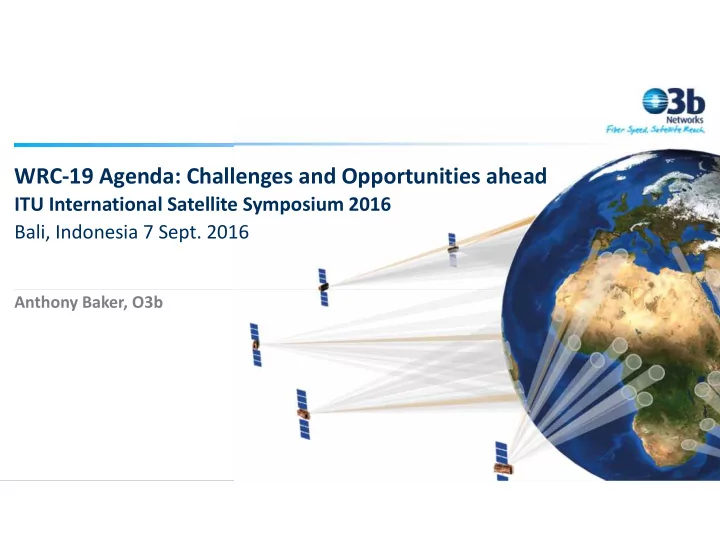
WRC-19 Agenda: Challenges and Opportunities ahead ITU International Satellite Symposium 2016 Bali, Indonesia 7 Sept. 2016 Anthony Baker, O3b WRC-19 Issues AGENDA 1. O3b one year on 2. AI 1.6: Regulatory framework for non-GSO FSS satellite


slide-1
SLIDE 1

WRC-19 Agenda: Challenges and Opportunities ahead

ITU International Satellite Symposium 2016 Bali, Indonesia 7 Sept. 2016

Anthony Baker, O3b

slide-2
SLIDE 2

WRC-19 Issues

AGENDA

  • 1. O3b – one year on
  • 2. AI 1.6: Regulatory framework for non-GSO FSS satellite

systems in V band NGSO-NGSO/GSO coordination

  • 3. AI 9.1.3: NGSO systems in C Band
  • 4. Bringing into use
slide-3
SLIDE 3

O3b – One Year On

Fiber without the Cable

3

slide-4
SLIDE 4

AI 9.1.3: NGSO systems in C Band

4

Background

  • Some Administrations are seeking to revisit EPFD limits in C-

band in the bands 3700-4200 MHz, 5925-6425 MHz, and 6725-7025 MHz and NGSO pfd limits in 3700-4200 MHz

  • Resolution 157 [COM5/6] calls to study technical and operational

issues and regulatory provisions for these NGSO systems

  • Studies to ensure that adequate protection is assured for GSO

systems in these bands

slide-5
SLIDE 5

5

slide-6
SLIDE 6

AI 1.6: Regulatory framework for non-GSO FSS satellite systems in V band

  • FSS V-bands of 37.5-42.5 GHz (s-to-E) and 47.2-48.9 GHz (limited to feeder links only), 48.9-50.2 GHz and 50.4-

51.4 GHz (all E-to-s)

  • Purpose is to develop new technologies above 30 GHz associated with both GSO and NGSO satellite

constellations to provide high-capacity and low-cost means of communication even to the most isolated regions

  • To conduct technical/regulatory studies for the operation of NGSO FSS while:
  • ensuring protection of GSO satellite networks in the FSS, MSS and BSS
  • not limiting/unduly constraining future GSO networks
  • not modifying the provisions of Article 21
  • Develop equivalent power flux-density limits for NGSO FSS towards GSO or into any geostationary FSS earth

station

  • Develop sharing conditions between NGSO FSS
  • WP4A leading discussion

6

slide-7
SLIDE 7

V-Band Challenges

  • Few deployed systems
  • Effects of rain fade (20-30 dB)
  • modelling propagation loss

accurately is important

  • Fading of the wanted and

interfering signals due to rain loss

  • Variation in transmit power of

wanted and interfering signals due to power control adjusting to rain loss

  • Correlation between

propagation loss between wanted and interfering paths

7

slide-8
SLIDE 8

PrestaBist Telecoms, Chad

It’s now a reality!

8

slide-9
SLIDE 9

AI 7 Satellite issues

9

The standing agenda item at all conferences to address satellite issues

  • 1. The ITU verification software to check NGSO compliance with RRs
  • The beam pointing strategies and control of interference to the GSO are not possible to model
  • We are addressing this in the ITU-R working group 4A
  • The WRC-15 recognised this and noted such in the minutes of the Plenary
  • 2. Bringing Into Use of NGSO networks
  • The current proposal is that 1 or 2 satellites BIU a constellation of thousands of satellites
  • Open to abuse
  • RRB considering Deployment Plan requirement
  • Minimum number of satellites to be define for intended service: Need for new service

definitions?

  • WP4A should further study and new regulations enacted at WRC-19
slide-10
SLIDE 10