The JoplinTornadoInfo Story SMEM Then and Now Rebecca Williams, - - PDF document

the joplintornadoinfo story
SMART_READER_LITE
LIVE PREVIEW

The JoplinTornadoInfo Story SMEM Then and Now Rebecca Williams, - - PDF document

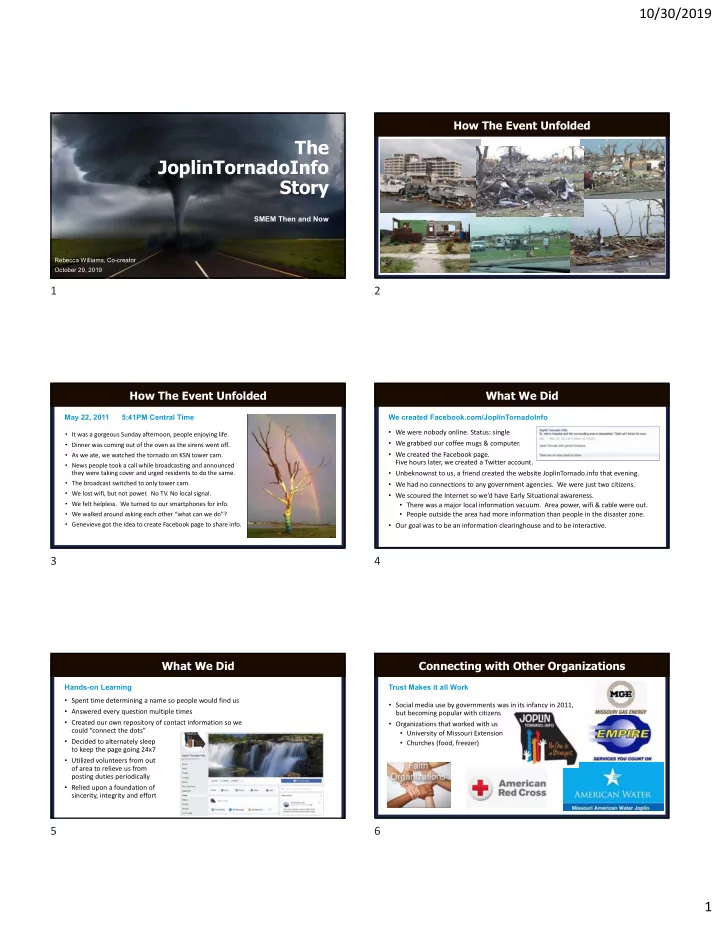
10/30/2019 How The Event Unfolded The JoplinTornadoInfo Story SMEM Then and Now Rebecca Williams, Co-creator October 29, 2019 1 2 How The Event Unfolded What We Did May 22, 2011 5:41PM Central Time We created


slide-1
SLIDE 1

10/30/2019 1

The JoplinTornadoInfo Story

SMEM Then and Now

Rebecca Williams, Co-creator October 29, 2019

How The Event Unfolded

  • It was a gorgeous Sunday afternoon, people enjoying life.
  • Dinner was coming out of the oven as the sirens went off.
  • As we ate, we watched the tornado on KSN tower cam.
  • News people took a call while broadcasting and announced

they were taking cover and urged residents to do the same.

  • The broadcast switched to only tower cam.
  • We lost wifi, but not power. No TV. No local signal.
  • We felt helpless. We turned to our smartphones for info.
  • We walked around asking each other “what can we do”?
  • Genevieve got the idea to create Facebook page to share info.

May 22, 2011 5:41PM Central Time

How The Event Unfolded

  • We were nobody online. Status: single
  • We grabbed our coffee mugs & computer.
  • We created the Facebook page.

Five hours later, we created a Twitter account.

  • Unbeknownst to us, a friend created the website JoplinTornado.info that evening.
  • We had no connections to any government agencies. We were just two citizens.
  • We scoured the Internet so we’d have Early Situational awareness.
  • There was a major local information vacuum. Area power, wifi & cable were out.
  • People outside the area had more information than people in the disaster zone.
  • Our goal was to be an information clearinghouse and to be interactive.

We created Facebook.com/JoplinTornadoInfo

What We Did

  • Spent time determining a name so people would find us
  • Answered every question multiple times
  • Created our own repository of contact information so we

could “connect the dots”

  • Decided to alternately sleep

to keep the page going 24x7

  • Utilized volunteers from out
  • f area to relieve us from

posting duties periodically

  • Relied upon a foundation of

sincerity, integrity and effort Hands-on Learning

What We Did

  • Social media use by governments was in its infancy in 2011,

but becoming popular with citizens

  • Organizations that worked with us
  • University of Missouri Extension
  • Churches (food, freezer)

Trust Makes it all Work

Connecting with Other Organizations

1 2 3 4 5 6

slide-2
SLIDE 2

10/30/2019 2

  • Created a rolodex of active organizations
  • We used legal pads because things were moving too fast
  • Assigned other organization personnel as Facebook page admins
  • They could push out their own information
  • Gained credibility for us
  • Gave validity to our information
  • Broke down reporting silos
  • Grew the page’s audience as others published critical information
  • Not only adding viewers, but adding first‐hand information
  • Provided “one stop shopping” for the public to find a broad spectrum of information

Benefits of Working with Others

Connecting with Other Organizations

FEMA Recognized the Importance of Engaging the WHOLE Community

Lessons Learned: Working with FEMA

  • Advanced planning with the WHOLE Community
  • Don’t recreate the wheel. Use existing resources.
  • Team Rubicon
  • ITDRC
  • Faith‐based
  • Government may fail to have sufficient communication

resources to manage a major disaster and operate 24/7

  • Hurricane Harvey; Tropical Storm Irma 40” of rain
  • Hurricane Maria (Puerto Rico)
  • Gatlinburg Fire
  • Citizens can and will do something to help (or not).

Manage volunteers

  • Don’t recreate the wheel. Use existing resources
  • Members of the public will communicate, repeat info

accurate or not, and use any and all social channels

  • Second wave disasters

Recognize you have NO control over what people will do

Lessons Learned: What People Will do

  • NOAA AM/FM Radio, Ham Radio are still functional when electricity is out and cells are

down

  • Don’t forget paper, WOM, bullhorns
  • Twitter faster and where EM hangout
  • Emergency pages aren’t just for emergencies

Prepare for them all to fail

The picture can't be displayed.

Lessons Learned: ALL Channels Need to be Used

  • Twitter to Text: “Follow [twitter handle] to 40404 gets text (also, FB to text function)
  • Twitter moves faster than Facebook and news breaks more quickly than on Facebook
  • YouTube, Vimeo or Facebook video
  • Don’t forget a written synopsis or transcript
  • Be mindful of people with limited data
  • Be mindful of those with disabilities
  • Young people live on Instagram
  • Multiple admins needed for 24/7 coverage
  • Out of state admins
  • Know the laws, records retention
  • If you didn’t document it, you didn’t do it: post post post.

Not everyone lives on Facebook

Lessons Learned: Know Your Technology

  • During an event is no time to learn how to update social media and no time to decide to be interactive.

You won’t have the personnel or skills to do so.

  • Make a mistake correct it….do not delete
  • Add disclaimers (for example: “This post is

being widely circulated but is an old photo not related to current conditions.”)

  • Refer to vetted functional efforts
  • For example: which shelters are open / closed.
  • Use official current sources, not newspaper articles.
  • Share only from vetted verified sources and then proceed with caution.
  • Check dates of all photos/videos

For example, train derailment during prior flood was used during 2016 flood and widely shared)

  • Having a rolodex of contacts to verify information
  • Be in it for the long haul

Finish What You’ve Started

Lessons Learned: Become the Trusted Source

7 8 9 10 11 12

slide-3
SLIDE 3

10/30/2019 3

  • FEMA recognizes whole community planning and response
  • Social Media for Disaster Recovery Guide is now listed

as a resource in FEMA’s Toolkit.

  • https://www.fema.gov/media‐library/assets/documents/166794
  • Governments recognize they can’t do it all. (CERT, etc)
  • Training is offered to public and private agencies to

foster cooperation in the digital space.

  • Multi‐state multi‐jurisdictional exercises take place involving

private sector entities and civic organizations. (Morris County NJ)

  • Trust of citizen practitioners by public sector agencies has increased exponentially.
  • Technology improvements: Facebook Crisis Response, Crowdsourced maps like the LA

Times fire maps, charging stations, online donation portals, mobile comm towers, virtual MARCs, Ready.gov and advanced preparedness information….

Improvements Made Since

  • Citizen Communicator
  • Lack of Standing without formal agency Communication Plan
  • Liability and/or Insurance issues
  • Records Retention & Open Public Records: do they apply?
  • Connecting with other organizations
  • Government Practitioner
  • Legal Issues & Applicable Court Cases
  • Explosion of social media channels and trying to be in all places
  • Training on new popular social media channels
  • Budgets: Who pays when the communicator is a citizen (advertising, any app costs, etc)
  • Managing rumors and well‐meaning citizens efforts

We’re making progress, but…

Difficulties That Exist Today

Current & Past Presentations: Slideshare.net/ChazNJ

Contact Information

Carol A. Spencer Stormzero, LLC Cedar Creek, TX 78612

973‐637‐0483 Stormzero.com carol@stormzero.com

Rebecca J. Williams Your Net Working, LLC Neosho, MO 64850

417‐434‐0379 YourNetWorking.net rebecca@stormzero.com

13 14 15