The M UNIN project www.unmanned-ship.org Consortium meeting, - - PowerPoint PPT Presentation

the m unin project
SMART_READER_LITE
LIVE PREVIEW

The M UNIN project www.unmanned-ship.org Consortium meeting, - - PowerPoint PPT Presentation

M aritime Unmanned Navigation through Intelligence in Networks The M UNIN project www.unmanned-ship.org Consortium meeting, Reykjavik 11-15 March COMPIT 2013 conference, Cortona, Italy 15-17 April Hans-Christoph Burmeister rnulf Rdseth


slide-1
SLIDE 1

SST.2012.5.2-5: Grant no. 314286 E-guided vessels: The 'autonomous' ship

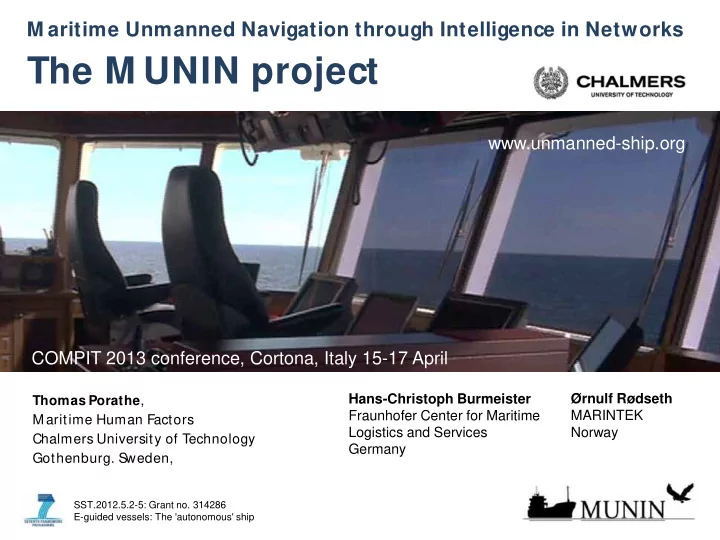
M aritime Unmanned Navigation through Intelligence in Networks

The M UNIN project

Consortium meeting, Reykjavik 11-15 March www.unmanned-ship.org

Hans-Christoph Burmeister Fraunhofer Center for Maritime Logistics and Services Germany Ørnulf Rødseth MARINTEK Norway

Thomas Porathe, M aritime Human Factors Chalmers University of T echnology

  • Gothenburg. Sweden,

COMPIT 2013 conference, Cortona, Italy 15-17 April

slide-2
SLIDE 2

Target ship: A simulated, about 200 meters long, dry bulk vessel of 57 000 DWT 2 /36

The autonomous/ unmanned ship

slide-3
SLIDE 3

An autonomous ship

Automatic navigation and collision avoidance. Automatic engine control. Not necessarily unmanned. Can house maintenance and repair crew. Even be partly manned.

An unmanned ship

No-one onboard. Not necessarily under automatic navigation / engine control. Can be remote controlled from shore center.

3 /36

Autonomous/ unmanned ships

slide-4
SLIDE 4

Objective of the project

To show the feasibility of autonomous/ unmanned shipping To show that an unmanned ship system is at least as safe as a manned.

M otivation

1. Shortage of mariners in Europe 2. Reduce “ human error” 3. Ultra-slow steaming, using ocean currents, leads to lower fuel costs and lower emissions, but also less efficient transport capacity and socially unacceptable voyage durations. 4. Lower manning costs

4 /36

slide-5
SLIDE 5

Objective of the project

To show the feasibility of autonomous/ unmanned shipping To show that an unmanned ship system is at least as safe as a manned.

M otivation

1. Shortage of mariners in Europe 2. Reduce “human error” 3. Ultra-slow steaming, using ocean currents, leads to lower fuel costs and lower emissions, but also less efficient transport capacity and socially unaccessible voyage durations. 4. Lower manning costs

4 /36

84-88% of tanker accidents 79% of towing vessel groundings 89-96% of collisions 75% of allisions 75% of fires and explosions

Various studies by TSB Canada, Cormier, UK P&I Club and Bryant. http:/ / www.wmu.se.fortet.funcform.se/o.o.i.s/ 71

“Human error” contribution to shipping accidents

slide-6
SLIDE 6

Objective of the project

To show the feasibility of autonomous/ unmanned shipping To show that an unmanned ship system is at least as safe as a manned.

M otivation

1. Shortage of mariners in Europe 2. Reduce “ human error” 3. Ultra-slow steaming, using ocean currents, leads to lower fuel costs and lower emissions, but also less efficient transport capacity and socially unacceptable voyage durations. 4. Lower manning costs

4 /36

slide-7
SLIDE 7

The unmanned / autonomous ship Daylight and IR cameras Shore Control Center (SCC) Rendezvous control Automatic collision avoidance Satellite link Autonomous bridge Autonomous engine room

5 /36

slide-8
SLIDE 8

Work tasks and partners

8

  • Architecture. To develop the necessary interface specifications for the ship and shore software

applications to communicate effectively and safely (MARINTEK, Norway)

  • Develop the autonomous bridge controller (Fraunhofer Center for Maritime Logistics and Services,

Germany)

  • Develop the autonomous engine controller (MarineSoft, Germany, MARORKA, Iceland)
  • Develop the Shore Control Centre (Chalmers University of Technology, Sweden, Aptomar,

Norway)

  • Proof of concept , simulated ship and engine (Wismar University of Applied Sciences)
  • Legal and liability analysis for automated and remote controlled ship systems (University College

Cork, Ireland)

  • Future concepts (All)

6 /36

slide-9
SLIDE 9

Functional Status Indicators sent each 5 sec.

Indicator Data reference FSI Bytes Location Position, heading, speed, distance from planned position as well as a position quality flag. Weather Wind speed/direction, wave and swell hight/ length/ direction 12 Visibility Visibility IR/Normal, radar range and clutter. COLREG status of ship. 8 Collision Vectors to targets, status/heading/speed of targets. 5 ships/objects in vicinity 40 Grounding Depth, distance to shore, complexity 6 Communication Critical communication directly to ship on VHF, GMDSS, NAVTEX, DSC, AIS 270 Stability Trim, heel, draft, watertight integrity, void space, water ingress. 20 Environment NOx, SOx, PM, Waste, Oil, GHG 12 Economy Fuel use and potential for late arrival, off hire etc. 6 Hull Equipment Hull monitoring, corrosion, equipment status, anchor, towing, ladders, etc. 12 Propulsion Direction, speed anomalies 4 Machinery Power, steam, auxiliary, hydraulic etc 10 Electric Generators, switchboard, emergency 6 Safety Main fire zones 16 Cargo Temperature, humidity, levels, 5 holds 30

Communications

7 /36
slide-10
SLIDE 10

Communications

1. One main communication channel based on a commercial VSAT service

  • perating in C-, Ku- or Ka-band. Capacity should be 4 M bps or higher to cover

the maximum aggregated bandwidth. This will enable unrestricted remote control of the ship. 2. A backup channel based on L-band Inmarsat or Iridium OpenPort with a capacity of 128 kbps or more. This would cover all but the high capacity links (e.g. video, voice communication). This will allow restricted remote control with full radar image, but only sporadic visual or IR images. 3. A dedicated and independent rendezvous communication channel based on, e.g., AIS or digital VHF technology. This allows recovery of ship even if main communication channels have been lost. 8 /36

High seas; Satellite communication Coastal waters: GSM/3G/4G, AIS, VDE

slide-11
SLIDE 11
  • Monitoring
  • Indirect control
  • Direct control
  • Situation handling

Shore Control Center

9 /36

slide-12
SLIDE 12
  • Monitoring
  • Indirect control
  • Direct control
  • Situation handling

Situation room: Team work, Immersion 3-D Nautical Chart * Picture insert from video/IR camera

Shore Control Center

* Porathe, T. (2006). 3-D Nautical Charts and Safe Navigation. Dissertation, Mälardalen University Press.

10 /36

slide-13
SLIDE 13

* Porathe, T. (2006). 3-D Nautical Charts and Safe Navigation. Dissertation, Mälardalen University Press.

10 /36

slide-14
SLIDE 14

Shore Control Center

Ship

  • wner

VTS

Pilot Unmanned ship Tugs

Mooring

Other vessels

Human Factors issues: 1.SCC bridge procedures. 2.What information must be available in different areas? VHF VHF RC Radio Control (RC) RC 240 hrs auto engine

Flag state 11 /36

slide-15
SLIDE 15

Shore Control Center Unmanned ship Unmanned ship Unmanned ship Unmanned ship Unmanned ship One Shore Control Centers may operate several unmanned ships?

Human Factors issues: 1.Manning of SCC? Same certification as on bridge: master and mates? Remote certificate? 2.The monitoring operator and out-of-the-loop syndrome. 3.De-skilling. 4.Bridge procedures. 5.How many ships can an SCC handle?

12 /36

slide-16
SLIDE 16

SCC Europe

Unmanned ship

SCC America SCC Asia

Shore Control Centers may work in shifts during day-light hours?

Human Factors issues: 1.Hand-over procedures. 2.How to transfer memory of ship conditions between crews

13 /36

slide-17
SLIDE 17

Scenarios

14 /36

slide-18
SLIDE 18

Scenarios

Release Vessel to Autonomous operation at pilot drop-off point

15 /36

slide-19
SLIDE 19

Scenarios

Open Sea Passage

16 /36

Release Vessel to Autonomous operation at pilot drop-off point

slide-20
SLIDE 20

Scenarios

Open Sea Passage Piracy, boarding and retrieval of ship

17 /36

Release Vessel to Autonomous operation at pilot drop-off point

slide-21
SLIDE 21

Scenarios

Open Sea Passage Piracy, boarding and retrieval of ship Periodic status updates from Vessel to Shore Control, planned maintenance

18 /36

Release Vessel to Autonomous operation at pilot drop-off point

slide-22
SLIDE 22

Scenarios

Open Sea Passage Piracy, boarding and retrieval of ship Periodic status updates from Vessel to Shore Control, planned maintenance Reduced communication capabilities - retrieve ship

19 /36

Release Vessel to Autonomous operation at pilot drop-off point

slide-23
SLIDE 23

Scenarios

Open Sea Passage Piracy, boarding and retrieval of ship Periodic status updates from Vessel to Shore Control, planned maintenance Reduced communication capabilities - retrieve ship Loss of GNSS position

20 /36

Release Vessel to Autonomous operation at pilot drop-off point

slide-24
SLIDE 24

Scenarios

Open Sea Passage Piracy, boarding and retrieval of ship Periodic status updates from Vessel to Shore Control, planned maintenance Reduced communication capabilities - retrieve ship Loss of GNSS position System failure message from other component, e.g., rudder or propeller

21 /36

Release Vessel to Autonomous operation at pilot drop-off point

slide-25
SLIDE 25

Scenarios

Open Sea Passage Piracy, boarding and retrieval of ship Periodic status updates from Vessel to Shore Control, planned maintenance Reduced communication capabilities - retrieve ship Loss of GNSS position System failure message from other component, e.g., rudder or propeller Small object detection that require support from shore control

22 /36

Release Vessel to Autonomous operation at pilot drop-off point

slide-26
SLIDE 26

Scenarios

Open Sea Passage Piracy, boarding and retrieval of ship Periodic status updates from Vessel to Shore Control, planned maintenance Reduced communication capabilities - retrieve ship Loss of GNSS position System failure message from other component, e.g., rudder or propeller Weather routing

23 /36

Release Vessel to Autonomous operation at pilot drop-off point Small object detection that require support from shore control

slide-27
SLIDE 27

Scenarios

Open Sea Passage Piracy, boarding and retrieval of ship Periodic status updates from Vessel to Shore Control, planned maintenance Reduced communication capabilities - retrieve ship Loss of GNSS position System failure message from other component, e.g., rudder or propeller Weather routing Collision detection and deviation through Autonomous control

24 /36

Release Vessel to Autonomous operation at pilot drop-off point Small object detection that require support from shore control

slide-28
SLIDE 28

Scenarios

Open Sea Passage Piracy, boarding and retrieval of ship Periodic status updates from Vessel to Shore Control, planned maintenance Reduced communication capabilities - retrieve ship Loss of GNSS position System failure message from other component, e.g., rudder or propeller Weather routing Request from other ship to participate in SAR

25 /36

Release Vessel to Autonomous operation at pilot drop-off point Small object detection that require support from shore control Collision detection and deviation through Autonomous control

slide-29
SLIDE 29

Scenarios

Open Sea Passage Piracy, boarding and retrieval of ship Periodic status updates from Vessel to Shore Control, planned maintenance Reduced communication capabilities - retrieve ship Loss of GNSS position System failure message from other component, e.g., rudder or propeller Weather routing Retrieve manual control at pilot pick-up point

26 /36

Release Vessel to Autonomous operation at pilot drop-off point Small object detection that require support from shore control Collision detection and deviation through Autonomous control Request from other ship to participate in SAR

slide-30
SLIDE 30

Scenarios

Open Sea Passage Piracy, boarding and retrieval of ship Periodic status updates from Vessel to Shore Control, planned maintenance Reduced communication capabilities - retrieve ship Loss of GNSS position System failure message from other component, e.g., rudder or propeller Weather routing Retrieve manual control at pilot pick-up point Flooding detection

27 /36

Release Vessel to Autonomous operation at pilot drop-off point Small object detection that require support from shore control Collision detection and deviation through Autonomous control Request from other ship to participate in SAR

slide-31
SLIDE 31

Scenarios

Open Sea Passage Piracy, boarding and retrieval of ship Periodic status updates from Vessel to Shore Control, planned maintenance Reduced communication capabilities - retrieve ship Loss of GNSS position System failure message from other component, e.g., rudder or propeller Weather routing Retrieve manual control at pilot pick-up point Flooding detection Intentional grounding

28 /36

Release Vessel to Autonomous operation at pilot drop-off point Small object detection that require support from shore control Collision detection and deviation through Autonomous control Request from other ship to participate in SAR

slide-32
SLIDE 32

Scenarios

Pilot unavailable, remote control into confined waters Open Sea Passage Periodic status updates from Vessel to Shore Control, planned maintenance Reduced communication capabilities - retrieve ship Loss of GNSS position System failure message from other component, e.g., rudder or propeller Piracy, boarding and retrieval of ship Weather routing Intentional grounding Retrieve manual control at pilot pick-up point Flooding detection

29 /36

Release Vessel to Autonomous operation at pilot drop-off point Small object detection that require support from shore control Collision detection and deviation through Autonomous control Request from other ship to participate in SAR

slide-33
SLIDE 33

I hope to be back in 2015 with the results. Thank you.