The method of viscosity solutions for analysis of singular diffusion - - PowerPoint PPT Presentation

the method of viscosity solutions for analysis of
SMART_READER_LITE
LIVE PREVIEW

The method of viscosity solutions for analysis of singular diffusion - - PowerPoint PPT Presentation

Mathematics for Nonlinear Phenomena: Analysis and Computation Sapporo, August 2015 The method of viscosity solutions for analysis of singular diffusion problems appearing in crystal growth problems Piotr Rybka Joint project with Y.Giga,


slide-1
SLIDE 1

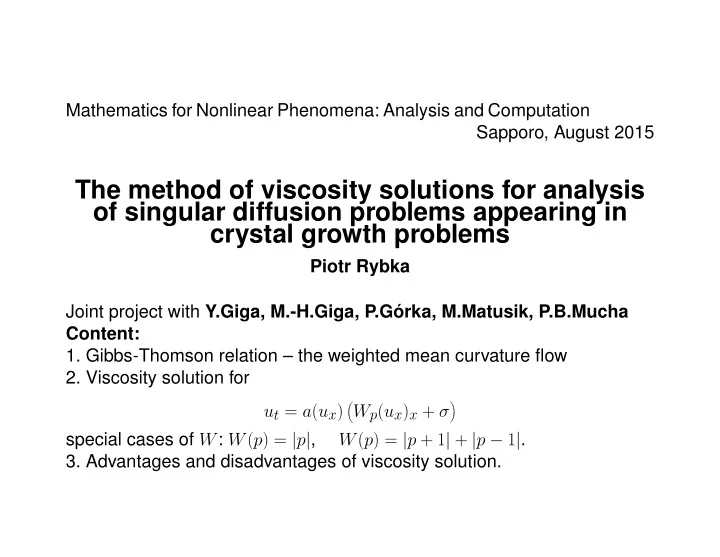
Mathematics for Nonlinear Phenomena: Analysis and Computation Sapporo, August 2015

The method of viscosity solutions for analysis

  • f singular diffusion problems appearing in

crystal growth problems

Piotr Rybka Joint project with Y.Giga, M.-H.Giga, P.Górka, M.Matusik, P.B.Mucha Content:

  • 1. Gibbs-Thomson relation – the weighted mean curvature flow
  • 2. Viscosity solution for

ut = a(ux)

(

Wp(ux)x + σ

)

special cases of W: W(p) = |p|, W(p) = |p + 1| + |p − 1|.

  • 3. Advantages and disadvantages of viscosity solution.
slide-2
SLIDE 2
  • 1. Setting up the geometric problem

We study equations behind the Gibbs-Thomson relation, i.e. βV = κγ + σ

  • n Γ(t).

(1) a) Γ(t) ⊂ I R2 – a curve, n its outer normal, β = β(n) – a kinetic coefficient. b) Formally, the weighted mean curvature is κγ = −divS

(

∇ζγ(ζ)|ζ=n(x)

)

. (2) If γ(ζ) = |ζ|, then κγ is the Euclidean mean curvature. Here, γ(p1, p2) = |p1|γΛ + |p2|γR, (3) c) σ – the driving (supersaturation, temperature, pressure, ...). It should be a solution to ϵσt = ∆σ, ϵ = 0

  • r

ϵ = 1. (4) Full scale numerical simulations for (1), (4) with smoothed out γ and β were perfomed by Garcke and co-workers (2013), but there is no corresponding

  • theory. Here, σ is given.

1

slide-3
SLIDE 3

We will study (1) for graphs or special closed curves, which are small perturbations of the shape minimizing the surface energy

Γ γ(n) dH1 under

the volume constraint. The minimizer is a scaled Wulff shape, Wγ, i.e. a ball in the space dual to (I R2, γ). For γ given by (3) the Wulff shape is a

  • rectangle. Our closed curves of special interest are small perturbations of

Wγ, bent rectangles,

−r −r r r

1

L L

1

R l l R R0

1 1 1 1 2

Λ

S+ S+ R Λ 1

x x

2 1

x =d (t,x ) x =d (t,x )

2 1

Fig.: A bent rectangle

2

slide-4
SLIDE 4

When we talk about a bent recangle, we assume that each side of a bent rectangle is a graph of a Lipschitz function such that it has three facets. Basically, a connected part of Γ(t), F, will be called a facet, if: 1) the normal to F is one of singular normals i.e. (±1, 0), (0, ±1), the nor- mals to the Wullf shape Wγ; 2) F is maximal with respect to set inclusion having property 1). We study (1) for graphs of u or bent rectangles when γ given by (3).

3

slide-5
SLIDE 5

Summary of know results 1) Novaga, Chambolle using variational tools constructed the flat flow of V = κγ in I

  • Rn. Restriction: convex body as a datum.

2) Andreu, Caselles, Mazon, Moll used nonlinear semigroup methods to solve ut = div

  ∇u

|∇u|

  in I

  • Rn. Anisotropic counterparts studied by Moll too.

3) Y.Giga, P .Górka, PR used variational tools to study βV = κγ + σ in I R2 for special closed curves and special σ. 4) Y.Giga, M.-H.Giga developed viscosity theory for ut = M(ux)

(

Wp(ux)x + σ

)

. 5) P .Mucha, PR proved existence of solutions to ut = (sgn ux)x+ϵuxx, (ϵ = 0

  • r ϵ = 1) by smooth approximation.

Today, I would like to present an apllication of approach 4) to 3) and 5).

4

slide-6
SLIDE 6

Our initial approach to study bent rectangles as variational solutions to (1) was the following: the corner is defined as the intersection of two facets of evolving graphs. Thus, it is sufficient to look at two graphs dR(t, ·), dΛ(t, ·). Set u = dR(t, x1), then n = (−ux1, 1)/

u2

x1 + 1. Hence,

∇γ is not well defined on facets!

  • Remark. If we stick u and n into (1), then we obtain

β(ux)ut =

     γΛsgn      

ux

u2

x1 + 1

           

x

+ σ

  • r equivalently

ut = M(ux)

(

Wp(ux)x + σ

)

, (5) where W(p) = γΛ|p|.

5

slide-7
SLIDE 7

Convexity of γ permits us to use the subdifferential, ∂γ, (defined for all xi ∈ I R2) in place of ∇ζγ(ζ)|ζ=n(x) in (2). We recall that the subdifferential is the set of all supporting hyperplanes, e.g. the subdifferential of f(x) = |x| at x = 0 is depicted below. Fig.: subdifferential ∂f(0).

6

slide-8
SLIDE 8

The use of ∂γ requires finding ξ, a selection ∂γ. Thus, the operator σ − divS∇ζγ(ζ)|ζ=n(x) (6) reduces to σ − ∂ξ ∂x, where ξ ∈ ∂γ. Our construction of variational solutions is based on the right selection of ξ. It is based of the observation that (6) is the E-L of functionals EΛ(ξ) =

SΛ |σ − divSξ|2H1,

ER(ξ) =

SR |σ − divSξ|2H1.

(7) We will show that variational solutions are viscosity solutions, in the sense developed by M.-H.Giga and Y.Giga. Here come the bonuses: uniqueness of variational solutions as well as preservation of verteces.

7

slide-9
SLIDE 9
  • 2. Variational solutions

A family of couples (Γ(t), ξ(t))t0 will be called a variational solution iff Γ(t) is a bent rectangle and ξ(t) is a solution to min{EΛ(ξ) : divSξ ∈ L2, ξ(x) ∈ ∂γ(n(x))}, min{ER(ξ) : divSξ ∈ L2, ξ(x) ∈ ∂γ(n(x))} and eq. (1) is satisfied in the L2 sense. An advantage of variational solutions is that they are ‘explicit’ compared to viscosity solutions. However, at a certain level of complication of the geometry of the data this advantage is lost.

8

slide-10
SLIDE 10

Proposition 2.1 Taking into account the form of the minimizers of ER, EΛ, then (1) on the sides SR and SΛ becomes ˙ R0/M(0) =

∫ l0

− σ(t, R0, s) ds + γR l0

  • n

[0, l0] dΛ

t = σ(t, dΛ, s)M(dΛ x)

for s ∈ (l0, l1) ˙ R1/M(0) =

∫ L1

l1

− σ(t, R1, s) ds + 2γR L1 − l1

  • n

[l1, L1] ˙ L0/M(0) =

∫ r0

− σ(t, s, L0) ds + γΛ r0

  • n

[0, r0] (8) dR

t = σ(t, s, dR)M(dR x )

for s ∈ (r0, r1) ˙ L1/M(0) =

∫ R1

r1

− σ(t, s, L1) ds + 2γΛ R1 − r1

  • n

[r1, R1]. Here, M(dx) = 1/β(dx).

  • Note. System (8) is not closed until we specify evolution of r0(·), r1(·), l0(·),

l1(·), these are genuine free boundaries. (8) is a system of Hamilton-Jacobi eqs with discontinuous Hamiltonians.

9

slide-11
SLIDE 11

Theorem 2.2(Giga, Górka, PR 2013) Let us suppose that Γ(0) is a bent rectangle such that dΛ

0 ∈ C2([l0, l1]), dR 0 ∈

C2([r0, r1]). Moreover, σ satisfies σ(x1, x2) = σ(±x1, ±x2) and xi ∂σ

∂xi(x1, x2) >

0, xi ̸= 0, i = 1, 2. (Berg’s effect). We assume that one of the following con- ditions occurs at each interfacial point ri, li, i = 0, 1. (a) condition (9) holds at r0 (resp. l0) and ˙ r0 < 0 (resp. ˙ l0 < 0), i.e. the facet shrinks at r0 : σ(t, r0, L0) =

∫ r0

− σ(t, s, L0) ds + γΛ r0 , (9)

  • r (b) ˙

r0 > 0 (resp. ˙ l0 > 0 ) and dR

x (r0(0)) > 0 (resp. dΛ x(l0(0)) > 0), i.e. the

facet expands. (Similar conditions at r1 and l1). Then, under some additional technical restrictions on data, there exists a variational solution to (1). If all the interfacial curves satisfy (9), (10), at r1 : σ(t, r1, L1) =

∫ R1

r1

− σ(t, s, L1) ds − 2γΛ R1 − r1 . (10) then the solution is unique.

10

slide-12
SLIDE 12

Comments on (9) and (10). Characteristics of the Hamilton-Jacobi eq. dt = σ(t, d, x)M(dx) interact with the free boundaries r0, r1, l0, l1. Any of these curves may be

nonlocal ODE x Hamilton−Jacobi eq.

classical

00

r r

Fig.: a shock wave r0

  • r

nonlocal ODE x

00

r r classical Hamilton−Jacobi eq.

Fig.: a rarefaction wave r0

11

slide-13
SLIDE 13

Further comments We know the structure of solutions, but: 1) We are not able to establish existence for all configurations; 2) Uniqueness limited to smooth data; 3) Corners motion is defined in an artificial way, it does not follow from equations. In order to resolve issues 2) and 3) we resort to viscosity theory. 4) Berg’s effect, xi ∂σ

∂xi(x1, x2) > 0, xi ̸= 0, i = 1, 2, has been established

experimentally, (Berg 1938) and it well-known in the Physics community (Yokoyama, Kuroda 1990, Yokoyama, Sekerka, Furukawa 2000, Nelson 2001). Despite efforts to prove it, (Seeger 1953, Giga, PR 2003), it se- ems that it is a rather rare mathematical phenomenon, related to regularity

  • f solutions (Kubica, PR 2014).

12

slide-14
SLIDE 14

On Berg’s effect We studied the following equation,

              

∆u = 0 in Ω := R2 \ R1, u = 0

  • n ∂R2,

∂u ∂n = un

  • n ∂R1,

(11) where R1 = (−r1, r1) × (−r2, r2), R2 = λ0R1, λ0 > 1, n is the outer normal to Ω and un =

      

a for |x2| = r2, b for |x1| = r1. Theorem 2.3 (A.Kubica, PR 2014) Let us suppose that R1 is as above. There are unique numbers α, β related with Ω such that |α| + |β| > 0 and if u is a weak solution to (11) then u ∈ C1(Ω) ⇐ ⇒ aα + bβ = 0. Tools used in the proof: the standard representation of singular solutions and careful analysis of the level sets of harmonic functions.

13

slide-15
SLIDE 15

Theorem 2.4 (A.Kubica, PR 2014) Let us suppose that R1 = Q = (−R, R)2. If u is a weak solution to (11), then u ∈ C1(Ω) ⇐ ⇒ a = b, i.e. number α, β from Theorem 2.3 satisfy α = −β ̸= 0. This is an easy consequence of the square symmetries. Theorem 2.5 (A.Kubica, PR 2015) Berg’s effect holds iff u ∈ C1(Ω). ⇒ Needs a refinement of the argument used in the proof of Theorem 2.3. ⇐ An easy corollary from Hopf Lemma (YG + PR 2003). Numerical simulations seem to support Berg’s, (Nürenberg, 2013), but this evidence is not strong.

14

slide-16
SLIDE 16
  • 3. Viscosity solutions

We would rather explain the motivation on the prototype problem, ut = (sgn ux)x, x ∈ I R mod 2π, u(x, 0) = u0(x). (12) We rewrite (12) as a gradient flow, ut ∈ −∂E(u), u(0) = u0, (13) where E(u) =

       ∫

T |Du|

u ∈ BV (T), +∞ u ∈ L2(T) \ BV (T). By the general theory of nonlinear semigroup, u, the solution to (13) satis- fies du+ dt = −(∂E(u))o, where (∂E(u))o denotes the canonical selection of ∂E(u). Thus, the notion

  • f viscosity solution should be consistent with this observation.

15

slide-17
SLIDE 17

3.1 Issues: There two problems with the definition a viscosity solution to ut = a(ux)(Wp(ux) + σ(x, t)), (x, t)) ∈ IT, u(0) = u0. (14) 1) To find a proper set of test functions, φ, and give meaning to (L(φx)x := (sgn ux)x, when the graph of φ has facets. 2) If u, φ ∈ C2 touch at x0 and u φ in a neighborhood of x0, then uxx(x0) φxx(x0). But this sort of conclusion is not instantly available for (L(ux))x, (L(φx)x, if u, φ have facets at x0. A new tool is necessary and it should be compatible with the properties of canonical section (∂E(u))+ (and solutions to (8)). Here, W ∈ C2(I R \ P), set P is finite, Wpp ∈ L∞(I R \ P) e.g. W(p) = a|p|. F. f ∈ C(I) is called p-faceted at x0, p ∈ P if there are R(f, x0) = [a, b] ⊂ (c, d), a < b x0 ∈ R(f, x0) s.t. f(x) ≡ ℓp(x) = p(x − x0) + f(x0) in R(f, x0) and f(x) ̸= ℓp(x) for all x ∈ J \ R(f, x0) R(f, x0) is called a faceted region of f.

16

slide-18
SLIDE 18

3.2. Definition (Wp(φx))x The canonical selection of ∂E(u) is the smallest element of ∂E(u). The definition of (Wp(φx))x is based on a minimization problem. We set J σ(ζ, J) =

         ∫

J |ζ′(x)|2 dx

if ζ ∈ H1(J), +∞ if ζ ∈ L2(J) \ H1(J). Let us call by ξσ,J

K

the unique solution to the obstacle problem min{J σ(ζ, J) : ζ ∈ K}, (15) where K is a convex, closed subset of H1, depending upon σ, W and φ, K = {ξ ∈ H1(I) : Z(x) − ∆/2 ξ(x) Z(x) + ∆/2, x ∈ I, +bc}, where Z is a primitive of σ.

  • Remark. We can prove a comparison principle for solutions to this minimi-

zation problem.

17

slide-19
SLIDE 19

Now, we define (Wp(φx))x. If φ ∈ C2 and φx ̸∈ P, then we set ΛZ

W(φ)(x) :=

(

W ′

p(φx)

)

x + σ(x, t).

If φ ∈ C2

P is p-faceted at x0 with the faceted region R(φ, x0) denoted by J,

then we set ΛZ

W(φ)(x) := d

dxξZ,J

χlχr(x).

18

slide-20
SLIDE 20

3.3 Definition of a viscosity solution A continuous real-valued function u on IT is a (viscosity) subsolution of ut = a(ux)(Wp(ux)x+σ(x, t)), (x, t) ∈ T×(0, T), u(x, 0) = u0(x). (16) if ψt(ˆ t, ˆ x) − ΛZ(ˆ

t,·) W

(ψ(ˆ t)) (ˆ x) 0 (17) whenever

(

ψ, (ˆ t, ˆ x)

)

∈ AP(IT) × IT fulfills max

IT

(u − ψ) = (u − ψ) (ˆ t, ˆ x). (18) Here, ψ(ˆ t) is a function on Ω defined by ψ(ˆ t) = ψ(ˆ t, ·) Obvious changes are required in the definition of a viscosity supersolution.

19

slide-21
SLIDE 21

3.4 Comparison principle The main advantage is the following comparison principle. Theorem 3.2. (Y.Giga, M.-H.Giga, PR, 2014) Let us suppose that u is a subsolution (resp. v is a supersolution) to (16) and u(x, 0) v(x, 0). Then, u(x, t) v(x, t) for all t ∈ [0, T).

20

slide-22
SLIDE 22

3.5 Bent rectangles as graphs Can we represent a bent rectanglea s a graph over T or another convenient reference manifold? Theorem 3.3. (a) Let us suppose that Γ is a bent rectangle, symmetric with respect to both coordinate axes, and such that |di

x| < 1, where i = Λ, R. If

a geometric condition depicted below holds, then Γ there exists a smooth reference manifold M and a function v : M → I R such that Γ is a graph of v over M. (b) Let us suppose that {Γ(t)}t∈[0,T) is a family of bent rectangles, with admissible functions dΛ(·, t), dR(·, t) defining them, such that: (i) for Γ(0) the geometric condition holds; (ii) Γ(0) is symmetric with respect to both coordinate axes, dΛ, dR ∈ C([0, T], C(I R)) and ri, li ∈ C[0, T], i = 0, 1. Then, there is ϵ > 0 such that all Γ(t), are graphs of v(t, ·) for t ∈ [0, ϵ) over the same reference manifold M.

21

slide-23
SLIDE 23

The geometric condition is as follows, see figure below. The paralellograms P1 and P2 encompass just the curved part joining corresponding facets. Then, the set of lines {y = −x+e}, indexed with e ∈ I R, intersecting P1 and P2 has a non-empty interior. Fig.: The geometric condition

22

slide-24
SLIDE 24

Bent rectangles satisfying the geometric condition will be called gently bent

  • rectangles. We need notation to talk about functions, whose graphs are

gently bent rectangles. Fig.: The partition of the arlength set of parameters

23

slide-25
SLIDE 25

Gently bent rectangles are graphs of profile function over the reference manifold M divided into UI ∪ UII ∪ UIII ∪ UIV ∪ UV , see figure below. Fig.: sketch of a graph of a profile function

24

slide-26
SLIDE 26

Theorem 3.4 If v(·, t) are the profile functions of Γ(t)t∈[0,T), then, β−1

(

κγ + σ

)

= a(vs, v, s)

(1 + κv)2 + v2

s

   ∂

∂pW(vs, s) + σ

   ,

t ∈ [0, T) (19) where s ∈ [0, 2πL) is the arc lenght parameter on M, σ = σ(v, x, t) and W(p, s) = φ1(s)γΛ|p| + φ2(s)(γΛ|p − 1| + γR|p + 1|) + φ3(s)γR|p|, a(p, v, s) =

(1 + κv)2 + p2/β

   (1 + κv)ν − pτ √

(1 + κv)2 + p2

    ,

(20) (21) φi’s are appropriate cut-off functions. Coefficient a is a positive, bounded Lipschitz, separated from zero and if vs|(a,b) = const, then a|(a,b) = a(vs). It is clear that the profile function has to satisfy the following equation, ut = a(ux, u, x, t)

(

Wp(ux, x)x + ˜ σ(u, x, t)

)

(x, t) ∈ IT, u(0) = u0, (22) with ˜ σ(u, x, t) is given by a complicated formula involving the cut-off func- tions φi, i = 1, 2, 3.

25

slide-27
SLIDE 27

We need to modify the notion of viscosity solution, because σ depends on

  • v. However, we can show the following fact.

Theorem 3.5 Let us suppose that Γ(t) is a family of gently bent rectan- gles which is a variational solution to (1) and u is the corresponding profile

  • function. Then, u is a viscosity solution to (22) if and only if (23) holds.

θ √ 2 2βR

    ∫ R1

r1

− σ(t, s, L1) ds − 2γ(nΛ) R1 − r1

    + (1 − θ)

√ 2 2βΛ

    ∫ L1

l1

− σ(t, R1, s) ds − 2γ(nR) L1 − l1

   

σ(t, R1(t), L1(t)) β(n) , (23) where θ ∈ [0, 1] and n is between nR and nΛ Condition (23) is important, because it guarantees that the verteces of Γ(t) will be preserved.

26

slide-28
SLIDE 28

3.5 A comparison principle and uniqueness Theorem 3.6 Let u and v be profile functions of a gently bent rectangle at each t ∈ [0, T] and u, v ∈ C(T×[0, T]). Assume that u and v are respectively a sub- and supersolution of (22) in T × (0, T). Assume that one of u and v is C1 in time on facets and facet ends move continuously in time. Then u v in T × [0, T] provided that u v at t = 0.

  • Proof. We use the standard variable doubling technique, when u and the

test function meet outside of facets. We proceed by ‘direct calculation’ if the touching point is on a facet of u.

27

slide-29
SLIDE 29

Theorem 3.7 Suppose that {Γ(t)}t∈[0,T) is a variational solution to (1) with Γ(0) = Γ0. If Γ0 satisfies the Geometric Condition, then {Γ(t)}t∈[0,T1) is a is a family of gently bent rectangles. If the kinetic coefficient β(·) satisfies (23), then {Γ(t)}t∈[0,T) is a unique solution to (1).

  • Proof. The profile function u of the family Γ(t) satisfies (22) in the visco-

sity sense. By the Comparison Principle we have uniqueness of viscosity solutions.

28

slide-30
SLIDE 30
  • 4. A simplified eq. for evolution of corners
  • Eq. (22) for the evolution of the profile function has a new feature – com-

peting slopes of facets. We could write for simplicity ut = (sgn (ux + 1) + sgn (ux − 1))x in (a, b) × I R+ =: IT, u(x, 0) = u0(x) and boundary conditions. (24) We could ask the basic questions about this equation: – existence, regularity; – competition of facets. The basic tool of existence of viscosity theory for (24) is Perron method, established by Y.Giga, M.-H.Giga, Nakayasu (2013) for eq. like (24). Ho- wever, it will not work is the data are too weak, e.g. u0 ∈ BV .

29

slide-31
SLIDE 31

Theorem 4.1 If we assume u0 ∈ BV , then there exists a unique solution u to (24) with Neumann or periodic Dirichlet boundary data. For that u, ut ∈ L2(IT), u ∈ L∞(0, T; BV [0, 1]). and there is Ω ∈ L2(0, T; W 1,2), satisfying ⟨ut, φ⟩ = −

I Ωφx dx

(25) for all test functions φ ∈ C∞

0 (I) and for a.e. t > 0. Moreover, Ω(x, t) ∈

(sgn ◦ (ux + 1) + sgn ◦ (ux − 1))(x, t) (resp. Ω(x, t) ∈ sgn ◦ ux + ux) for a.e. (x, t). In order to explain the origin and meaning of Ω we formally test (24) with ϕ ∈ C∞

0 (IT). This yields

∫ T ∫

I [ut · ϕ + L(ux) · ϕx] dtdx = 0.

Hence, Ω(x, t) ∈ L ◦ ux(x, t). The last term is treated as a composition of multivalued functions.

30

slide-32
SLIDE 32

Proposition 4.2 Suppose u ∈ BV (a, b) is a steady state of (24), i.e. 0 = (sgn (ux + 1) + sgn (ux − 1))x, in (a, b). (26) (a) If u satisfies the periodic boundary conditions, then u is Lipschitz conti- nuous and |ux| 1. (b) If u satisfies Neumann boundary conditions, then u is Lipschitz continu-

  • us and |ux| 1.

However, the story for Dirichlet is more complicated, because its definition is non-obvious. In particular, there exist discontinuous solutions of (26), hence u ∈ L∞(0, T; BV [0, 1]) is the optimal regularity for this data.

31

slide-33
SLIDE 33

Counting facets We say that a facet F(ξ−, ξ+) has zero curvature, if either ξ− = a or ξ+ = b

  • r Ω has the same value at ξ− and ξ+.

Theorem 4.3 If u is a solution to (24), then for a.e. t > 0 the number of facets with non-zero curvature is finite. Steps of the proof. 1) We check that if F(ξ−, ξ+) is a facet, then Ω|[ξ−,ξ+] is a linear function. 2) We notice that

I u2 t dx =

I |Ωx|2 dx

F(Iι)

Iι |Ωx|2 dx =

F(Iι)

(ω+ − ω−)2 ξ+

i − ξ− i

. Here, F(Iι), ι ∈ J is the collection of all non-zero curvature facets. We immediately conclude that the number of facets in F(Iι) is finite.

32

slide-34
SLIDE 34

Theorem 4.4 Weak solutions to (24) constructed in Theorem 4.1 are vi- scosity solutions. The proof is based of the ability to compare Λχl,χr(I1) and Λχl,χr(I2) sugge- sted in earlier. The proof requires checking possible touching configuration. The main difficulties are related to merging facets and discontinuities of ut. The proof is elementary but tedious. Conclusions. 1) Oscillations are OK; 2) Estimates for the extinction time are available, because difficult data are enclosed by simpler ones.

33

slide-35
SLIDE 35

Example We notice that u0(x) = x2 sin(x−1) ∈ BV (−1, 1). We see that for any t > 0 most of the facet interaction are over, only a finite number of facets with non-zero curvature are left. We approximate u0 with un

0(x) =

      

0, x ∈ [− 1

nπ, 1 nπ],

x2 sin(x−1), x ∈ [−1, 1] \ [− 1

nπ, 1 nπ].

We have a estimate on the extinction time for the evolution with initial con- dition un

0, hence for u0, but no closed formula for it.

34

slide-36
SLIDE 36

Work in progress We could use the technique of smooth approximation to more general L(p) = ∂W

∂p (p), where W is convex with linear growth at in-

  • finity. Smooth solutions are viscosity solutions to the regularized problems.

Are their weak limits viscosity solutions (in our sense) of the orginal pro- blems? Yes! The work with Atsushi Nakaysu is in progress.

35