
SLIDE 1
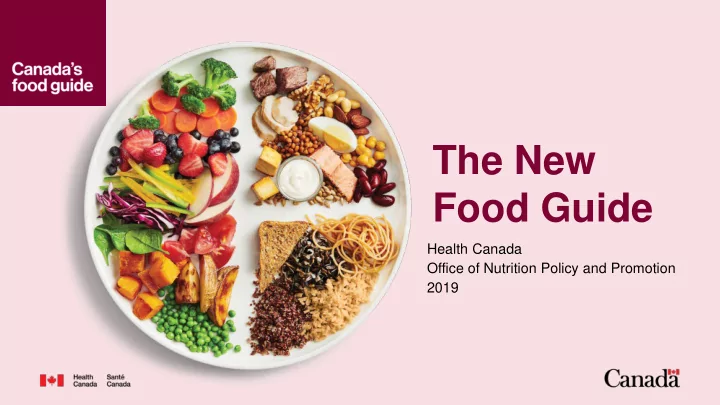
The New Food Guide
Health Canada Office of Nutrition Policy and Promotion 2019
The New Food Guide Health Canada Office of Nutrition Policy and - - PowerPoint PPT Presentation
The New Food Guide Health Canada Office of Nutrition Policy and Promotion 2019 Overview Background Evidence and engagement Whats new with Canadas Food Guide For health professionals and policy makers For
Health Canada Office of Nutrition Policy and Promotion 2019
2
3
4
Integrated widely by governments and stakeholders into nutrition policies, programs, and resources. Taught in schools and promoted by health professionals when supporting Canadians to eat well. Can help influence the foods served and sold in Canada’s public institutions from day cares and schools, to long-term care facilities, as well as the foods Canadians choose for themselves and their families.
5
Disease Risk Unhealthy diet is a primary risk factor for disease burden in Canada Complex Nutrition information can be difficult to use and understand Confusing Conflicting healthy eating messages are everywhere Credible Canadians need credible healthy eating information
6
To address challenges for users such as:
healthy meals and snacks
To ensure alignment with most current evidence on topics such as sodium, saturated fat and sugars.
7
8
The best available evidence was considered, including:
health from respected authorities including systematic reviews on over 100 food-related topics
The Evidence Review for Dietary Guidance 2015 and the Food, Nutrients and Health: Interim Evidence Update 2018, form the foundation of the new Food Guide. Industry-commissioned reports were excluded to reduce the potential for, or the perception of, conflict of interest.
9
Consulted extensively to ensure resources are evidence based, useful, and relevant to Canadians. Online public consultations with Canadians and interested stakeholders helped to identify needs and expectations. To help communicate the guidance accurately, targeted consultations were held with:
health charities
10
Submissions received during public consultations were summarized in What We Heard reports available at Canada.ca. When Health Canada senior officials met with organizations to discuss the development of the Food Guide, details including the name of the
Health Canada’s Office of Nutrition Policy and Promotion officials responsible for drafting the Food Guide did not meet with industry representatives to discuss the Food Guide.
11
User-Centred
Public opinion research and consultations to understand how healthy eating information is used
Diversity
Tested with a range of ages, household incomes, locations, education levels, and cultural backgrounds
Considerations
Determinants of health, the environment, and cultural diversity, including social, cultural and historical context
Peoples
Health Literacy
Lens applied throughout the crafting and testing of messages
12
13
The new Food Guide is an online suite of resources that better meets the needs of different users including the general public, policy makers, and health professionals. Highlights include:
healthy eating habits including cooking more often and being mindful of eating habits
including guidance on confectioneries and sugary drinks such as soft drinks, sweetened milk and juice
healthy whenever, and wherever they go
14
Available in English and French
Professionals and Policy Makers
Dietary Guidance 2015 and the Food, Nutrients and Health: Interim Evidence Update 2018
15
As part of reconciliation, the Government of Canada acknowledges that program and policy making must support self-determination, as well as recognize the distinct nature and lived experience of First Nations, Inuit and Métis. The integration of Indigenous considerations has been informed through engagement with Indigenous academics, health professionals and National Indigenous Organizations.
and historical factors that are determinants of healthy eating and that may influence the application of dietary guidance in Indigenous populations.
experience and expertise working with Indigenous populations provided input to inform the Food Guide snapshot.
16
For Health Professionals and Policy Makers For use when developing policies, programs, and educational resources. Forms the foundation for the Food Guide resources. Provides guidance on:
foundation for healthy eating
negative impact on health when consumed on a regular basis
healthy eating
17
Vegetables, fruit, whole grains, and protein foods should be consumed
Why? Patterns of eating that emphasize plant-based foods typically result in higher intakes of vegetables and fruit, nuts, soy protein, and fibre; and lower intake of processed meats and foods that contain mostly saturated fat. Eating more vegetables and fruit is linked to a lower risk of cardiovascular disease. Eating more nuts or soy protein is linked to improved blood lipid levels. Higher fibre intake is linked to improved blood lipid levels and a lower risk of cardiovascular disease, colon cancer, and type 2 diabetes. Processed meat has been linked to colorectal cancer and foods that contain mostly saturated fat are linked to unfavourable blood lipid levels and a higher risk of type 2 diabetes. Protein foods include legumes, nuts, seeds, tofu, fortified soy beverage, fish, shellfish, eggs, poultry, lean red meat including wild game, lower fat milk, lower fat yogurts, lower fat kefir, and cheeses lower in fat and sodium.
18
Foods that contain mostly unsaturated fat should replace foods that contain mostly saturated fat.
Why? Cardiovascular disease is one of the leading causes of death in Canada. Lowering the intake of saturated fat by replacing it with unsaturated fat decreases total and LDL- cholesterol. Elevated LDL-cholesterol is a well-established risk factor for cardiovascular disease. The intention is not to reduce total fat in the diet. Rather, it is to help reduce intakes of saturated fat, while encouraging foods that contain mostly unsaturated fat.
19
Water should be the beverage of choice.
Why? Water supports health and promotes hydration without adding calories to the diet. Water is essential for metabolic and digestive processes. Adequate intake is based on the total water required to prevent the effects of dehydration.
20
Processed or prepared foods and beverages that contribute to excess sodium, free sugars, or saturated fat undermine healthy eating and should not be consumed regularly.
Why? Canadians are purchasing more highly processed foods. When consumed on a regular basis, they can contribute to excess sodium, sugars, or saturated fat. These nutrients are linked to chronic disease risk when consumed in excess.
21
Considerations There are health risks associated with alcohol consumption.
Why? Alcoholic beverages can contribute a lot of calories to the diet with little to no nutritive
Alcohol can be a significant source of sodium, free sugars, or saturated fat when mixed with syrups, sugary drinks, or cream-based liquors. Well-established health risks are associated with long-term alcohol consumption, including increased risk of many types of cancer and other serious health conditions, such as hypertension and liver disease.
Foods and beverages offered in publically funded institutions should align with Canada’s Dietary Guidelines.
Why? Offering healthier options and limiting the availability of highly processed foods and beverages, such as sugary drinks and confectioneries, creates supportive environments for healthy eating.
22
Cooking and food preparation using nutritious foods should be promoted as a practical way to support healthy eating.
Why? There has been a shift from cooking meals with basic ingredients towards use of highly processed products, which requires fewer or different skills. The increased use of these products has decreased the transfer of food skills to children and adolescents. Improving food skills by cooking and preparing food at home can contribute to improved food choices and eating behaviours among Canadians of all ages. It may also make it easier for Canadians to reduce household food waste.
23
Food labels should be promoted as a tool to help Canadians make informed food choices.
Why? Food labels can help Canadians make informed food choices in various settings, such as grocery stores. Encouraging the use of food labels can be an effective strategy to promote the selection of nutritious foods and support the preparation of healthy meals and snacks.
24
Programs and policies that align with these Guidelines provide an opportunity to create supportive environments for healthy eating. Creating supportive environments across settings, such as schools, workplaces, recreation centres, and health care facilities, can help increase the influence of the Guidelines. Understanding and acting on the barriers that make it challenging for Canadians to make healthy food choices are essential for the successful implementation of the Guidelines.
25
For Canadians At-a-glance presentation of food choices and eating habits. An interactive, mobile- responsive online resource that is also printer-friendly. Online entry point to Canada’s healthy eating recommendations (slides 26- 28).
26
Eat plenty of vegetables and fruits, whole grain foods and protein foods. Choose protein foods that come from plants more often.
fat.
Examples:
quinoa
milk and fortified soy beverages
27
Make water your drink of choice.
Unsweetened drink options other than water can include lower fat white milk, plant-based beverages, coffee and tea
28
Limit highly processed foods. If you choose these foods, eat them less often and in small amounts.
ingredients that have little to no added sodium, sugars or saturated fat. Use food labels. Be aware that food marketing can influence your choices.
29
Be Mindful of Your Eating Habits.
are hungry and when you are full. Cook More Often.
and preparing meals. Enjoy Your Food.
part of healthy eating. Eat Meals with Others.
across generations and cultures.
30
31
Canada’s Food Guide is….
…an online suite of resources that better meets the needs of the general public, policy makers, and health professionals. …based on a solid foundation of evidence and recommendations are aligned with many jurisdictions and trusted health authorities. ...shifting to provide more actionable advice for Canadians on healthy food choices and healthy eating habits.
32
Canada’s Healthy Eating Pattern for Health Professionals and Policy Makers
healthy eating pattern that will provide more specific guidance
Online resources
33
Considerations for Indigenous Peoples Health Canada and Indigenous Services Canada are working with First Nations, Inuit and Métis to support the development of distinction-based healthy eating tools as part of the revision process.
34
If you wish to share messages about the Food Guide, you can access:
snapshot Content can be found at Canada.ca/FoodGuide