
SLIDE 1
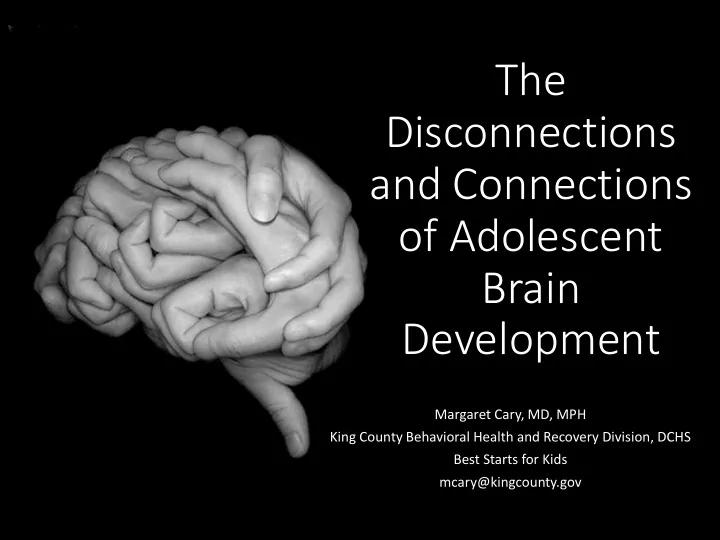
The Disconnections and Connections
- f Adolescent
Brain Development
Margaret Cary, MD, MPH King County Behavioral Health and Recovery Division, DCHS Best Starts for Kids mcary@kingcounty.gov
The Disconnections and Connections of Adolescent Brain - - PowerPoint PPT Presentation
The Disconnections and Connections of Adolescent Brain Development Margaret Cary, MD, MPH King County Behavioral Health and Recovery Division, DCHS Best Starts for Kids mcary@kingcounty.gov Disclosures No conflicts of interest or
Margaret Cary, MD, MPH King County Behavioral Health and Recovery Division, DCHS Best Starts for Kids mcary@kingcounty.gov
No conflicts of interest or financial disclosures
Cary: SBH Retreat 2 August 29, 2018
Cary: SBH Retreat 3 August 29, 2018
Cary: SBH Retreat 4 August 29, 2018
Cary: SBH Retreat August 29, 2018 5
ABCDStudy.org
Rosenberg, Nat Comm. 2018
Cary: SBH Retreat 6
EXPERIENCES:
SKILLS:
August 29, 2018
“Biological systems undergoing rapid developmental changes are especially vulnerable to disorganizing influences.”
Lenroot & Giedd, 2006
Cary: SBH Retreat 7 August 29, 2018
O’Don ‘bac nt’
4–21
Cary: SBH Retreat 8
Tau & Peterson, Neuropsychopharmacology, 2009.
August 29, 2018
Amygdala
SIGNIFICANCE (fear and anger) Hippocampus
FACT/EVENT & EMOTIONALLY SALIENT Prefrontal Cortical Regions
FUNCTION Nucleus Accumbens
OF MOTIVATION & DRIVES (pleasure)
LIMBIC SYSTEM:
(automatic function) & Neuroendocrine (stress response) Regulation
Basal Ganglia
INITIATION, POSTURAL RESPONSE, HABITS
Cary: SBH Retreat 9 August 29, 2018
Cary: SBH Retreat 10 August 29, 2018
Adolescence: Disproportional Maturation
Cary: SBH Retreat 11
Casey, Dev Rev. 2008.
Limbic regions: emotional reactions, social connection
: motivation (sex, drugs, rock ‘n roll)
August 29, 2018
Adolescence: Burgeoning Ability to Pursue Goals
Cary: SBH Retreat 12
d‘: capacity to discriminate, select, and execute correct response
Insel, Nat Comm. 2017. August 29, 2018
Gardner & Steinberg, Dev Psychology, 2005.
Cary: SBH Retreat 13 August 29, 2018
regions and emotionally & socially responsive regions
social connection
Cary: SBH Retreat 14 August 29, 2018
Cary: SBH Retreat 15
EXPERIENCES:
SKILLS:
August 29, 2018
“A cell is a machine for turning experience into biology.”
Steve Cole, quoted in Dobbs, The social life of genes. Pacific Standard, 2014. Cary: SBH Retreat 16 August 29, 2018
independent & Experience dependent processes
experience
Cary: SBH Retreat 17 August 29, 2018
strengthening
empathy
maturation
Cary: SBH Retreat 18
The Creation of Crow, Bartow
August 29, 2018
Impact of Adversity and Trauma
Cary: SBH Retreat 19 August 29, 2018
“Responsive relationships are developmentally expected and biologically essential.”
Harvard Center on the Developing Child: Working Paper 12: The Science of Neglect
Impact of Trauma and Adversity
Cary: SBH Retreat 20
Andersen & Teicher. Trends in Neurosci, 2008.
August 29, 2018
Impact of Resilience, Post-Traumatic Growth, Culture, Connection
Cary: SBH Retreat August 29, 2018 21
Cary: SBH Retreat 22 August 29, 2018
Cary: SBH Retreat 23
Help me understand you? What are you up to?
August 29, 2018
Cary: SBH Retreat 24
Curiosity, connection, collaboration Problem solving
August 29, 2018
Strike when the iron is cold
Cary: SBH Retreat August 29, 2018 25
Cary: SBH Retreat August 29, 2018 26
Cary: SBH Retreat August 29, 2018 27
Cary: SBH Retreat 28
From the Mad River to the Little Salmon River, or The Responsibility of Raising a Child. Bartow
August 29, 2018