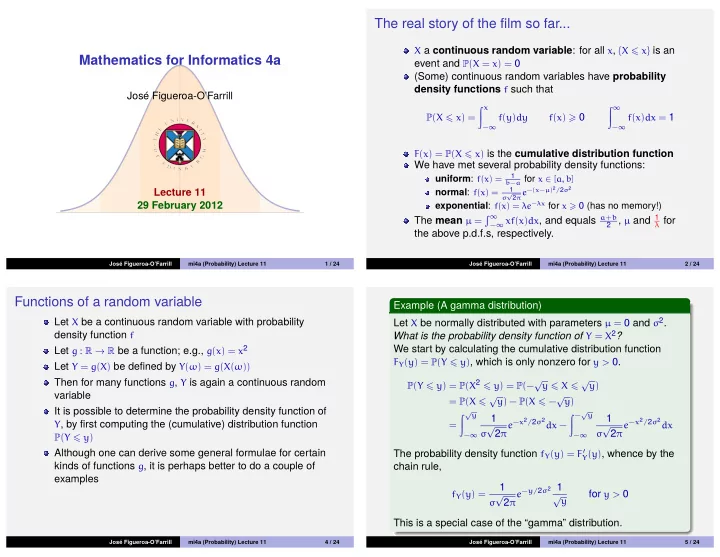

SLIDE 1
Mathematics for Informatics 4a
Jos´ e Figueroa-O’Farrill Lecture 11 29 February 2012
Jos´ e Figueroa-O’Farrill mi4a (Probability) Lecture 11 1 / 24
The real story of the film so far...
X a continuous random variable: for all x, {X x} is an
event and P(X = x) = 0 (Some) continuous random variables have probability density functions f such that
P(X x) = x
−∞
f(y)dy f(x) 0 ∞
−∞
f(x)dx = 1 F(x) = P(X x) is the cumulative distribution function
We have met several probability density functions:
uniform: f(x) =
1 b−a for x ∈ [a, b]
normal: f(x) =
1 σ √ 2πe−(x−µ)2/2σ2
exponential: f(x) = λe−λx for x 0 (has no memory!)
The mean µ =
∞
−∞ xf(x)dx, and equals a+b 2 , µ and 1 λ for
the above p.d.f.s, respectively.
Jos´ e Figueroa-O’Farrill mi4a (Probability) Lecture 11 2 / 24
Functions of a random variable
Let X be a continuous random variable with probability density function f Let g : R → R be a function; e.g., g(x) = x2 Let Y = g(X) be defined by Y(ω) = g(X(ω)) Then for many functions g, Y is again a continuous random variable It is possible to determine the probability density function of
Y, by first computing the (cumulative) distribution function P(Y y)
Although one can derive some general formulae for certain kinds of functions g, it is perhaps better to do a couple of examples
Jos´ e Figueroa-O’Farrill mi4a (Probability) Lecture 11 4 / 24
Example (A gamma distribution) Let X be normally distributed with parameters µ = 0 and σ2. What is the probability density function of Y = X2? We start by calculating the cumulative distribution function
FY(y) = P(Y y), which is only nonzero for y > 0. P(Y y) = P(X2 y) = P(−√y X √y) = P(X √y) − P(X −√y) = √y
−∞
1
σ √
2π
e−x2/2σ2dx − −√y
−∞
1
σ √
2π
e−x2/2σ2dx
The probability density function fY(y) = F′
Y(y), whence by the
chain rule,
fY(y) =
1
σ √
2π
e−y/2σ2 1 √y
for y > 0 This is a special case of the “gamma” distribution.
Jos´ e Figueroa-O’Farrill mi4a (Probability) Lecture 11 5 / 24