
SLIDE 1
DBS Database Systems The Relational Model, the Relational Algebra and SQL
Peter Buneman 5 Oct, 2010
The Relational Model – an Introduction
This 30-year old model is by far the most popular, but not the first, “logical” approach to databases. In these lectures we are going to discuss relational query languages. We’ll discuss a “theoretical language”: relational algebra and then SQL. The “theoretical” language is not useless. To implement and optimize SQL we use relational algebra as the “internal” language.
DBS 2.1
What is a relational database?
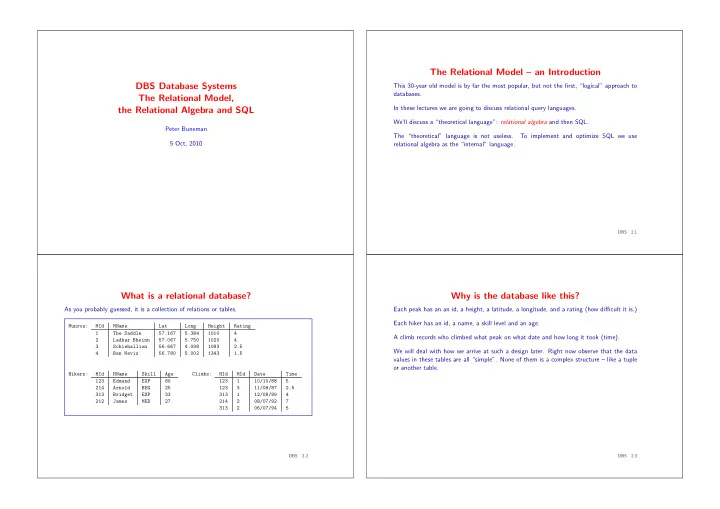
As you probably guessed, it is a collection of relations or tables.
Munros: MId MName Lat Long Height Rating 1 The Saddle 57.167 5.384 1010 4 2 Ladhar Bheinn 57.067 5.750 1020 4 3 Schiehallion 56.667 4.098 1083 2.5 4 Ben Nevis 56.780 5.002 1343 1.5 Hikers: HId HName Skill Age 123 Edmund EXP 80 214 Arnold BEG 25 313 Bridget EXP 33 212 James MED 27 Climbs: HId MId Date Time 123 1 10/10/88 5 123 3 11/08/87 2.5 313 1 12/08/89 4 214 2 08/07/92 7 313 2 06/07/94 5
DBS 2.2
Why is the database like this?
Each peak has an an id, a height, a latitude, a longitude, and a rating (how difficult it is.) Each hiker has an id, a name, a skill level and an age. A climb records who climbed what peak on what date and how long it took (time). We will deal with how we arrive at such a design later. Right now observe that the data values in these tables are all “simple”. None of them is a complex structure – like a tuple
- r another table.
DBS 2.3