SLIDE 1
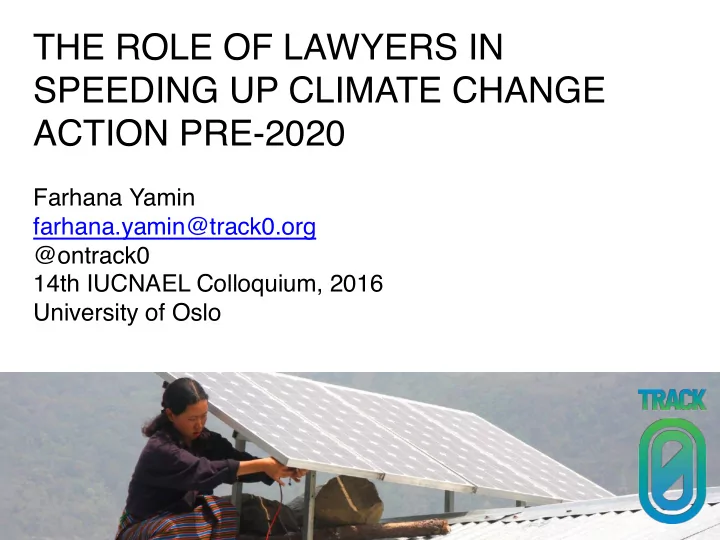
THE ROLE OF LAWYERS IN SPEEDING UP CLIMATE CHANGE ACTION PRE-2020
Farhana Yamin farhana.yamin@track0.org @ontrack0 14th IUCNAEL Colloquium, 2016 University of Oslo
SLIDE 2 4 Suggestions
Celebrate Paris Agreement – miracle of multilateralism Educate in-house counsel: climate risks are their problem Use courts & tribunals: litigation works! Forge new alliances: SDGs apply to all & create
- pportunities & challenges & for all
SLIDE 3
Paris Agreement
SLIDE 4 Paris Summit: Why was it significant?
- 150 leaders - the biggest gathering of leaders in history on
any subject: each gave personal commitment to climate action
- 30,000 + attendees at COP 21 itself
- Many initiatives driven by business, cities, NGOs generating
action:
- 114 companies committed to set emissions-reduction targets in line
with what the science says is necessary to limit warming to 2 degrees C;
- 53 companies pledged to transition to 100 percent renewable
power;
- America’s six largest banks issued a statement in support of a
global climate agreement;
- 365 companies applauded EPA’s emissions standards for U.S.
power plants;
- More than 1,000 companies are already pricing carbon internally or
plan to in the next couple years.
SLIDE 5
What was at Stake?
SLIDE 6
Small nations had to play a big role…
Source: Climatehome: 16/12/15
SLIDE 7
High Ambition Coalition
Who was in it?
– A ministerial coalition between rich & poor, to support the Presidency in delivering the highest ambition deal in Paris – Based on many alliances/networks but pulled together by RMI in run up to and at Paris
Why was it needed?
– Support for the French Presidency – Party led negotiations – political deals needed to be made by Parties – Unity & end game process/rules of procedure
What difference did it make? Key to getting a deal that is:
– science-based & has 1.5/LTG of net zero by mid-century at its heart (direction of travel) – Entrenches domestic & international 5 year political cycle to ratchet up commitments (pace of travel & joined up national processes) – Keep political balance & pursue not just cuts but also on adaptation/ loss & damage and financing
SLIDE 8 Summary of Paris Agreement
- Adaptation, Finance & Global Temperature Goal: (Article 2)
- Global decarbonisation goal, progression & pace provisions: NDCs and
upwards progression/5 year ratchet mechanism (Article 4)
- Forest/land use (Article 5) & International offsets/trading (Article 6)
- Adaptation (Article 7)
- Loss & Damage (Article 8) – with exclusion of Liability & Compensation
- Finance (Article 9) & Technology (Article 10), Capacity Building (Article 11) &
Education (Article 12)
- Transparency requirement re GHG emissions & financial support (Article 13)
- 5 year global stocktakes (Article 14) - starting 2018 then in 2023
- Compliance ((Article 15) & Entry into Force (Article 21)
- Non state actors – enhanced role of business, cities, civil society (Decision
1/CP.1, paras 117 – 133)
SLIDE 9 Global Goal of 2/1.5ºC
Temperature Limit
Article 2: 1.This Agreement…aims to strengthen the global response to the threat
- f climate change, in the context of sustainable development and efforts
to eradicate poverty, including by: (a) Holding the increase in the global average temperature to well below 2 °C above pre-industrial levels and to pursue efforts to limit the temperature increase to 1.5 °C above pre-industrial levels, recognizing that this would significantly reduce the risks and impacts of climate change; 2 major wins in Paris:
- Securing support for 1.5ºC temperature limit from all Parties; this
secures survival pathway for SIDS & require rapid decarbonisation in line with the science
- Securing a special report from the IPCC on the impacts of and
emissions pathways for 1.5ºC by 2018
SLIDE 10 Decarbonisation or
Net Zero Emissions Goal
- The temperature limit of 2/1.5ºC frames the pathway as one that
requires global decarbonisation or net zero emissions early in the second half of the century Article 4 sets out this long-term decarbonization goal:
- 1. In order to achieve the long-term temperature goal set out in Article
2, Parties aim to reach global peaking of greenhouse gas emissions as soon as possible…and to undertake rapid reductions thereafter…so as to achieve a balance between anthropogenic emissions by sources and removals by sinks of greenhouse gases in the second half of this century.”
- Staying below 1.5ºC requires global emissions to be net zero by around
2040-2060 – or by mid-century
- Paris Agreement sends strong signal that we are working towards the
end of the fossil fuel era, and that developed countries must rapidly
- decarbonise. It also means developing countries avoid locking in high
fossil fuel based future and meeting growing energy needs with renewable forms of energy.
SLIDE 11
Nationally Determined Contributions (NDCs) – Mandatory every 5 years
Article 4 (2) “Each Party shall prepare, communicate and maintain successive nationally determined contributions that it intends to achieve. Parties shall pursue domestic mitigation measures, with the aim of achieving the objectives of such contributions” (3) Each Party’s successive nationally determined contribution will represent a progression beyond the Party’s then current nationally determined contribution and reflect its highest possible ambition, reflecting its common but differentiated responsibilities and respective capabilities, in the light of different national circumstances.”
SLIDE 12 Adaptation (Article 7)
- The Paris Agreement establishes a global goal of
“enhancing adaptive capacity, strengthening resilience and reducing vulnerability to climate change”, linking reduced impacts to early decarbonisation
- And a national obligation to engage in “adaptation planning
processes”.
- Inclusion of a global goal on adaptation in Paris shows
recognition that adaptation to climate impacts is seen as a big priority
- The UNFCCC “institutional arrangements” for adaptation
action will be reviewed in 2017, and likely be strengthened.
SLIDE 13 Loss and Damage (Article 8)
Contentious issue at Paris but included thanks to SIDS/LDCS! The Paris Agreement anchors and extends the Warsaw International Mechanism, paving the way to address (“through cooperation & support”) impacts from extreme and slow-onset climate events that cannot be adapted to (e.g. loss of ecosystems, fish stocks and even territory). Recognition of L & D very important. Paris Decision para 48: “Decides on the continuation of the Warsaw International Mechanism for Loss and Damage associated with climate change impacts…” Paris Decision para 49: “Requests the executive Committee of the Warsaw International Mechanism to establish a clearinghouse for risk transfer that serves as a repository for information and insurance and risk transfer, in
- rder to facilitate the efforts of Parties to develop and implement
comprehensive risk management strategies.” Paris Decision para 52 Agrees that Article 8…does not involve or provide a basis for any liability or compensation
SLIDE 14 Finance (Article 9)
Technology (Article 10)
- The Paris Agreement extended to 2025 the
current goal of mobilizing $100 billion a year in climate finance for developing countries by 2020.
- A higher goal will be set for the period after 2025
as “Such mobilization of climate finance should represent a progression beyond previous efforts.” (Art 9(3))
- The UN Green Climate Fund (GCF) will be a
main channel for delivery of this support.
SLIDE 15 2020 2019 2018 2017 2016 2025 2024 2023 2022 2021 Facilitative Dialogue (Progress towards mitigation LTG) Global Stocktake (Progress on mitigation, adaptation & support) Countries submit new
2030 horizon Countries submit new NDC with 2035 horizon Facilitative Dialogue (pre-2020 finance & mitigation ambition)
Political moments for raising ambition Decision points on key technical & institutional foundations
Review of Warsaw International Mechanism (WIM) Review of adaptation institutions
COP 22 COP 23 COP 24 COP 25 COP 26 COP 27 COP 28 COP 29 COP 30 COP 31
Adopt accounting modalities for public finance Review of capacity building committee
UNFCCC Negotiations: Forward Look
Adoption of the rules & modalities for - the global stocktake; scope of future NDCs; the compliance committee; market mechanisms; transparency of action & support (MRV); and recommendations on mobilisation of support - will occur at the first session of the meeting of the Parties to the Paris Agreement, which could be held at any time, but will likely be in 2020.
SLIDE 16 Assessing The Paris Agreement
Strengths
- Universal: All Parties to take
action
- Strong signals to markets: global
goal of 2/1.5; decarbonisation & goals of adaptation & finance
- Upward ambition: progression of
NDCs & finance over time
- Transparency: 2 year reports/5
year stocktakes, SIDS/LDCs leeway, these moments will drive action
- Mobilization & engagement of
new actors: new role & mechanism for non-state actors & education/public participation/CB to underpin implementation
Weaknesses
- NDCs; commitments based on
national circumstances may never add up to 2/1.5 pathways
- Weak goals & commitments:
many rules are mainly procedural
- r else not defined precisely
enough for enforcement
- Tough negotiations ahead: e.g.
transparency rules key but remain to be developed. May prove contentious/not complied with
facilitative approach likely to be agreed as mechanisms develop
- Uncertainty: when will entry into
force happen; US elections & litigation re Clean Air Act
SLIDE 17
Educate In-House Counsel: Climate Risks for Every Business, Supply Chain and Investment
SLIDE 18
ET Carbon Rankings
SLIDE 19
Companies carbon footprints & exposure of portfolios to carbon/ stranded assets
SLIDE 20
Courts & Tribunals: Cases Happening Worldwide
SLIDE 21 Urgenda Foundation v
The Netherlands
Plaintiff: Urgenda Foundation (a non-profit
- rganisation) and 900 Dutch
citizens Defendant: Dutch government Order given: 24 June 2015 (decision appealed by Dutch government)
SLIDE 22
Future Generations: Juliana v US
21 young people invoking constitutional rights to life, liberty & property rights & public trust doctrine Demand for declaration & emissions reductions based on science based timeframes
SLIDE 23
Foster v Washington Department of Ecology
Plaintiff: Zoe and Stella Foster Defendant: Washington State Department of Ecology Order given: 23 June 2015
SLIDE 24
Anpier, in collaboration with Greenpeace
Inspired by Urgenda, The Spanish National Association of Photovoltaic Energy Producers (Anpier) , with the help of lawyer Juan Castro Gil, are fighting to ensure that the government reimburse promised rates to photovoltaic producers.
SLIDE 25
Welsh village, Fairbourne:
Potential Case?
Property Blight – Possible case Welsh village to sue UK government over 'alarmist' rising sea level claim Residents of Fairbourne, in Gwynedd, say predictions that the sea level will rise by a metre a year have hit house prices and investment, Reported in The Telegraph, 11 Feb 2016
SLIDE 26 Leghari v Pakistan
Plaintiff: Ashgar Leghari Defendant: Federation
Orders given: 4 September 2015 & 2016
SLIDE 27
Saul Luciano Lliuya v RWE
Plaintiff: Saul Luciano Lliuya Defendant: RWE (a German utility company and Carbon Major) Ongoing
SLIDE 28
International Courts & Tribunals
SLIDE 29
ICJ Advisory Opinion?
Description
SLIDE 30
Forging New Alliances:
Sustainable Development Goals
SLIDE 31
SLIDE 32 April 2016 -
UN High Level Event on SDGs and Paris Agreement Signature Ceremony Most developing countries now deciding how to integrate implement Paris, SDGs and Sendai Framework
- n DRR together. Most developed
countries not joining up policy- making and working in silos re climate change, security, migration and disasters
Mashall Islands’ President Hilda Heine signing Paris and speaking on SDGs, April 2016
SLIDE 33
SLIDE 34
Key issues for Marshall Islands:
how SDGs, climate action and
survival will be integrated & balanced?
– Droughts – King tides – Health issues – Social security – Banking – Fisheries – Shipping – Sea level rise & migration & existential issues – And limited capacity & access to finance
SLIDE 35
Thank You
Farhana Yamin farhana.yamin@track0.org track0.org @ontrack0 Track 0 is an independent not-for-profit, which serves as a hub to support all those working to get green house gas emissions on track to zero.