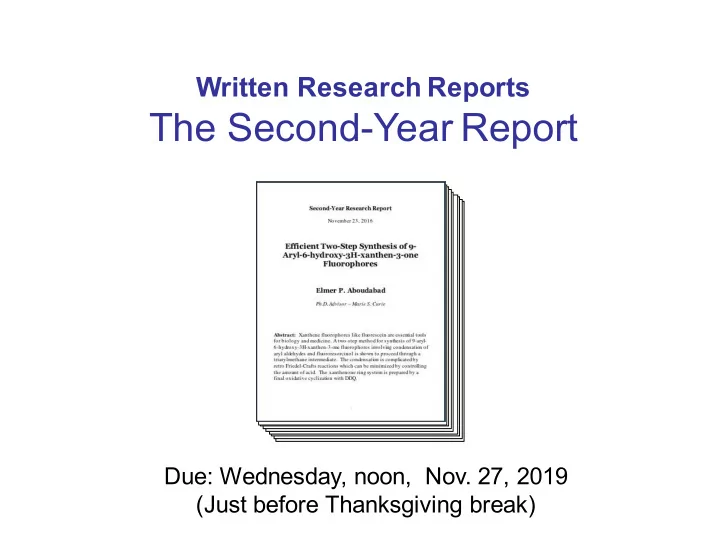
The Second-Year Report Due: Wednesday, noon, Nov. 27, 2019 (Just - - PowerPoint PPT Presentation
Written Research Reports The Second-Year Report Due: Wednesday, noon, Nov. 27, 2019 (Just before Thanksgiving break) Six Basic Requirements for a Ph.D. in Chemistry http://www.chem.uci.edu/ 1. Completion of a minimum of seven approved
Six Basic Requirements for a Ph.D. in Chemistry
http://www.chem.uci.edu/
- 1. Completion of a minimum of seven
approved courses with maintenance of an average grade of B or better.
- 2. Completion of a second-year Written
Examination.
- 3. Completion of an Oral Examination for
Advancement to Candidacy.
- 4. Completion of the teaching
requirement (four quarters).
- 5. Completion of six quarters in residence
at UCI.
- 6. Submission of an acceptable doctoral
dissertation.
Year 1
- Fall
- Winter
- Spring
- Summer
Year 2
- Fall
- Winter
- Spring
- Summer
Years 3-
Y2R Courses Orals
GOAL OF THE 2ND-YEAR WRITTEN EXAMINATION
https://www.chem.uci.edu/graduate/current-students
PREPARE PUBLICATION-READY MANUSCRIPTS
Generally, you will compile:
- 1. Descriptive Title + Abstract
- 2. Introduction
3.a. Results and
- b. Discussion
- 4. Conclusions and Future Work
- 5. Scholarly References
- 6. Experimental Section
- 7. Supporting Information
Organization of the Research Report Second-Year Report and Orals
≤10 pages combined or separate
- 1. Satisfactory research progress
What are we looking for in a Second-Year Report?
- Fully characterized products
- Yields for many, many reactions
- Purified proteins or peptides
- Developed and validated new assays
Scholarly Background
- Why is the project important to society?
- What was done in the past?
- What is the gap in technology/knowledge that needs to be
filled? Research
- What obstacles did you overcome?
- If you worked with someone else, which accomplishments
are yours?
- Future goals
- 2. A written document that communicates effectively
- I can not overemphasize the importance of making
significant research progress.
- A well written report identifies challenges you faced
- unstable compounds, poor protein expression, low
transformation efficiencies, difficulties in purification, assay (ir-reproducibility).
- Faculty understand the difference between lack of
effort and challenging projects. About Research Progress on the Second-Year Report
condns O EtO CN O O HO CN O 6 7 yield 7 conditions 0% 1 M HCl, 100 °C 0% 0.1 M H2SO4, 100 °C 0% 0.05 eq. p-TsOH, 100 °C 0% 1 M KOH/EtOH, 25 °C 0% 6 M HCl, 100 °C 0% (S.M.)
- C. ligrea lipase, phosphate buffer, 25 °C
0% (S.M.) 0.1 M acetic acid, H2O/dioxane, 25 °C 0% 0.1 M acetic acid, H2O/dioxane, 100 °C
Explain WHY it didn't work:
- Identify the side-products.
- Look up reactivity of
similar functional groups.
this doesn't demonstrate thinking
Experimental and Characterization Data
http://pubsapp.acs.org/paragonplus/submission/joceah/joceah_authguide.pdf?
See: "Author Guidelines."
- The Journal of Organic Chemistry
- ACS Chemical Biology
- 1. Follow the standards of the community
- 2. Follow the standards of your research group
- See perfected research reports from senior students.
- See published papers from your group
- See dissertations from your group
Experimental and Characterization Data
- I. WHAT YOU GOT (e.g., ... 36.2 mg of diene 43 (3:1 E/Z) as a yellowish solid.)
- A. Yield. Significant figures should match measured reagents.
- 1. Isolated mass
- 2. Spectroscopic/chromatographic peak ratios versus an internal standard
- B. Stereoisomeric ratios
(e.g., (±)-2-hydroxybut-3-ene, 4:1 E/Z, 95:5 syn/anti, 74% ee)
- C. Physical state (for solids, include a m.p.)
- D. Rf and eluant system
- II. EVIDENCE FOR IDENTITY AND PURITY (J. Org. Chem. Dec, 2018)
http://pubsapp.acs.org/paragonplus/submission/joceah/joceah_authguide.pdf?
- A. Evidence for IDENTITY (chemical structure and stereochemistry)
1.1H NMR and 13C NMR http://pubsapp.acs.org/paragonplus/submission/acs_nmr_guidelines.pdf?
- 2. HRMS or ElementalAnalysis to support molecular formula
- 3. IR absorptions of distinctive functional groups (C=O), O-H, sp C-H, et
- II. EVIDENCE FOR IDENTITY AND PURITY (J. Org. Chem. Dec, 2018)
- B. Degree of and Evidence of PURITY
The Journal of Organic Chemistry requires "that the purity level that has been attained be faithfully documented. When new
- r
known synthesized compounds are the study materials for physical measurements or bioassays, a purity level of at least 95% needs to be documented."
- 1. 1H NMR spectrum with all peaks integrated (0-10 ppm)
- 2. Combustion Analysis (%C, %H, %N)
- 3. Narrow melting point range when matching known solids
Experimental and Characterization Data
Selective Analysis of 1H NMR Spectra?
HN O O CH3 O O CH3 H3C CH3 OH MW: 219.23
Algebra: Derive Wt% from NMR Mole Ratios
HN O O CH3 O O CH3 H3C CH3 OH MW: 219.23 O O MW: 88.11 m x 219.23 g/mol + n x 88.1g/mol = 3.61 g n m = 5 95 n = 0.00085 moles EtOAc 75 mg EtOAc n = mole EtOAc; m = mole product 3.54 g product + 2 equations 2 unknowns from NMR corrected yield = 87.8%
- vs. uncorrected yield = 89.5%
An Accurate Honest Description
HN O O CH3 O O CH3 H3C CH3 OH MW: 219.23
Alternative writeup: …After the solvent removal, the residue was purified with gel column chromatography (EtOAc/petrol ether, 1:5). After evaporation of solvent, compound 25 was obtained as a pale yellow oil (3.61 g) containing a small amount (5 mol%, 2.1 wt% by 1H NMR) of ethyl acetate (88% yield of 25).
0.11 0.15 0.17
Characterization of New Biological Substances Identity and Homogeneity
- Identity = the sequence of an oligonucleotide, gene, or protein
- Homogeneity = usually means only one type of biooligomer
Biologists rarely account for water content, buffer molecules, or ions. An enzyme might be considered “pure” even if contaminated with DNA, as long as they don’t affect the biological activity.
- ACS Chemical Biology: “Provide evidence to firmly establish both the
identity and the purity of new substances. The criteria vary according to substance categories but may include electrophoretic, chromatographic, spectrometric, spectroscopic, crystallographic, or
- ther analytical methods. Supply sequencing or functional data for all
biological constructs, such as fusion proteins, plasmids, etc.”
Exceptions to Standard Characterization
- Sensitive (unstable) compounds
Explain their reactivity (thermal ring-opening, oxygen autoxidation, acid-sensitivity). Estimate the final level of purity and offer convincing evidence of the chemical structure. You can convert it to a stable, characterizable derivative. Consult with your advisor in these situations.
- Unexpected chemical structures:
Require more detailed characterization.
N NH3+ Cl- O H2N t-Bu CoCl2 O H N Cl t-Bu 23c
- The spelling should be perfect.
- The grammar should be perfect.
- The references should be perfect with perfect formatting,
perfect spelling, and perfect scholarship.
- The layout should be perfect.
Evaluation Criteria for the Second-Year Research Report Your report should be perfect.
- Consistent fonts
- Consistent structure drawing settings
- Consistent orientation of chemical structures
- Drawings should appear professional
- Key features should be clearly labeled
- Easily readable font sizes should be chosen
- Writing or figures from other sources should be clearly
referenced.
Java-Based Experimental Data Checker OnLine Version at: http://www-jmg.ch.cam.ac.uk/tools/magnus/checker.html
- S. E. Adams, J. M. Goodman, R. J. Kidd, A. D. McNaught, P. Murray-Rust, F. R. Norton, J. A. Townsend and C. A. Waudby
- Org. Biomol. Chem. 2004, 2, 3067-3070.
- 1. Read a perfected report and a from a senior student and
look at some completed Ph.D. theses from your group. 2. Talk about the report with a senior lab member and your advisor 3. Get help. Have senior students and your advisor read
- ver it.
4. Consult the UCI Department of Chemistry web page on Graduate Advising Information. Advice For Preparation
https://www.chem.uci.edu/Graduate-Advising
Blah, blah blah…
posted down here
Who Reviews the Second-Year Report?
http://www.zimbio.com/pictures/5x5E8YrFYpd/Senate+Com mi ttee+Hearing+Banking+Industy+ Subprime/2Gq EyPMOwGG/Donald+ Kohn
- The second-year report is assigned for review by two
faculty referees, much like a manuscript or grant application.
- Your Ph.D. advisor does not review your report.
- Each faculty member reviews 2-4 reports, depending on
the number of reports to be reviewed.
- Faculty meet to discuss their reviews, identify weak and
strong students, and determine the outcome.
- 1. Research Progress
Is student making satisfactory progress in their research?
- 2. Clarity of presentation
- a. Introduction: Have the problem and the current state of knowledge
been clearly defined?
- b. Results: Are results clearly presented? Did you distinguish your
accomplishments from those of coworkers?
- c. Discussion: Are the conclusions supported by the data?
- d. Future Goals: Is there a plan to circumvent problems or capitalize on
key findings?
- e. Experimental Procedures: Are compounds characterized with
respect to identity and purity? Details are important. Format is important.
- f. Literature Cited: Is literature cited generously? Are correct formats
employed?
- g. Supporting Information: Are the data accurately and clearly
portrayed?
Evaluation Criteria for the Second Year Report
How is the Second-Year Report Reviewed?
Two faculty members will be assigned the report as primary readers.