The Separation of Different Mass Groups AI & unsupervised - - PowerPoint PPT Presentation

the separation of different mass groups
SMART_READER_LITE
LIVE PREVIEW

The Separation of Different Mass Groups AI & unsupervised - - PowerPoint PPT Presentation

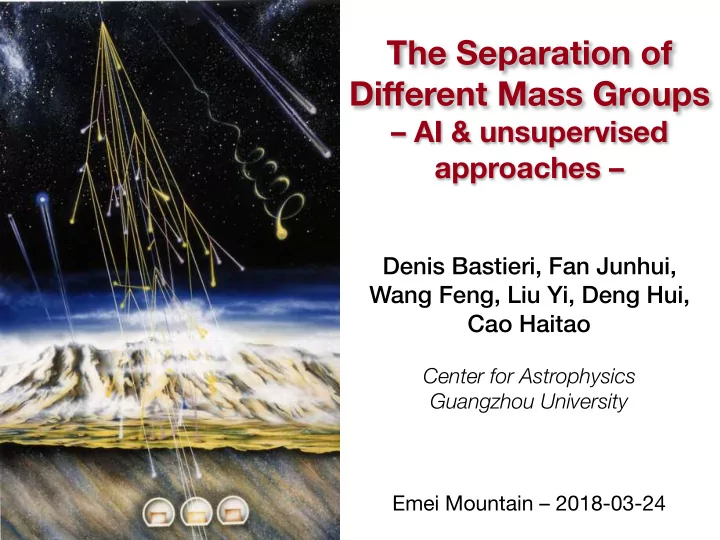
The Separation of Different Mass Groups AI & unsupervised approaches Denis Bastieri, Fan Junhui, Wang Feng, Liu Yi, Deng Hui, Cao Haitao Center for Astrophysics Guangzhou University Emei Mountain 2018-03-24


slide-1
SLIDE 1

The Separation of Different Mass Groups

– AI & unsupervised
 approaches –

Denis Bastieri, Fan Junhui,
 Wang Feng, Liu Yi, Deng Hui,
 Cao Haitao


 Center for Astrophysics
 Guangzhou University Emei Mountain – 2018-03-24

slide-2
SLIDE 2
  • D. Bastieri, LHAASO@Emei, March 24, 2018

Measuring nuclear mass at ground level

2

  • Indirect measurement, heavily relying on Montecarlo.
  • Inelastic cross-section is proportional


to A⅔, so that light nuclei penetrates
 deeper into our atmosphere.

  • In addition, as A increases, so does Z,


and the number of μ produced.
 (prob. maybe skewed by toy-MC…)

  • So there are mainly two effects as


A increases:

  • the shower ripes earlier, and at lower altitudes it is then smother,
  • the number of μ produced increases,

⇒ muons carry large transverse momenta, depleting the core.

E =100 TeV light
 nucleus heavy
 nucleus

slide-3
SLIDE 3
  • G. Di Sciascio, Padova, Jan. 31, 2018

Composition at the knee: KASCADE

3

Astroparticle Physics 24 (2005) 1 Astroparticle Physics 31 (2009) 86

from the analysis of the nearly vertical shower set: The knee is ob- served at an energy around 5 PeV with a change of the index Dc 0:4. Considering the results of the mass group spectra, in all analyses an appearance of knee-like features in the spectra of the light elements is ascertained. In all solutions the positions of the knees in these spectra is shifted to higher energy with increasing element number.

The knee in the all-particle spectrum is due to the bending of the light (proton) component

energy E [GeV ]

2

10

3

10

4

10

5

10

6

10

]

1.7

GeV

  • 1

sr

  • 1

s

  • 2

[m

2.7

E dJ/dE .

3

10

4

10

5

10

AMS BESS Caprice Ryan HEGRA Sokol-2 JACEE RUNJOB Tibet

KASCADE proton, SIBYLL 2.1 analysis KASCADE proton, QGSJet 01 analysis

proton spectrum

sea level

primary energy E [GeV]

6

10

7

10

8

10

]

1.5

GeV

  • 1

sr

  • 1

s

  • 2

[m

2.5

E . dJ/dE

1 10

2

10

3

10

4

10

proton helium carbon

QGSJet 01

primary energy E [GeV]

6

10

7

10

8

10

]

1.5

GeV

  • 1

sr

  • 1

s

  • 2

[m

2.5

E . dJ/dE

1 10

2

10

3

10

4

10 SIBYLL 2.1

proton helium carbon

slide-4
SLIDE 4
  • G. Di Sciascio, Padova, Jan. 31, 2018

Composition at the knee: KASCADE

4

13

10

J(E) (m

2.5

Scaled flux E

13

10

14

10

15

10

16

10

RHIC (p-p)

  • p)

γ HERA (

energy E [GeV]

6

10

7

10

8

10

]

1.5

GeV

  • 1

sr

  • 1

s

  • 2

[m

2.5

E dN/dE

1 10

2

10

3

10

4

10 QGSJet 01

silicon iron

19

10

20

10

γ

energy E [GeV]

6

10

7

10

8

10 SIBYLL 2.1

silicon iron

The knee in the all-particle spectrum is due to the bending of the light (proton) component Helium or carbon the most abundant element at knee

▼ KASCADE ▲ KASCADE-Grande Fe H He - Si

M.B. Comptes Rendus (2014)

Energy threshold ≈ PeV

slide-5
SLIDE 5
  • D. Bastieri, LHAASO@Emei, March 24, 2018

Toy Montecarlo

5

  • Used CORSIKA as installed with corsika+simtel-array (CTA)
  • Simulated 10,000 p at 10 TeV (and saved only electrons and muons).


Height of first interaction 14,410 m s.l.m.

  • Z ~ Schimmerling & al. model (2004)
  • A ~ simulated to be within band of stability:


used to compute the height of first interaction.

  • Superposition: nucleus behaving as A protons


interacting from the height of first interaction
 (protons randomly picked from the pool of
 simulated protons)

  • Shower sampled at 4,410 m s.l.m
  • Removed 20% of hits (to simulate efficiency)
  • Known issues: p cascades differently at different


heights and many others…

slide-6
SLIDE 6
  • D. Bastieri, LHAASO@Emei, March 24, 2018

Dichromatic images

6

  • The idea is to use a dichromatic image, using for the red channel the density
  • f muons and for the green channel the density of electrons.
  • The array side extends ±40 m for


a quick cross-check with ARGO.

  • Hits saturated at 8 bits


(almost no bias) for electrons.

  • Densities computed in bins of


area, results smoothed, 22 bins


  • n side ~2× finer than ARGO.
  • Images are 22 × 22 pixels,


upsampled to 32 × 32 pixels for
 a faster implementation (as I had
 already a working FCN).

  • FCN (Fully Convolutional


Network) handed using cuDNN
 and NVIDIA/DIGITS.

slide-7
SLIDE 7
  • D. Bastieri, LHAASO@Emei, March 24, 2018

Results

7

  • Simulation in fair agreement with ARGO.
  • Need to revise some potential issues in simulation (CR composition in Z and A,

height of first interaction, longer range of interactions for nucleons in the Superposition technique, differences between p and n…)

  • Results optimized to give 26


for xxFe. Data were rounded
 to the next integer.

  • Artifacts need to be understood.
  • No bkg in simulation


¿abnormal waist at Z = 1?

  • Graph doesn’t show the

  • ccupancy of each dot!
  • Still, the analysis shows some


promising trends!

Real Z Reconstructed Z