SLIDE 1
The story of a veteran
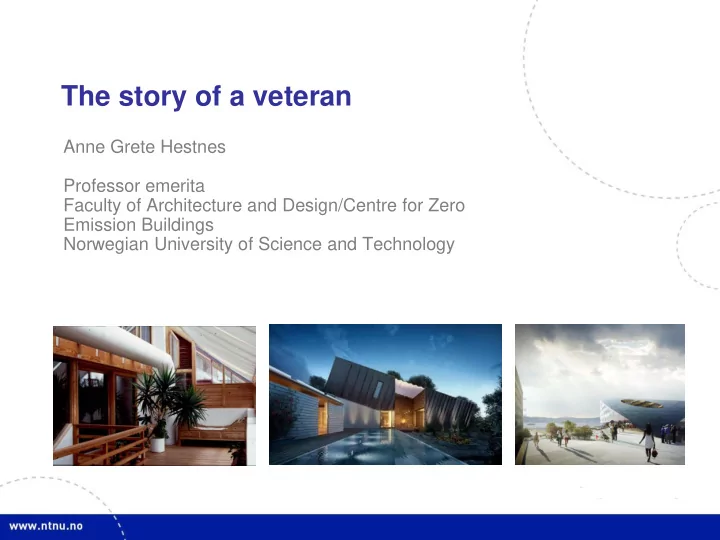
Anne Grete Hestnes Professor emerita Faculty of Architecture and Design/Centre for Zero Emission Buildings Norwegian University of Science and Technology
SLIDE 2
My career in solar
Refuge du Gouter, France 1977: Hired at a Norwegian research institute (SINTEF) to design Norway’s first solar house 1982 (?): Served as chairman of the Norwegian Solar Energy Association (four terms) Attended my first ISES Board meetings (as observer, representing the Norwegian association) 1985: Awarded a full professorship in architecture at the Norwegian University of Science and Technology (specialization – energy use in buildings) 1998-2000:President of ISES Europe 2001-2003: President of ISES 2011: Received the Farrington Daniels Award (for “contribution to the advancement and knowledge of energy conservation and solar energy in the built environment”) Other relevant activities: Chairman of the conference North Sun’92 International chairman of Eurosun 2000 Scientific chairman of Eurosun 2002 Associate and guest editor of Solar Energy (1996-2006) Project leader (Operating Agent) for IEA’s Solar Heating and Cooling Programme’s Task 13 and Task 23 (1988-2002)
SLIDE 3 My professional story –
in line with the story of solar in Norway
- from systems based on air to systems based on
water to photovoltaics
- from passive solar to active solar to hybrid
systems to solar buildings
- from single technologies to whole building
design
- from solar buildings to solar architecture
- from passive solar to zero emission buildings
and neighborhoods and Solar Cities?
SLIDE 4
At the start:
Sunspaces and atria
Amenity value more important than energy savings
Dwelling at 63oN - Malvik IEA SHC Task 8 case study) My own sunspace, 35 years old and still a delight. (At 63oN - Trondheim) University campus at 63oN - NTNU (IEA SHC Task 11 case study)
SLIDE 5 The trends I see:
- Continuing reductions in energy use per m2 (as a result of stricter building codes and ..)
- Higher ambient temperatures (as a result of climate change?)
Several consequences:
- Less need for space heating (and concentrated to the relatively darker winter months)
- More need for space cooling
- Relatively greater need for heating of DHW
- Much more focus on electricity
- Passive solar heating systems partly out
except windows/direct gain
- Passive solar cooling systems in
primarily ventilation
- Active solar heating of DHW most important
- PV always useful
= Solar buildings
I.e.:
SLIDE 6
Better potential for cost effectiveness Both for solar thermal systems and for PV systems PV: Solar thermal:
At the same time:
Towards building integration
SLIDE 7
Building integration/architectural integration
an issue for architects
Brynseng school, Oslo Retrofit, Bergen Cultural Center, Os
SLIDE 8 The focus now is on environmental issues rather than on solar as such. Therefore:
Zero emission buildings
a challenge also for architects
«Form follows energy» ?
Powerhouse I, Trondheim
Source: Skanska
Monte Rosa Hütte, Switzerland
Source: V.Wittwer
Refuge du Gouter, France Refuge du Arpont, France
SLIDE 9
Zero emission - Architectural consequences
”Zero Energy Buildings are designed to perform well, be comfortable, require only standard maintenance, and look no different than ordinary buildings”.
Quote: NREL/U.S.DOE
Nonsense! Zero emission buildings will have many different architectural expressions and provide many architectural possibilities!
Architect: Coop Himmelblau Source: Klaudia Farkas, NTNU
SLIDE 10 A Norwegian example:
Powerhouse Brattørkaia
Office building planned as “plus energy house”
- Alliance: Entra, Skanska, Snøhetta, Hydro, ZERO
- Location: Trondheim
- Size: 7 stories, ~ 7000 m² TFA
Illustrates two trends:
- The trendsetting architects now like to use solar
systems (especially PV).
- The design of such buildings require so-called
integrated design processes – where all the actors cooperate from the start. “The integrated design process has been crucial in the development of this project.”
Source illustrations: Skanska Quote: T.Hegli, Snøhetta
SLIDE 11
And women in solar?
Refuge du Gouter, France Refuge du Arpont, France
Continually increasing number of female students! Women especially interested in environmental issues.
The future looks bright!!
Students at a seminar in our international MSc- program on Zero Emission Buildings