The story of the film so far... (Temporally homogeneous) Markov - - PowerPoint PPT Presentation

the story of the film so far
SMART_READER_LITE
LIVE PREVIEW

The story of the film so far... (Temporally homogeneous) Markov - - PowerPoint PPT Presentation

The story of the film so far... (Temporally homogeneous) Markov chains { X 0 , X 1 , . . . } are characterised by an stochastic transition matrix P , Mathematics for Informatics 4a with entries p ij = P ( X n + 1 = j | X n = i ) for all n The


slide-1
SLIDE 1

Mathematics for Informatics 4a

José Figueroa-O’Farrill Lecture 17 21 March 2012

José Figueroa-O’Farrill mi4a (Probability) Lecture 17 1 / 1

The story of the film so far...

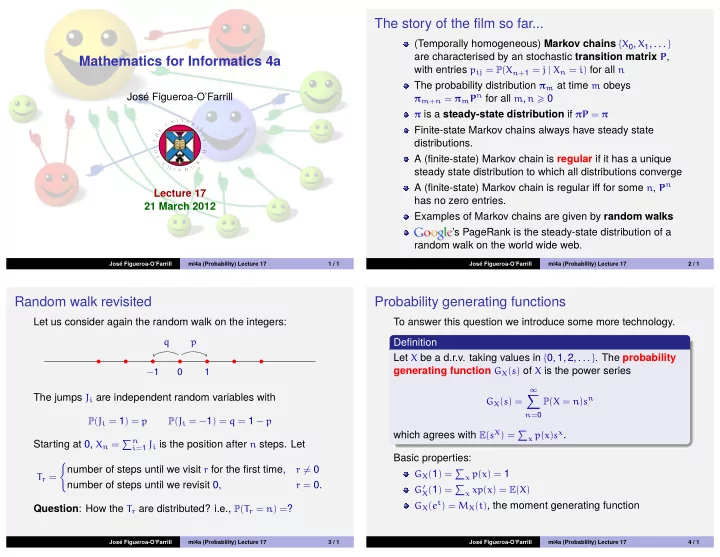
(Temporally homogeneous) Markov chains {X0, X1, . . . } are characterised by an stochastic transition matrix P, with entries pij = P(Xn+1 = j | Xn = i) for all n The probability distribution πm at time m obeys

πm+n = πmPn for all m, n 0 π is a steady-state distribution if πP = π

Finite-state Markov chains always have steady state distributions. A (finite-state) Markov chain is regular if it has a unique steady state distribution to which all distributions converge A (finite-state) Markov chain is regular iff for some n, Pn has no zero entries. Examples of Markov chains are given by random walks ’s PageRank is the steady-state distribution of a random walk on the world wide web.

José Figueroa-O’Farrill mi4a (Probability) Lecture 17 2 / 1

Random walk revisited

Let us consider again the random walk on the integers:

p q

−1

1

The jumps Ji are independent random variables with

P(Ji = 1) = p P(Ji = −1) = q = 1 − p

Starting at 0, Xn = n

i=1 Ji is the position after n steps. Let

Tr =

  • number of steps until we visit r for the first time,

r = 0

number of steps until we revisit 0,

r = 0.

Question: How the Tr are distributed? i.e., P(Tr = n) =?

José Figueroa-O’Farrill mi4a (Probability) Lecture 17 3 / 1

Probability generating functions

To answer this question we introduce some more technology. Definition Let X be a d.r.v. taking values in {0, 1, 2, . . . }. The probability generating function GX(s) of X is the power series

GX(s) =

  • n=0

P(X = n)sn

which agrees with E(sX) =

x p(x)sx.

Basic properties:

GX(1) =

x p(x) = 1

G′

X(1) = x xp(x) = E(X)

GX(et) = MX(t), the moment generating function

José Figueroa-O’Farrill mi4a (Probability) Lecture 17 4 / 1

slide-2
SLIDE 2

Examples

1

Let X be binomial with parameters (n, p), so

p(r) = n

r

  • prqn−r, for 0 r n and with q = 1 − p. Then

GX(s) =

n

  • r=0

p(r)sr =

n

  • r=0

n r

  • prqn−rsr = (q + ps)n

using the binomial theorem.

2

Let X be geometrically distributed with parameter p, so that

p(k) = qk−1p for k 1 and again q = 1 − p. Then GX(s) =

  • k=1

p(k)sk =

  • k=1

qk−1psk = ps

  • n=0

(qs)n = ps

1 − qs , for |s| < 1

q.

The P(X = n) are obtained by expanding GX(s) in powers of s.

José Figueroa-O’Farrill mi4a (Probability) Lecture 17 5 / 1

Behaviour under independence

Theorem Let X, Y be independent d.r.v.s with probability generating functions GX(s) and GY(s). Then

GX+Y(s) = GX(s)GY(s)

Proof is mutatis mutandis as for moment generating functions. Example Let X = n

k=1 Ik, where Ik are independent Bernoulli trials with

success probability p. Then GIk(s) = q + ps, with q = 1 − p, and

GX(s) =

n

  • k=1

GIk(s) =

n

  • k=1

(q + ps) = (q + ps)n ,

whence X is binomial with parameters (n, p), as expected.

José Figueroa-O’Farrill mi4a (Probability) Lecture 17 6 / 1

Conditional expectation I

Definition Let X, Y be random variables with joint distribution pX,Y(x, y). Then the conditional distribution of X given Y is

p(x | y) = P(X = x | Y = y) = P({X = x} ∩ {Y = y}) P({Y = y}) = pX,Y(x, y) pY(y)

It follows that the marginal distribution

pX(x) =

  • y

pX,Y(x, y) =

  • y

p(x | y)pY(y)

so that

E(X) =

  • x

xpX(x) =

  • x
  • y

xp(x | y)pY(y)

José Figueroa-O’Farrill mi4a (Probability) Lecture 17 7 / 1

Conditional expectation II

Interchanging the order of the sums,

E(X) =

  • y
  • x

xp(x | y)pY(y) =

  • y

E(X | Y = y)pY(y)

which defines the conditional expectation of X given Y:

E(X | Y = y) =

  • x

xp(x | y)

This defines a random variable E(X | Y), which is a function of Y, whose value at y is E(X | Y = y). Thus we have

E(X) = E (E(X|Y))

and similarly for any function Z = h(X),

E(Z) = E(E(Z|Y))

where

E(Z|Y = y) =

  • x

h(x)p(x | y)

José Figueroa-O’Farrill mi4a (Probability) Lecture 17 8 / 1

slide-3
SLIDE 3

Example (Random sums) Let X1, X2, . . . be i.i.d. and let N be an N-valued d.r.v. independent from the Xi. Let T = N

r=0 Xr. What is GT(s)?

We calculate this by conditioning on N:

E(sT) =

  • n

E(sT | N = n)P(N = n)

By independence,

E(sT | N = n) = E(sX1+···+Xn) = E(sX1) . . . E(sXn) = (GX(s))n

where GX(s) is the p.g.f. of any of the Xi. Hence

GT(s) =

  • n

GX(s)nP(N = n) = E(GX(s)N) = GN(GX(s))

In particular, E(T) = G′

T(1) = G′ N(GX(1))G′ X(1) = E(N)E(X)

José Figueroa-O’Farrill mi4a (Probability) Lecture 17 9 / 1

Example (Gambler’s ruin – revisited) A gambler starts with £k and makes a number of independent £1 bets with even odds. The gambler stops when she has either £0 or £N. Let Tk be the length of the game. What is E(Tk)? Conditioning on the result of the first bet, and letting τk = E(Tk),

τk = E(Tk|win)P(win) + E(Tk|lose)P(lose) = 1

2(1 + τk+1) + 1 2(1 + τk−1)

= 1 + 1

2(τk+1 + τk−1)

for 0 < k < n whereas τ0 = τN = 0. τk is quadratic in k with zeroes at 0 and

N, so τk = ck(N − k) for some constant c. Plugging it into the

equation for k = 1, we see that c = 1 and hence

E(Tk) = k(N − k)

José Figueroa-O’Farrill mi4a (Probability) Lecture 17 10 / 1

The Galton–Watson problem I

In 1873, Francis Galton posed a problem

  • ut of his concern in the decay of families
  • f “men of note”. In more modern

language, a similar problem is the following. A population of individuals reproduces itself in generations. Let Xn denote the size of the population in the nth

  • generation. There are two rules:

1

each member of a generation produces a family (maybe of size 0) in the next generation

2

family sizes of all individuals are i.i.d. random variables If we assume that X0 = 1, what is the probability that Xn = 0 for some n? i.e., will the family become extinct?

José Figueroa-O’Farrill mi4a (Probability) Lecture 17 11 / 1

The Galton–Watson problem II

The problem was (partially) solved by the Reverend Henry Watson, a mathematician, who together with Galton wrote On the probability of extinction of families in 1874. It gave rise to a class of problems known as branching processes.

  • José Figueroa-O’Farrill

mi4a (Probability) Lecture 17 12 / 1

slide-4
SLIDE 4

The Galton–Watson problem III

The population at the nth generation is a random sum of random variables:

Xn =

Xn−1

  • j=1

ξ(n−1)

j

where ξ(n−1)

j

is the size of the family of the jth individual of the (n − 1)st generation. They are i.i.d. with p.g.f. G(s). Let us write

Gn(s) for the p.g.f. of Xn. Then by the

random sums example ,

Gn(s) = Gn−1(G(s)) = Gn−2(G(G(s))) = · · · = Gn(s)

i.e., the nth iterate of G.

Gn is the p.g.f. of Xn, whence Gn(s) =

  • j=0

P(Xn = j)sj = ⇒ P(Xn = 0) = Gn(0) = Gn(0)

José Figueroa-O’Farrill mi4a (Probability) Lecture 17 13 / 1

The Galton–Watson problem IV

We are interested in the large n limit, call it z. If z exists, it obeys

G(z) = z. Formally, if Gn(0) → z as n → ∞, applying G again to

both sides, we have Gn+1(0) → G(z), but Gn+1(0) → z, hence

G(z) = z. We can also see this graphically:

0.1 0.2 0.3 0.4 0.5 0.6 0.7 0.1 0.2 0.3 0.4 0.5 0.6 0.7

There is always one solution: z = 1, namely extinction! Watson concluded (incorrectly) that extinction was inevitable. Luckily (?) that’s not always the case.

José Figueroa-O’Farrill mi4a (Probability) Lecture 17 14 / 1

Example (Extinction and survival for Poisson branching) Suppose that the family sizes are Poisson distributed, so that

G(s) =

  • k=0

e−λ λk

k! sk = e−λeλs = eλ(s−1)

We must solve the equation eλ(z−1) = z for 0 z 1. For λ 1 the only solution is z = 1, so the family will be extinct with probability 1, but for λ > 1 there is a nonzero probability of survival:

0.2 0.4 0.6 0.8 1.0 0.2 0.4 0.6 0.8 1.0 0.2 0.4 0.6 0.8 1.0 0.2 0.4 0.6 0.8 1.0

José Figueroa-O’Farrill mi4a (Probability) Lecture 17 15 / 1

Example (Extinction and survival for “geometric” branching) Suppose that the family sizes are distributed by a geometric distribution p(k) = qkp for k 0 and q = 1 − p. Then

G(s) =

  • k=0

qkpsk = p

1 − qs We must solve the equation

p 1−qz = z for 0 z 1. It has two

roots (for q = 0, otherwise z = 1)

z = 1 ±

  • 1 − 4pq

2q

= 1 ±

  • (2p − 1)2

2(1 − p) so one root is always 1 (extinction) and the other is

p 1−p, which

is < 1 only for p < 1

  • 2. So if p 1

2, extinction is inevitable, but if

p < 1

2 there is a chance of survival.

José Figueroa-O’Farrill mi4a (Probability) Lecture 17 16 / 1

slide-5
SLIDE 5

Hitting times for random walks I

Recall our motivating example: the

  • ne-dimensional random walk

Let r > 0 and let Tr be the number of steps until we visit r for the first time, starting at 0. Let Tk,k+1 be the number of steps needed to reach k + 1 having reached k. Then T0,1 = T1 and the Tk,k+1 are i.i.d.

Tr = T0,1 + T1,2 + · · · + Tr−1,r and by independence E(sTr) = E(sT1)r

Conditioning on the first jump,

E(sT1) = E(sT1 | J1 = 1)P(J1 = 1) + E(sT1 | J1 = −1)P(J1 = −1) = sp + sE(sT−1,0+T0,1)q = sp + sqE(sT1)2

which we solve for E(sT1)

José Figueroa-O’Farrill mi4a (Probability) Lecture 17 17 / 1

Hitting times for random walks II

Let E(sT1) = x and we must solve x = sp + sqx2 Assuming that q = 0, there are two solutions:

x = 1 ±

  • 1 − 4pqs2

2sq but only one has a power series expansion around s = 0:

E(sT1) = 1 −

  • 1 − 4pqs2

2sq Hence for r > 0,

E(sTr) =

  • 1 −
  • 1 − 4pqs2

2sq

r

and for r < 0 we simply replace p ↔ q

José Figueroa-O’Farrill mi4a (Probability) Lecture 17 18 / 1

Hitting times for random walks III

How about E(sT0)? We condition on the first jump:

E(sT0) = E(sT0 | J1 = 1)P(J1 = 1) + E(sT0 | J1 = −1)P(J1 = −1) = sE(sT1,0)p + sE(sT−1,0)q = spE(sT−1) + sqE(sT1) = sp

  • 1 −
  • 1 − 4pqs2

2sp

  • + sq
  • 1 −
  • 1 − 4pqs2

2sq

  • = 1 −
  • 1 − 4pqs2

∴ E(T0) =

4pq

  • 1 − 4pq

− → ∞

if p = q

José Figueroa-O’Farrill mi4a (Probability) Lecture 17 19 / 1

Summary

We introduced the probability generating function

GX(s) = E(sX) of an N-valued d.r.v.

If X, Y are independent, then GX+Y(s) = GX(s)GY(s) We defined the conditional distribution of X given Y:

p(x | y) = P(X = x | Y = y)

and the conditional expectation of X given Y, E(X | Y), a d.r.v. and a function of Y: E(X | Y = y) =

x xp(x | y)

E(X) = E(E(X | Y))

We looked at random sums of random variables We introduced branching processes and looked at the Galton–Watson problem of extinction of family names We revisited the one-dimensional random walk and calculated the p.g.f.s for the hitting times

José Figueroa-O’Farrill mi4a (Probability) Lecture 17 20 / 1