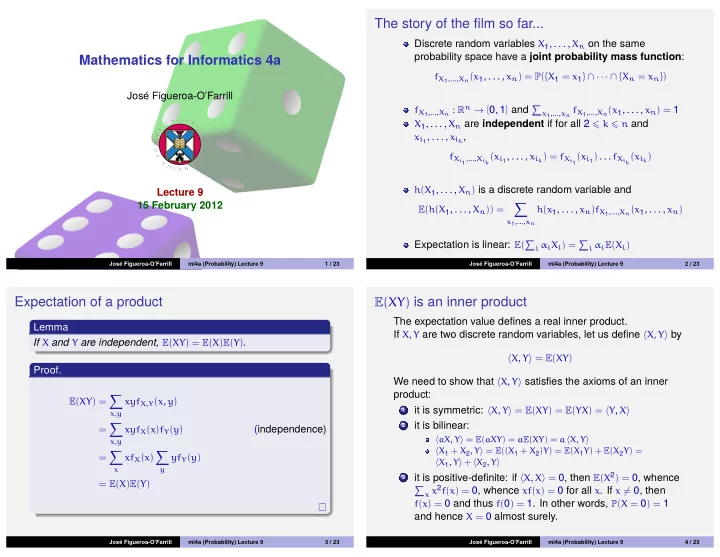
The story of the film so far... Discrete random variables X 1 , . . . - - PowerPoint PPT Presentation

the story of the film so far
SMART_READER_LITE
LIVE PREVIEW

The story of the film so far... Discrete random variables X 1 , . . . - - PowerPoint PPT Presentation

The story of the film so far... Discrete random variables X 1 , . . . , X n on the same probability space have a joint probability mass function : Mathematics for Informatics 4a f X 1 ,..., X n ( x 1 , . . . , x n ) = P ( { X 1 = x 1 }


slide-1
SLIDE 1

Mathematics for Informatics 4a

Jos´ e Figueroa-O’Farrill Lecture 9 15 February 2012

Jos´ e Figueroa-O’Farrill mi4a (Probability) Lecture 9 1 / 23

The story of the film so far...

Discrete random variables X1, . . . , Xn on the same probability space have a joint probability mass function:

fX1,...,Xn(x1, . . . , xn) = P({X1 = x1} ∩ · · · ∩ {Xn = xn}) fX1,...,Xn : Rn → [0, 1] and

x1,...,xn fX1,...,Xn(x1, . . . , xn) = 1

X1, . . . , Xn are independent if for all 2 k n and xi1, . . . , xik, fXi1,...,Xik(xi1, . . . , xik) = fXi1(xi1) . . . fXik(xik) h(X1, . . . , Xn) is a discrete random variable and E(h(X1, . . . , Xn)) =

  • x1,...,xn

h(x1, . . . , xn)fX1,...,Xn(x1, . . . , xn)

Expectation is linear: E(

i αiXi) = i αiE(Xi)

Jos´ e Figueroa-O’Farrill mi4a (Probability) Lecture 9 2 / 23

Expectation of a product

Lemma If X and Y are independent, E(XY) = E(X)E(Y). Proof.

E(XY) =

  • x,y

xyfX,Y(x, y) =

  • x,y

xyfX(x)fY(y)

(independence)

=

  • x

xfX(x)

  • y

yfY(y) = E(X)E(Y)

Jos´ e Figueroa-O’Farrill mi4a (Probability) Lecture 9 3 / 23

E(XY) is an inner product

The expectation value defines a real inner product. If X, Y are two discrete random variables, let us define X, Y by

X, Y = E(XY)

We need to show that X, Y satisfies the axioms of an inner product:

1

it is symmetric: X, Y = E(XY) = E(YX) = Y, X

2

it is bilinear:

aX, Y = E(aXY) = aE(XY) = a X, Y X1 + X2, Y = E((X1 + X2)Y) = E(X1Y) + E(X2Y) = X1, Y + X2, Y

3

it is positive-definite: if X, X = 0, then E(X2) = 0, whence

  • x x2f(x) = 0, whence xf(x) = 0 for all x. If x = 0, then

f(x) = 0 and thus f(0) = 1. In other words, P(X = 0) = 1

and hence X = 0 almost surely.

Jos´ e Figueroa-O’Farrill mi4a (Probability) Lecture 9 4 / 23

slide-2
SLIDE 2

Additivity of variance for independent variables

How about the variance Var(X + Y)? Var(X + Y) = E((X + Y)2) − E(X + Y)2

= E(X2 + 2XY + Y2) − (E(X) + E(Y))2 = E(X2) + 2E(XY) + E(Y2) − E(X)2 − 2E(X)E(Y) − E(Y)2 = Var(X) + Var(Y) + 2 (E(XY) − E(X)E(Y))

Theorem If X and Y are independent discrete random variables Var(X + Y) = Var(X) + Var(Y)

Jos´ e Figueroa-O’Farrill mi4a (Probability) Lecture 9 5 / 23

Covariance

Definition The covariance of two discrete random variables is Cov(X, Y) = E(XY) − E(X)E(Y) Letting µX and µY denote the means of X and Y, respectively, Cov(X, Y) = E((X − µX)(Y − µY)) Indeed,

E((X − µX)(Y − µY)) = E(XY) − E(µXY) − E(µYX) + E(µXµY) = E(XY) − µXµY

Jos´ e Figueroa-O’Farrill mi4a (Probability) Lecture 9 6 / 23

Example (Max and min for two fair dice) We roll two fair dice. Let X and Y denote their scores. Independence says that Cov(X, Y) = 0. Consider however the new variables U = min(X, Y) and V = max(X, Y):

U

1 2 3 4 5 6 1 1 1 1 1 1 1 2 1 2 2 2 2 2 3 1 2 3 3 3 3 4 1 2 3 4 4 4 5 1 2 3 4 5 5 6 1 2 3 4 5 6

V

1 2 3 4 5 6 1 1 2 3 4 5 6 2 2 2 3 4 5 6 3 3 3 3 4 5 6 4 4 4 4 4 5 6 5 5 5 5 5 5 6 6 6 6 6 6 6 6

E(U) = 91

36, E(U2) = 301 36 , E(V) = 161 36 , E(V2) = 791 36 , E(UV) = 49 4

= ⇒ Var(U) = Var(V) = 2555

1296

and Cov(U, V) =

  • 35

36

2

Jos´ e Figueroa-O’Farrill mi4a (Probability) Lecture 9 7 / 23

Definition Two discrete random variables X and Y are said to be uncorrelated if Cov(X, Y) = 0. Warning Uncorrelated random variables need not be independent! Counterexample Suppose that X is a discrete random variable with probability mass function symmetric about 0; that is, fX(−x) = fX(x). Let

Y = X2. Clearly X, Y are not independent: f(x, y) = 0 unless y = x2 even if fX(x)fY(y) = 0. However they are uncorrelated: E(XY) = E(X3) =

  • x

x3fX(x) = 0

and similarly E(X) = 0, whence E(X)E(Y) = 0.

Jos´ e Figueroa-O’Farrill mi4a (Probability) Lecture 9 8 / 23

slide-3
SLIDE 3

An alternative criterion for independence

The above counterexample says that the following implication cannot be reversed:

X, Y

independent =

⇒ E(XY) = E(X)E(Y)

However, one has the following Theorem Two discrete random variables X and Y are independent if and

  • nly if

E(g(X)h(Y)) = E(g(X))E(h(Y))

for all functions g, h. The proof is not hard, but we will skip it.

Jos´ e Figueroa-O’Farrill mi4a (Probability) Lecture 9 9 / 23

The Cauchy–Schwarz inequality

Recall that X, Y = E(XY) is an inner product. Every inner product obeys the

Cauchy–Schwarz inequality :

X, Y2 X, X Y, Y

which in terms of expectations is

E(XY)2 E(X2)E(Y2)

Now, Cov(X, Y)2 = E((X − µX)(Y − µY))2 E((X − µX)2)E((Y − µY)2) whence Cov(X, Y)2 Var(X) Var(Y)

Jos´ e Figueroa-O’Farrill mi4a (Probability) Lecture 9 10 / 23

Correlation

Let X and Y be two discrete random variables with means µX and µY and standard deviations σX, σY. The correlation ρ(X, Y)

  • f X and Y is defined by

ρ(X, Y) = Cov(X, Y) σXσY

From the Cauchy–Schwarz inequality, we see that

ρ(X, Y)2 1 = ⇒ −1 ρ(X, Y) 1

Hence the correlation is a number between −1 and 1: a correlation of 1 suggests a linear relation with positive slope between X and Y, whereas a correlation of −1 suggests a linear relation with negative slope.

Jos´ e Figueroa-O’Farrill mi4a (Probability) Lecture 9 11 / 23

Example (Max and min for two fair dice – continued) Continuing with the

previous example , we now simply compute

ρ(U, V) =

Cov(U, V)

  • Var(U) Var(V)

= 352

362

  • 2555

362

= 35

73.

Remark The funny normalisation of ρ(X, Y) is justified by the following:

ρ(αX + β, γY + δ) = sign(αγ)ρ(X, Y)

which follows from Cov(αX + β, γY + δ) = αγ Cov(X, Y) and σαX+β = |α|σX and σγY+δ = |γ|σY.

Jos´ e Figueroa-O’Farrill mi4a (Probability) Lecture 9 12 / 23

slide-4
SLIDE 4

Markov’s inequality

Theorem (Markov’s inequality) Let X be a discrete random variable taking non-negative values. Then

P(X a) E(X) a

Proof.

E(X) =

  • x0

xP(X = x) =

  • 0x<a

xP(X = x) +

  • xa

xP(X = x)

  • xa

xP(X = x)

  • xa

aP(X = x) = aP(X a)

Jos´ e Figueroa-O’Farrill mi4a (Probability) Lecture 9 13 / 23

Example A factory produces an average of n items every week. What can be said about the probability that this week’s production shall be at least 2n items? Let X be the discrete random variable counting the number of items produced. Then by Markov’s inequality

P(X 2n) n

2n = 1

2 .

So I wouldn’t bet on it! Markov’s inequality is not terribly sharp; e.g.,

P(X E(X)) 1 .

It has one interesting corollary, though.

Jos´ e Figueroa-O’Farrill mi4a (Probability) Lecture 9 14 / 23

Chebyshev’s inequality

Theorem Let X be a discrete random variable with mean µ and variance σ2. Then for any

ε > 0, P(|X − µ| ε) σ2 ε2

Proof. Notice that for ε > 0, |X − µ| ε if and only if (X − µ)2 ε2, so

P(|X − µ| ε) = P((X − µ)2 ε2) E((X − µ)2) ε2 = σ2 ε2

(by Markov’s)

Jos´ e Figueroa-O’Farrill mi4a (Probability) Lecture 9 15 / 23

Example Back to the factory in the previous example, let the average be

n = 500 and the variance in a week’s production is 100, then

what can be said about the probability that this week’s production falls between 400 and 600? By Chebyshev’s,

P(|X − 500| 100) σ2

1002 =

1 100

whence

P(|X − 500| < 100) = 1 − P(|X − 500| 100) 1 −

1 100 = 99 100 .

So pretty likely!

Jos´ e Figueroa-O’Farrill mi4a (Probability) Lecture 9 16 / 23

slide-5
SLIDE 5

The law of large numbers I

Consider a number n of independent discrete random variables

X1, . . . , Xn with the same probability mass function. One says

that they are “independent and identically distributed”, abbreviated “i.i.d.”. In particular, they have the same mean and variance. The law of large numbers says that in the limit n → ∞,

1 n (X1 + · · · + Xn) → µ

in probability. The law of large numbers justifies the “relative frequency” interpretation of probability. For example, it says that tossing a fair coin a large number n of times, the proportion of heads will approach 1

2 in the limit n → ∞, in the sense that deviations from 1 2 (e.g., a long run of heads or of tails) will become increasingly

rare.

Jos´ e Figueroa-O’Farrill mi4a (Probability) Lecture 9 17 / 23

100,000 tosses of a fair (?) coin

Jos´ e Figueroa-O’Farrill mi4a (Probability) Lecture 9 18 / 23

The law of large numbers II

Theorem (The (weak) law of large numbers) Let X1, X2, . . . be i.i.d. discrete random variables with mean µ and variance σ2 and let Zn = 1

n(X1 + · · · + Xn). Then

∀ε > 0 P(|Zn − µ| < ε) → 1

as n → ∞ Proof. By linearity of expectation, E(Zn) = µ, and since the Xi are independent Var(Zn) =

1 n2 Var(X1 + · · · + Xn) = σ2 n . By

Chebyshev,

P(|Zn − µ| ε) σ2 nε2 = ⇒ P(|Zn − µ| < ε) 1 − σ2 nε2

Jos´ e Figueroa-O’Farrill mi4a (Probability) Lecture 9 19 / 23

The law of large numbers III

We will now justify probability as relative frequency. Let (Ω, F, P) be a probability space and let A ∈ F be an event. Let IA denote the indicator variable of A, a discrete random variable defined by

IA(ω) =

  • 1,

ω ∈ A

0,

ω ∈ A

The probability mass function f of an indicator variable is very simple: f(1) = P(A) and hence f(0) = 1 − P(A). Its mean is given by

µ = E(IA) = 0 × f(0) + 1 × f(1) = f(1) = P(A)

and its variance by

σ2 = Var(IA) = (0 − µ)2f(0) + (1 − µ)2f(1) = P(A)2(1 − P(A)) + (1 − P(A))2P(A) = P(A)(1 − P(A))

Jos´ e Figueroa-O’Farrill mi4a (Probability) Lecture 9 20 / 23

slide-6
SLIDE 6

The law of large numbers IV

Now imagine repeating the experiment and counting how many outcomes belong to A. Let Xi denote the random variable which agrees with the indicator variable of A at the ith trial. Then the X1, X2, . . . are i.i.d. discrete random variables, with mean P(A) and variance P(A)(1 − P(A)). Let Zn = 1

n(X1 + · · · + Xn). What does Zn measure?

Zn measures the proportion of trials with outcomes in A

after n trials. This is what we had originally called N(A)/n. The law of large numbers says that in the limit as n → ∞,

Zn → P(A) in probability.

This makes precise our initial hand-waving argument of

N(A)/n “converging in some way” to P(A).

Jos´ e Figueroa-O’Farrill mi4a (Probability) Lecture 9 21 / 23

Summary

X, Y independent: E(XY) = E(X)E(Y) E(XY) defines an inner product X, Y independent: Var(X + Y) = Var(X) + Var(Y)

In general: Var(X + Y) = Var(X) + Var(Y) + 2 Cov(X, Y) covariance: Cov(X, Y) = E(XY) − E(X)E(Y). If Cov(X, Y) = 0 we say X, Y are uncorrelated correlation: ρ(X, Y) = Cov(X, Y)/(σ(X)σ(Y)) measures “linear dependence” between X, Y We proved two inequalities:

Markov: P(|X| a) E(|X|)/a Chebyshev: P(|X − µ| ε) σ2/ε2

The law of large numbers “explains” the relative frequency definition of probability: it says that if Xi are i.i.d. discrete random variables, then as n → ∞,

1 n(X1 + · · · + Xn) → µ in probability; i.e., deviations from µ

are still possible, but they are increasingly improbable

Jos´ e Figueroa-O’Farrill mi4a (Probability) Lecture 9 22 / 23

Proof of the Cauchy–Schwarz inequality

The Cauchy–Schwarz inequality says that if x, y are any two vectors in a positive-definite inner product space, then

| x, y | |x||y| ,

where |x| =

  • x, x is the length.

Any two vectors lie on a plane, so let’s pretend we are in R2, and diagonalising −, −, we take it to be the dot product. In that case,

x · y = |x||y| cos θ ,

where θ is the angle between x and y. Since | cos θ| 1, the inequality follows.

θ x y

Back to the main story. Jos´ e Figueroa-O’Farrill mi4a (Probability) Lecture 9 23 / 23