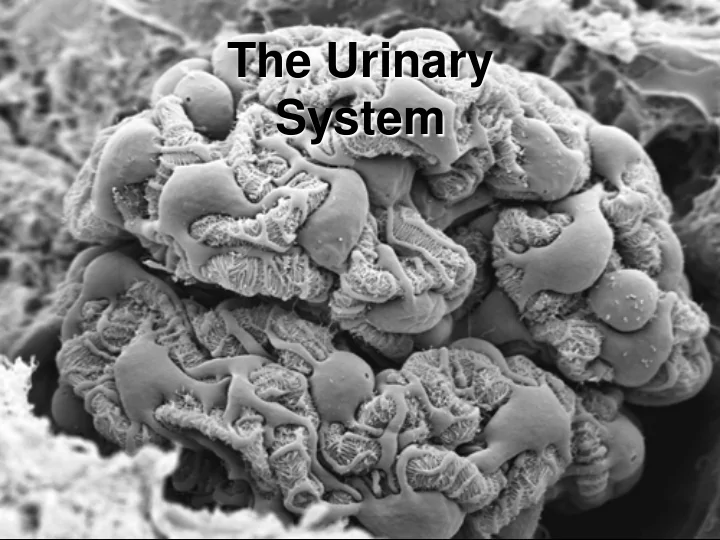
The Urinary System The Urinary System General Renal (kidney) - PowerPoint PPT Presentation
The Urinary System The Urinary System General Renal (kidney) Functions Urine formation and concentration Maintain the volume and composition of the ECF! Eliminate toxins, metabolic wastes, and excess water out of the body
The Urinary System
The Urinary System • General Renal (kidney) Functions – Urine formation and concentration – Maintain the volume and composition of the ECF! – Eliminate toxins, metabolic wastes, and excess water out of the body • Main waste products produced are: – Urea – Uric acid – Creatinine – Hormone Production: • Calcitriol – derivative of Vit D3 that increases Ca2+ absorption by intestinal mucosa • Renin – regulation of blood pressure • EPO (erythropoeitin) – increases erythrocyte production produced by peritubular capillary endothelium
The Urinary System • Function of other urinary system components: – Ureters • Conduct urine from renal hilus to urinary bladder – Urinary Bladder • Store urine & involved in micturition – Urethra • Female: conduct urine from bladder to external environment • Male: conduct urine & semen to external environment
Organs of the Urinary System • Kidneys • Ureters • Urinary bladder • Urethra Figure 23.1a
Location and External Anatomy of Kidneys • Located in the retroperitoneal position • Lateral to T 12 –L 3 vertebrae • Average kidney – 12 cm tall, 6 cm wide, 3 cm thick • Hilus – on concave surface • Kidney surrounded by: – Renal capsule (dense irregular c.t.) – Adipose capsule – Renal fascia (continuous with the renal capsule)
Internal Anatomy of the Kidneys
Microscopic Anatomy of the Kidneys • Functional unit of the kidney = Nephron – Microscopic – approx 1.25 million/kidney equating to about 85 miles of tubules! – Nephron Components: • Vascular – renal corpuscle • Tubular – PCT, Loop of Henle (Nephron Loop), DCT • Tubovascular – Juxtaglomerular apparatus – Collecting Components: • Collecting Duct • Papillary Duct – Nephron + Collecting Components = Uriniferous Tubule (means tubule which conducts urine)
Mechanisms of Urine Production • Glomerular Filtration – filtrate of blood leaves kidney capillaries • Tubular Reabsorption – most nutrients, water, and essential ions reclaimed • Tubular Secretion – active process of removing undesirable molecules
Uriniferous Tubule Location Figure 23.4a
The Nephron • Renal corpuscle – glomerulus and glomerular capsule – Glomerulus – tuft of capillaries • Capillaries are fenestrated • Glomerular (Bowman’s) capsule – Parietal layer – simple squamous epithelium – Visceral layer – consists of podocytes
Renal Corpuscle and the Filtration Membrane
Renal Corpuscle and the Filtration Membrane • Large molecules are prevented from passing through the filtration membrane, due to fenestrations & filtration slits Negatively charged molecules are repelled by large anions in basement membrane
Tubular Section of Nephron • Filtrate proceeds to renal tubules from glomerulus – Proximal convoluted tubule – Loop of Henle (nephron loop) • Descending limb • Thin segment • Thick segment – Distal convoluted tubule
Tubular Section of Nephron Figure 23.4b
Classes of Nephron • Cortical nephrons – 85% of nephrons – Most of nephron is in the cortex of kidney • Juxtamedullary nephrons – 15% of nephrons – Extend deep into the renal pyramid & have long Loop of Henle – Responsible for urine concentration & dilution
Classes of Nephron Figure 23.9a
Collecting Tubules (Collecting ducts) • Collecting tubules – receive urine from distal convoluted tubules Figure 23.4a
Microscopic Blood Vessels • Nephrons are associated with several types of capillary beds: – Glomerulus – fed and drained by afferent & efferent arterioles – Peritubular capillaries – arise from efferent arterioles • Low-pressure, porous capillaries • Absorb solutes – Vasa recta – thin-walled looping vessels • Part of the kidney’s urine-concentrating mechanism
Summary of Blood Vessels Supplying the Kidney abdominal renal segmental Interlobar arcuate Interlobular afferent aorta artery arteries arteries arteries arteries arterioles 1 glomerular ~ 1,000,000 capillaries efferent arterioles peritubular capillaries & vasa recta 1 inferior vena renal Interlobar arcuate interlobular cava vein vein vein vein
Summary of Blood Vessels of the Kidney
The Tubovascular Component • Juxtaglomerular apparatus – Functions in the regulation of blood pressure • Vascular – afferent arteriole • Tubular - DCT • Juxtaglomerular cells of afferent arteriole – Act as mechanoreceptors – JGA cells secrete renin • Macula densa cells of distal convoluted tubule – Tall, closely packed epithelial cells – Act as chemoreceptors control vasodilation/vasoconstriction of afferent arteriole
Juxtaglomerular Apparatus Figure 23.11
Ureters • Carry urine from the kidneys to the urinary bladder • Oblique entry into bladder prevents backflow of urine • Histology of ureter – Mucosa – transitional epithelium – Muscularis – two layers • Inner longitudinal layer • Outer circular layer – Adventitia – typical connective tissue
Urinary Bladder • A collapsible muscular sac • Stores and expels urine – Full bladder – spherical • Expands into the abdominal cavity – Empty bladder • Lies entirely within Figure 23.14 the pelvis
Urinary Bladder • Urachus – closed remnant of the allantois • Prostate gland – in males – Lies directly inferior to the bladder – Surrounds the urethra Figure 23.15
Structure of the Urinary Bladder and Urethra Figure 23.17a
Structure of the Urinary Bladder and Urethra Figure 23.17b
Urethra • Epithelium – Transitional epithelium – near the bladder – Stratified and pseudostratified columnar – mid urethra – Stratified squamous epithelium – near the distal end • Internal urethral sphincter – involuntary smooth muscle • External urethral sphincter – voluntarily inhibits urination
Urethra • In females – length of 3–4 cm • In males – 20 cm in length – three named regions – Prostatic urethra – passes through the prostate gland – Membranous urethra – through the urogenital diaphragm – Spongy (penile) urethra – passes through the length of the penis
Micturition
Slides • Renal cortex • Cross section & long section through pyramids • Ureter • Urinary bladder • urethra
Renal cortex
Renal Pyramid (cs) Renal Papillae
ureter cross section
Urinary Bladder
Urethra (male)
Urethra (female)
Recommend
More recommend
Explore More Topics
Stay informed with curated content and fresh updates.