The use of pumping lemma I Recall that from previous examples we - - PowerPoint PPT Presentation

the use of pumping lemma i
SMART_READER_LITE
LIVE PREVIEW

The use of pumping lemma I Recall that from previous examples we - - PowerPoint PPT Presentation

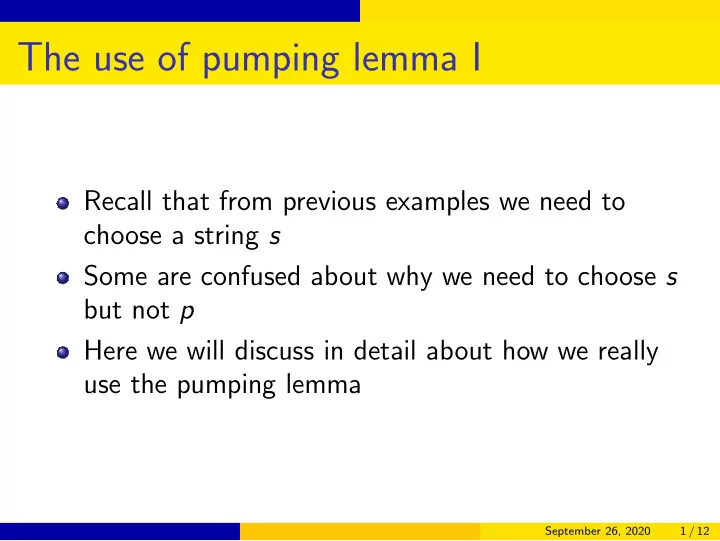
The use of pumping lemma I Recall that from previous examples we need to choose a string s Some are confused about why we need to choose s but not p Here we will discuss in detail about how we really use the pumping lemma September 26, 2020 1 /


slide-1
SLIDE 1

The use of pumping lemma I

Recall that from previous examples we need to choose a string s Some are confused about why we need to choose s but not p Here we will discuss in detail about how we really use the pumping lemma

September 26, 2020 1 / 12

slide-2
SLIDE 2

The use of pumping lemma II

Let’s start from the following statement ∀n, 1 + · · · + n = n(n + 1) 2 What is the opposite statement? ∃n such that 1 + · · · + n = n(n + 1) 2 Formally, in the pumping lemma regular ⇒ some properties

September 26, 2020 2 / 12

slide-3
SLIDE 3

The use of pumping lemma III

“Some properties” are in fact ∃p, {∀s ∈ A, |s| ≥ p[∃x, y, z such that s = xyz and (xy iz ∈ A, ∀i ≥ 0, and |y| > 0 and |xy| ≤ p)]} To do the proof by contradiction, we need the

  • pposite statement of the right-hand side

∀p, {∃s ∈ A, |s| ≥ p, [∀x, y, z (opposite of (s = xyz and (xy iz ∈ A, ∀i ≥ 0, and |y| > 0 and |xy| ≤ p)))]}

September 26, 2020 3 / 12

slide-4
SLIDE 4

The use of pumping lemma IV

What is the opposite of s = xyz and xy iz ∈ A, ∀i ≥ 0, and |y| > 0 and |xy| ≤ p? Various equivalent forms are possible. The one we consider is (s = xyz and |y| > 0 and |xy| ≤ p) → ∃i ≥ 0, xy iz / ∈ A

September 26, 2020 4 / 12

slide-5
SLIDE 5

The use of pumping lemma V

Therefore, the opposite statement of the right-hand side that we really use is ∀p, {∃s ∈ A, |s| ≥ p, [∀x, y, z ((s = xyz and |y| > 0 and |xy| ≤ p) → ∃i ≥ 0, xy iz / ∈ A)]} (1) Note that the opposite of A&B

September 26, 2020 5 / 12

slide-6
SLIDE 6

The use of pumping lemma VI

is A → ¬B See the truth table A B A&B ¬(A&B) ¬B A → ¬B 1 1 1 1 1 1 1 1 1 1 1 1 1 To prove (1), the “exists” part is important You can see that we need to choose s and find an i

September 26, 2020 6 / 12

slide-7
SLIDE 7

The use of pumping lemma VII

In a sense we guess s or i to see if the statement can be proved. If not, we may try other choices About ∀x, y, z, · · · in (1) you can see in examples that we go through all possible cases of x, y, z

September 26, 2020 7 / 12

slide-8
SLIDE 8

Example 1.75 I

F = {ww | w ∈ {0, 1}∗} not regular We choose s = 0p10p1 ∈ F If s = xyz, |xy| ≤ p, |y| > 0, then y = 0 . . . 0 and thus xy 2z = 0 . . . 010p1 = ww

September 26, 2020 8 / 12

slide-9
SLIDE 9

Example 1.75 II

What if we say there exists i = 3 such that xy iz = xy 3z = 0 . . . 010p1 = ww? The proof is still correct. Note that we only need to find an i such that xy iz is not in the language

September 26, 2020 9 / 12

slide-10
SLIDE 10

Example 1.76 I

D = {1n2 | n ≥ 0} not regular For this language we have n = 0, 10 = ǫ n = 1, 11 = 1 n = 2, 14 = 1111 n = 3, 19 = 111111111 We choose s = 1p2 ∈ D

September 26, 2020 10 / 12

slide-11
SLIDE 11

Example 1.76 II

If s = xyz, |xy| ≤ p, |y| > 0 then p2 < |xy 2z| ≤ p2 + p < (p + 1)2 and therefore xy 2z / ∈ D

September 26, 2020 11 / 12

slide-12
SLIDE 12

Example 1.76 III

What if we consider i = 0? It seems that (p − 1)2 < p2 − p ≤ |xy 0z| < p2 can also give us xy 0z not in the language. However, (p − 1)2 < p2 − p may not hold at p = 1. Note that p is any positive integer now However, we still have the proof because as we said,

  • ne i is enough

September 26, 2020 12 / 12