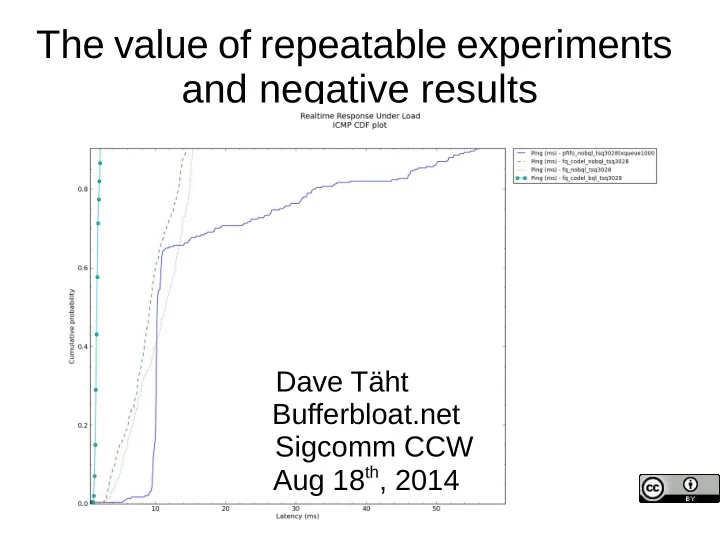
The value of repeatable experiments and negative results Dave Tht - - PowerPoint PPT Presentation

the value of repeatable experiments and negative results
SMART_READER_LITE
LIVE PREVIEW

The value of repeatable experiments and negative results Dave Tht - - PowerPoint PPT Presentation

The value of repeatable experiments and negative results Dave Tht Bufferbloat.net Sigcomm CCW Aug 18 th , 2014 Installing netperf-wrapper Linux (debian or ubuntu) sudo apt-get install python-matplotlib python-qt4 fping subversion


slide-1
SLIDE 1

The value of repeatable experiments and negative results

Dave Täht Bufferbloat.net Sigcomm CCW Aug 18th, 2014

slide-2
SLIDE 2

Installing netperf-wrapper

  • Linux (debian or ubuntu)

– sudo apt-get install python-matplotlib python-qt4 fping subversion git-core – git clone https://github.com/tohojo/netperf-wrapper.git – cd netperf-wrapper; sudo python setup.py install – See the readme for other dependencies.(netperf needs to be compiled

with –enable-demo)

  • OSX

– Requires macports or brew, roughly same sequence

  • Data Set: http://snapon.lab.bufferbloat.net/~d/datasets/
  • This slide set:

http://snapon.lab.bufferbloat.net/~d/sigcomm2014.pdf

slide-3
SLIDE 3

Bufferbloat.net Resources

Reducing network delays since 2011...

Bufferbloat.net: http://bufferbloat.net Email Lists: http://lists.bufferbloat.net (codel, bloat, cerowrt-devel, etc) IRC Channel: #bufferbloat on chat.freenode.net Codel: https://www.bufferbloat.net/projects/codel CeroWrt: http://www.bufferbloat.net/projects/cerowrt Other talks: http://mirrors.bufferbloat.net/Talks Jim Gettys Blog: http://gettys.wordpress.com Google for bloat-videos on youtube... Netperf-wrapper test suite: https://github.com/tohojo/netperf-wrapper

slide-4
SLIDE 4

“Reproducible” vs “Repeatable” Experiments

  • Researcher MIGHT be

able to repeat experiment in light of new data.

  • Reviewer typically lacks

time to reproduce.

  • Reader MIGHT be able,

from the descriptions in the paper, reproduce the result, by rewriting the code from scratch.

  • Researcher MUST be easily

repeat the experiment in light of new data.

  • Reviewer SHOULD be able

to re-run the experiment and inspect the code.

  • Reader SHOULD be able

from the code and data supplied by the research, repeat the experiment quickly and easily.

slide-5
SLIDE 5

What's wrong with reproducible?

  • Coding errors are terribly

common – code review is needed...

  • Reproduction takes time I don't

have.

  • Science in physical law is
  • constant. Gravity will be the

same tomorrow, as today...

  • In computer science, the laws

are agreements, and protocols, and they change

  • ver time.
  • You have 30 seconds to get

my attention.

  • 5 minutes, tops, to make a

point.

  • There are thousands of

papers to read.

  • Show me something that

works... that I can fiddle with, or change a constant to match another known value... anything....

slide-6
SLIDE 6

Open Access

  • Cathedral and the Bazaar
  • Why programmers don't bother joining

ACM

  • Artifacts

Aaron Swartz

slide-7
SLIDE 7

A working engineer's Plea: Help me out here!

  • First, lose TeX:

– HTML and mathjax work just fine now. – I forgot everything I knew about TeX in 1992....

  • Math papers

– Please supply a link to a mathematica, wolfram language, or spreadsheet of your analysis

  • You had to do it for yourself anyway...
  • CS Papers

– Supply source code in a public repository like github – Put raw results somewhere – Keep a vm or testbed around that can repeat your result – Make it possible for others to repeat your experiment – It would be great if there was a way to comment on your paper(s) on the web

  • And do Code Review, before Peer Review

– Your code might suck. News for you: everyone's code sucks. – Defect rates even in heavily reviewed code remain high, why should yours

be considered perfect?

slide-8
SLIDE 8

Several Fundamental Laws of Computer Science

  • Murphy's Law: “Anything that can go wrong, will...”

– At the worst possible time... – At the demo... – And in front of your boss.

  • Linus's Law: “With enough eyeballs, all bugs are shallow”

– “With enough bugs, all eyeballs are shallow” - Post-Heartbleed corollary

  • Everything evolves – getting faster, smaller, more complex, with

ever more interrelationships...

  • And if assumptions are not rechecked periodically...
  • You get:
slide-9
SLIDE 9

Network Latency with Load: 2011

Fiber Cable (DOCSIS 2.0) ADSL Wifi

slide-10
SLIDE 10

March, 2011: no AQM or Fair Queue algorithm worked right on Linux

  • Turn on red, sfq, what have you...
  • On ethernet at line rate (10mbit, 100mbit, GigE) – nearly

nothing happened

  • On wifi – nothing happened
  • On software rate limited qos systems – weird stuff

happened (on x86) that didn't happen on some routers

  • Everything exhibited exorbitant delays... wifi especially,

but ethernet at 100mbit and below was also terrible...

Bufferbloat was everywhere...And the fq/aqm field was dead, dead, dead.

And we didn't know why...

slide-11
SLIDE 11

Bufferbloat was at all layers of the network stack

  • Virtual machines
  • Applications
  • TCP
  • CPU scheduler
  • FIFO Queuing systems (qdiscs)
  • The encapsulators (PPPoe and VPNs)
  • The device drivers (tx rings & buffers)
  • The devices themselves
  • The mac layer (on the wire for aggregated traffic)
  • Switches, routers, etc.
slide-12
SLIDE 12

We went back to the beginning of Internet Time...

  • 1962 Donald Davies “packet” = 1000 bits (125 bytes)

"The ARPANET was designed to have a reliable communications subnetwork. It was to have a transmission delay between hosts of less than ½ second. Hosts will transmit messages, each with a size up to 8095 bits. The IMPs will segment these messages into packets, each

  • f size up to 1008 bits."
  • - http://www.cs.utexas.edu/users/chris/think/ARPANET/Technical_Tour/overview.shtml
  • 70s-80s packet size gradually grew larger as headers grew
  • 80s ethernet had a maximum 1500 MTU
  • 90s internet ran at a MTU of 584 bytes or less
  • IPv6 specified minimum MTU as 1280 bytes
  • 00's internet hit 1500 bytes (with up to 64k in fragments)
  • 10's internet has TSO/GSO/GRO offloads controlling flows with up to 64k bursts – TSO2 has

256k bursts...

  • Were these giant flows still “packets”? Average packet size today is still ~300 bytes...

VOIP/gaming/signalling packets generally still less than 126 bytes

slide-13
SLIDE 13

Fundamental reading: Donald Davies, Leonard Kleinrock & Paul Baran

  • http://www.rand.org/content/dam/rand/pubs/research_memoran

da/2006/RM3420.pdf

  • Kleinrock - “Message delay in communication nets with storage”

http://dspace.mit.edu/bitstream/handle/1721.1/11562/33840535.p df

  • Are Donald Davies 11 volumes on packet switching not online??
  • Van Jacobson & Mike Karels - “Congestion Avoidance and

Control”

http://ee.lbl.gov/papers/congavoid.pdf

  • Nagle: “Packet Switches with infinite storage”

http://tools.ietf.org/html/rfc970

slide-14
SLIDE 14

Fair Queuing Research, revisited

  • RFC970
  • Analysis and simulation of a Fair Queuing Algorith
  • Stochastic Fair Queueing (SFQ) – used in

wondershaper

  • Deficit Round Robin- had painful setup
  • Quick Fair Queuing – crashed a lot
  • Shortest Queue First – only in proprietary firmware
  • FQ_CODEL – didn't exist yet
slide-15
SLIDE 15

AQM research, revisited

  • RED – Didn't work at all like the ns2 model
  • RED in a different Light – not implemented
  • ARED - unimplemented
  • BLUE – couldn't even make it work right in ns2
  • Stochastic Fair Blue – implementation needed the sign

reversed and it still didn't work

– We talked to Kathie Nichols, Van Jacobson, Vint Cerf, John Nagle,

Fred Baker, and many others about what had transpired in the 80s and 90s.

– And established a web site and mailing list to discuss what to do...

slide-16
SLIDE 16

Some debloating progress against all these variables...

  • 2011 Timeline:

– April: TSO/GSO exposed as causing htb breakage

  • Turning it off gave saner results on x86

– June: Infinite retry bug in wifi fixed

  • :whew: no congestion collapse here

– August: “Byte Queue Limits” BQL developed

  • Finally, multiple AQM and FQ algorithms had bite
  • Even better, they started scaling up to 10GigE and higher!

– October: eBDP algorithm didn't work out on wireless-n – November: BQL deployed into linux 3.3

  • Multiple drivers upgraded
  • 2 bugs in RED implementation found and fixed
  • Finding these problems required throwing out all prior results (including all of

yours) and repeating the experiments...

– And I stopped believing in papers...

slide-17
SLIDE 17

The value of Byte Queue Limits 2 orders of magnitude lag reduction

0.2 0.4 0.6 0.8 5000 10000 15000 20000 P ( R T T ≤ h ) RTT h (ms)

Size of Ring Buffer/qdisc (packets) 80 4920 128 4872 256 4744 512 4488 1024 3976 2048 2952 4096 904

Latency without BQL

0.2 0.4 0.6 0.8 1 40 50 60 70 80 90 100 110 120 130 P ( R T T ≤ h ) RTT h (ms)

Size of Ring Buffer/qdisc (packets) 80 4920 128 4872 256 4744 512 4488 1024 3976 2048 2952 4096 904

9:Latency with BQL.

Src: Bufferbloat Systematic Analysis (published this week at its2014)

slide-18
SLIDE 18

New starting Point: WonderShaper

  • Published 2002:

– Combines fair queuing + a poor man's AQM (permutation) on outbound – 3 levels of service via classification – 12 lines of code...

  • Worked, really well, in 2002, at 800/200kbit speeds.

– I'd been using derivatives for 9 years... – Most open source QOS systems are derived from it – But it didn't work well in this more modern era at higher speeds

  • What else was wrong?

(google for “Wondershaper must die”)

slide-19
SLIDE 19

2012 progress in Linux

  • Jan: SFQRED (hybrid of SFQ + RED) implemented

– ARED also

  • May: Codel algorithm published in ACM queue
  • June: codel and fq_codel (hybrid of DRR + codel) slammed into the linux kernel
  • Aug: pie published
  • And....

– The new FQ and AQM tech worked at any line rate without configuration! (so long as you

had BQL,

– Or HTB with TSO/GSO/GRO turned off.

  • SQM (CeroWrt's Smart Queue Management) developed to compare them all...
  • Netperf-wrappers started to test them all...
slide-20
SLIDE 20

FQ_Codel

  • A hybrid of

– DRR (Deficit Round Robin) Fair Queueing – Codel (for queue length management) – With some SQF-like features for the sparsest flows

  • Achieves near-0 queue delay for sparse flows, and under 20ms
  • f queue delay for heavier loads
  • It and variants are currently winner among the congestion

management on-the-router tools in OpenWrt, dd-wrt, CeroWrt, Ipfire, and free.fr's deployment

  • NS2 and NS3 models available
  • http://tools.ietf.org/html/draft-hoeiland-joergensen-aqm-fq-codel-

00

slide-21
SLIDE 21

Web page load time wins

Video at: http://www.youtube.com/watch?v=NuHYOu4aAqg

slide-22
SLIDE 22

“FQ_Codel provides great isolation... if you've got low- rate videoconferencing and low rate web traffic they never get dropped. A lot of issues with IW10 go away, because all the other traffic sees is the front of the

  • queue. You don't know how big its window is, but you

don't care because you are not affected by it. FQ_Codel increases utilization across your entire networking fabric, especially for bidirectional traffic...” “If we're sticking code into boxes to deploy codel, don't do that. Deploy fq_codel. It's just an across the board win.”

  • Van Jacobson

Van Jacobson IETF 84 Talk IETF 84 Talk

slide-23
SLIDE 23

Linux TCP advances: 2010-2014

  • Linux 3.0: Proportional Rate Reduction
  • Linux 3.3: Byte Queue Limits
  • Linux 3.4 RED bug fixes & IW10 & SFQRED
  • Linux 3.5 Fair/Flow Queuing packet scheduling (fq_codel, codel)
  • Linux 3.6 Stability improvements to fq_codel
  • Linux 3.7 TCP small queues (TSQ)
  • Linux 3.8 HTB breakage
  • Linux 3.11 HTB fixed
  • Linux 3.12 TSO/GSO improvements
  • Linux 3.13 Host FQ + Pacing
  • Linux 3.15 Change to microseconds from milliseconds throughout networking kernel
  • The Linux stack is now mostly “pull through”, where it used to be “push”, and looks nothing like it did 4 years ago.
  • At least a dozen other improvements I forget

PLEASE don't bother writing any more papers against linux 3.3. Please use the most current kernels you can. A 3.2.X kernel is a STABLE release containing NONE of these improvements.

Please repeat your experiments!

slide-24
SLIDE 24

Host Queue improvments: sch_fq

  • Most Fair Queuing systems were developed in the 80s and 90s using

approximations for “Time” and “Flows” due to lack of CPU during those decades.

  • sch_fq is a new pure fq scheduler by Eric Dumazet, using wallclock time

and a red/black tree to manage all flows without any stochastic hashing.

  • Parts are inherited from FQ_codel (but no AQM)
  • Has sufficient bands to be a drop in replacement for PFIFO_FAST
  • Has support for a larger initial quantum (IW burst support)
  • Supports “Pacing” of (particularly) ON/OFF flows like DASH with a

setsockopt.

  • Works with millions of active flows
  • Will probably become the Linux default.
slide-25
SLIDE 25

With BQL, TSQ, and fq_codel, most

  • f us declared victory, and went off

to implement them in the real world!

  • And (we're sorry...) didn't write a paper on them.
  • Van, Eric, & Andrew went off to google
  • OpenWrt “Barrier Breaker”, CeroWrt, Ipfire and free.fr

adopted it all immediately... followed by dd-wrt and others...

  • It went into multiple other Linux distros
  • PIE went into DOCSIS 3.1
  • And we went to try and refine them further...

– With tons and tons of negative results – And refinements throughout the rest of linux...

slide-26
SLIDE 26

26

Some pending Internet Drafts

  • AQM working group
  • https://datatracker.ietf.org/doc/charter-ietf-aqm/
  • Pending drafts:
  • http://snapon.lab.bufferbloat.net/~d/draft-taht-home-gateway-best-practices-00.html
  • http://tools.ietf.org/html/draft-white-aqm-docsis-pie-00
  • http://tools.ietf.org/html/rfc2309 Is beiing revised
  • http://tools.ietf.org/html/draft-ietf-aqm-recommendation-03
  • http://tools.ietf.org/id/draft-kuhn-aqm-eval-guidelines-00.txt
  • http://tools.ietf.org/html/draft-hoeiland-joergensen-aqm-fq-codel-00
  • http://tools.ietf.org/html/draft-nichols-tsvwg-codel-02
  • http://sandbox.ietf.org/doc/draft-baker-aqm-sfq-implementation/
slide-27
SLIDE 27

Fair Queuing Vs AQM Vs E2E

The debate on where congestion control mechanisms should go has raged for 30+ years, going back to: Jan 16-17, 1986: The very first ietf meeting

  • IMHO: In order of effectiveness

– FQ wins over – AQM which wins over – E2E – AND that all these techniques are useful and needed.

  • But: I didn't believe that til after thousands of experiments covering a wide range of

scenarios, using multiple tcps, multiple aqm systems, and writing tons of tests,

  • And... doing multiple test deployments across the cerowrt userbase
  • “fq-codel” is the thing to beat (on ethernet/cable/fiber) Not wifi! Yet!
  • Since then we have focused on improving various tools to look harder at multiple network

scenarios.

  • Maybe I can convince you with repeatable experiments. Or you convince me with

repeatable experiments...

slide-28
SLIDE 28

Some Repeatable Experiments

  • Tcptrace and xplot.org
  • Netperf-wrapper (by Toke Hoeiland-Joergensen)

– Standardized data format, 30+ network specific tests, 20+ plot types, extensive support for batching and other

automation, usage of alternate TCP algorithms, in combination with other web and voip-like traffic

  • CeroWrt

– Inexpensive actual router configurable with nearly every AQM and FQ algorithm using “SQM” – Emulations of common CMTS and DSLAM behavior – Results proven sane to 50mbits – Most of cerowrt is already in openwrt “Barrier Breaker”.

  • SQM (“Smart Queue Management”)

– Drop in replacement for wondershaper portable to all modern linuxes – Uses fq_codel by default

  • NS2 models of codel, sfq_codel, and pie moving to mainline
  • NS3 models of codel, fq_codel, asymmetric edge networks, etc,

– Google 2014 summer of code – Nearly done!

slide-29
SLIDE 29

Installing netperf-wrapper

  • Linux (debian or ubuntu)

– sudo apt-get install python-matplotlib python-qt4 fping subversion git-core – git clone – cd netperf-wrapper; sudo python setup.py install – See the readme for other dependencies.(netperf needs to be compiled with

–-enable-demo)

  • OSX

– Requires macports or brew, roughly same sequence

  • Data Set: http://snapon.lab.bufferbloat.net/~d/datasets/
  • This slide set: http://snapon.lab.bufferbloat.net/~d/sigcomm2014.pdf
  • Run:

– netperf-wrapper –gui yourchoiceofdata*.gz – Or netperf-wrapper -x -H snapon.lab.bufferbloat.net rrul

slide-30
SLIDE 30

20/8Mbit cable modem performance w htb + 3 tier fq_codel (SQM)

slide-31
SLIDE 31

Some newer reads

  • Controlling Queue Delay : http://queue.acm.org/detail.cfm?id=2209336
  • 2002 TCP Pacing paper seemingly refuted

http://reproducingnetworkresearch.wordpress.com/2013/03/13/cs244-13-tcp-pacing- and-buffer-sizing/

  • On the self similar nature of Network Traffic:

http://ecee.colorado.edu/~ecen5032/handouts/94LelandSelfSim.pdf

  • Google for lots of papers on “Packet Pairing”.
  • Van Jacobson's Queue Rant: http://www.pollere.net/Pdfdocs/QrantJul06.pdf
  • Pfabric and related look a lot like “shortest queue first”:

http://www.stanford.edu/~skatti/pubs/sigcomm13-pfabric.pdf

  • On the Co-existence of AQM and Low Priority Congestion Control:

http://perso.telecom-paristech.fr/~drossi/paper/rossi13tma-b.pdf

– Note that LPCC has a dirty little secret – 100ms delay target...

slide-32
SLIDE 32

I wish I had some red rubber stamps for new papers....

  • [Rejected: Ludicrous constants]
  • [Rejected: Can't replicate results]
  • [Rejected: Incorrect assumptions]
  • [Rejected: Tool is broken]
  • [Rejected: can't reproduce results]
  • [Rejected: doesn't replicate original bufferbloat experiment]
  • [Rejected: over-uses statistical legerdemain ]
  • [Rejected: doesn't use real-world settings for buffering, rtt, etc]
  • [Rejected: tool doesn't work]
  • [Rejected: Simulation implements outdated TCP]
  • [Rejected: Simulation doesn't measure sane loads]
  • [Rejected: Analytical TCP models completely disregard slow start]
  • [Rejected: Poisson not pareto distributions]
  • [Rejected: 95th percentile considered acceptable]
slide-33
SLIDE 33

Kathie Nichols, Van Jacobson

Gripe #1: Acceptable queueing delays?

Academia (from multiple papers, this chart considers 200ms to be a “bufferbloat episode:” from “characterising bufferbloat from end hosts”) Dave Taht, Eric Dumazet Jim Gettys Rong Pan Bufferbloat.net, linux netdev Google, etc.

slide-34
SLIDE 34

Gripe 2: Bandwidths and Physical RTTs under test

Technology Bandwidth Down/Up RTT Typical buffering Cable 8M/1M, 20/5, 50/10, 100/20, higher 16-38ms 256k-1Mbyte down 256kup FIOS 25M/25M, 50/50, higher 8-18ms 512K down DSL 1M/384k, 8/768,20/1 8-40ms 64k down, 64k up Wifi 1Mbit-1+gbit 1ms-80s 512 packets Google Fiber 5M/1M,1G/1G 3-5ms Unk Compared Verses Academia NS2 1-10Mbit 100ms 50-100 packets NS3 1-10Mbit 4-200ms 50-100 packets Mininet 1-100Mbit 4-100ms 50 packets

slide-35
SLIDE 35

Real Network “Constants”

  • Speed of light in the medium
  • Media Acquisition time (Cable Request/Grants, Wifi EDCA)
  • Min/max Packet size (MTU)
  • TCP

– Initial window (IW4, IW10) – Slow Start Threshold – RTO timeout

  • Aggregation sizes
  • These constants matter hugely at low bandwidths (< 10Mbit),

increasingly less as you get past 100mbit.

  • If you start fixing the endpoints, your choices change
slide-36
SLIDE 36

Gripe 3: More realistic loads

slide-37
SLIDE 37

Moving forward: Further challenges

  • Quest for a full replacement for PFIFO_Fast (diffserv support)
  • Adding support for software or hardware rate limiting at higher rates
  • Other delay based AQM systems (fq_PIE, etc)
  • Further research into the interrelationship of drop mechanisms and fair

queuing at high (1gig+ rates) on real traffic

  • Developing better tests
  • Pouring codel and fq_codel derivatives into hardware and other operating

systems

  • Coaxing the universe to try it

to try it and deploy it deploy it

  • And there are a few problematic protocols like uTP and DASH, and new
  • nes like webrtc, that need to be looked at harder
  • And...
slide-38
SLIDE 38

Smarter Queue Management

  • Smashing bloat in Device Drivers
  • Tighter OS abstractions
  • Applications
  • Policing
  • Rate Shaping
  • Active Queue Length Management
  • Fair or Flow Queueing
  • DiffServ-based Prioritization
slide-39
SLIDE 39

What role for ECN? (Explicit congestion notification?)

  • Positives:

– Use a spare 2 bits to mark a packet: lossless signaling of congestion – Very useful in Data Centers and in well controlled links

  • Negatives:

– Used to crash a lot of – API Breaks “the everything is a file” abstraction – No sane way to negotiate end to end and easily abused on the open Internet – After 10 years of near-deployment some theorists want to redefine it from “Floyd ECN”

( a mark is equivalent to a drop) to “Immediate ECN” (DCTCP) , a multi-bit-over-multi- packet signal.

  • Support for it is on by default in FQ_codel, but off in everything else, including

TCP endpoints. Mosh is using it as a test, with good results.

  • Can it be used in new protocols like Quic, or in Videoconferencing, or routing

protocols?

slide-40
SLIDE 40

Open questions on FQ_Codel

  • It and variants win across the board against pure AQM.
  • Still some debate about SFQ-like or DRR-like attributes

– At lower bandwidths SFQ-like wins – Higher bandwidths DRR wins – QFQ has “interesting” results

  • What's the right number of flows relative to bandwidth and real use?
  • Can it be implemented in hardware?
  • What's the right target delay?
  • Can the random permutation of the hash be detected and abused?
  • What's the right things to hash against (5 tuple? Mac addr?)
  • What are the effects inline with other Queue management systems?
  • Can it apply to tx-op limited layer 2 rather than just packets?
  • Can weighting be used?
slide-41
SLIDE 41

Big Layer 2 problems ahead

  • Wireless-n/AC,DOCSIS, GPON, MOCA, all

do packet aggregation.

  • They also do scheduling (request/grant for

DOCSIS, GPON, MOCA, EDCA for wireless)

  • All these new technologies aren't very open

and move a great deal of “intelligence” into places where they can't be analyzed or improved by open engineers or academia

slide-42
SLIDE 42

Bufferbloat.net's next project: MAKE-WIFI-FAST

  • We think we can cut queue delay on wifi under

load to 20ms or less, at any bandwidth.

  • There are hard problems left with aggregation,

txop optimization, qos, driver re-organisation, and EDCA scheduling.

  • Please come help!
  • https://lists.bufferbloat.net/listinfo/make-wifi-fas
slide-43
SLIDE 43

Questions?