The well- -baby vision baby vision The well Span of concentration - - PDF document

the well baby vision baby vision the well
SMART_READER_LITE
LIVE PREVIEW

The well- -baby vision baby vision The well Span of concentration - - PDF document

The challenges The challenges The well- -baby vision baby vision The well Span of concentration Span of concentration examination examination Best management Best management Communication Communication


slide-1
SLIDE 1

1

The well The well-

  • baby vision

baby vision examination examination

Fran Franç çoise

  • ise Rateau

Rateau Australia Australia

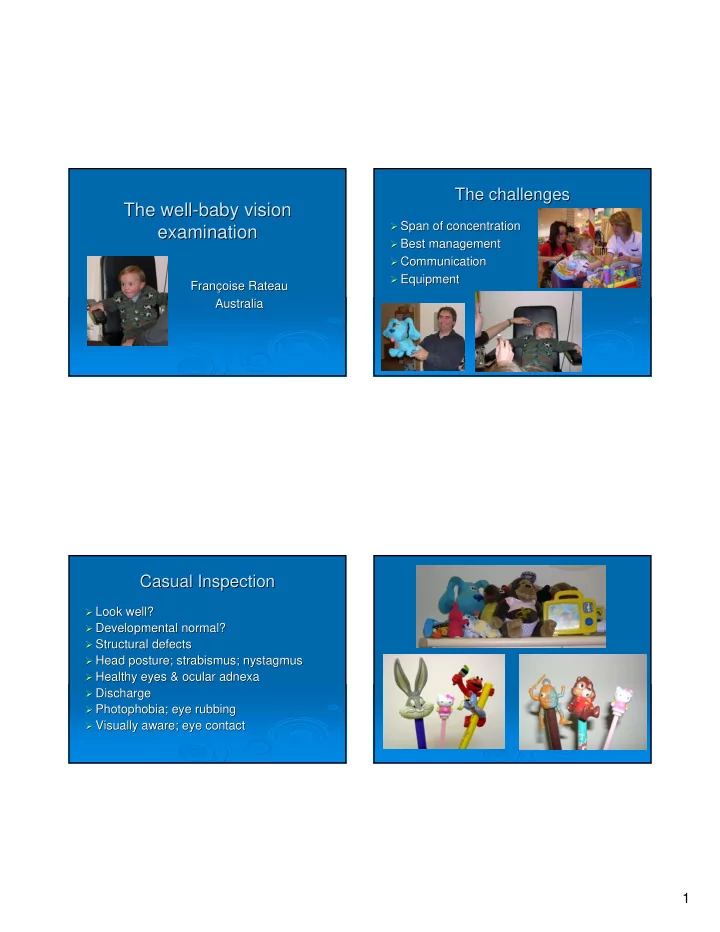
The challenges The challenges

  • Span of concentration

Span of concentration

  • Best management

Best management

  • Communication

Communication

  • Equipment

Equipment

Casual Inspection Casual Inspection

  • Look well?

Look well?

  • Developmental normal?

Developmental normal?

  • Structural defects

Structural defects

  • Head posture; strabismus; nystagmus

Head posture; strabismus; nystagmus

  • Healthy eyes & ocular adnexa

Healthy eyes & ocular adnexa

  • Discharge

Discharge

  • Photophobia; eye rubbing

Photophobia; eye rubbing

  • Visually aware; eye contact

Visually aware; eye contact

slide-2
SLIDE 2

2

The aim of the examination The aim of the examination

  • Prevention of strabismus/amblyopia

Prevention of strabismus/amblyopia

  • Prevention of vision problems that can

Prevention of vision problems that can affect development & learning; quality of affect development & learning; quality of life issues life issues

  • Detection of pathology (primary and

Detection of pathology (primary and secondary), neurological disorders (eg secondary), neurological disorders (eg nystagmus, ptosis) and congenital nystagmus, ptosis) and congenital malformations malformations

What could we measure? What could we measure?

  • Casual inspection

Casual inspection

  • Cover test and

Cover test and motilities; NPC motilities; NPC

  • Pupils

Pupils

  • Vision

Vision -

  • FPL

FPL

  • Refractive status:

Refractive status: dry, wet dry, wet

  • Fusional ranges

Fusional ranges

  • Accommodation:

Accommodation: near ret, near ret,

  • Stereo

Stereo

  • Visual fields

Visual fields

  • Slit lamp

Slit lamp

  • Internal

Internal

  • Developmental

Developmental tests; reflexes tests; reflexes

My baby examination My baby examination

  • Casual inspection

Casual inspection

  • Visually aware

Visually aware

  • Fix & Follow

Fix & Follow

  • Equal avoidance to

Equal avoidance to cover cover

  • Motilities FROM

Motilities FROM

  • Pupils

Pupils

  • Ortho to cover test

Ortho to cover test

  • Near ret

Near ret

  • Cycloplegic ret

Cycloplegic ret

  • External

External

  • DFE

DFE

History History

  • Presenting complaint and who notices

Presenting complaint and who notices this? this?

  • Well?

Well?

  • Development wnl?

Development wnl?

  • Birth history; Apgar score

Birth history; Apgar score

  • Medications

Medications

  • FOH

FOH

slide-3
SLIDE 3

3

FOH of strabismus and amblyopia FOH of strabismus and amblyopia

Ingram & Walker 1979: Siblings of strabismus/amblyopia children Ingram & Walker 1979: Siblings of strabismus/amblyopia children

  • N=215 preschool siblings of children who

N=215 preschool siblings of children who presented with strabismus/amblyopia presented with strabismus/amblyopia

  • If no hyperopia/astigmatism/anisometropia

If no hyperopia/astigmatism/anisometropia present in sibling at age 1, they have 10% present in sibling at age 1, they have 10% chance of developing strab/amb. chance of developing strab/amb.

  • If

If ≥ ≥+2.00D sph in both eyes and/or +2.00D sph in both eyes and/or ≥ ≥1.5D of 1.5D of astigmatism, now have 40% chance of being astigmatism, now have 40% chance of being found later to have strab/amb found later to have strab/amb

  • (CT, VA <6/12 linear or >1line IOD

(CT, VA <6/12 linear or >1line IOD)

)

FOH of strabismus and amblyopia FOH of strabismus and amblyopia

Aurell and Norsell 1990 Aurell and Norsell 1990 A longitudinal study of children with a family history of strabi A longitudinal study of children with a family history of strabismus smus

  • If 1 parent or sibling has ET then 17%

If 1 parent or sibling has ET then 17% chance of child getting ET and 38% chance of child getting ET and 38% chance of being >+4.00D at 1 year chance of being >+4.00D at 1 year

  • If >+4.00D and FOH of ET then 46%

If >+4.00D and FOH of ET then 46% chance of ET chance of ET

slide-4
SLIDE 4

4

Case History Case History-

  • JB, IB

JB, IB

  • JB

JB May 2000 May 2000; 8 mo. ; 8 mo.

  • ?Intermittent ET; CT0

?Intermittent ET; CT0

  • Near ret +0.25OU

Near ret +0.25OU

  • Cyclo +4.50D

Cyclo +4.50D

  • June 2003

June 2003

  • Dry dist +2.00 +1.50

Dry dist +2.00 +1.50

  • Near ret +1.00/

Near ret +1.00/-

  • 0.50

0.50

  • Cyclo +4.50;Rx near

Cyclo +4.50;Rx near

  • 2004

2004 dry+4.25 4.00 dry+4.25 4.00

  • IB May 2002

IB May 2002; 9 mo ; 9 mo

  • Near ret +0.75 +1.75

Near ret +0.75 +1.75

  • Cyclo +7.00 +7.50

Cyclo +7.00 +7.50

  • 20BO fused and

20BO fused and released released

  • Oct 2002

Oct 2002

  • Dist dry ~+4.00 OU

Dist dry ~+4.00 OU

  • Near ret 1.00

Near ret 1.00→ →+2.00 +2.00

  • +8

+8.00/ .00/-

  • 1D +9.50/

1D +9.50/-

  • 1D

1D

Case history DB Case history DB

  • Sept 2005

Sept 2005; 7 mo. ; 7 mo.

  • Dist dry +2.00 OU

Dist dry +2.00 OU

  • Near ret +0.50 to

Near ret +0.50 to +2.00 +2.00

  • Cyclo +6.50 +7.00/

Cyclo +6.50 +7.00/-

  • 0.75

0.75

  • Mum:

Mum: pl/ pl/-

  • 4.00 +0.75/

4.00 +0.75/-

  • 4.75

4.75

  • Dad

Dad +8.25/ +8.25/-

  • 1.25 +7.75/

1.25 +7.75/-

  • 1.25

1.25 Strab Sx age 3 yrs Strab Sx age 3 yrs Orthotrope Orthotrope No fly No fly

Referral sources to our practice Referral sources to our practice

  • 58% Maternal and Child Health nurses

58% Maternal and Child Health nurses

  • 30% Family in care

30% Family in care

  • 9% Friends

9% Friends

  • 3% Other

3% Other

  • N=33, ages 2

N=33, ages 2-

  • 19 months, median 8

19 months, median 8 months (SD4.5) months (SD4.5)

slide-5
SLIDE 5

5

Why do they present Why do they present

  • 64% ET/XT (usually ET)

64% ET/XT (usually ET)

  • 9% routine

9% routine

  • 9% presumed ptosis

9% presumed ptosis

  • 6% eyes don

6% eyes don’ ’t move together t move together

  • 3% (1/33) nystagmus; photophobia;

3% (1/33) nystagmus; photophobia; rubbing eyes; poor awareness of rubbing eyes; poor awareness of environment; roving eyes; watery eyes; environment; roving eyes; watery eyes; FOH ref error FOH ref error

Cycloplegic refraction Cycloplegic refraction

  • Term to 12 months 0.5%

Term to 12 months 0.5% cyclopentolate (Hatch); cyclopentolate (Hatch); punctal occlusion punctal occlusion

  • (also toddlers with heart

(also toddlers with heart arrhythmias, Down arrhythmias, Down syndrome, hepatic syndrome, hepatic problems etc) problems etc)

  • Preterm 0.2%; after 4

Preterm 0.2%; after 4 months 1% (Repka) months 1% (Repka)

Near and cycloplegic retinoscopy Near and cycloplegic retinoscopy data from our practice data from our practice

Retinoscopy- near and cyclo

  • 2
  • 1

1 2 3 4 5 6 7 8 1 2 3 4 5 6 7 8 9 10 11 12 13 14 15 16 Patients Dioptres cyclo near

Comparing noncycloplegic with cycloplegic Comparing noncycloplegic with cycloplegic retinoscopy in Pre retinoscopy in Pre-

  • School children

School children

  • Maino J et al

Maino J et al Noncycloplegic vs Noncycloplegic vs cycloplegic cycloplegic retinoscopy in Pre retinoscopy in Pre-

  • School children

School children 1984 1984 “ “little little agreement agreement between the two between the two findings findings” ” (Mohindra) (Mohindra)

  • Gwiazda:1996 Half the

Gwiazda:1996 Half the children with infantile children with infantile sph equiv sph equiv’ ’s <+0.50D s <+0.50D are myopic at age are myopic at age 9to16 years (vs 20%) 9to16 years (vs 20%)

  • Atkinson 1996

Atkinson 1996 Videorefractive images Videorefractive images without cycloplegia without cycloplegia Accommodative lag Accommodative lag strongly predictive of strongly predictive of hyperopia ( hyperopia (≥ ≥+3.50) +3.50) under cycloplegia under cycloplegia

slide-6
SLIDE 6

6

Why do they present Why do they present

  • 64% ET/XT (usually ET)

64% ET/XT (usually ET)

  • 9% routine

9% routine

  • 9% suspected ptosis

9% suspected ptosis

  • 6% eyes don

6% eyes don’ ’t move together t move together

  • (3%) 1/33 photophobia; rubbing eyes; poor

(3%) 1/33 photophobia; rubbing eyes; poor awareness of environment; roving eyes; awareness of environment; roving eyes; watery eyes; FOH ref error; nystagmus watery eyes; FOH ref error; nystagmus

Nystagmus Nystagmus

  • CIN jerk, conjugate, autosomal dominant

CIN jerk, conjugate, autosomal dominant

  • SDN albinism, cataract, aniridia,

SDN albinism, cataract, aniridia, coloboma, achromatopsia, Leber coloboma, achromatopsia, Leber’ ’s, optic s, optic chiasmal glioma chiasmal glioma

  • Vertical, seesaw, pendular

Vertical, seesaw, pendular

  • Triangular, then pendular then jerk

Triangular, then pendular then jerk

Assessing the vision of an infant Assessing the vision of an infant

  • Awareness of & interest in environment

Awareness of & interest in environment

  • Brisk pupil reaction direct & consensually

Brisk pupil reaction direct & consensually to light to light

  • Good eye contact (vs looking

Good eye contact (vs looking through faces) through faces)

  • Beware nystagmus or

Beware nystagmus or roving eye movements roving eye movements

Assessing the vision of an infant Assessing the vision of an infant

  • Fix and follow

Fix and follow

  • thumb

thumb

  • Target: distance/near; face/toy

Target: distance/near; face/toy

  • Equal avoidance of cover

Equal avoidance of cover

  • Fixation preference if

Fixation preference if strabismus present strabismus present

  • Induced strabismus

Induced strabismus-

  • 10BD/ 15BI

10BD/ 15BI

slide-7
SLIDE 7

7

Assessing the vision of an infant Assessing the vision of an infant

  • Preferential looking

Preferential looking

  • Sweep VEP, ERG

Sweep VEP, ERG

  • Age 2 months follow past midline

Age 2 months follow past midline

  • Age 3 months vertical eye movements

Age 3 months vertical eye movements

  • CSM: Central (vs eccentric), steady (not

CSM: Central (vs eccentric), steady (not nystagmoid/roving), maintained (when nystagmoid/roving), maintained (when

  • ther eye uncovered i.e. no strab)
  • ther eye uncovered i.e. no strab)

External examination External examination

  • Lid ptosis, colour, oedema

Lid ptosis, colour, oedema

  • Eyelid/iris coloboma

Eyelid/iris coloboma

  • Ocular melanosis, naevus of Ota; caf

Ocular melanosis, naevus of Ota; café é au lait au lait

  • Dermoids (conj or periocular)

Dermoids (conj or periocular)

  • Cutaneous haemangioma

Cutaneous haemangioma

  • Pupils; heterochromia; transillumination

Pupils; heterochromia; transillumination

  • Clear cornea & lens; corneal diameter

Clear cornea & lens; corneal diameter

  • Leukocoria

Leukocoria

  • Proptosis

Proptosis

Dilated Fundus Examination Dilated Fundus Examination

  • Retinoschisis or RD

Retinoschisis or RD

  • PHPV

PHPV

  • Retinoblastoma

Retinoblastoma

  • Albinism

Albinism

  • Toxoplasmosis

Toxoplasmosis

  • ON flat, pink, size, cupping,

ON flat, pink, size, cupping, developmentally normal developmentally normal

Cycloplegic refractions in healthy Cycloplegic refractions in healthy children aged 1 to 48 months children aged 1 to 48 months

Mayer, Hansen, Moore and Fulton, 2001 Mayer, Hansen, Moore and Fulton, 2001

  • Normal population

Normal population

  • N=514

N=514

  • Median N=43 per

Median N=43 per group (range 32 group (range 32-

  • 52)

52)

  • 85% white

85% white

  • Gestational age

Gestational age ≥ ≥37w 37w

  • Apgar score

Apgar score ≥ ≥8 8

  • Uncomplicated

Uncomplicated neonatal period neonatal period

  • No medical problems

No medical problems

  • Parents report

Parents report developmentally developmentally normal normal

slide-8
SLIDE 8

8

Cycloplegic refractions in healthy Cycloplegic refractions in healthy children aged 1 to 48 months children aged 1 to 48 months

Mayer, Hansen, Moore and Fulton, 2001 Mayer, Hansen, Moore and Fulton, 2001

  • 1 drop 1% cyclopentolate + punctal

1 drop 1% cyclopentolate + punctal

  • cclusion
  • cclusion
  • Retinoscopy by BM optom & AF ophthal

Retinoscopy by BM optom & AF ophthal

  • Masked as to other refractionist

Masked as to other refractionist’ ’s results s results

Cycloplegic refractions in healthy Cycloplegic refractions in healthy children aged 1 to 48 months children aged 1 to 48 months

Mayer, Hansen, Moore and Fulton, 2001 Mayer, Hansen, Moore and Fulton, 2001

  • Significant

Significant decline in decline in hyperopia hyperopia with age with age

  • Significant

Significant ↓ ↓ in range in range

  • f
  • f

spherical spherical equivalent equivalent

Cycloplegic refractions in healthy Cycloplegic refractions in healthy children aged 1 to 48 months children aged 1 to 48 months

Mayer, Hansen, Moore and Fulton, 2001 Mayer, Hansen, Moore and Fulton, 2001

  • At each age spherical equivalents

At each age spherical equivalents normally distributed normally distributed

  • 1% anisometropia

1% anisometropia ≥ ≥ 1D 1D (Ingram 6.5% age 1)

(Ingram 6.5% age 1)

  • 25% astigmatism

25% astigmatism ≥ ≥ 1D 1D

  • 3% astigmatism

3% astigmatism ≥ ≥2 2

  • 56% ATG, 29% WTR, 14% oblique

56% ATG, 29% WTR, 14% oblique (> (>± ±15 15º º; all mirror images) ; all mirror images) (Ingram found

(Ingram found WTR=ATR in 1 year olds WTR=ATR in 1 year olds

Cycloplegic refractions in healthy Cycloplegic refractions in healthy children aged 1 to 48 months children aged 1 to 48 months

Mayer, Hansen, Moore and Fulton, 2001 Mayer, Hansen, Moore and Fulton, 2001

Highest Highest prevalence prevalence

  • f subjects
  • f subjects

with with astigmatism astigmatism @ ages 2.5, @ ages 2.5, 4, 6, 9 4, 6, 9 months months

slide-9
SLIDE 9

9

Myopia Myopia

  • 3% myopia

3% myopia ≥ ≥ -

  • 0.50D (Mayer et al)

0.50D (Mayer et al)

  • Congenital/infantile myopia is usually of

Congenital/infantile myopia is usually of large magnitude (>5D) and tends to large magnitude (>5D) and tends to remain stable throughout life (Repka) remain stable throughout life (Repka)

  • Occurs in Stickler

Occurs in Stickler’ ’s syndrome, RP & glauc s syndrome, RP & glauc

  • Mild ROP some

Mild ROP some ↑ ↑in freq mild myopia in freq mild myopia

  • Moderate/severe ROP have distributions

Moderate/severe ROP have distributions clearly skewed to myopic sph equivalents clearly skewed to myopic sph equivalents

Changes in refraction between Changes in refraction between ages 1 and 3 ages 1 and 3½ ½ years 1979 years 1979

Ingram and Barr BJO 1979 Ingram and Barr BJO 1979

  • 1% Cyclopentolate;

1% Cyclopentolate; refraction by Ingram refraction by Ingram

  • N=148

N=148

  • 1 year olds presenting

1 year olds presenting for immunisation for immunisation

  • Aniso both appeared

Aniso both appeared and disappeared and disappeared

  • At age one, 12/148

At age one, 12/148 aniso yet by age 3.5 aniso yet by age 3.5

  • nly 7/12 still had
  • nly 7/12 still had

aniso and 8 new aniso and 8 new children had aniso children had aniso

Changes in refraction between Changes in refraction between ages 1 and 3 ages 1 and 3½ ½ years years

Ingram and Barr 1979 Ingram and Barr 1979

  • If at age 1year <+2.50D, significant trend

If at age 1year <+2.50D, significant trend to emmetropia to emmetropia

  • If at age 1 year

If at age 1 year ≥ ≥ +2.50, may become +2.50, may become more or less hyperopic more or less hyperopic

  • Significant decrease in both the incidence

Significant decrease in both the incidence

  • f astigmatism in individual eyes and the
  • f astigmatism in individual eyes and the

number of children who have >1.50DC number of children who have >1.50DC

Changes in refraction between the Changes in refraction between the ages of 1 and 3 ages of 1 and 3½ ½ years years

Ingram and Barr 1979 Ingram and Barr 1979

  • If

If ≥ ≥+3.50, 48% chance of squint and 57% +3.50, 48% chance of squint and 57% possibility of amblyopia possibility of amblyopia

  • Persistent (after intervention) severe (6/24

Persistent (after intervention) severe (6/24

  • r worse) amblyopia had either
  • r worse) amblyopia had either ≥

≥+3.50 or +3.50 or ≥ ≥-

  • 4.00D meridional ref error at age 1yr

4.00D meridional ref error at age 1yr

slide-10
SLIDE 10

10

Atkinson 1981 Atkinson 1981-

  • 4

4

  • 3166 infants screened by orthoptist using

3166 infants screened by orthoptist using 1% cyclopent. & isotropic photorefraction 1% cyclopent. & isotropic photorefraction

  • 4.6% >+3.50D

4.6% >+3.50D

  • Strong trend for

Strong trend for ↓ ↓ hyperopia hyperopia

  • No sig difference in rate of

No sig difference in rate of ↓ ↓ hyperopia bw hyperopia bw those who wore partial correction & those those who wore partial correction & those uncorrected uncorrected

↓ hyperopia most marked if no marked hyperopia most marked if no marked astig astig

Atkinson 1981 Atkinson 1981-

  • 4

4

  • Measured outcome at 4 years

Measured outcome at 4 years

  • 21% of hyperopes who did not wear a

21% of hyperopes who did not wear a correction became strabismic (vs 1.6% of correction became strabismic (vs 1.6% of emmetropic controls and 6.3% of the emmetropic controls and 6.3% of the treatment compliant group) treatment compliant group)

  • 68% of non

68% of non-

  • treated group achieved VA

treated group achieved VA less than 6/9 (vs 11.1% of emmetropic less than 6/9 (vs 11.1% of emmetropic controls and 28.6% of the treatment controls and 28.6% of the treatment compliant group) compliant group)

What to prescribe & when What to prescribe & when

  • Strabismus or amblyopia

Strabismus or amblyopia

  • Age 1 onwards watch very carefully

Age 1 onwards watch very carefully hyperopia over 3D and intervene if higher hyperopia over 3D and intervene if higher

  • Decide on basis of age, degree & stability

Decide on basis of age, degree & stability

  • f hyperopia, accommodation status,
  • f hyperopia, accommodation status,

binocular status, VA, developmental status binocular status, VA, developmental status

  • Emmetropisation & success of intervention

Emmetropisation & success of intervention Ingram vs. Atkinson Ingram vs. Atkinson

What I say to parents What I say to parents

  • Your child

Your child’ ’s profile versus the normal s profile versus the normal profile profile

  • What if we Rx and what if we don

What if we Rx and what if we don’ ’t t

  • If no intervention, when is the next

If no intervention, when is the next assessment important assessment important

slide-11
SLIDE 11

11

Final notes Final notes

  • Have to cycloplege 0 to 2 year olds

Have to cycloplege 0 to 2 year olds

  • Pathology can exist and be dangerous

Pathology can exist and be dangerous

  • Think before prescribing for low/moderate

Think before prescribing for low/moderate cylinder & anisometropia cylinder & anisometropia

  • Consider prescribing for +3.00 and over

Consider prescribing for +3.00 and over

  • Myopia is unusual

Myopia is unusual

  • Work quickly, using helpers; invest in toys

Work quickly, using helpers; invest in toys

  • Review as often

Review as often as necessary as necessary