ThorCon: Low Cost, Dependable, CO2-free Power 1 Key Features of - - PowerPoint PPT Presentation

thorcon low cost dependable co2 free power
SMART_READER_LITE
LIVE PREVIEW

ThorCon: Low Cost, Dependable, CO2-free Power 1 Key Features of - - PowerPoint PPT Presentation

ThorCon: Low Cost, Dependable, CO2-free Power 1 Key Features of ThorCon Technology Safe Low pressure device with passive shutdown - does not depend on operators or electronics Lower cost electricity Provides baseload and load


slide-1
SLIDE 1

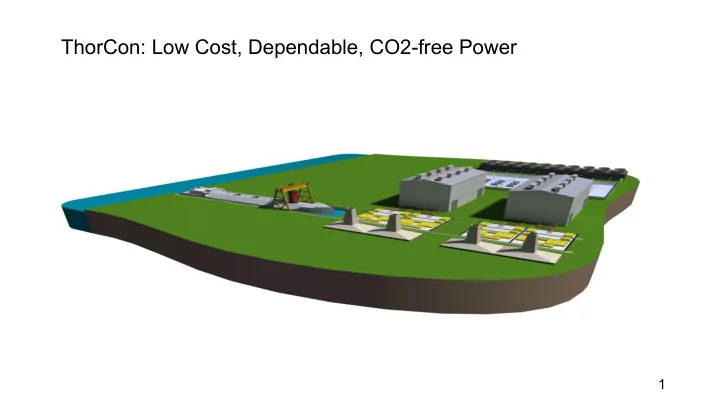
ThorCon: Low Cost, Dependable, CO2-free Power

1
slide-2
SLIDE 2

Key Features of ThorCon Technology

  • Safe


Low pressure device with passive shutdown - does not depend on operators or electronics


  • Lower cost electricity


Provides baseload and load following electricity at inexpensive rates.


  • Now - 


Pragmatic approach that does not depend on new technology


  • Volume production 


Design can be mass produced at 10-20 GWe per year (or more).
 2

slide-3
SLIDE 3

Electricity Demand Continues to Grow Rapidly


Supplied Mostly by Coal

One large nuclear plant is around 1GWe Total US usage is 500 Gwe Roughly 1kW/person in Europe & Calif. World population currently 7B people May stabilize at 10-12B => 10-12,000 GWe Oil unlikely to expand 5x. Electricity applications will expand
 transport Industrial heat Demand could go as high as 70,000 Gwe Nuclear is the only energy source that can do the job with low environmental impact. But to be widely adopted nuclear must be safe and the lowest cost solution.

1970 1980 1990 2000 2010 2020 2030 2040 2050 500 1000 1500 2000 2500 3000 3500 4000 4500 5000 Total Use Total Forecast Fossil Supplied Fossil Forecast

Year Worldwide Electricity Consumption (GWe) Source US Energy Information Administration

slide-4
SLIDE 4

Indian Electrical Growth is Accelerating

  • Electricity growth is accelerating in India.
  • Vast majority of India's electricity generation is

yet to be built

  • China grew at 35GW/year over the last twelve

years.

  • 80% of that was coal and that is creating

problems so that some of the coal power plants are being replaced.

  • IF we can get nuclear to be cheaper than coal we

can avoid the problems associated with massive coal burning.

Indi

  • 1940

1950 1960 1970 1980 1990 2000 2010 2020 100 200 300 400 500 600 India Consumption China Electricity Production

G w e Year

slide-5
SLIDE 5

Volume Production System

3

slide-6
SLIDE 6

Ultra large crude carrier cost $89M ThorCon ¼ th the steel and simpler construction

Build Nuclear Power Plants Like ULCC’s

4

slide-7
SLIDE 7

Shipyard Productivity

  • Productivity comes from semi-automation.
  • 67,000 tons of complex steel vs 18,000 simple for ThorCon nuclear island.
  • Direct labor: 700,000 man-hours. About 40% steel, 60% outfitting.
  • 4 to 5 man-hours per ton of hull steel.

5

slide-8
SLIDE 8

Shipyard Quality.

  • 150 to 500 ton blocks. Forces precise dimensional control.
  • Inspection and testing far easier at sub-assembly, assembly, and block level.
  • Defects found early. Most corrected without affecting overall schedule.
  • If ship has > 15 days offhire a year, operating in a hostile environment, it’s a
  • lemon. 15 days annual offhire is 96% availability.

6

slide-9
SLIDE 9

Build Everything On An Assembly Line

  • Reactor yard produces 150--500 ton blocks. About 100 blocks per 1GWe plant.
  • Blocks are pre-coated, pre-piped, pre-wired, pre-tested.
  • Focus quality control at the block and sub-block level.
  • Blocks barged to site, dropped into place, and welded together.
  • 90+% labor at factory
  • Hyundai shipyard in Ulsan, South Korea pictured below is sufficient to manufacture 100 GWe

power plants per year. Proposed shipyard sufficient to manufacture 10 one GWe power plants per year. 7

slide-10
SLIDE 10

Build the Largest Blocks at the Factory We Can

Block size is limited by transport 80% of world population lives within 500 miles of coast or major river Target using barges - allows much larger blocks than train or truck. Barge up to 23 meters wide. Height depends on river or open ocean. Length essentially unlimited. Crane soft limit of 500 tonnes.

8

slide-11
SLIDE 11

One large shipyard to factory- build new power plants Barge to NPP site (around 20 barge loads per GWe) NPP sites (1 GWe site shown)
 1,000-20,000 GWe total)

9

slide-12
SLIDE 12

One large shipyard to factory- build new power plants Barge to NPP site (around 20 barge loads per GWe) NPP sites (1 GWe site shown)
 1,000-20,000 GWe total) Canship delivers new cans and takes

  • ld cans back for recycling. Also

transports new fuel and returns spent

  • fuel. One round trip every four years

to each 1GWe site. Can recycling center cleans and inspects cans, replace graphite, stores offgas and graphite wastes. Similar to a shipyard.

10

slide-13
SLIDE 13

One large shipyard to factory- build new power plants Barge to NPP site (around 20 barge loads per GWe) NPP sites (1 GWe site shown)
 1,000-20,000 GWe total) Canship delivers new cans and takes

  • ld cans back for recycling. Also

transports new fuel and returns spent

  • fuel. One round trip every four years

to each 1GWe site. Can recycling center cleans and inspects cans, replace graphite, stores offgas and graphite wastes. Similar to a shipyard. Fuel recycling center. Initial fluorination & vacuum distill to recover most of fuel salt. Store spent fuel for future processing.
 
 Future IAEA secure site.
 Uranium re-enrichment and Pu extraction to recover remaining valuable content.

11

slide-14
SLIDE 14

Plant Overview

12

slide-15
SLIDE 15

ThorCon: Cheap, Dependable, CO2-free Power

Outside-in overview of ThorCon Design

13

slide-16
SLIDE 16

1 GWe ThorCon Baseline Site Plan

14 310 m 330 m

slide-17
SLIDE 17
  • Uses 600MWe turbine/generator
  • Same spec’s as coal plants
  • Most cost efficient size
  • Back off from full spec’s to increase

reliability and lifetime

  • Need turbine/generator for full testing


  • (Small markets could use a single

module and a smaller turbine/generator.)

Fission Prototype Uses Two Power Modules
 500 MWe

15

slide-18
SLIDE 18
  • Nuclear plant divided into 250 MWe/

557 MWt underground power modules.

  • Each module is made up of two Cans

housed in silos.

  • Each Can contains a 250 MWe reactor,

primary loop pump, and primary heat exchanger.

  • Cans are duplexed. To accommodate 4

year moderator life, Can operates for four years, then cools down for four years, and then is changed out.

Power Module is 250 MWe

16

slide-19
SLIDE 19

ThorCon’s Heart: The Can

  • Pump pushes fuelsalt around loop at just under 3000 kg/s. 14

sec loop time.

  • Pot full of graphite slows neutrons produced by fuel creating

chain reaction which heats fuelsalt from 564C to 704C.

  • Also converts portion of Th to U-233, portion of U-238 to

Pu-239.

  • Primary Heat Exchanger transfers heat to secondary salt

cooling.

  • One major moving part.
  • Pot pressure about 4 bar gage.
  • Pump header tank extracts fission product gases.
  • Fuse valve (grey) melts on Can over-temperature.

17

slide-20
SLIDE 20
  • If Can overheats for whatever reason, fuse

valve melts and primary loop drains to Fuelsalt Drain Tank (FDT).

  • No moderator, geometry designed to reduce

reactivity, => no chain reaction, no chance for re-criticality

  • No operator intervention required.
  • No valves to realign.
  • Nothing operators can do to stop this drain.


  • If primary loop ruptures - (equivalent to a

meltdown and primary containment breach) then the fuel salt drains to FDT.

  • In most cases, damage limited to Can change
  • ut.

ThorCon Can Silo

18

slide-21
SLIDE 21

ThorCon is a Four Barrier Design

1. Primary Loop Piping, Pump, Pot, HX 2. Can/Drain Tank, 5 bar over-pressure. 3. Silo Cavity. Inerted. Duplex/triplex barrier. 4. Silo Hall, 1 bar over-pressure. Triplex barrier.

  • At least one internal barrier between

modules.

  • All but top of silo hall barrier well

underground

  • Fuelsalt chemistry: the 5th barrier?

19

slide-22
SLIDE 22

Fixability

  • Don’t pretend things will last 30 or 40 years. Often we don’t know the MTBF.

Even if we did, things are going to break and we do not know when. Plan for it.


  • Everything but the building must be replaceable with modest impact on plant
  • utput.

  • The existing nuclear challenge: when something breaks, it can be very

hard to go in and fix it.


  • ThorCon addresses this key problem with duplexing, easy access (due to

low pressure), and swappable modules.

20

slide-23
SLIDE 23

Cheap, reliable, carbon-free electricity
 NOW!

no new research no unobtainable materials shipyard production speed replaceable irradiated materials

The ThorCon Design Philosophy

steam power conversion factory quality control fixable, replaceable parts no scale-up delay

21

slide-24
SLIDE 24

Year 1 2 3 4 5 6 7 8 9 10 
 $10M $85M $35M $210M $275M $65M (self-financed)

The ThorCon Required Funding

Nonfission Plant Fission Plant

Seed Deploy ThorCons
 2 5 10 Yard

Prepare bid packages, negotiate bids, identify any risk areas, draft PSAR Build 250MWe non-fission prototype (year 2), nonfission tests (year 3) Build 500MWe fission plant (year 4)

Fission Tests

Tests leading to license (years 5&6) Build reactor yard (year 7) 22

slide-25
SLIDE 25

Goals for Seed


(Year 1)

  • Develop bid packages
  • negotiate with vendors
  • identify areas that are beyond current commercial capabilities
  • design out what we can
  • Generate and R&D plan for the remainder
  • Goal is to be ready to build, some components may still require

development but we need to identify the box they fit into.

  • Determine the host country, site selection
  • Raise next round funding.

25

slide-26
SLIDE 26

Goals for Non-fission Prototype 


(Years 2 & 3)

  • Contract and build single power module in year 2
  • Electric heat, no fission 5-10MW, no turbine
  • No fissile but does contain thorium and uranium
  • Year 3: Test fluid dynamics, pump, heat transfer rates, thermal

expansion, heat exchanger performance, off-gas removal, flow & pressure sensors, salt properties, salt transfers, fuse valve performance, transfer to dump tank (thermal shock), membrane wall performance, etc.

  • Goal to reduce need to make changes to fission prototype.

26

slide-27
SLIDE 27

Build Fission Plant 


(Year 4 & half of year 5)

  • Contract and build dual power module
  • turbine & generator
  • Zero power at end of year four.
  • Turbine & generator six months into year 5.
  • No fission: repeat many of previous tests.
  • Very low power tests include: reactivity measurements, shutdown

rod measurements, flow control reactivity, neutron activity measurements, salt balance measurements.

  • Goal to be ready to go to high power.

27

slide-28
SLIDE 28

Fission Tests 


(Years 5&6)

  • Normal operations to full power. Increase power checking

controllability, sensors, salt balance, flow control, heat transfers as we increase power in year 5.

  • Casualities testing. Cause simulated casualities (loss of heat

sink, loss of flow, station blackout, team pipe burst, … ) and verify system performs as expected.

  • Goal: complete all testing needed to get license.
  • Review of testing by regulators should be ongoing during the

tests.

28

slide-29
SLIDE 29

Build the Yard 


(Year 7)

  • Choose site, install panel lines, install robotic welders, train staff

to set up a modest yard capable of fabricating10 one GWe plants per year.

  • During this time we may also be building commercial power

plants by contracting to existing shipyards if license comes quickly.

29

slide-30
SLIDE 30

Deploy ThorCons 


(Years 8-11)

  • Start two in year 8 (complete at end of year 9).
  • Start five in year 9 (complete at end of year 10).
  • Start ten in year 10 (complete at end of year 11).
  • Ramp up to higher throughput is dependent on market takeup.
  • 30
slide-31
SLIDE 31

Financial Forecast

slide-32
SLIDE 32

Year Net Income $M 8 $1,200 9 $4,200 10 $9,000 11 $12,000 12 $12,000 Total $38,400

Net Profit from Power Plant Sales

slide-33
SLIDE 33

12 $M Equity $680 Gross Income $66,507 Net Income $39,627 IRR 65%

Economic Profile of First 12 Years

slide-34
SLIDE 34

12

Economic Notes

  • Financial forecast assumes selling power plants for $2B/GWe, income from

management contracts, and sales of power from prototype.

  • Some markets will prefer to buy power through long term power purchase
  • agreements. In which case, we own and operate the power plants.