THURSDAY, FEBRUARY 27, 2014 7:00 am Registration/Breakfast 8:00 - - PDF document

thursday february 27 2014 7 00 am registration breakfast
SMART_READER_LITE
LIVE PREVIEW

THURSDAY, FEBRUARY 27, 2014 7:00 am Registration/Breakfast 8:00 - - PDF document

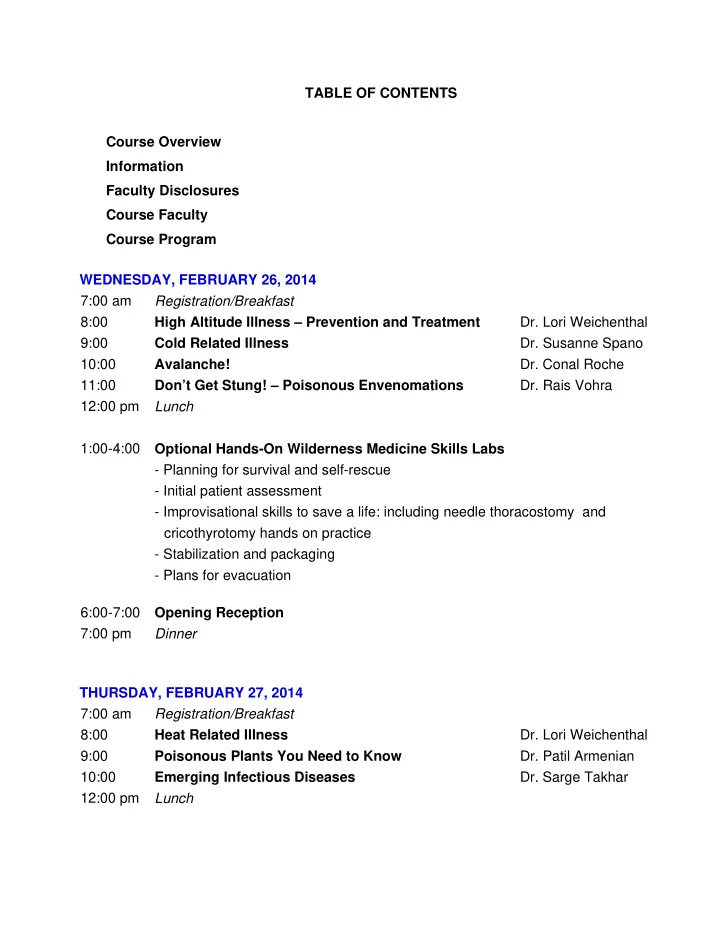
TABLE OF CONTENTS Course Overview Information Faculty Disclosures Course Faculty Course Program WEDNESDAY, FEBRUARY 26, 2014 7:00 am Registration/Breakfast 8:00 High Altitude Illness Prevention and Treatment Dr. Lori Weichenthal 9:00


slide-1
SLIDE 1

TABLE OF CONTENTS Course Overview Information Faculty Disclosures Course Faculty Course Program WEDNESDAY, FEBRUARY 26, 2014 7:00 am Registration/Breakfast 8:00 High Altitude Illness – Prevention and Treatment

  • Dr. Lori Weichenthal

9:00 Cold Related Illness

  • Dr. Susanne Spano

10:00 Avalanche!

  • Dr. Conal Roche

11:00 Don’t Get Stung! – Poisonous Envenomations

  • Dr. Rais Vohra

12:00 pm Lunch 1:00-4:00 Optional Hands-On Wilderness Medicine Skills Labs

  • Planning for survival and self-rescue
  • Initial patient assessment
  • Improvisational skills to save a life: including needle thoracostomy and

cricothyrotomy hands on practice

  • Stabilization and packaging
  • Plans for evacuation

6:00-7:00 Opening Reception 7:00 pm Dinner THURSDAY, FEBRUARY 27, 2014 7:00 am Registration/Breakfast 8:00 Heat Related Illness

  • Dr. Lori Weichenthal

9:00 Poisonous Plants You Need to Know

  • Dr. Patil Armenian

10:00 Emerging Infectious Diseases

  • Dr. Sarge Takhar

12:00 pm Lunch

slide-2
SLIDE 2

1:00-4:00 Optional Hands-On Wilderness Medicine Skills Labs (REPEAT)

  • Planning for survival and self-rescue
  • Initial patient assessment
  • Improvisational skills to save a life: including needle thoracostomy and

cricothyrotomy hands on practice

  • Stabilization and packaging
  • Plans for evacuation

7:00 pm KEYNOTE SPEAKER/DINNER Lessons from the Alaska Wilderness

  • Dr. Jennifer Dow

FRIDAY, FEBRUARY 28, 2014 7:00 am Registration/Breakfast 8:00 Search and Rescue in the National Parks

  • Dr. Geoff Stroh
  • Dr. Megann Young

Erika Jostad 10:00 Don’t Forget Your Safety Pin – 30 Ways it Can Save Your Life

  • Dr. Desiree Crane

11:00 Final Case Scenarios – Applying What You Have Learned Course Staff 12:00 pm Adjourn

slide-3
SLIDE 3

University of California, San Francisco at Fresno, Department of Emergency Medicine Presents

High Sierra Wilderness Medicine Conference 2014

Wednesday – Friday

February 26-28, 2014 Granlibakken Conference Center & Lodge Tahoe City, California Course Co-Chairs Danielle Campagne, MD Lori Weichenthal, MD Megann Young, MD

University of California, San Francisco School of Medicine

slide-4
SLIDE 4

University of California, San Francisco School of Medicine Presents

High Sierra Wilderness Medicine Conference 2014

Educational Objectives Upon completion of this program, attendees should be able to:

  • Apply evidence-based management options of medical problems that are unique to the

wilderness setting including high altitude illness, environmental exposure, lightning injuries, and toxic plant ingestions;

  • Improve necessary skills for remote medical care including patient assessment, trauma

care, orthopaedic manipulation, wilderness improvisation, and pearls of basic survival;

  • Incorporate leadership and teamwork skills in the wilderness setting to affect improved

patient outcomes. Accreditation The University of California, San Francisco School of Medicine (UCSF) is accredited by the Accreditation Council for Continuing Medical Education to provide continuing medical education for physicians. UCSF designates this live activity for a maximum of 12.00 AMA PRA Category 1 Credit™ toward the AMA Physician’s Recognition Award. Physicians should

  • nly claim credit commensurate with the extent of their participation in the

activity. UCSF designates optional hands-on workshops for a maximum of 3.00 AMA PRA Category 1 Credit™ toward the AMA Physician’s Recognition Award. Physicians should only claim credit commensurate with the extent of their participation in the activity. This CME activity meets the requirements under California Assembly Bill 1195, continuing education and cultural and linguistic competency. Nurses: For the purpose of recertification, the American Nurses Credentialing Center accepts AMA PRA Category 1 Credit™ issued by organizations accredited by the ACCME. Pharmacists: The California Board of Pharmacy accepts as continuing professional education those courses that meet the standard of relevance to pharmacy practice and have been approved for AMA PRA Category 1 Credit™. Physician Assistants: AAPA accepts category 1 credit from AOACCME, Prescribed credit from AAFP, and AMA PRA Category 1 Credit™ from organizations accredited by the ACCME.

slide-5
SLIDE 5

General Information

Attendance Verification/Sign-In Sheet / CME Certificates

Please remember to sign-in when you check in at the UCSF Registration Desk on your first day. You only need to sign-in once for the course, when you first check in. Evaluation Your opinion is important to us – we do listen! We have two evaluations for this

  • meeting. The speaker evaluation is the bright blue hand-out you received when you

checked in. Please complete this during the meeting and turn it in to the registration staff at the end of the conference. The overall conference evaluation is online at: http://www.ucsfcme.com/evaluation Upon completing the online evaluation, your CME certificate will be automatically generated and emailed to you. We request you complete this evaluation within 30 days of the conference in order to receive your CME certificate through this format. Security We urge caution with regard to your personal belongings and syllabus books. We are unable to replace these in the event of loss. Please do not leave any personal belongings unattended in the meeting room during lunch or breaks or overnight. Optional Activities Space is still available for the optional hands on workshops being held on both February 26th and 27th. Please see the registration desk to register (additional fees do apply). This is open to all attendees. Presentations Updated PDF presentations will be available on our website www.cme.ucsf.edu approximately 2-4 weeks post event. We will only post presentations for those authorized by the presenters.

slide-6
SLIDE 6

Federal and State Law

Regarding Linguistic Access and Services for Limited English Proficient Persons I. Purpose. This document is intended to satisfy the requirements set forth in California Business and Professions code 2190.1. California law requires physicians to obtain training in cultural and linguistic competency as part of their continuing medical education programs. This document and the attachments are intended to provide physicians with an overview of federal and state laws regarding linguistic access and services for limited English proficient (“LEP”) persons. Other federal and state laws not reviewed below also may govern the manner in which physicians and healthcare providers render services for disabled, hearing impaired or other protected categories II. Federal Law – Federal Civil Rights Act of 1964, Executive Order 13166, August 11, 2000, and Department of Health and Human Services (“HHS”) Regulations and LEP Guidance. The Federal Civil Rights Act of 1964, as amended, and HHS regulations require recipients of federal financial assistance (“Recipients”) to take reasonable steps to ensure that LEP persons have meaningful access to federally funded programs and services. Failure to provide LEP individuals with access to federally funded programs and services may constitute national origin discrimination, which may be remedied by federal agency enforcement action. Recipients may include physicians, hospitals, universities and academic medical centers who receive grants, training, equipment, surplus property and other assistance from the federal government. HHS recently issued revised guidance documents for Recipients to ensure that they understand their obligations to provide language assistance services to LEP persons. A copy of HHS’s summary document entitled “Guidance for Federal Financial Assistance Recipients Regarding Title VI and the Prohibition Against National Origin Discrimination Affecting Limited English Proficient Persons – Summary” is available at HHS’s website at: http://www.hhs.gov/ocr/lep/ . As noted above, Recipients generally must provide meaningful access to their programs and services for LEP persons. The rule, however, is a flexible one and HHS recognizes that “reasonable steps” may differ depending on the Recipient’s size and scope of services. HHS advised that Recipients, in designing an LEP program, should conduct an individualized assessment balancing four factors, including: (i) the number or proportion of LEP persons eligible to be served or likely to be encountered by the Recipient; (ii) the frequency with which LEP individuals come into contact with the Recipient’s program; (iii) the nature and importance

  • f the program, activity or service provided by the Recipient to its beneficiaries; and (iv) the

resources available to the Recipient and the costs of interpreting and translation services. Based on the Recipient’s analysis, the Recipient should then design an LEP plan based on five recommended steps, including: (i) identifying LEP individuals who may need assistance; (ii) identifying language assistance measures; (iii) training staff; (iv) providing notice to LEP persons; and (v) monitoring and updating the LEP plan. A Recipient’s LEP plan likely will include translating vital documents and providing either on-site interpreters or telephone interpreter services, or using shared interpreting services with other

  • Recipients. Recipients may take other reasonable steps depending on the emergent or non-

emergent needs of the LEP individual, such as hiring bilingual staff who are competent in the skills required for medical translation, hiring staff interpreters, or contracting with outside public

  • r private agencies that provide interpreter services. HHS’s guidance provides detailed

examples of the mix of services that a Recipient should consider and implement. HHS’s guidance also establishes a “safe harbor” that Recipients may elect to follow when determining whether vital documents must be translated into other languages. Compliance with the safe harbor will be strong evidence that the Recipient has satisfied its written translation obligations. In addition to reviewing HHS guidance documents, Recipients may contact HHS’s Office for Civil Rights for technical assistance in establishing a reasonable LEP plan.
slide-7
SLIDE 7

III. California Law – Dymally-Alatorre Bilingual Services Act. The California legislature enacted the California’s Dymally-Alatorre Bilingual Services Act (Govt. Code 7290 et seq.) in order to ensure that California residents would appropriately receive services from public agencies regardless of the person’s English language skills. California Government Code section 7291 recites this legislative intent as follows: “The Legislature hereby finds and declares that the effective maintenance and development of a free and democratic society depends

  • n the right and ability of its citizens and residents to communicate

with their government and the right and ability of the government to communicate with them. The Legislature further finds and declares that substantial numbers of persons who live, work and pay taxes in this state are unable, either because they do not speak or write English at all, or because their primary language is other than English, effectively to communicate with their government. The Legislature further finds and declares that state and local agency employees frequently are unable to communicate with persons requiring their services because of this language barrier. As a consequence, substantial numbers of persons presently are being denied rights and benefits to which they would

  • therwise be entitled.

It is the intention of the Legislature in enacting this chapter to provide for effective communication between all levels of government in this state and the people of this state who are precluded from utilizing public services because of language barriers.” The Act generally requires state and local public agencies to provide interpreter and written document translation services in a manner that will ensure that LEP individuals have access to important government services. Agencies may employ bilingual staff, and translate documents into additional languages representing the clientele served by the agency. Public agencies also must conduct a needs assessment survey every two years documenting the items listed in Government Code section 7299.4, and develop an implementation plan every year that documents compliance with the Act. You may access a copy of this law at the following url: http://www.spb.ca.gov/bilingual/dymallyact.htm

slide-8
SLIDE 8

Disclosures

The following faculty speakers, moderators, and planning committee members have disclosed NO financial interest/arrangement or affiliation with any commercial companies who have provided products or services relating to their presentation(s) or commercial support for this continuing medical education activity: Patil Armenian, MD Danielle Campagne, MD Desiree Crane, DO Jennifer Dow, MD, FACEP, FAWM Erika Jostad Conal Roche, MD Susanne Spano, MD, FACEP Geoff Stroh, MD Sukhjit Takhar, MD Rais Vohra, MD Megann Young, MD Lori Weichenthal, MD, FACEP This UCSF CME educational activity was planned and developed to: uphold academic standards to ensure balance, independence, objectivity, and scientific rigor; adhere to requirements to protect health information under the Health Insurance Portability and Accountability Act of 1996 (HIPAA); and, include a mechanism to inform learners when unapproved or unlabeled uses of therapeutic products or agents are discussed or referenced. This activity has been reviewed and approved by members of the UCSF CME Governing Board in accordance with UCSF CME accreditation policies. Office of CME staff, planners, reviewers, and all others in control of content have disclosed no relevant financial relationships.

slide-9
SLIDE 9

COURSE CO-CHAIRS Danielle Campagne, MD Assistant Clinical Professor of Emergency Medicine, UCSF School of Medicine; Director, Wilderness Medicine/EMS Fellowship Lori Weichenthal, MD, FACEP Associate Professor of Clinical Emergency Medicine, UCSF School of Medicine; Associate Director, Wilderness Medicine/EMS Fellowship; Associate Residency Program Director Megann Young, MD Assistant Clinical Professor of Emergency Medicine, UCSF School of Medicine COURSE FACULTY Patil Armenian, MD Assistant Clinical Professor of Emergency Medicine, UCSF School of Medicine Desiree Crane, DO Wilderness Medicine Fellow Department of Emergency Medicine UCSF Fresno Jennifer Dow, MD, FACEP, FAWM Medical Advisor, National Park Service – Alaska Region; Emergency Department Chair, Alaska Regional Hospital, Anchorage AK Erika Jostad Sierra Crest Subdistrict Ranger EMS Coordinator, Sequoia and Kings Canyon National Parks Conal Roche, MD Assistant Professor of Clinical Emergency Medicine, University of Cincinnati Susanne Spano, MD, FACEP Assistant Clinical Professor of Emergency Medicine, UCSF School of Medicine; Director, Wilderness Medicine Education, UCSF Fresno Geoff Stroh, MD Associate Professor of Clinical Emergency Medicine; National Park Service Medical Advisor Sukhjit Takhar, MD Brighan and Women’s Hospital Instructor of Emergency Medicine, Harvard Medical School, Boston, MA Rais Vohra, MD Associate Professor of Clinical Emergency Medicine; Director of Clinical Toxicology