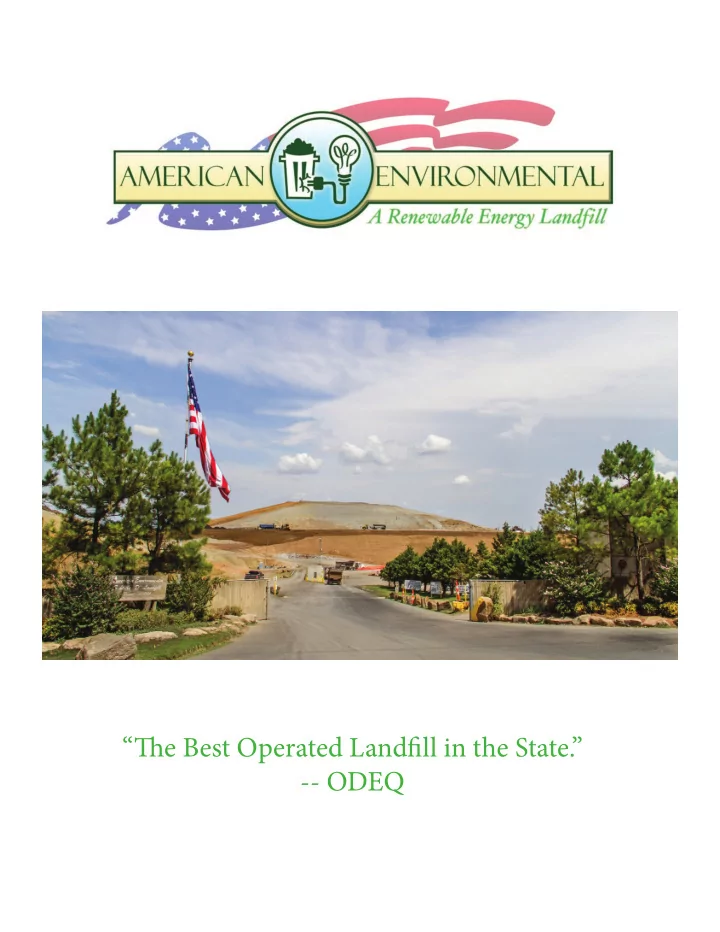
Tie Best Operated Landfjll in the State. -- ODEQ American - - PDF document

tie best operated landfjll in the state odeq american
SMART_READER_LITE
LIVE PREVIEW

Tie Best Operated Landfjll in the State. -- ODEQ American - - PDF document

Tie Best Operated Landfjll in the State. -- ODEQ American Environmental Landfjll AEL prides itself on maintaining a high level of service while meeting and exceeding state and national environmental standards. Our company has repeatedly


slide-1
SLIDE 1

“Tie Best Operated Landfjll in the State.”

  • - ODEQ
slide-2
SLIDE 2

2

American Environmental Landfjll

AEL prides itself on maintaining a high level of service while meeting and exceeding state and national environmental standards. Our company has repeatedly been named the, “best operated [landfjll] in the state,” according to ODEQ and was designated by Tie Solid Waste Association of North America (SWANA) as a leading landfjll in the industry. AEL stands second to none when it comes to our commitment to environmental awareness, community service and innovation. We continue to build a legacy around these core ideas while working to lead Tulsa to a greener and more sustainable future. American Environmental Landfjll’s primary service is the safe disposal of nonhazardous solid

  • waste. AEL is permitted to accept and manage municipal solid waste, non-hazardous industrial

waste (both liquid and solid), contaminated soil with no TPH restrictions, municipal and industrial sludge, friable and non-friable asbestos and other non-hazardous industrial waste (NHIW). Tie facility is EPA approved to accept CERCLA waste. All NHIW is profjled and approved prior to shipment. Transport is manifested and disposal is documented and reported to the Oklahoma Department of Environmental Quality (ODEQ).

slide-3
SLIDE 3

3

Landfjll Design

AEL is a subtitle D landfjll regulated by the ODEQ. ODEQ evaluates in detail AEL’s design process features including:

  • Bottom Liner Design
  • Cell Design
  • Quality Control
  • Leachate Collection System Design
  • Leachate Management Plans
  • Storm Water Management Plan
  • Groundwater Monitoring Plans
  • Landfjll Gas Monitoring Plan
  • Air Quality Control Plan
  • Daily Cover Requirements
  • Final Closure Requirements

Tie landfjll design is certifjed by a professional engineer and is then approved by the state regulatory agency with an operating permit.

Liner Design

Tie liner is the crucial element of the total landfjll design process and ensures environmental

  • protection. Tie purpose of any liner is to prevent migration of leachate from the site. Leachate

is the result of water that has percolated through the waste and is a potential pollutant if it is not managed correctly. Major elements of liner design and installation include selection of materials with minimum permeability, selection of proper compaction processes, moisture content, and in situ densities. As recognized by environmental experts and regulatory agencies, recompacted impermeable clay liners provide protection against leachate migration.

slide-4
SLIDE 4

4

Quality Control

To certify that the liner design is constructed precisely to plan, AEL implements a quality control and assurance program. Independent professional engineers monitor the construction steps, and perform quality assurance testing at key points of the project. AEL will only commence operation

  • f a sanitary landfjll afuer all quality assurance testing is completed and the landfjll has been

approved by the ODEQ.

Surface Water Management Plan

To reduce the potential for leachate generation, an efgective surface water management plan is required to minimize infjltration of water. Minimal infjltration is achieved by progressively covering and capping the site with low permeability soils as the site is fjlled, using a surface grading design that promotes runofg while maximizing evaporation, seeding with high transpiration plants, and constructing perimeter drainage systems that prevent surface run-on and provide adequate surface run-ofg. Efgective drainage is provided by culverts, diversion berms, roadside swales, and perimeter ditches.

Leachate Collection and Treatment

Tie leachate collection layer at AEL consists of a 24-inch drainage layer with a hydraulic conductivity greater than or equal to 1x10⁻³ cm/sec. Tie drainage layer diverts the leachate to 6-inch diameter perforated HDPE leachate collection pipes, which are bedded in granular media fjlled trench drains. Tirough the collection pipes, leachate is collected in sumps, and pumped to the leachate storage pond. Electric submersible pumps equipped with liquid level pressure transducers are located in each sump and are programmed to automatically start as leachate depths within each sump reach a certain level. Tie leachate storage pond has a composite liner design, including a compacted low permeability soil liner overlain by a 60-mil HDPE geomembrane. AEL currently recirculates leachate over composite lined areas of the landfjll as an interim measure while developing a long- term solution to leachate management.

slide-5
SLIDE 5

5

Monitoring

AEL takes many precautions to ensure the environment is free from any contaminants. By closely monitoring ground and surface water and methane, AEL ensures that the landfjll site performs as designed and protects the environment. Tracking ground and surface water and methane migration patterns allows AEL to detect migration quickly. In addition, AEL has developed important groundwater monitoring well installation and sampling procedures that help eliminate the common problem of measuring contamination from sources unrelated to the landfjll. Our experienced hydrologist and other specialists constantly interpret groundwater monitoring data and statistics for fast, appropriate response. AEL’s LFG monitoring system consists of a perimeter compliance network of 12 gas probes located at or near the permit boundary. Monthly monitoring of the 12 perimeter compliance monitoring gas probes is conducted by 3rd party LFG consultants. Should methane levels exceed the lower explosive limit in any of the gas probes, AEL employs efgective design alternatives to prevent potential migration of the methane. Tie recommended alternative will depend on methane value, soil conditions, climate, depth to an impermeable layer and distance to buildings. Follow-up monitoring ensures these measures are efgective.

slide-6
SLIDE 6

6

Clean, Safe Sanitary Landfjll Operations

AEL is a quiet and productive neighbor. Tiat’s because AEL makes every efgort to ensure everyday operations are as trouble-free as

  • possible. AEL’s well-trained employees help make
  • ur landfjlls good neighbors by carrying out such

daily tasks as compaction of waste; daily covering; use of litter fences; removal of stray debris; and watering on-site roads. Maintaining a top-notch operation also involves the following important tasks: establishing all- weather roads to the waste disposal area; selecting proper equipment; maintaining a small, contained working area; maintaining traffjc control and safety at the working face; preventing mud from being tracked onto public streets; using sight berms to shield disposal operations from public view; landscaping areas in need of visual improvement; and most importantly, assisting our customers while they are at AEL. AEL is the only solid waste facility in Oklahoma that provides customers with access to a Moby Dick Wheel Washer, a high volume low pressure system designed to remove waste and mud from wheels and frame of trucks. Tiis state of the art wheel washing systems ensures all trucks are in compliance with Oklahoma Department of Transportation’s regulations.

slide-7
SLIDE 7

7

Security

AEL has several proven safeguards to protect against unauthorized waste dumping. Strong security fences and locked gates stop intruders from entering when the site is closed. Tie scale house is also equipped with a digital infra-red camera to ensure the safety of the landfjll. A manned guard house also prevents the entry of all vehicles until they are fjrst inspected by trained employees. As a subtitle ‘D’ landfjll American Environmental Landfjll accepts the following waste:

  • All municipal solid waste
  • Construction demolition material
  • Special & industrial waste
  • Liquid waste
  • Out of state waste

AEL’s employees are trained to monitor incoming loads to ensure that absolutely no hazardous materials are accepted according to the Waste Exclusion Plan (WEP). Under no circumstance will AEL accept the following waste:

  • Radioactive
  • Regulated PCB
  • Regulated untreated infectious biomedical
  • Friable and Non-Friable Asbestos
  • Regulated hazardous waste

It is the responsibility of all generators and haulers to properly identify and characterize the waste prior to disposing of it at AEL. Random load inspections are conducted as part of the requirements of the ODEQ.

slide-8
SLIDE 8

8

Litter

Litter control is achieved through litter control fences, daily covering, proper compaction of waste as it is received and by employees hired to pick up stray litter. Signage is also posted asking patrons to cover their loads when inside the landfjll. Tiese measures help minimize the accumulation of unsightly litter and make AEL among the most litter-free landfjlls in America.

Dust

Dust can be a major problem for all earth-moving operations, including landfjlls. AEL, however, reduces or eliminates the problem by establishing and maintaining vegetative cover in inactive areas, watering roads as necessary to control blowing dust and limiting the amount of land disturbances in soil borrow areas.

Erosion

Preventing exposure of covered refuse due to erosion requires certain design and operation

  • features. Among them are erosion-resistant capping soils; side slopes not steeper than a

proportion of 1-vertical foot to 4-horizontal feet; smooth grading and the use of vegetation and erosion control matting.

Odor Control

Odor control is accomplished by compaction, covering and landfjll gas control. Compaction and daily covering provide the main means of odor prevention. However, in some cases, supplementary odor control may be necessary through the installation of a landfjll gas collection, venting and fmaring system.

slide-9
SLIDE 9

9

Liquid and Semi-Solid Waste Bulking

AEL is also certifjed to conduct a liquid solidifjcation operation for your convenience. Liquids and semi-solid waste typically are rejected at a standard solid waste facility to limit leachate production in the landfjll. With the liquid solidifjcation program at AEL, liquids and semi-solid wastes can be accepted and mixed with a bulking material for proper disposal in the landfjll. Tiis makes it easy and convenient for waste haulers throughout the area. AEL has capacity to store and process 80,000 gallons of liquid waste at one time! AEL receives and processes liquid and semi-solid waste, including, but not limited to:

  • Industrial
  • Cooling fmuids/cutting oils
  • Rinse water
  • Latex paint, ink, etc.
  • Food production waste
  • Municipal waste
  • Tank bottoms/sludges
  • Drilling waste

Liquid waste is placed into buried containers over a lined area and mixed with bulking material in order to convert the liquid into a solid form, thus making it acceptable for the landfjll. Bulking materials typically include such materials as:

  • Auto Shredder Residue or Auto Flufg
  • Fly Ash
  • Sawdust/Wood Shavings
  • Concrete
  • Dirt/Shale
  • Sand

Once the liquid and bulking agents are mixed, a Paint Filter Liquids Test (EPA Method SW- 846/9095) will be performed to ensure the liquid is suffjciently bulked. A small amount of the bulked waste is placed in a conical shaped paint fjlter and allowed to sit in the fjlter for fjve

  • minutes. Afuer the fjve minutes, if any liquid has passed through the fjlter, more bulking agents

must be added. Tiis test determines the solidity of the bulk waste and determines when it is acceptable for landfjll disposal. Once the bulked material passes the paint fjlter test, it is then loaded into an ofg-road truck, and transported to the active face for disposal among other standard wastes. Please contact AEL to schedule a drop-ofg. Tiey will provide you with information regarding paperwork, certifjcations and documentation required prior to disposal.

slide-10
SLIDE 10

10

Trash to Energy

At AEL, we’ve implemented some innovative approaches for using non-recyclable trash residue at

  • ur landfjll to produce renewable energy and power homes.

Our process captures methane gas from decomposing trash through a series of strategically drilled wells. Tiis allows us to collect the gas and convert it via three generators into electricity to power over 4000 homes around our landfjll area. It’s our way of squeezing every bit of use out of the disposal process—creating new sources of renewable energy—while also benefjtting our community.

Leading the Way in Waste Disposal

AEL has become an exceptional leader in landfjll operations throughout the Midwest region. In providing a safe, clean environment to dispose of municipal, commercial, and industrial nonhazardous waste, nonhazardous liquid and semi-solid waste at its solidifjcation area, ODEQ has recognized AEL as “Tie Best Operated Landfjll in the State.” With over 220 acres of permitted landfjll space available, AEL is the largest landfjll in the state assuring the most cost efgective long-term disposal solution available in our region.