Timeline Presentation: Special Moments in my Life As part of our - - PDF document

timeline presentation special moments in my life
SMART_READER_LITE
LIVE PREVIEW

Timeline Presentation: Special Moments in my Life As part of our - - PDF document

Timeline Presentation: Special Moments in my Life As part of our Social Studies discussions about Families, your child will have the chance to present themselves, their family and the many special moments that you have had together in the form of


slide-1
SLIDE 1

Timeline Presentation: Special Moments in my Life

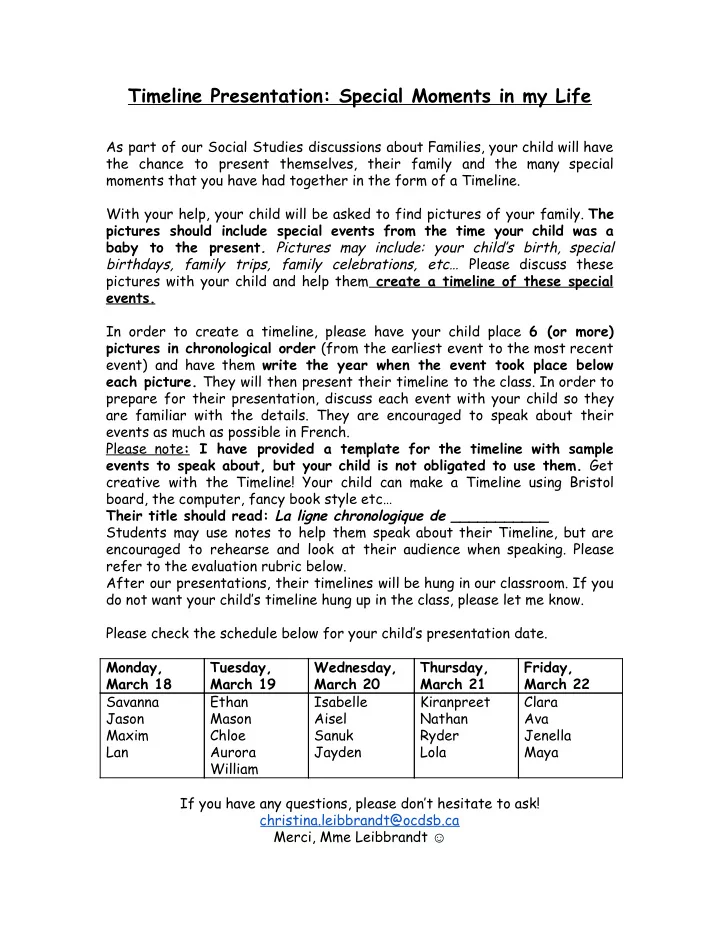
As part of our Social Studies discussions about Families, your child will have the chance to present themselves, their family and the many special moments that you have had together in the form of a Timeline. With your help, your child will be asked to find pictures of your family. ​The pictures should include special events from the time your child was a baby to the present​. Pictures may include: your child’s birth, special birthdays, family trips, family celebrations, etc… Please discuss these pictures with your child and help them create a timeline of these special events. In order to create a timeline, please have your child place ​6 (or more) pictures in chronological order (from the earliest event to the most recent event) and have them ​write the year when the event took place below each picture. They will then present their timeline to the class. In order to prepare for their presentation, discuss each event with your child so they are familiar with the details. They are encouraged to speak about their events as much as possible in French. Please note​: I have provided a template for the timeline with sample events to speak about, but your child is not obligated to use them. ​Get creative with the Timeline! Your child can make a Timeline using Bristol board, the computer, fancy book style etc… Their title should read:​ La ligne chronologique de ___________ Students may use notes to help them speak about their Timeline, but are encouraged to rehearse and look at their audience when speaking. Please refer to the evaluation rubric below. After our presentations, their timelines will be hung in our classroom. If you do not want your child’s timeline hung up in the class, please let me know. Please check the schedule below for your child’s presentation date. Monday, March 18 Tuesday, March 19 Wednesday, March 20 Thursday, March 21 Friday, March 22 Savanna Jason Maxim Lan Ethan Mason Chloe Aurora William Isabelle Aisel Sanuk Jayden Kiranpreet Nathan Ryder Lola Clara Ava Jenella Maya If you have any questions, please don’t hesitate to ask! christina.leibbrandt@ocdsb.ca Merci, Mme Leibbrandt ​☺

slide-2
SLIDE 2

Grille d’évaluation Evaluation Rubric

Level 1 Level 2 Level 3 Level 4 Identifying and

  • rganizing

chronologically some significant events One or two events placed and presented Not in any sort

  • f order

A few events placed and presented Not in chronological

  • rder

Six events placed and presented mostly in chronological

  • rder

Many different types events placed and presented in chronological

  • rder

Recounts personal experiences Includes no details Includes some details Includes many details Includes several relevant details Body Language Rarely looks at the audience when speaking Reads notes for the entire presentation Sometimes looks at the audience when speaking Uses notes consistently Usually looks at the audience when speaking Uses notes on

  • ccasion

Always looks at the audience when speaking Does not use notes at all Voice and expression Speaks with very little confidence, clarity and expression Speaks with some confidence, clarity and expression Speaks with confidence, clarity and expression Speaks with a high degree of confidence, clarity and expression Use simple French vocabulary and language structures to express ideas Rarely uses proper language structures Rarely speaks in French Sometimes uses proper language structures Speaks sometimes in French Usually uses proper language structures Speaks mostly in French Almost always uses proper language structures Speaks entirely in French Pronounces familiar vocabulary correctly Rarely pronounces familiar vocabulary correctly Sometimes pronounces familiar vocabulary correctly Usually pronounces familiar vocabulary correctly Almost always pronounces familiar vocabulary correctly Answers follow-up questions about familiar topics Answers questions with limited effectiveness Answers questions with some effectiveness Answers questions with considerable effectiveness Answers questions with a high degree of effectiveness

slide-3
SLIDE 3

Examples

slide-4
SLIDE 4