SLIDE 1
HOMO-LUMO MAPS AND GOLDEN GRAPHS Tomaž Pisanski, Slovenia CSD5, Sheffield, England Wednesday, July 21, 2010
SLIDE 2 Outline – HOMO-LUMO maps
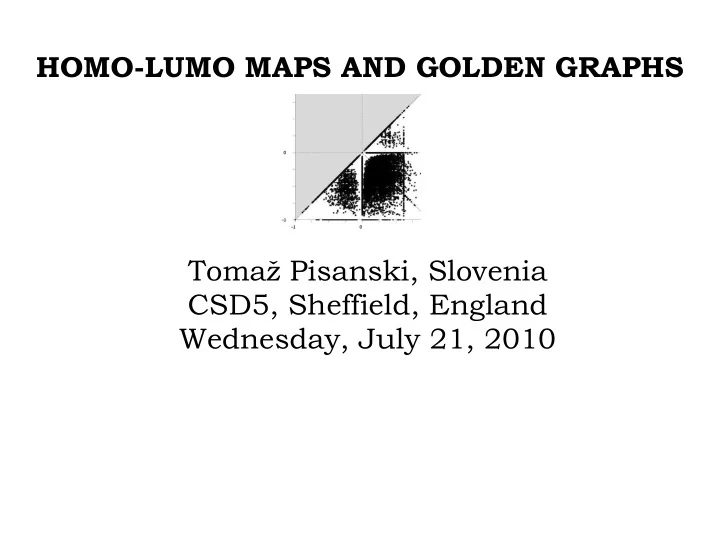
Recently, we introduced a graphical tool for investigating spectral properties of graps that we caled HOMO-LUMO maps. On a HOMO-LUMO map a graph G is represented by point with (
h, l)
coordinates, where , roughly speaking
h and l are
the two middle eignevalues of G. The difference (
h- l) is the well-known HOMO-
LUMO gap in Hueckel theory. Therefore it is surprising that although the middle eigenvalues have clear significance in mathematical chemistry not much attention has been paid to them in spectral graph theory.
SLIDE 3 Outline- Golden Graphs
It turns our that the HOMO-LUMO maps are well suited tool in investigating families of graphs, such as molecular trees, fullerenes, etc., where extremal points or appearing patterns raise interesting
- questions. For instance, for small molecular graphs
the HOMO-LUMO plot clearly shows that the vertical line
h= 1/ , where
is the golden ratio, is heavily
- populated. We call graphs with
h= 1/
golden
- graphs. We present some results and raise some
questions that resulted from the study of HOMO- LUMO maps.
SLIDE 4 References
- 1. P.W. Fowler, T. Pisanski, HOMO-LUMO maps for
chemical graphs, MATCH Commun. Math. Comput. Chem., 64 (2010) 373-390.
- 2. P.W. Fowler, T. Pisanski, HOMO-LUMO maps for
fullerenes, Acta Chim. Slov., In press, 2010.
SLIDE 5
Golden graphs or Golden HOMO graphs?
Ernesto Estrada: I just want to mention that the name "golden spectral graphs" and "golden graphs" have been introduced by myself in 2007. I am attaching a new paper on this topic which is now in press in Automatica with the definition and some properties of golden graphs. I think that to avoid confusions it would be better if you can call your graphs "golden HOMO-LUMO" ones instead of golden graphs. Estrada, E. (2007). Graphs (networks) with golden spectral ratio. Chaos, Solitons and Fractals, 33, 1168- 1182.
SLIDE 6 Graph spectrum
Recall the definition of graph spectrum. Let G be a graph on n vertices and A(G) its adjacency matrix. The collection of eigenvalues
spectrum of G. Since A(G) is symmetric matrix the spectrum is real and can be described as follows:
1 ≥ 2 ≥ ... ≥ n
SLIDE 7 Spectral radius
Spectral radius: (G) = max|
i|} 1 is called the leading or
principal eigenvalue. We may consider a disk centered in the origin of the complex plane which covers all eigenvalues and has the least possible radius.
1
SLIDE 8 Some properties
Proposition 1. Graph spectrum is real and is a graph invariant. Proposition 2. (max valence bound ) (G) ≥ (G). Proposition 3.
1 =
(G). Proposition 4.
1≥2m/n = d (average valence).
Theorem 5. Spectrum is symmetric if and only if the graph is bipartite. Theorem 6. If G is regular of valence d then (G) = d.
SLIDE 9 HOMO-LUMO gap
In addition to principal eigenvalue other eigenvalues have been studied in chemical graph theory (minimal, second
We are interested in the middle eigenvalues. For even n this is well-defined. Define H = n/2 and L = 1 + n/2. If n is odd, we define H = L = (n+1)/2. In chemical graph theory the eigenvalue difference
H - L
is called the HOMO-LUMO gap of G.
SLIDE 10 Chemical graphs
G is a chemical graph if It is connected Its max valence is at most 3: (G) < 4. Motivation from chemistry: Chemical graphs model fully conjugated - systems. Vertex - Carbon atom Edge -
- bond (= overlap of two adjacent sp2
- orbitals)
There are n delocalized -orbitals.
SLIDE 11
A several step process:
(2s,2px,2py,2pz)
- 2. 3 hybrid sp2 orbitals (+ one
pure pz orbital)
- 3. A pair of adjacent hybrids forms
a -bond
- 4. A pair of adjacent p-orbitals
forms a -bond accomodating two electrons.
- 5. Alternative: Pz electrons are
delocalized and move in eigenspaces of the adjacency matrix.
SLIDE 12 Simple Hückel model
chemical graph eigenvalue eigenvector positive eigenvalue negative eigenvalue assignment of tags to eigenvectors. number of tags eigenvector with two tags eigenvector with one tag eigenvector with no tags eigenvector belonging to an eigenvalue with multiplicity > 1. molecular graph of fully - conjugated system.
molecular orbital bonding orbital anti-bonding orbital electron configuration number of -electrons fully occupied orbital partially occupied orbital unoccupied orbital degenerate orbital
SLIDE 13
Electronic configuration of a graph
Let G be a graph. Vector e = (e1,e2,...,en) with ei from {0,1,2} is called an electronic configuration with k electrons on G if ei = k. In this paper we consider only the case k = n.
SLIDE 14
Ground-state electronic configuration
Electronic configuration may be
ground-state configuration excited-state configuration
Ground-state configuration is completely determined by the following principles:
Aufbau principle Pauli principle Hund's rule
Note: In simple Hückel model ground-state configuration is completely determined by the graph. This means that this concept is a graph invariant.
SLIDE 15 Aufbau Principle
Fill orbitals in order of decreasing eigenvalue.
(+)
1
(-)
n
SLIDE 16
Pauli Principle
No orbital may contain more than two elecrons
SLIDE 17
Hund's Rule of Maximum Multiplicity
No orbital receives the second electron before all orbitals degenerate with it have each received one. 1 2 3 4 5 6
SLIDE 18 HOMO- LUMO
Eigenvector with two tags belonging to the smallest eigenvalue. Eigenvector with no tags belonging to the largest eigenvalue. The difference of the corresponding eigenvalues. HOMO - Highest Occupied Molecular Orbital LUMO - Lowest Unoccupied Molecular
HOMO-LUMO gap: the energy difference of the corresponding molecular orbitals
SLIDE 19 HOMO-LUMO gap
HOMO - Highest Occupied Molecular Orbital LUMO - Lowest Unoccupied Molecular Orbital
(+)
1
(-)
n
HOMO LUMO HOMO- LUMO gap
SLIDE 20 Existence of partially occupied
There is no problem with the HOMO-LUMO gap if there are no partially occupied orbitals. Partially occupied orbitals may arise for two reasons.
n is odd. n is even or odd but there are partially occupied molecular orbitals arising from Hund's rule.
In any case, if there are partially occupied orbitals, they all have the same energy level. In this case the definition of HOMO and LUMO has to be amended. If there exists a partially occupied orbital it is both HOMO and LUMO (SOMO) and the HOMO-LUMO gap is 0.
SLIDE 21
Closed-shell vs. Open-shell molecules
A well-known concept in mathematical chemistry is the idea of an open-shell vs. closed-shell molecule. It has been refined (see Fowler, Pisanski, 1994) to properly closed pseudo closed meta closed
One could give an algebraic definition for these concepts, but … we turned to geometry
SLIDE 22 HOMO-LUMO map
The pair of HOMO-LUMO eigenvalues (
HOMO, LUMO)
may be represented as a point in a plane. For a family of graphs we get a set of points. Such a diagram in the HOMO-LUMO plane is called the HOMO-LUMO map of .
HOMO LUMO
SLIDE 23 Regions in HOMO-LUMO maps
A well-known concept in mathematical chemistry is the idea
closed-shell molecule. It has been refined as shown on the left (see Fowler, Pisanski, 1994) to properly closed pseudo closed meta closed
SLIDE 24 Regions in HOMO-LUMO maps
Note: Open-shell is the same thing as HOMO-LUMO gap is 0. Note: The region above the
attained in the ground state. Recently we extended the definition to properly open pseudo open meta open
SLIDE 25
Lines in a HOMO-LUMO map
Some important lines: y = x (open-shell) y = -x (balanced) If two points lie on the same lines the graphs are called: isohomal (vertical) isolumal (horizontal) isodiastemal (y = x +c, same HOMO-LUMO gap).
SLIDE 26 Pseudo-bipartite graphs
All bipartite graphs are balanced. However, there exist non-bipartite balanced
graphs pseudo- bipartite. balanced = bipartite + pseudo-bipartite
SLIDE 27 Chemical triangle
The right triangle with vertices (-1,-1),(1,- 1),(1,1) is called the chemical triangle.
(-1,-1) (1,-1) (1,1)
SLIDE 28 Conjecture
The right triangle with vertices (-1,-1),(1,- 1),(1,1) is called the chemical triangle. Conjecture: Each chemical graph is mapped in the chemical triangle.
(-1,-1) (1,-1) (1,1)
SLIDE 29 The Heawood graph
The Heawood graph is the only known counter- example to the conjecture. Levi graph (= incidence graph) of the Fano plane 6-cage 7 hexagonal regions on
- torus. Proof that maps
- n torus require up to 7
colors.
SLIDE 30 Hückel Energy
Total energy of -system may be approximated by the energy of an electronic configuration e: HE(G,e) = ei
i.
For a ground-state electronic configuration we get the Hückel energy of a graph: HE(G) = 2(
i + 2 + ... + n/2), if n even.
HE(G) = 2(
i + 2 + ... + (n-1)/2) + (n+1)/2 if n odd.
SLIDE 31 Energy of a graph
The concept of graph energy E(G) was introduced by Ivan Gutman in the 70's as the sum of absolute values of its eigenvalues. E(G) = |
i|.
In general E(G) HE(G). For bipartite graphs the equality holds. If G has n vertices and m edges then the following are true: Proposition 7: 0 =
i,
Proposition 8: 2m = |
i|2,
Proposition 9. E(G) ≥ 2
1
Proof: By Propsition 7, the sum of all positive eigenvalues add up to E(G)/2. Hence E(G)/2 ≥
1 and the result follows.
SLIDE 32
Comb
Comb(p) is a tree on n = 2p vertices. Vertices: ui, vi. Edges: ui~ vi. and ui~ui+1.
SLIDE 33 Conjecture holds for trees
Theorem 10: All chemical trees are mapped into the chemical triangle. Proof: In 1999 Zhang and An proved that among all chemical trees combs have maximal HOMO-LUMO
- gap. In 2001 Fowler, Hansen, Caporossi and Soncini
determined the eigenvalues of a comb with n=2p
- vertices. From their result it follows that
=
p = cos( p/(p+1)) + (1+cos2( p/(p+1)))1/2
Clearly 21/2 -1 ≤
p ≤ 1. Since trees are bipartite
graphs
LUMO = -
the result follows.
SLIDE 34 Anti-spectral Radius
Motivated by the notion of spectral radius, as the smallest radius centered at the origin that covers the whole spectrum we define the HOMO-LUMO radius r(G) as the largest radius that misses the spectrum. (It must hit at least one eigenvalue).
r(G) = min{|
i|}
For a properly closed graph this would be r(G) = min{
H, - L}
1
SLIDE 35
An Observation
Note that graph G is singular if and only if its antispectral radius is zero: r(G) = 0. If at the same time R(G) > 0, G must be either pseudo or meta.
SLIDE 36 HOMO-LUMO Radius
We define the third radius R(G) as the smallest radius of a disc tcontered in the origin that covers both HOMO and LUMO eigenvalue and we call it the HOMO-LUMO radius: R(G) = max{|
H|, | L|}
Proposition 11: For all graphs r(G) ≤ R(G). The equality holds if and only if G is properly closed (or properly open). We may now restate our conjecture: For each chemical graph R(G) ≤ 1.
1
SLIDE 37
Two results
Theorem 12: Let G be a properly closed graph of average valence d. Then its HOMO-LUMO radius R(G) is bounded: R(G) ≤ 2sqrt(d). Theorem 13: Let G be a balanced graph of average valence d. Then its HOMO-LUMO radius R(G) is bounded: R(G) ≤ sqrt(d). The proof of both results follows from the following Lemmata.
SLIDE 38 McClelland's Lemma
We give a short independent proof of McClelland's lemma. Lemma 14: E(G) ≤ sqrt(2mn). Proof: Apply the well-known fact that the quadratic mean is greater or equal to the arithmetic mean to the absolute values of n eigenvalues of G we obtain:
sqrt((1/n) |
i|2) ≥ (1/n) | i|
Using 2m = |
i|2 and E(G) = | i|, we obtain
sqrt(2m/n) ≥ E(G)/n and therefore E(G) ≤ sqrt(2mn).
SLIDE 39 Lemma
Lemma 15: Let G be a properly closed graph of average valence d = 2m/n. Then (
H - L)/2 ≤
sqrt(d). Proof: In the properly closed case the minimum min{|
i|} is attained by HOMO- or LUMO-eigenvalue.
More precisely, H is the index of the smallest positive and L the index of the largest negative eigenvalue. Therefore E(G) = |
i| ≥ n( H - L)/2.
Since d = 2m/n, by McClelland's Lemma we may derive: n sqrt(d) = sqrt(2mn) ≥ E(G) ≥ n(
H - L)/2.
The resulting inequality follows readily.
SLIDE 40 Proofs
The area above the skew line satisfies Lemma 15. Proof of Theorem 12: Follows directly from Lemma 15 In this case R is determined by the dotted red line.. Proof of Theorem 13: All balanced graphs (green line) are proper, hence Lemma 15
- applies. In this case R is
determined by the blue line.
2sqrt(d) Lemma 15 proper
SLIDE 41
Some Problems
Problem 1. How sharp are the bounds of Theorems 12 and 13? Problem 2. Does there exist a constant K such that R(G) < K, for any graph G? Problem 3. Determine the family of graphs for which HE(G) = E(G).
SLIDE 42 Graphs outside chemical triangle
Gašper Jaklič, Patrick Fowler and TP found several infinite families of (non- chemical) graphs
triangle with the property that R(G) tends to infinity.
(-1,-1) (-1,1) (1,1)
SLIDE 43
Graphs with maximal value of R
Among graphs on n vertices, the ones maximizing R are: n = 6 .... Five-sided pyramid. (Wheel with 5 spokes) n = 8 .... Twodimensional subdivision of tetrahedron. n = 10 .... Complement of the Petersen graph Problem 4. Determine extremal n-graphs with respect to R. Problem 5. Determine extremal (n,m)-graphs with respect to R.
SLIDE 44
Some computer experiments
The Wheels (or pyramid graphs) Clear distinction between odd number of vertices and even number of vertices. Meta open and properly closed One golden example
SLIDE 45
Some experiments
Cartesian product Cn x K2
SLIDE 46
Some experiments
Cartesian product Cn x K3 No properly closed example?
SLIDE 47
Some experiments
Cartesian product Cn x K4
SLIDE 48
Some experiments
Cartesian product Cn x K5 No properly closed example in chemical triangle?
SLIDE 49
Division lines
Visible division lines that partition the map into regions. Each region should be studied separately.
SLIDE 50 Golden graphs
On the left, there is a clearly visible vertical line at
H = 1/
, where . is the golden section sqrt(5))/2 and 1/ = 1
A graph with
H = 1/
is called a golden graph. Some other visible lines:
H = 0, L = -1, H= L H= - L .
SLIDE 51
Some questions
SLIDE 52
Two more questions
SLIDE 53
Some golden graphs
Path P4 Cycles C5, C10. The graph below is non-bipartite with no pentagons. Some bipartite golden graphs
SLIDE 54
Golden chemical graphs
Here are all 23 golden chemical graphs for n < 10.
SLIDE 55 Missing graph
There are only 22
missing.
SLIDE 56
Small non-chemical golden graphs
SLIDE 57 How many benzenoids are golden?
Is naphthalene the
benzenoid? Are there infinitely many bipartite golden chemical graphs?
SLIDE 58 Golden Fullerenes
Patrick Fowler discovered 5 golden fullerenes: n = 32,40,50,50,60. Note:
Most numbers divisible by 5. Two on 50 vertices C60 – buckminsterfullerene!
Conjecture: There are
fullerenes. Search for other golden polyhedra: Conjecture: There are no other golden polyhedra.
SLIDE 59 Golden chemical graphs
#vertices #ch graphs #golden ch g 2 1 3 2 4 6 1 5 10 1 6 29 6 7 64 1 8 194 12 9 531 2 10 1733 47 11 5524 5 12 19430 206 13 69322 10 14 262044 740 15 1016740 57 16 4101318 3913
Number of chemical graphs and number of golden chemical graphs
…, 16.
SLIDE 60
The Five Golden Fullerenes
Among the five golden fullerenes it is also the largest: C60 – Buckminster Fullerene
SLIDE 61 An interesting twist
In June 2010 Roger Blakeney Mallion pointed out an interesting phenomenon that may
shell graphs.
R.B.Mallion, D.H.Rouvray: Molecular Topology and the Aufbau Principle, Mol. Phys. 36(1978) 125—128. R.B.Mallion, D.H.Rouvray: On a new index for characterising the vertices of certain non-bipartite graphs, Studia Sci. Math. Hungarica 13(1978) 229— 243. R.B. Mallion: An analytical illustration of the relevance of molecular topology to the Aufbau process, CCA 56 (1983) 477—490.
SLIDE 62 Jahn-Teller Graphs
# vertices # graphs 2 3 1 4 1 5 8 6 10 7 206 8 473 9 30900
JT graph: open-shell with k SOMO orbitals occupied in total by s electrons, such that
- 1. 1 s ≤ 2k-1
- 2. s ≠ k.
- 3. There are two cases:
- 4. s < k (each orbital is either
empty or has one electron)
- 5. s > k (each orbital has
either one or two electrons)
SLIDE 63 Jahn-Teller Molecular Graphs
# vertices #molecular graphs 2 3 1 4 1 5 1 6 7 7 8 1 9 34 10 14 11 357 12 185 13 4456 14 2885
SLIDE 64
Announcements
Ars Mathematica Contemporanea publishes papers in Mathematical Chemistry (or Chemical applications of Mathematics) Bled 2011 (7th Slovenian International Conference in Graph Theory) will take place 19 – 25 June 2011.
SLIDE 65 CSD 6 will take place in Slovenia in 2012. It will be organized by Klavdija Kutnar and Tomaž
- Pisanski. Details will be
available at the Bled meeting in 2011.