Tonal Morphology: Is it Different? Larry M. Hyman University of - - PDF document

tonal morphology is it different larry m hyman
SMART_READER_LITE
LIVE PREVIEW

Tonal Morphology: Is it Different? Larry M. Hyman University of - - PDF document

Morphology of the Worlds Languages (MOWL) Leipzig, June 11-13, 2009 Tonal Morphology: Is it Different? Larry M. Hyman University of California, Berkeley (1) Tone: Is it different? (Hyman 2007) Tone is like segmental phonology in every


slide-1
SLIDE 1

Morphology of the World’s Languages (MOWL) Leipzig, June 11-13, 2009

Tonal Morphology: Is it Different? Larry M. Hyman

University of California, Berkeley

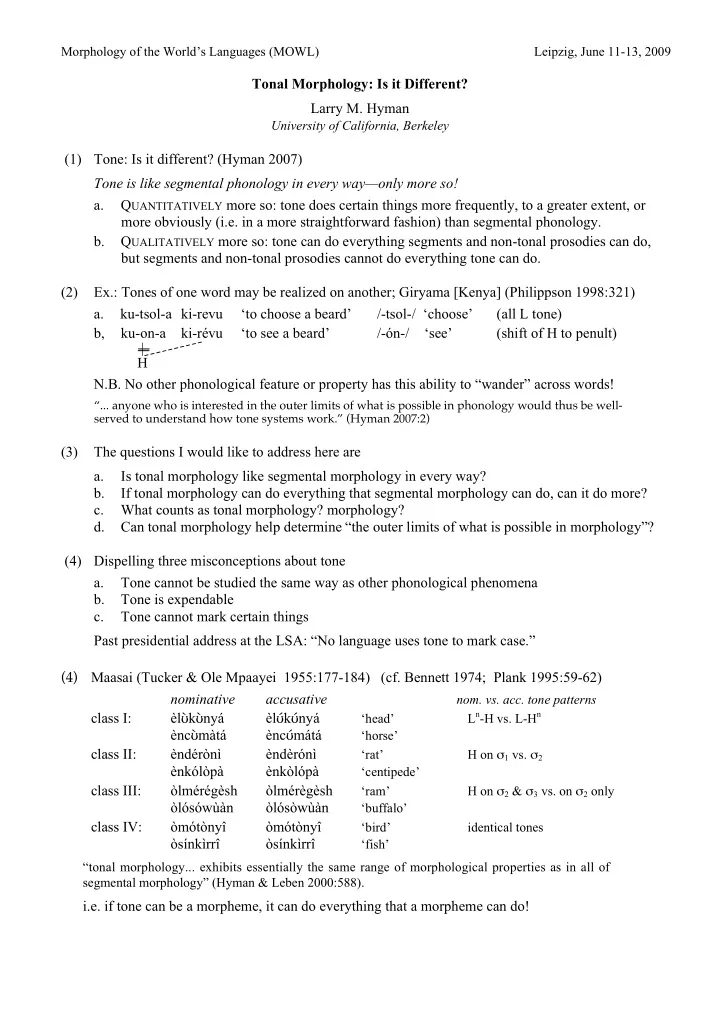
(1) Tone: Is it different? (Hyman 2007) Tone is like segmental phonology in every way—only more so! a. QUANTITATIVELY more so: tone does certain things more frequently, to a greater extent, or more obviously (i.e. in a more straightforward fashion) than segmental phonology. b. QUALITATIVELY more so: tone can do everything segments and non-tonal prosodies can do, but segments and non-tonal prosodies cannot do everything tone can do. (2) Ex.: Tones of one word may be realized on another; Giryama [Kenya] (Philippson 1998:321) a. ku-tsol-a ki-revu ‘to choose a beard’ /-tsol-/ ‘choose’ (all L tone) b, ku-on-a ki-révu ‘to see a beard’ /-ón-/ ‘see’ (shift of H to penult) | H N.B. No other phonological feature or property has this ability to “wander” across words!

“... anyone who is interested in the outer limits of what is possible in phonology would thus be well- served to understand how tone systems work.” (Hyman 2007:2)

(3) The questions I would like to address here are a. Is tonal morphology like segmental morphology in every way? b. If tonal morphology can do everything that segmental morphology can do, can it do more? c. What counts as tonal morphology? morphology? d. Can tonal morphology help determine “the outer limits of what is possible in morphology”? (4) Dispelling three misconceptions about tone a. Tone cannot be studied the same way as other phonological phenomena b. Tone is expendable c. Tone cannot mark certain things Past presidential address at the LSA: “No language uses tone to mark case.” (4) Maasai (Tucker & Ole Mpaayei 1955:177-184) (cf. Bennett 1974; Plank 1995:59-62) nominative accusative

  • nom. vs. acc. tone patterns

class I: èlU$kU$nyá èlU@kU@nyá

‘head’ Ln-H vs. L-Hn

èncU$màtá èncU@mátá

‘horse’

class II: èndérònì èndèrónì

‘rat’ H on σ1 vs. σ2

ènkólòpà ènkòlópà

‘centipede’

class III: òlmérégèsh òlmérègèsh

‘ram’ H on σ2 & σ3 vs. on σ2 only

òlósówùàn òlósòwùàn

‘buffalo’

class IV: òmótònyî òmótònyî

‘bird’ identical tones

òsínkìrrî òsínkìrrî

‘fish’ “tonal morphology... exhibits essentially the same range of morphological properties as in all of segmental morphology” (Hyman & Leben 2000:588).

i.e. if tone can be a morpheme, it can do everything that a morpheme can do!

slide-2
SLIDE 2

2

(6) Some of the complexities derive from the fact that tone (and hence tonal morphology) can be a. extremely paradigmatic b. extremely syntagmatic c. extremely ambiguous (analytically open-ended) d, extremely opaque (significant differences between inputs and outputs) (7) The 8 tone patterns of Iau [Indonesia: Papua] are phonologically paradigmatic on nouns, morphologically paradigmatic on verbs (Bateman 1990:35-36) (↑´ = a super-high tone)

Tone Nouns Verbs

H bé

‘father-in-law’

‘came’ totality of action punctual

M be#

‘fire’

ba#

‘has come’ resultative durative

H↑H bé↑´

‘snake’

bá↑´

‘might come’ totality of action incompletive

LM bè #

‘path’

bà #

‘came to get’ resultative punctual

HL bê

‘thorn’

‘came to end point’ telic punctual

HM bé #

‘flower’

bá #

‘still not at endpoint’ telic incompletive

ML be#`

‘small eel’

ba#`

‘come (process)’ totality of action durative

HLM bê #

‘tree fern’

bâ #

‘sticking, attached to’ telic durative

(8) Syntagmatic final vs. penultimate H tone in Chimwiini (Kisseberth 2009) a. grammatical tone only (no tone contrasts on lexical morphemes, e.g. noun stems, verb roots) b. H tone limited to last two moras: final H = morphologically conditioned; penult H = default c. 1st & 2nd person subjects condition final H tone vs. 3rd person default penultimate H

singular plural

n-ji:lé

‘I ate’

chi-ji:lé

‘we ate’

ji:lé

‘you sg. ate’

ni-ji:lé

‘you pl. ate’

jí:le

‘s/he ate’

wa-jí:le

‘they ate’

d. the only difference between the 2nd and 3rd person singular [noun class 1] is tonal (9) Ambiguous: paradigmatic vs. syntagmatic marking of number on Kunama [Eritrea] “possessive determiners” (Connell, Hayward & Ashkaba 2000:17) paradigmatic person-number number-person

  • cf. Hakha Lai

sg. pl. sg. pl. sg. pl. sg. pl. 1st pers. (excl.)

  • àaN-
  • áaN-
  • aaN-`
  • aaN-´

`-aaN- ´-aaN- ka kâ-n

2nd pers.

  • èy-
  • éy-
  • ey-`
  • ey-´

`-ey- ´-ey- na nâ-n

3rd pers.

  • ìy-
  • íy-
  • iy-`
  • iy-´

`-iy- ´-iy- a â-n

1st pers. incl.

  • íN-
  • iN-´

´-iN- While segmental morphology is canonically concatenative, tone is often hard to “segment”; vs. plural -n in Hakha Lai [Myanmar, NE India] proclitics (toneless in singular, falling tone in pl.) (10) Why is this important? If you can’t segment tone unambigously, how does this affect generalizations such as Trommer (2003:284): a. number agreement should be maximally rightwards (cf. Mayer 2009) b. person agreement shuld be maximally leftwards

  • cf. Hawkins & Gilligan (1988), who indicate that languages show a clear suffix tendency for marking

number [also gender, case, indefiniteness, nominalization, mood, tense, aspect, valence, causative] vs. Enrique-Arias (2002) who suggests that person marking favors prefixation.

(11) Recall Chimwiini, where it turns out that 1st/2nd final H vs. 3rd person penultimate H tone is a property of the phonological phrase — hence, person marking occurs way to the right!

slide-3
SLIDE 3

3

a. jile: namá

‘you sg. ate meat’

jile ma-tu:ndá

‘you sg. ate fruit’

b. jile: náma

‘s/he ate meat’

jile ma-tú:nda

‘s/he ate fruit’

(12) Chimwiini reflects an original tonal difference on subject prefixes; cf. Cahi dialect of Kirimi a. /U$-kU$-túng-a/ → U$-kU$-túng-á

‘s/he is tying’

/U$-/

‘2nd pers. sg.’

b. /U@-kU$-túng-a/ → U@-kU@-↓túng-á

‘you sg. are tying’

/U@-/

‘3rd pers. sg. [class 1]’

H H (13) 1st/2nd vs. 3rd person tone is marked at the end of each (nested) phonological phrase ( ] ) a. Ø-wa-t5ind5il5il5e w-aaná ] n5amá ] ka: chi-sú ]

'you sg. cut for the children meat with a knife'

b. Ø-wa-t5ind5il5il5e w-áana ] n5áma ] ka: chí-su ]

's/he cut for the children meat with a knife'

(14) Implementation of the Chimwiini facts (in the spirit, at least, of Kisseberth 2009) a. 1st and 2nd person subject markers have an underlying /H/ tone b. this H tone links to the last syllable of the phonological phrase (cf. Giryama in (2b)) c. any phonological phrase lacking a H tone receives one on its penult Although person marking is “late” in outputs, since the 1st/2nd person /H/ is attributed to the subject prefix “slot” underlyingly, it is “early” in inputs, where the generalizations should probably be stated. (15) Question: What is this? a. morphology?

(property of [+1st pers.] and [+2nd pers.] subject prefixes)

b. phonology?

(property of the phonological phrase—H is semi-demarcative)

c. syntax?

(property of the syntactic configurations which define the P-phrases)

c. intonation?

(not likely—who ever heard of a 1st/2nd vs. 3rd person intonation?)

Should the penult/final H be viewed as phrasal morphology? Not exactly like English -’s (16) What counts as tonal morphology? morphology?

“... morphology refers to... the branch of linguistics that deals with words, their internal structure, and how they are formed.” (Aronoff & Fudeman 2005:1-2) “Morphology is the study of systematic covariation in the form and meaning of words.” (Haspelmath 2002:2) “This book is about morphology, that is, the structure of words.... Morphology is unusual amongst the subdisciplines of linguistics, in that much of the interest of the subject derives not so much from the facts

  • f morphology themselves, but from the way that morphology interacts with and relates to other branches
  • f linguistics, such as phonology and syntax.” (Spencer 1991:xii)

(17) Three ways in which tone can be a morphological exponent a. tone = the only exponent

(e.g. 2sg. vs. 3sg. subject prefixes in Chimwiini)

b. tone = a consistent exponent

(e.g. 1st/2nd vs. 3rd person marking in Chimwiini)

c. tone = an incidental exponent

(e.g. 2sg. /U$-/ vs. 3sg. /U@-/ subject prefixes in Kirimi)

(18) Limiting attention to (17a,b), tonal morphology can be completely analogous to segmental morphology or may diverge in (i) what it marks; (ii) how it marks it. I’ll start with relatively canonical tonal morphology, then consider these two divergences. (19) The tonal patterns on Iau verbs in (7) lend themselves to a featural, paradigmatic display—the portmanteau tone patterns do not appear to be further segmentable (you’re welcome to try!)

slide-4
SLIDE 4

4

telic totality of action resultative Punctual HL H LM Durative HLM ML M Incompletive HM H↑H

(20) Other systems are clearly segmentable, e.g. person marking in Modo [Sudan] (Nougayrol 2006)

/ata, H/ ‘be bitter’ /uba, L/ ‘sing’ 1sg, 2sg, 2pl /H-/ átá H-H ‘you are bitter’ úbà H-L ‘you sing’

  • 3sg. 1pl (excl & incl), 3pl

/L-/ àtá@ L-L ‘it is bitter’ ùbà L-L ‘s/he sings’

(21) Tone (and other prosodic features) show the familiar sensitivity to internal morphological structure, e.g. the “tonal layers” of Dinka (Andersen 1992-4:61):

“The morphological layers are simultaneous but ‘vertically’ ordered, with the root as the ‘deepest’ layer,

  • ptionally followed by the derivational layer, followed by an inflectional layer.”

wé-ec ‘kick it hither!’ [kick.CENTRIPETAL.2sg]

voice length tone inflectional layer (2sg) — — H

  • cf. Pulleyblank (1986)

derivational layer (CP) [+breathy] +1 L for cyclic tonology root layer (‘kick’) — 1 F

(22) Instead of “layers” (strata), paradigmatic conflicts may require a ranking of the tonal spell-outs by inflectional features, e.g. Leggbó [Nigeria] root+suffix tones (Hyman et al 2002:407).

MCA/ORA SRA NEG Root tone: /L/ /M/ /L/ /M/ /L/ /M/ Perf./Prog. H-M M-M L-M M-M H-M M-M MCA: main clause affirmative Habitual L-L M-L L-L M-L H-M M-M SRA, ORA: subj./obj. relative affirmative Irrealis L-L M-L L-L M-L L-L M-L NEG: negative (all contexts)

Irrealis >> Negative >> Habitual >> Other

(“irrealis” = future/conditional) L-L/M-L H-M/M-M L-L/M-L

(23) Comparison with Dagbani [Ghana] (Hyman & Olawsky 2004:107) Future >> {MCA, Imperfective} >> Lexical (default)

H LH H vs. L In both Leggbó and Dagbani, future tense ~ irrealis mood are “higher” (further out) than aspect, as per Bybee’s (1985) “Relevance Hierarchy”. Such disjunctive tone patterns vie for the same “slot”.

(24) Kikuria [Tanzania, Kenya] assigns a H tone to different moras of the verb stem, depending on the tense (Marlo & Mwita 2009:2) (the H then spreads to the penult; [ = stem-initial boundary) a. µ1 n-to-o- [ hóótóótér-a

‘we have reassured’ Past

b. µ2 n-to-o- [ hoótóótér-a

‘we have been reassuring’ Past progressive

c. µ3 n-to-re- [ hootóótér-a

‘we will reassure’ Future

d. µ4

to-ra- [ hootoótér-a

‘we are about to reassure’ Inceptive

(25) When the stem is one mora short, a rising tone is obtained; when two moras short, the Lº = level a. µ4 to-ra- [ karaaNg-á

‘we are about to fry’ H tone assignment:

b. µ4 to-ra- [ sukur-a&

‘we are about to rub’

[ sukur-a µ@ c. µ4 to-ra- [ Bun-aº

‘we are about to break’

[ Bun-a µ µ@ d. µ4 to-ra- [ ry-aº

‘we are about to eat’

[ ry-a µ µ µ@

slide-5
SLIDE 5

5

(26) When the following word is underlyingly toneless, its moras are counted + spreading to penult a. µ4 to-ra- [ karaaNg-á éƒétç@ç@kE

‘we are about to fry a banana’

b. µ4 to-ra- [ sukur-a éƒétç@ç@kE

‘we are about to rub a banana’

c. µ4 to-ra- [ Bun-a eƒétç@ç@kE

‘we are about to break a banana’

e. µ4 to-ra- [ ry-a eƒet ç @ç@kE

‘we are about to eat a banana’

(27) So-called “tone cases” in (South-) Western Bantu are interesting both for what they mark and how they do it, e.g. Giphende (based on joint work with Mwatha Ngalasso)

5 “cases” : 1. /L-L.L/ 2. /L-L.L.L/ 3. /L-L.H/ 4. /L-L.H.L/ 5. /L-H.L/ 6. /L-H.H/ 7. /L-H.H.L/ 8. /L-H.H.H/ Citation, subject, left dislocation, object of

  • neg. infinitive

L-L.L L-L.L.L L-L.H L-L.H.L L-H.L L-H.H L-H.H.L L-H.H.H Focused object H-H.L H-H.H.L L-L.H L-L.H.L L-H.L L-H.H L-H.H.L L-H.H.H Genitive; second

  • bject; object after
  • neg. verb, subject

after rel. verb H-H.L H-H.H.L H-L.H H-L.H.L L-H.L L-H.H L-H.H.L L-H.H.H Object after aff. verb

  • r

na ‘with’ H-H.L H-H.H.L H-H.↓H H-H.↓H.L H-↓H.L H-↓H.H H-↓H.H.L H-↓H.H.H Predicative (‘it’s ...’) H-H.L H-H.H.L H-L.H H-L.H.L H-H.L H-H.H H-H.H.L H-H.H.H

  • cf. Kikongo (Daelemann 1983) Umbundu (Schadeberg 1986) and Blanchon (1998) for historical account.

(28) Two issues concerning the above tonal alternations in Giphende a. morphological: is this case?

“Case is a system of marking dependent nouns for the type of relationship they bear to their heads.” (Blake 2001:1)

b. phonological: how do we implement the above differences?

i. Giphende and related languages are analyzed with an underlying /H/ vs. /Ø/ contrast ii. all but the first row of forms involve H tones coming in from the left

  • iii. how can these H tones be differentiated synchronically? by strata? prefix vs. clitic vs. pseudo-

word? (Van de Velde 2009)

  • iv. what else is like this? German Umlaut? Buch/Bücher vs. dumm/dummer (cf. gross/grösser)

(29) Barasana possessive pronoun “case”? (Gomez-Imbert & Kenstowicz 2000:438-9) ~kúbú (H) ‘shaman’ ~bídì (HL) ‘pet’

~ = nasal prosody

~bádí (H) ‘our’ ~bádí ~kúbú ~bádí ~bídí ~ídà (HL) ‘their’ ~ídà ~kúbù ~ídà ~bídì

Possessors can impose case on their “head” noun (Nikolaeva & Spencer 2009:13-14), but this is a phonological “agreement”, not a morphological one. But whether the above tonal agreement is phonology

  • r morphology, nothing else can do this!

(30) The moral: Once tone is involved, tonal morphology can take on a life of its own! a. it surpasses the capability of other featural prosodies, stress, length, and segmental morphology in general b. it therefore is often exempted from claimed universals or typological generalizations

slide-6
SLIDE 6

6

“Theories of floating features have required... feature-specific constraints; often these are proposed to deal with mutation (tone is a bit different).” (de Lacy 2008:2) “The Tautomorphemicity Principle: Avoid feet or syllables containing concatenative morpheme boundaries.... The principle does not apply to abstract morphemes that one might posit in accounting for tone patterns or stem alternations.” (Bickel 2003.90-91)

(31) Two ways for tonal morphemes not to align with syllables (+ marks heteromorphemicity): a. many to one b.

  • ne to many

c. both, via spreading + contouring σ σ + σ σ + σ T + T T T + T (32) An example of each a. Higi [Nigeria]: /yE$ + ´/ → [yE&]

‘you pl.’ (subject, [+CPL])

(Mohrlang 1974:118) cf. [yE$]

‘you pl.’ (subject, [-CPL])

b. Tucano [Brazil]: /apó + bi~/ → apó-bí~

‘he repaired’

(Ramirez 1997:73) H c. Kuki-Thaadow [NE India]: /hùon + thúm/ → hùon thu&m

‘three gardens’

(Hyman, in press): L H L H (33) Non-concatenative “replacive” tones (Welmers 1973:132-3) also produce heteromorphemicity a. V → N (HÉL) in Standard Mandarin [China] (Wang 1972:489)

[tone marking changed]

shán

‘to fan’

→ shân

‘fan’

l"‡an

‘to connect’

→ lîan

‘chain’

shù

‘to count’

→ shû

‘number’

b. N → A (H) in Chalcatongo Mixtec [Mexico] (Hinton et al 1991:154; Macaulay 1996:64) b"‹kò

‘cloud’

→ b"¤kó

‘cloudy’

sò/ò

‘ear’

→ só/ó

‘deaf’

ká/ba#

‘filth’

→ ká/bá

‘dirty’

c. A → V (L) in Lulubo [Sudan] (Andersen 1987:51)

  • #sú

‘good’

→ òsù

‘to become good’

àke#lí

‘red’

→ àkèlì

‘to become red’

áfç@rç@

‘yellow’

→ àfç$rç$

‘to become yellow’

(34) Tones may correlate with form classes or functions a. Mpi [Thailand] : nouns and verbs are characterized by three non-intersecting tone patterns

i. sí ‘four’ ii. s"‹ @ ‘to roll’ (Matisoff 1978) s"‹ ‘a color’ s"› ‹ ‘to be putrid’ sì ‘blood’ sî ‘to die’

b. Mundang [Chad]: only grammatical morphemes give full /H, M, L/ contrasts (Elders 2000:73) c. Bamileke-Fe/fe/ [Cameroon] (Hyman 1972): /H/ marks grammatical morphemes vs. /M, L/, vhµ# ‘ashes’, sA#k ‘bird’ → vhµ@ sA#k ‘ashes of the bird’; + lA@ ‘that (near hearer)’ d. Paic"‚ [New Caledonia] (Rivierre 1974:327): /H, M/ vs. five /L/ tone morphemes: ò ‘futur’, mwàa ‘ponctuel successif’, bwàa ‘en voie d’achèvement’, mù ‘habituel’, è0 ‘le’ (article). (35) Tautomorphemicity interfaces with two criteria often invoked in tone system typology a. presence vs. absence of tonal “perturbations” (morphotonemics)

slide-7
SLIDE 7

7

“In general, the inherent tone of each syllable is maintained regularly and there are very few perturbations either phonologically or morphologically conditioned, apart from the intonational features....” (Higi [Nigeria]; Mohrlang 1974:118) “Verb stem tones are perturbed only through affixation, whereas noun stem tones may also be perturbed by association with other word bases.” (Gadsup [Papua New Guinea]; SIL:6)

b. presence vs. absence of tonal morphology, broadly conceived

“These tones on the syllable serve to distinguish vocabulary items, but they do not serve to distinguish the grammatical categories of the language.” (Gude [Nigeria]; Hoskison 1983:17) Tangkhul Naga [NE India] has /H, M, L/ and no tonal morphology and tones stay put on their own syllables: páay ‘defecate’, pa#ay ‘be cheap, able’, pàay ‘jump’ (from 2002-3 field methods class)

  • vs. only grammatical tone in Chimwiini (cf. (8)) and Kuni-Boazi [Papua New Guinea] (Fumey 2006:5)

“Kuni has contrastive grammatical tone, which plays a very important role on clause level. More than 30 grammatically distinct tone patterns have been found. No lexical tone contrasts have been found, however.”

(36) Ratliff’s (1992a) typology “organized around how tonal contrasts are used” (Ratliff 1992b:134) a. Type A, e.g. White Hmong [China, northern SE Asia]

i. lexical ii. minor morphological uses of tone (expressive, reduplication, compound formation...)

b. Type B, e.g. Kanuri [Nigeria, Chad, Cameroon]

i. lexical ii. major morphological uses of tone (all type A functions + derivation, inflection...)

(37) An attempted idealization in terms of two extreme types (“canonical”? —cf. Corbett 2007) a. Type A: Lethargic. Tones are stable, domesticated (they stay home), isolated, uninteresting (they are so well-behaved you wouldn’t even know they were “autosegmental”!) b. Type B: Restless. Tones wander all over the place, wreak havoc on all parts of the grammar (they’re so wanderlustig you sometimes can’t figure out where they belong!) (38) Some final observations and questions a. two unambiguous situations of (non-incidental) tonal morphology: (i) concatenative tonal morphemes; (ii) derivational/inflectional tonal alternations conditioned at the word level b. although common, tonal morphology is non-canonical as there is apparently no language which uses tone and nothing else for morphological purposes

“There is an overall tendency cross-linguistically for morphology to be expressed by affixes rather than by changes of the form of the root (root allomorphy) or changes in stress, tone, and so on. In general, if a language makes use of, say, ablaut to signal a morphological property, then it will also make use of affixation.” (Spencer 2006:115). “If a tone language makes significant use of segmental morphology (either affixal or ablaut), it will make grammatical use of tone.” (Ratliff 1992b:143)

(39) To conclude, recalling Chimwiini, the division between tonal morphology, phrasal tonology, and intonational phonology may not always be clear a. Mazahua [Mexico] (Pike 1951:101)

Intoneme Meaning Intoneme Meaning L% “colorless finality” MH% “surprise” H% “is that what you said/mean?” ML% “anger, disgust” M% “something is expected to follow” H:L% “calling, shouting” “The pitches of all syllables which do not immediately precede word space are those of the tonemic

  • system. The pitch of any syllable immediately preceding word space is part of the intonemic system.”
slide-8
SLIDE 8

8

b. Kuni-Boazi [Papua New Guinea] (Fumey 2006:5) (cf. (34b) above)

“There is tone contrast between Future tense and Past tense, Intentive and Non-Intentive, Declarative and Interrogative, Affirmative and Negative, ‘only’ and ‘not’, Subordinative and main clause, Attention Drawing and Existential, subordinative purpose future and subordinate purpose past.”

In some cases what may be morphemes is not morphology. References

Andersen, Torben. 1987. An outline of Lulubo phonology. Studies in African Linguistics 18.39-65l. Andersen, Torben. 1992-1994. Morphological stratification in Dinka: on the alternations of voice quality, vowel length, and tone in the morphology of transitive verbal roots in a monosyllabic language. Studies in African Linguistics 23.1-63. Aronoff, Mark & Kirsten Fudeman. 2005. What is morphology? Oxford: Blackwell. Bateman, Janet. 1990. Iau segmental and tonal phonology. Miscellaneous Studies of Indonesian and Other Languages in Indonesia 10.29-42. Bennett, Patrick R. 1974. Tone and the Nilotic case system. Bulletin of the School of African and Oriental Studies 37.19-28. Bickel, Balthasar. 2003. Prosodic tautomorphemicity in Sino-Tibetan. In David Bradley, Randly LaPolla, Boyd Michailovsky & Graham Thurgood (eds), Language variation: papers on variation and change in the Sinosphere and in the Indosphere in honour of James A. Matisoff, 89-99. Canberra: Pacific Linguistics. Blake, Barry J. 2001. Case. Cambridge University Press. Blanchon, Jean Alain (1998). Semantic/pragmatic conditions on the tonology of the Kongo noun-phrase: a diachronic hypothesis. In Larry M. Hyman & Charles W. Kisseberth (eds), Theoretical aspects of Bantu tone, 1-32. Stanford: Center for the Study of Language and Information (CSLI). Bybee, Joan L. 1985. Morphology. A study of the relation between meaning and form. Amsterdam: John Benjamins. Connell, Bruce A., Richard J. Hayward & John Abraha Ashkaba. 2000. Observations on Kunama tone (Barka dialect). SAL 29.,1-41. Corbett, Greville G. 2007. Canonical typology, suppletion and possible words. Language 83.8-42 Daeleman, Jan (1983). Tone-groups and tone-cases in a Bantu tone-language. ITL: review of applied linguistics 60/61.131-141. de Lacy, Paul. 2008. The absolutely neutralizing coalescence theory of mutation. Handout of paper presented at the Network of Core Mechanisms of Exponence, Universität Leipzig, Jan. 8, 2008. Elders, Stefan. 2000. Grammaire mundang. Leiden: CNWS. Enrique-Arias, Andrés (2002). Accounting for the position of verbal agreement morphology with psycholinguistic and diachronic explanatory factors. Studies in Language 26.1-31. Fumey, R. 2006. Kuni-Boazi Organized Phonology Data, Kuni data. Papua New Guinea: SIL. Gomez-Imbert, Elsa & Michael Kenstowicz. 2000. Barasana tone and accent. IJAL 66.419-463. Haspelmath, Martin. 2002. Understanding morphology. London: Arnold. Hawkins, John A.; and Gilligan, Gary (1988). Prefixing and suffixing universals in relation to basic word order. In Papers in universal grammar: generative and typological approaches, John A. Hawkins and Heather K. Holmback (eds.), 219-259. Lingua 74:219-259. Hinton, Leanne, Gene Buckley, Marv Kramer & Michael Meacham . 1991. Preliminary analysis of Chalcatongo Mixtec tone. Southern Illinois University Occasional Papers in Linguistics 16.147-155. Hoskison, James Taylor. 1983. A grammar and dictionary of the Gude language. Doctoral dissertation. OSU. Hyman, Larry M. 1972. A phonological study of Fe/fe/-Bamileke. Supplement 4, Studies in African Linguistics. Hyman, Larry M. 2007. Tone: is it different? To appear in John Goldsmith, Jason Riggle & Alan Yu (eds), The Blackwell Handbook of Phonological Theory, 2nd edition. Blackwell. Hyman, Larry M. In press. Kuki-Thaadow: An African tone system in Southeast Asia. In Franck Floricic (ed.), Mélanges offerts à Denis Creissels, Les Presses de l’Ecole Normale Supérieure. Hyman, Larry M. & William R. Leben. 2000. Suprasegmental processes. In G. Booij, Christian Lehmann & Joachim Mugdan (eds), A Handbook on Inflection and Word Formation, 587-594. Berlin: De Gruyter. Hyman, Larry M., Heiko Narrog, Mary Paster, & Imelda Udoh. 2002. Leggbó verb inflection: A semantic and phonological particle analysis. Proceedings of the 28th Annual Berkeley Linguistic Society Meeting, 399- 410. Hyman, Larry M. & Knut Olawsky. 2004. Dagbani verb tonology. In Chege Githiora, Heather Little field & Victor Manfredi (eds), Trends in African Linguistics 4, 97-108. Trenton, N.J.: Africa World Press, Inc. Kisseberth, Charles W. 2009. The theory of prosodic phrasing: the Chimwiini evidence. Paper presented at the 40th Annual Conference on African Linguistics, University of Illinois, Urbana-Champaign, April 9-11, 2009.
slide-9
SLIDE 9

9

Macaulay, Monica. 1996. A grammar of Chalcatongo Mixtec. Berkeley & Los Angeles: University of California Press. Marlo, Michael & Chacha Mwita. 2009. Problems in Kuria H tone assignment. Ms. Indiana University & Kenyatta University. Matisoff, James A. 1978. Mpi and Lolo-Burmese microlinguistics. Tokyo: Institute for the Study of Languages and Cultures of Asia and Africa. Mayer, Thomas. 2009. On the asymmetry of person and number marking. Paper presented at the Workshop on Asymmetries and Universals in Honour of Frans Plank, Schloss Freudental, May 24, 2009. Mohrland, Roger. 1974. Higi. In John Bendor-Samuel (ed.), Ten Nigerian tone systems, 117-122. Studies in Nigerian Languages, 4. Jos and Kano: Institute of Linguistics and Centre for the Study of Nigerian Languages. Nikolaeva, Irina & Andrew Spencer. 2009. The possession-modification scale: A universal of nominal morpho

  • syntax. Ms.

Nougayrol, Pierre. 2006. Tones and verb classes in Bongo. In Al-Amin Abu-Manga, Leoma Gilley, &Anne Storch (eds), Insights into Nilo-Saharan Language, History and Culture. Köln: Rüdiger Köppe Verlag. Philippson, Gérard. 1998. Tone reduction vs. metrical attraction in the evolution of Eastern Bantu tone systems. In L. M. Hyman & C. W. Kisseberth (eds), Theoretical aspects of Bantu tone, 315–329. Stanford: CSLI. Pike, Eunice V. 1951. Tonemic-intonemic correlation in Mazahua (Otomi). IJAL 17: 37-41. Reprinted in Ruth

  • M. Brend (ed.), Studies in tone and intonation, 100-107. Basel: S. Karger, 1975.

Plank, Frans. 1995. (Re-)introducing Suffixaufnahme. In Frans Plank (ed.), Double case: agreement by Suffixaufnahme, 3-110. New York: Oxford University Press. Pulleyblank, Douglas. 1986. Tone in lexical phonology. Dordrecht: D. Reidel. Ramirez, Henri. 1997. A fala tukano: dos Ye|pâ-Masa. Tomo I. Gramática. CEDEM: Manaus, Brazil. Inspectoria Salesiana Missionária da Amazônia. Rivierre, Jean-Claude. 1974. Tons et segments du discours en langue paic"‚ (Nouvelle Calédonie). Bulletin de la Société de Linuistique de Paris 69.325-340. Ratliff, Martha. 1992a. Form and function in tone languages. In Laura A. Buszard-Welcher et al (eds), Special session on the typology of tone languages, 134-144. Berkeley Linguistics Society 18. Ratliff, Martha. 1992b. Tone language type change in Africa and Asia: !Xu, Gokana and Mpi. Diachronica 9.239-257. Schadeberg, Thilo C. (1986). Tone cases in Umbundu. Africana linguistica X, 423-447. Tervuren: Musée Royal de l’Afrique Centrale. Spencer, Andrew. 1991. Morphological theory. Oxford: Basil Blackwell. Spencer, Andrew. 2006. Morphological universals. In Ricardo Mairal & Juana Gil (eds), Linguistic universals, 101-129. Cambridge University Press.

  • SIL. n.d. Gadsup (Ontena dialect) language. Organized Phonology Data. SIL New Guinea.

Trommer, Jochen. 2003. The interaction of morphology and syntax in affix order. Yearbook of Morphology 2002, 283-324.

Tucker, A. N. and J. tompo Ole Mpaayei. 1955. A Maasai Grammar with Vocabulary. London: Longmans, Green and Company.

Van de Velde, Mark. 2009. Tonal affixes, clitics and pseudowords in Eton: the preservation of morphological structure after segmental attrition. Paper presented at MOWL, Leipzig, June 11, 2009. Wang, William S.-Y. 1972. The many uses of Fo. In A. Valdman (ed.), Papers in linguistics and phonetics dedicated to the memory of Pierre Delattre, 487-503. The Hague: Mouton. Welmers, Wm. E. 1973. African language structures. Berkeley & Los Angeles: University of California Press.