Turning Data into Action: Truck Tractor Crashes on Tribal Lands in - - PowerPoint PPT Presentation

turning data into action truck tractor crashes on tribal
SMART_READER_LITE
LIVE PREVIEW

Turning Data into Action: Truck Tractor Crashes on Tribal Lands in - - PowerPoint PPT Presentation

Turning Data into Action: Truck Tractor Crashes on Tribal Lands in Arizona, 2007-2015 Source: azcentral.com National Tribal Transportation Conference October 6, 2016 Topics Background 3 Crash Analyses 2 Road Safety Assessments


slide-1
SLIDE 1

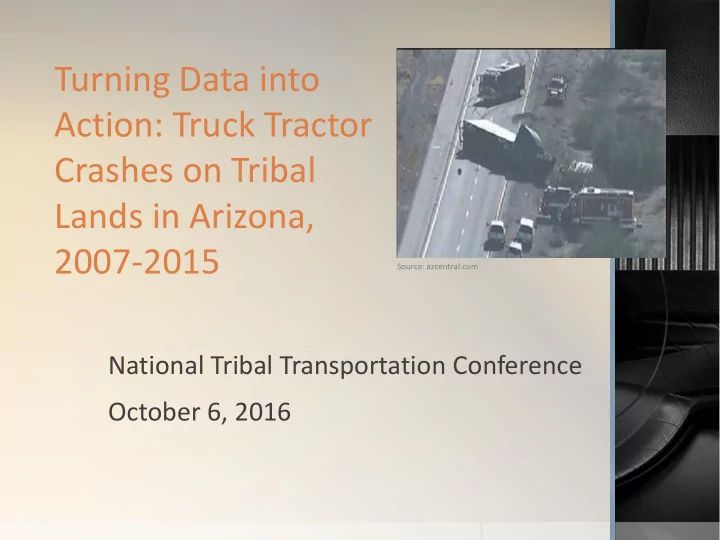
Turning Data into Action: Truck Tractor Crashes on Tribal Lands in Arizona, 2007-2015

National Tribal Transportation Conference October 6, 2016

Source: azcentral.com
slide-2
SLIDE 2

Topics

  • Background
  • 3 Crash Analyses
  • 2 Road Safety Assessments
  • Recommendations
  • Outcomes for the Kaibab

Band of Paiute Indians

Source: azcentral.com

slide-3
SLIDE 3

Background

slide-4
SLIDE 4

Definition: Truck Tractor

  • Non-cargo carrying

power unit in combination with a semi-trailer.

  • Truck tractors and semi-

trailer combinations, referred to as tractor/trailers.

Source: U.S. Department of Transportation, Federal Motor Carrier Safety Administration

slide-5
SLIDE 5

Why Care about Truck Traffic Safety in Arizona?

  • Arizona is in the middle of a large, expanding trade

triangle connecting Southern California, Texas and northern Mexico.

  • Annually, commercial trucks make about 8 million trips

into and out of Arizona with most on east-west interstate routes.

  • North-south trade with Mexico and Canada

is a major initiative for Arizona.

  • By 2050, freight shipments are expected to

triple in Arizona.

Source: Santa Cruz Commerce Center

slide-6
SLIDE 6

MVCs on American Indian Reservations in Arizona

1997-2006 Crash Analysis

slide-7
SLIDE 7

2010 Statewide Crash Analysis Report

  • Utilized reported 1997-2006 crash data in the Arizona

Location Identification Surveillance System

  • Completed an analysis of statewide crashes on Tribal lands

in Arizona

  • Injury and fatal crash rates were about 5 times higher on

Tribal lands than statewide for:

  • Lane departure crashes involving truck tractors
  • Speed-related crashes involving truck tractors
  • Under reporting of vehicle type in 9% of lane departure

fatal crashes on Tribal lands

slide-8
SLIDE 8

2012 Crash Summary

1997-2006 Crash Analysis

slide-9
SLIDE 9

2012 Statewide Crash Summary Method & Result

  • Utilized 1997-2006 reported crash data in the Arizona

Location Identification Surveillance System (ALISS)

  • Examined 27,382 total crashes on Tribal lands
  • Identified n=1,543 total truck tractor crashes on Tribal

lands

slide-10
SLIDE 10

Objectives

  • Compile truck tractor crash rates for Tribal lands and

statewide

  • Total
  • Fatal
  • Injury
  • Identify high crash locations
  • Identify frequencies
  • Crash severity
  • Collision manner
  • First harmful event
  • Low light conditions

Source: overdrive.com

slide-11
SLIDE 11

Comparison of Truck Tractor Crash Rates on Tribal Lands and Statewide, 1997-2006

2% 24% 74%

0% 0% 10% 20% 30% 40% 50% 60% 70% 80% Crash Type Percentage (%) of all AZ Tractor/Trailer Crashes

Tractor Trailer Crash Rates, Statewide, 1997-2006

Fatal Crashes Injury Crashes Property Damage Crashes Unknown Outcome

4% 30% 64% 2%

0% 10% 20% 30% 40% 50% 60% 70% Crash Type

Percentage (%) of all Tribal Land Tractor/Trailer Crashes

Tractor Trailer Crash Rates, Tribal Lands, 1997-2006

Fatal Crashes Injury Crashes Property Damage Crashes Unknown Outcome

slide-12
SLIDE 12

High Crash Locations on Tribal Lands

  • 93% of truck tractor

crashes occurred on interstates and state routes

  • 33% of truck tractor

crashes occurred on I-10

  • 14% of truck tractor

crashes occurred on I-40

Developed by Jonathan Davis, ITCA ArcGIS Fellow

slide-13
SLIDE 13

Collision Manner

  • Single vehicle crashes:

29%

  • Multiple vehicle crashes:
  • Sideswipe in same

direction: 24%

  • Rear-end crashes: 22%
  • Other: 27%

29% 24% 22% 27% Truck Tractor Crashes by Collision Manner, 1997-2006

Single Vehicle Sideswipe in Same Direction Rear End Other

slide-14
SLIDE 14

First Harmful Event

  • Crashed with other

vehicle crashes: 63%

  • Crashed into fixed
  • bject: 9%
  • Overturned: 8%
  • Dropped object from

vehicle: 6%

  • Other: 14%

63% 9% 8% 6% 14% Truck Tractor Crashes by First Harmful Event, 1997-2006

Other Vehicle Fixed Object Overturned Dropped Object from Vehicle Other

slide-15
SLIDE 15

Low Light Conditions

  • Defined as dark/dusk/dawn
  • 35% of total truck tractor

crashes occurred within low light conditions

  • 48% of single vehicle truck

tractor crashes happened in low light conditions

Source: www.mybinc.com/blog/category/motor- vehicle-record-check Source: www.corporatedriving.com/semi-truck- driving-safety/

slide-16
SLIDE 16

Truck Tractor Crashes On and Off Tribal Lands in Arizona

2007-2015 Crash Analysis

slide-17
SLIDE 17

Truck Tractor Crash Analysis: 2007-2015 Methods & Results

  • Utilized 2007-2015 reported crash data in ALISS
  • Used Global Position System coordinates to identify

truck tractor crashes on and off Tribal lands

  • Identified n=17,292 total truck tractor crashes
  • 760 on Tribal lands
  • 16,532 off Tribal lands
slide-18
SLIDE 18

Objectives

  • Compare truck tractor crash rates on Tribal lands versus off

Tribal lands

  • Total
  • Fatal
  • Injury
  • Identify high crash locations
  • Identify frequencies
  • Crash severity
  • Collision manner
  • First harmful event
  • Light conditions
  • Time of day
  • Single and Multiple Vehicles Crashes

Source: overdrive.com

slide-19
SLIDE 19

Comparison of Truck Tractor Crash Rates on and

  • ff Tribal Lands, 2007-2015

87 2.7 8 1.4 0.4 92 2.5 4.1 0.7 0.3 10 20 30 40 50 60 70 80 90 100 No Injury Possible Injury Minor Injury Severe Injury Fatal Percent Tribal Lands Tribal Lands, Off

slide-20
SLIDE 20

Year

0.9 0.5 14 15 17 15 16 6 15 1.2 1.4 14 15 15 15 15 11 12 2 4 6 8 10 12 14 16 18 2007 2008 2009 2010 2011 2012 2013 2014 2015 Percentage Tribal Lands Tribal Lands, Off

slide-21
SLIDE 21

High Crash Locations on Tribal Lands

  • 93% of truck tractor

crashes occurred on interstates and state routes

  • 33.5% of truck

tractor crashes

  • ccurred on I-10
  • 18% of truck tractor

crashes occurred on I-40

Developed by Jonathan Davis, ITCA ArcGIS Fellow

slide-22
SLIDE 22

Collision Manner

0.0 5.0 10.0 15.0 20.0 25.0 30.0 35.0 Rear End Sideswipe, same direction Angle Rear to Side Sideswipe, opposite direction Left Turn Other Single Vehicle Head On Unknown Rear to Rear Percent Tribal Land Tribal Lands, Off

slide-23
SLIDE 23

Single and Multiple Vehicle Crashes

70 30 80 20 10 20 30 40 50 60 70 80 90 100 Multiple Vehicles Single Vehicle Percentage Tribal Lands Tribal Lands, Off

slide-24
SLIDE 24

First Harmful Events

58 10 7 3 3 2 11 3 1 1 69 4 4 2 2 2 8 3 1 10 20 30 40 50 60 70 80 Percentage First Harmful Event Tribal Lands Tribal Lands, Off

slide-25
SLIDE 25

Light Conditions

66 27 3 2.5 0.8 0.8 69 16 10 2.8 1.8 0.8 10 20 30 40 50 60 70 80 90 100 Daylight Dark, not lighted Dark, lighted Dawn Dusk Dark, unknown lighting Percentage Light Conditions Tribal Lands Tribal Lands, Off

slide-26
SLIDE 26

Time of Day

1 2 3 4 5 6 7 8 9 1 2 3 4 5 6 7 8 9 10 11 12 13 14 15 16 17 18 19 20 21 22 23 Percent Hour of Crash Tribal Lands Tribal Lands, Off

slide-27
SLIDE 27

Strengths and Limitations of ALISS Data Analyses

Strengths

  • 8 & 10 years of crash

data in analyses

  • Crash locations are

accurate Limitations

  • Include tribal and non-

tribal drivers

  • Misclassification of truck

tractor trailers

Source: Federal Highway Administration, FHWA-RD-01-159

slide-28
SLIDE 28

ITCA Recommendations for Tribes

Policy:  Strengthen Tribal traffic codes pertaining to commercial traffic

  • n Tribal lands

 Participate in Arizona Strategic Highway Safety Plan implementation for heavy vehicles Enforcement:  Conduct traffic stops of commercial vehicles  Invest in Tribal police training to become certified commercial vehicle inspectors  Conduct commercial vehicle inspections regularly Education:  Conduct “Share the Road” training for Tribal members to heighten awareness of driving strategies near commercial vehicles Engineering:  Complete analyses of MVC involving commercial traffic  Utilize Road Safety Assessments  Utilize traffic calming strategies on state routes through Tribal communities  Place rumble strips to minimize lane departures

slide-29
SLIDE 29

Road Safety Assessment

July 2010

slide-30
SLIDE 30

Process

  • Assessment of State Route (SR) 389, mileposts 30-31
  • Team: ADOT, ADPS, BIADOT WRO, and IHS

2-lane, unlit, rural asphalt road w/paved shoulders East-west direction Generally flat w/low hills and flat horizontal curves Speed is 65 mph Center line recessed pavement markers Center and edge line rumble strips

slide-31
SLIDE 31

Data Analyses

2008 Traffic Count

  • ADOT data
  • Average Daily Traffic 2,500

vehicles per day at intersection

  • f State Route (SR)389 and

BIA50

  • 15% truck traffic
  • ADOT/ADPS indicated truck

volumes significantly higher, possibly 30%

  • SR389 one of few non-

interstate routes to permit triple trailers

Crash History, 1999-2008

  • 50 total crashes
  • 2 fatalities
  • 5 serious injuries
  • Overturn crashes
slide-32
SLIDE 32

Start-up Meeting: Tribal Concerns

  • Tribe has a current

turning lanes project at BIA50

  • Many “near misses” at

BIA50 and SR389

  • SR389 unique mix of

road users: large trucks, unfamiliar drivers, international visitors, recreational vehicles, boat trailers, bicyclists and local traffic

BIA50 and SR389 Intersection

slide-33
SLIDE 33

Suggestions

Potential Safety Issue Potential Countermeasures

Difficult to see the intersection, especially at night

  • Install advance intersection warning

sign approx. 500 prior to BIA50

  • Install 2-directional arrow sign on the

south side of SR389

  • Install 360 degree delineators along

the turn radii on BIA50 Passing zone in intersection relays conflicting information to drivers

  • Mark SR389 for no passing zone at

BIA50 intersection Stop bar is faded and located 21 feet from the intersection

  • Relocate BIA 50 stop bar closer to

SR389 Stop sign is too high at 10 feet

  • Lower stop sign to 7 feet

Need right turning lane on SR389

  • Construct right turn lane on SR389
  • Consider off set rather than

conventional right-turn lane Need left turning lane on SR389

  • Provide left turning lanes on SR389
slide-34
SLIDE 34

Road Safety Assessment (RSA)

March 2014

slide-35
SLIDE 35

Process

  • Assessment of SR389, mileposts 14-30
  • Team: ADOT, Mohave County and ITCA

2-lane, unlit, rural asphalt road w/paved shoulders East-west direction Generally flat w/low hills and flat horizontal curves Speed is 65 mph Center line recessed pavement markers Center and edge line rumble strips

slide-36
SLIDE 36

Data Analyses

Traffic Counts

  • County data
  • Average Annual Daily Traffic

at the SR389/Pipe Springs Intersection projected as 2,400 vehicles per day by 2030

  • Average Daily Traffic 585

vehicles per day, Jul. 27-Aug. 10, 2011

Crash History, 2004-2013

  • 31 total crashes
  • 0 fatalities
  • 1 serious injury
  • Rear-end and overturn

crashes

slide-37
SLIDE 37

Start-up Meeting: Tribal Concerns

  • Lack of advance signage

for intersection

  • Disruption of traffic on

SR389 caused by mining truck turning at intersection

  • Miners directly accessing

SR389 from parking area rather than intersection

SR389/South Antelope Valley Road (CR109) Intersection

slide-38
SLIDE 38

Suggestions

Potential Safety Issue Countermeasure for Consideration

At parking area, miners have created direct access to SR389 instead of using the intersection

  • Limit parking area access to the

intersection

  • Remove direct access to SR389

from parking area No advances street name signs for the intersection

  • Install advance street name signs
  • n SR389 for Antelope Valley
slide-39
SLIDE 39

Start-up Meeting: Tribal Concerns

  • Lack of storage space in turn

lanes causes traffic backups on SR389

  • Truck parking on shoulders of

SR389 shoulder or Pipe Springs causes congestion

  • No lighting at intersection
  • Directional signage too close to

the intersection

  • Shoulder drop offs too steep near

the intersection

  • Increased traffic volumes to

monument, restaurant, gas

station and campground

SR389/Pipe Springs National Monument Road (CR15) Intersection

slide-40
SLIDE 40

Suggestions

Potential Safety Issue Countermeasure for Consideration

Limited sight distance for vehicle turning from Pipe Springs

  • Move stop line on Pipe Springs

closer to SR389 Shoulder parking on Pipe Springs

  • Restripe Pipe Springs approach

EB and WB traffic queuing on SR389 right and left turns to Pipe Springs EB and WB turn lanes are insufficient length for 65 mph

  • Lengthen turn lanes

EB and WB guide and recreational sign are inconsistent: legend, placement and lateral offset

  • Place consistent signage: legend,

placement and lateral offset WB regulatory sign position

  • Position WB regulatory sign
slide-41
SLIDE 41

Outcomes for the Kaibab Band of Paiute Indians

2012-2016

slide-42
SLIDE 42

Intersection of BIA50 and SR389

slide-43
SLIDE 43
  • Increase safety
  • No turning lanes on SR389
  • Heavy commercial truck traffic on

SR389

  • 3 trailers
  • No shoulders on SR389 to pull over
  • Limited visibility on SR389
  • Sunrise: morning hours
  • Sunset: evening hours
  • Speeding on SR389: 70+mph
  • Posted limit is 65mph

RSA Purpose for Tribe

slide-44
SLIDE 44

Funding

  • SR389 improvements were funded with Highway Safety

Improvement Program monies: Federal Aid safety funds administered by ADOT.

  • BIA50 design and construction for the turning lane project was

funding by the Tribal Transportation Program.

slide-45
SLIDE 45

Road Feature Improvements

  • Constructed offset right turn lane on SR389
  • Installed left turn lane on SR389
  • Added no passing zone in the intersection and

signage on SR389

  • Installed an intersection warning sign with

BIA50 route plaques 500 feet in advance of the intersection on east and west sides

  • Installed a two-direction arrow sign on SR389
  • Refreshed the stop bar on BIA50 and relocated

it closer to SR389

  • Lowered the stop sign on BIA50 to 7 feet
  • Installed 360 delineators along the turn radii
  • n BIA50.
slide-46
SLIDE 46

Intersection of Mohave County 15 and SR389

slide-47
SLIDE 47

RSA Purpose for Tribe

SR389 and Mohave County 15 are access roads to:

  • Tribal Administration building
  • Tribal gas station, convenience

store and restaurant

  • Tribal recreational vehicle

campground

  • Pipe Springs National

Monument (National Parks)

  • Communities of Moccasin and

villages of Red Hills, Juniper and Kaibab Large Vehicle Types Using the Intersection of SR389 and Mohave County 15

  • Truck tractor trailers, including

petroleum

  • Recreational vehicles
  • Pickup trucks hauling trailers
  • Trucks with boat trailers
  • School busses

SR389 is the western access road to the Grand Canyon northern rim and a freight route.

slide-48
SLIDE 48

Challenges

  • 2 access roads on the Kaibab Indian Reservation are owned by

ADOT (SR389)and Mohave County (15)

  • In the data driven process for the Highway Safety Improvement

Program, the traffic counts and crash data were examined and don’t show fatalities or serious injuries.

  • In Arizona, road owners have to apply for the Highway Safety

Improvement Program funds

  • The tribe is interested to apply for funding with road owners

approval.

  • Due to tribal staff shortage and new administration, RSA

meeting and agreements have been delayed.

slide-49
SLIDE 49

Next Steps

  • Tribe to meet with Mohave County and ADOT to get approval to

apply for funding for road improvement and expansion.

  • Tribe and 2 road owners enter into an agreement to improve

the intersection.

  • Tribal Council resolution to support road owners’ funding

application.

slide-50
SLIDE 50

Share the Road Training

June 2016

slide-51
SLIDE 51

Partnerships

  • Kaibab Band of Paiute Indians
  • Government
  • Tribal members, including teens
  • Arizona Department of Public Safety
  • Inter Tribal Council of Arizona, Inc.
  • Walmart
slide-52
SLIDE 52

Crashes, 2007-2014

  • 5% of fatal crashes involved a

commercial vehicle

  • 1% of people fatally injured involved

a commercial vehicle crash on Tribal lands in Arizona

  • 13% of people injured involved a

commercial vehicle crash on Tribal lands in Arizona Injuries

  • People <21 years of age: 16% of

people fatally injured in commercial vehicle crashes on Tribal lands in Arizona were under 21 years

  • People <24 years of age: 16% of

people injured in commercial vehicle crashes on Tribal lands in Arizona were under 24 years

slide-53
SLIDE 53

Curriculum Messages

Car drivers are principally at fault in 70-75% of fatal car-truck crashes.

  • Stay out of the No Zones (Blind spots)
  • Pass trucks with caution (pass trucks on the left side for maximum visibility and

maintain a consistent speed)

  • Don’t cut off a truck (leave plenty of room when you pull in front of a truck)
  • Give sufficient space to trucks (give plenty of room to trucks to avoid dangerous

situations)

  • Allow space between trailer and curb (trucks make wide turns)
  • Practice patience (try to avoid any erratic moves or rapid lane changes,

speeding, aggressive driving)

  • Lower your headlights (bright lights reflecting off large trucks can be blinding to

truck drivers)

  • Signal sooner (gives trucks a chance to slow down or stop sooner)
  • Merge with caution (avoiding merging in front of a truck, if traffic is present)
slide-54
SLIDE 54

Blind Spot Demonstration

  • Positioned commercial vehicle

in front of 2 vehicles parked in the right and rear blind spots

  • Participants sit in the parked

commercial vehicle to view the blind spots while the driver explains the dangers

Avoid staying in the right No Zone. Never pass on this side

  • f a big

truck Look for the entire truck in your rear view mirror before moving in front of a big truck Never tailgate or draft a big truck Pass at a safe speed

  • nly on

the left side of a big truck

slide-55
SLIDE 55

Evaluation

Topics Government Employees Teens Reported the training increased their knowledge and awareness 97% 100% Reported that it resulted in a change in their attitudes and perceptions 91% 100% Reported that the training enhanced their skills 94% 100% Were overall satisfied with the training 97% 100%

slide-56
SLIDE 56

Contacts

Kaibab Band of Paiute Indians

  • Laura Savala-Levi

Coordinator for the Tribal Motor Vehicle Injury Prevention Project

Laura.Savala@kaibabpaiute-nsn.gov

(928) 643-8331

Inter Tribal Council of Arizona, Inc., Tribal Epidemiology Center

  • Erica Weis, Epidemiologist

Erica.Weis@itcaonline.com

  • Esther Corbett, Project Manager

Esther.Corbett@itcaonline.com (602) 258-4822

Partially funded by the Department of Health and Human Services Office of Minority Health