8/7/2019 1
U.S. Dairy Sector at Crossroads
2019 Midsouth Ruminant Nutrition Conference Grapevine, TX August 7, 2019
- Dr. Marin Bozic
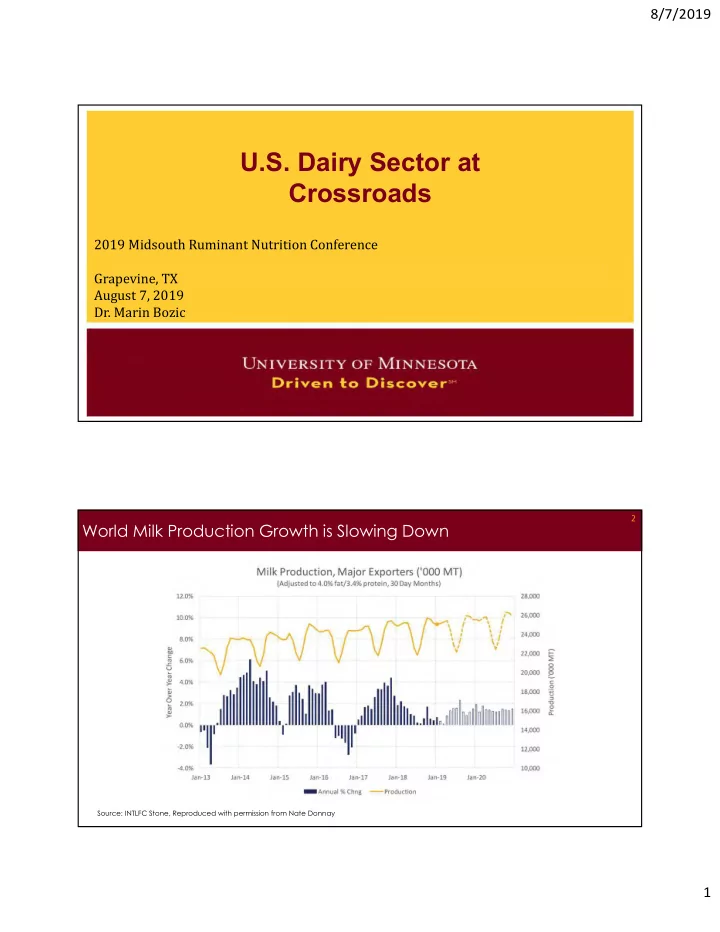
World Milk Production Growth is Slowing Down
2
Source: INTLFC Stone, Reproduced with permission from Nate Donnay
U.S. Dairy Sector at Crossroads 2019 Midsouth Ruminant Nutrition - - PDF document
8/7/2019 U.S. Dairy Sector at Crossroads 2019 Midsouth Ruminant Nutrition Conference Grapevine, TX August 7, 2019 Dr. Marin Bozic 2 World Milk Production Growth is Slowing Down Source: INTLFC Stone, Reproduced with permission from Nate
2
Source: INTLFC Stone, Reproduced with permission from Nate Donnay
3
4
5
Slowing domestic and global milk production has lifted U.S. dairy prices. Forecasted prices are $1.00-$1.50/cwt higher than in 2018. But factors inflicting pain over 2015-2018 will remain, and need to be analyzed in detail…
6 Source: CFFM FINBIN
2007-2014 Average: $1.14/cwt 2015-2018 Average:
$0.00 $1.00 $2.00 $3.00 $4.00 2007 2008 2009 2010 2011 2012 2013 2014 2015 2016 2017 2018
7
Wisconsin, 7.9% Minnesota, 9.4%
0% 1% 2% 3% 4% 5% 6% 7% 8% 9% 10% 2008 2009 2010 2011 2012 2013 2014 2015 2016 2017 2018 2019
8
200,000 400,000 600,000 800,000 1,000,000 1,200,000 Number of Dairy Farms 0.0% 2.0% 4.0% 6.0% 8.0% 10.0% 12.0% 1966 1970 1974 1978 1982 1986 1990 1994 1998 2002 2006 2010 Reduction in Number of Dairy Farms
2018 WI Exit Rate
9
Source: Dr. Bob Yonkers, IDFA based on USDA, NASS
10
0% 5% 10% 15% 20% 25% 30% 35% 40% Percent of US Dairy Herd 100-200 200-500 500-1000 1000-2000 2000+
1000-2000: 2007 / 16.1% 2000+: 34.7% and Rising 500-1000: 2005 / 14.3% 100-200: 1997 / 20% 200-500: 2000 / 18% 1) “large farms” multi-site dairy agribusinesses 2) “family ownership” non- family partnerships 3) external equity financing no longer relying solely on retained earnings for expansions 4) No longer constrained to
to escape local processing capacity constraints 5) Larger % of milk by dairies that are not ‘last- generation’ dairies exists are increasingly involuntary
11
1,000,000 2,000,000 3,000,000 4,000,000 5,000,000 6,000,000
INVENTORY OF MILK COWS: (1 TO 99 HEAD) INVENTORY OF MILK COWS: (100 TO 199 HEAD) INVENTORY OF MILK COWS: (200 TO 499 HEAD) INVENTORY OF MILK COWS: (500 TO 999 HEAD) INVENTORY OF MILK COWS: (1,000 OR MORE HEAD)
1997 2002 2007 2012 2017
12
22% 12% 11% 20% 19% 16% 87% 7% 3%
13
Source: IFCN
14
Agricultural surplus meant there was enough food around to feed soldiers, priests, artisans, government… So why are we lamenting consolidation?
15
16
8,000,000 9,000,000 10,000,000 11,000,000 12,000,000 13,000,000 14,000,000 15,000,000 16,000,000 11/1/2014 11/1/2015 11/1/2016 11/1/2017 11/1/2018
Barrel Cheese Sales reported in NDPSR (4 week moving average)
17
0.0% 0.5% 1.0% 1.5% 2.0% 2.5% 5-Yr CAGR Yield Per Cow US Population Growth 5 10 15 20 25 1950 1956 1962 1968 1974 1980 1986 1992 1998 Million Dairy Cows
18
19
510 520 530 540 550 560 570 1995 1998 2001 2004 2007 2010 2013 2016 lbs / per person
20
500 520 540 560 580 600 620 640 660 1995 1998 2001 2004 2007 2010 2013 2016 lbs/ per person
21
22 0% 2% 4% 6% 8% 10% 12% 14% 16% 18% 8.5 9.0 9.5 10.0 10.5 11.0 11.5 1980 1985 1990 1995 2000 2005 2010 2015 Exports as % of U.S. Milk Solids Million Dairy Cows Average number of milk cows in the U.S. U.S. Dairy Exports as % of U.S. Milk Solids 0% 2% 4% 6% 8% 10% 12% 14% 16% 18% 20% 2003 2005 2007 2009 2011 2013 2015 2017
U.S. Share of World Dairy Trade Volume
23
To keep the U.S. dairy herd stable, U.S. needs to exports 40-50% of incremental skim solids (protein & lactose). The single most important reason why U.S. dairy producers did not enjoy decent profit margins since 2015 are languishing exports. Without exports, markets need to depress the milk price sufficiently to incentivize herd contraction.
Most-favored-nation (MFN): treating other people equally. Under the WTO agreements, countries cannot normally discriminate between their trading
(such as a lower customs duty rate for one
same for all other WTO members.
$0 $200,000,000 $400,000,000 $600,000,000 $800,000,000 $1,000,000,000 $1,200,000,000 $1,400,000,000 Imports Exports Dairy $0 $200,000,000 $400,000,000 $600,000,000 $800,000,000 $1,000,000,000 $1,200,000,000 $1,400,000,000 Imports Exports Dairy
$0 $5,000,000,000 $10,000,000,000 $15,000,000,000 $20,000,000,000 $25,000,000,000 $30,000,000,000 Dairy Ag Imports Exports $0 $5,000,000,000 $10,000,000,000 $15,000,000,000 $20,000,000,000 $25,000,000,000 $30,000,000,000 Dairy Ag
$0 $100,000,000,000 $200,000,000,000 $300,000,000,000 $400,000,000,000 $500,000,000,000 Dairy Ag Total Goods $0 $100,000,000,000 $200,000,000,000 $300,000,000,000 $400,000,000,000 $500,000,000,000 Dairy Ag Total Goods Imports Exports
Source: https://ustr.gov/sites/default/files/2019_Trade_Policy_Agenda_and_2018_Annual_Report.pdf
Net energy trade quadrillion British thermal units
10 20 30 40 1990 2000 2010 2020 2030 2040 2050 2017 history projections Low Oil and Gas Resource and Technology Low Oil Price High Economic Growth Reference Low Economic Growth High Oil Price High Oil and Gas Resource and Technology net imports net exports
$0.00 $0.50 $1.00 $1.50 $2.00 $2.50 $3.00 $3.50 $4.00 2015 2016 2017 2018 Net Payment Per Cwt
$0.00 $0.50 $1.00 $1.50 $2.00 $2.50 $3.00 $3.50 $4.00 $4.50 $5.00 $5.50 Net benefit (indemnity minus premiums)
Source: Atten Babbler Insurance Services Source: Atten Babbler Insurance Services
45
$9.00 $10.00 $11.00 $12.00 $13.00 $14.00 $15.00 $16.00 $17.00
DRP Gross Indemnities (Assuming No Yield Shocks) Insurance Strategy: 100% Class III, 95% Coverage Level, Always Protect Front Quarter
46
$9.00 $10.00 $11.00 $12.00 $13.00 $14.00 $15.00 $16.00 $17.00 $18.00
DRP Gross Indemnities (Assuming No Yield Shocks) Insurance Strategy: 100% Class III, 95% Coverage Level, Always Protect Most Distant Quarter
47