Understanding Luminous Infrared Galaxies in the Herschel Era Arp 84 - - PowerPoint PPT Presentation

understanding luminous infrared galaxies in the herschel
SMART_READER_LITE
LIVE PREVIEW

Understanding Luminous Infrared Galaxies in the Herschel Era Arp 84 - - PowerPoint PPT Presentation

Understanding Luminous Infrared Galaxies in the Herschel Era Arp 84 David B. Sanders (sanders@ifa.hawaii.edu) Institute for Astronomy, University of Hawai`i Collaborators: Jason Chu (IfA), Kirsten Larson (Caltech/IPAC), Joseph Mazzarella


slide-1
SLIDE 1

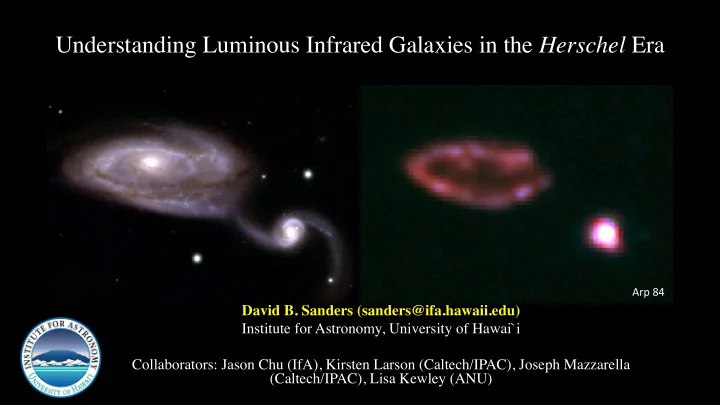
Understanding Luminous Infrared Galaxies in the Herschel Era

David B. Sanders (sanders@ifa.hawaii.edu) Institute for Astronomy, University of Hawai`i Collaborators: Jason Chu (IfA), Kirsten Larson (Caltech/IPAC), Joseph Mazzarella (Caltech/IPAC), Lisa Kewley (ANU)

Arp 84

slide-2
SLIDE 2

Understanding submm-selected LIRGs in the Herschel Era

David B. Sanders (sanders@ifa.hawaii.edu) Institute for Astronomy, University of Hawai`i Collaborators: Jason Chu (IfA), Kirsten Larson (Caltech/IPAC), Joseph Mazzarella (Caltech/IPAC), Lisa Kewley (ANU)

Arp 84

SMG20 – Durham – 8/01/17

slide-3
SLIDE 3

Understanding Luminous Infrared Galaxies in the Herschel Era

  • I. Z ~ 0 (PACS+SPIRE) The Herschel-GOALS atlas
  • II. Z ~ 2.3 (BPT diagram) Herschel vs. MOSDEF selection
slide-4
SLIDE 4

Why Study Luminous IR Galaxies?

  • Hundreds of luminous infrared galaxies (LIRGs) first discovered in the

1980s.

  • They emit the bulk of their bolometric luminosities in the infrared:

LIR= L(8-1000 μm).

– LIRG: 11 ≤ log(LIR/L¤) < 12 – ULIRG: 12 ≤ log(LIR/L¤) < 13

  • Many are interacting/merging
  • (U)LIRGs much more common in the

high-z universe (detected as SMGs).

Ricci+ 2017

slide-5
SLIDE 5
  • Consists of the 201 brightest galaxies in the Revised

Bright Galaxy Sample (RBGS) with LIR≥1011 L¤.

  • GOALS is a statistically complete, flux-limited local

sample of infrared luminous galaxies.

  • They represent a complete picture of galaxy evolution in

the local universe.

è Critical to study these galaxies in the FIR/submm, where they emit the bulk of their bolometric luminosity.

slide-6
SLIDE 6
  • I. Herschel-GOALS Observations
  • Entire GOALS sample imaged by PACS and SPIRE (PI: Sanders).
  • Photodetector Array Camera and Spectrometer (PACS)

– 70 μm è 5.6” beam FWHM – 100 μm è 6.8” – 160 μm è 11.4”

  • Spectral and Photometric Imaging Receiver (SPIRE)

– 250 μm è 18.1” – 350 μm è 25.2” – 500 μm è 36.6”

Herschel PACS and SPIRE Transmission Curves

100 1000 Wavelength [µm] 0.0 0.2 0.4 0.6 0.8 1.0 Normalized Response

Chu+ 2017

slide-7
SLIDE 7

The Herschel-GOALS Atlas

  • Maps of all 201 GOALS systems

have been published for all six Herschel bands in Chu et al. (2017).

  • Aperture photometry measured for

every GOALS object:

– Total system fluxes. – Component fluxes where possible.

  • Very good signal to noise ratios:

– PACS: Typical S/N~10-20 – SPIRE: Typical S/N~5-15

IRAS F13564+3741 (Arp 84)

209.6991 209.6741 209.6491 209.6241 209.5991 37.3890 37.4140 37.4390 37.4640 37.4890 Declination

10 Kpc = 36.0" FOV = 100 Kpc2

70 µm 100 µm

58m 47.79s 58m 41.79s 13h 58m 35.80s 58m 29.80s 58m 23.80s

+37:23:20.51 +37:24:50.50 +37:26:20.50 +37:27:50.49 +37:29:20.48 160 µm 250 µm Right Ascension 350 µm 500 µm

Data: http://irsa.ipac.caltech.edu/data/GOALS/galaxies/

slide-8
SLIDE 8

Results: Infrared SEDs of (U)LIRGs

11.00 < log(LIR/LSun) < 11.25

1 10 100 1000 λ [µm] 9 10 11 12 ν Lν [log LSun]

11.25 < log(LIR/LSun) < 11.50

1 10 100 1000 9 10 11 12

11.50 < log(LIR/LSun) < 11.75

1 10 100 1000 9 10 11 12

11.75 < log(LIR/LSun) < 12

1 10 100 1000 9 10 11 12

12.00 < log(LIR/LSun) < 12.25

1 10 100 1000 9 10 11 12

12.25 < log(LIR/LSun)

1 10 100 1000 9 10 11 12

(Chu+ 2017bc, in prep.)

slide-9
SLIDE 9

Results: Infrared SEDs of (U)LIRGs

11.00 < log(LIR/LSun) < 11.25

1 10 100 1000 λ [µm] 9 10 11 12 ν Lν [log LSun]

N=64

11.25 < log(LIR/LSun) < 11.50

1 10 100 1000 9 10 11 12

N=58

11.50 < log(LIR/LSun) < 11.75

1 10 100 1000 9 10 11 12

N=38

11.75 < log(LIR/LSun) < 12

1 10 100 1000 9 10 11 12

N=19

12.00 < log(LIR/LSun) < 12.25

1 10 100 1000 9 10 11 12

N=13

12.25 < log(LIR/LSun)

1 10 100 1000 9 10 11 12

N=9

IRAS

(Chu+ 2017bc, in prep.)

slide-10
SLIDE 10

Results: Infrared SEDs of (U)LIRGs

IRAS + Spitzer + WISE

11.00 < log(LIR/LSun) < 11.25

1 10 100 1000 λ [µm] 9 10 11 12 ν Lν [log LSun]

N=64

11.25 < log(LIR/LSun) < 11.50

1 10 100 1000 9 10 11 12

N=58

11.50 < log(LIR/LSun) < 11.75

1 10 100 1000 9 10 11 12

N=38

11.75 < log(LIR/LSun) < 12

1 10 100 1000 9 10 11 12

N=19

12.00 < log(LIR/LSun) < 12.25

1 10 100 1000 9 10 11 12

N=13

12.25 < log(LIR/LSun)

1 10 100 1000 9 10 11 12

N=9

(Chu+ 2017bc, in prep.)

slide-11
SLIDE 11

Results: Infrared SEDs of (U)LIRGs

IRAS + Spitzer + WISE + Herschel

11.00 < log(LIR/LSun) < 11.25

1 10 100 1000 λ [µm] 9 10 11 12 ν Lν [log LSun]

N=64

11.25 < log(LIR/LSun) < 11.50

1 10 100 1000 9 10 11 12

N=58

11.50 < log(LIR/LSun) < 11.75

1 10 100 1000 9 10 11 12

N=38

11.75 < log(LIR/LSun) < 12

1 10 100 1000 9 10 11 12

N=19

12.00 < log(LIR/LSun) < 12.25

1 10 100 1000 9 10 11 12

N=13

12.25 < log(LIR/LSun)

1 10 100 1000 9 10 11 12

N=9

(Chu+ 2017bc, in prep.)

slide-12
SLIDE 12

Results: Infrared SEDs of (U)LIRGs

(Chu+ 2017b, in prep.)

Median Infrared SEDs of GOALS and KINGFISH Galaxies

1 10 100 1000 λ [µm] 8 9 10 11 12 ν Lν [log LSun] 12.25 < log(LIR/LSun) 12.00 < log(LIR/LSun) < 12.25 11.75 < log(LIR/LSun) < 12.00 11.50 < log(LIR/LSun) < 11.75 11.25 < log(LIR/LSun) < 11.50 11.00 < log(LIR/LSun) < 11.25 10.50 < log(LIR/LSun) < 10.75 10.25 < log(LIR/LSun) < 10.50 10.00 < log(LIR/LSun) < 10.25 9.75 < log(LIR/LSun) < 10.00

  • SED peak:

Ø Becomes brighter, with

significant jump at highest LIR.

Ø Peak is at shorter wavelengths

with increasing LIR.

  • FIR/sub-mm spectral index:

Ø GOALS: Nearly constant at all

LIR at λ≥250 μm, F∝ν4.05±0.12.

Ø Sub-LIRGs less steep. Ø x2 extra jump in luminosity at

LIR at λ≥60 μm in highest bin.

  • MIR (30-70 μm) spectral index:

Ø Relatively constant for all

GOALS bins, except two highest bins.

slide-13
SLIDE 13

Results: Comparison to Model SEDs

  • We compared our median

SEDs to the model predictions

  • f Chary & Elbaz (2001).
  • CE01 produced SED templates
  • f galaxies as a function of IR

luminosity using IRAS, ISO, and SCUBA data.

Chu et al., (2017b, in prep.)

CE01 Median Infrared SEDs

8 9 10 11 12 ν Lν [log LSun]

12.25 < log(LIR/LSun) < 12.50 12.00 < log(LIR/LSun) < 12.25 11.75 < log(LIR/LSun) < 12.00 11.50 < log(LIR/LSun) < 11.75 11.25 < log(LIR/LSun) < 11.50 11.00 < log(LIR/LSun) < 11.25 10.50 < log(LIR/LSun) < 10.75 10.25 < log(LIR/LSun) < 10.50 10.00 < log(LIR/LSun) < 10.25 9.75 < log(LIR/LSun) < 10.00

1 10 100 1000 λ [µm] −3.0 −2.5 −2.0 −1.5 −1.0 −0.5 0.0 log[ν Lν/LIR]

slide-14
SLIDE 14

Chu et al., (2017b, in prep.)

Results: Comparison C+17 to CE01 Model SEDs

9.75 < log(LIR/LSun) < 10.00

1 10 100 1000 λ [µm] 8 9 10 11 12 ν Lν [log LSun] N=10

10.00 < log(LIR/LSun) < 10.25

1 10 100 1000 8 9 10 11 12 N=8

10.25 < log(LIR/LSun) < 10.50

1 10 100 1000 8 9 10 11 12 N=7

10.50 < log(LIR/LSun) < 10.75

1 10 100 1000 8 9 10 11 12 N=6

11.00 < log(LIR/LSun) < 11.25

1 10 100 1000 8 9 10 11 12 N=64

11.25 < log(LIR/LSun) < 11.50

1 10 100 1000 8 9 10 11 12 N=58

11.50 < log(LIR/LSun) < 11.75

1 10 100 1000 8 9 10 11 12 N=38

11.75 < log(LIR/LSun) < 12

1 10 100 1000 8 9 10 11 12 N=19

12.00 < log(LIR/LSun) < 12.25

1 10 100 1000 8 9 10 11 12 N=13

12.25 < log(LIR/LSun)

1 10 100 1000 8 9 10 11 12 N=9

  • In the FIR/sub-mm, CE01 slightly underestimates

flux in some bins, while in others it overestimates.

  • In the MIR, CE01 matches the data well except in

highest LIR bins where it overestimates.
slide-15
SLIDE 15

Results: Far-Infrared Colors

  • Plot of far-IR flux ratios as a function of

LIR, including the following SED templates:

Ø Chary & Elbaz (2001) Ø Rieke et al. (2009)

Chu et al., (2017b, in prep.)

  • Comparison with models:

Ø R09 predicts the KINGFISH galaxies

well, except the 70/100 color.

Ø CE01 predicts the KINGFISH galaxies

well, except the 70/250 color.

Ø Both models over-predict the 70/250

color for the GOALS galaxies.

slide-16
SLIDE 16
  • II. Optical Line Diagnostics of (U)LIRGs
  • Powerful tool to study a galaxy’s ISM

conditions.

  • First put forth by Baldwin, Phillips,

Terlevich (1981), hence “BPT” diagrams.

  • Uses optical emission line flux ratios to

separate starburst and AGN galaxies:

  • [O III] λ5007 / Hβ
  • [N II] λ6583 / Hα
  • [S II] λλ6717, 6731 / Hα
  • [O I] λ6300 / Hα

Yuan et al. (2010)

  • Theoretical classification lines:
  • Kewley+ 2001 proposed first set of

theoretical BPT classification lines for z=0.

  • Kewley+ 2013a produced theoretical

classification lines up to z=3.

Increasing LIR Where do (U)LIRGs at z~2.3 lie on the BPT diagram?

slide-17
SLIDE 17

z ~ 2.3 Redshift Distribution

Secure Redshifts on BPT Plot Secure Redshifts on BPT Plot

2.0 2.2 2.4 2.6 Redshift 5 10 15 20 Number of Galaxies

IR−Selected (MIR + FIR) Star−Forming (sBzK) All Galaxies

slide-18
SLIDE 18

z ~ 2.3 Stellar Mass Distribution

Stellar Mass Distribution on BPT Plot Stellar Mass Distribution on BPT Plot

8 9 10 11 12 log(M/MSun) 5 10 15 20 Number of Galaxies

IR−Selected (MIR + FIR) Star−Forming (sBzK) All Galaxies

slide-19
SLIDE 19

Optical Line Diagnostics of (U)LIRGs @ z ~ 2.3

  • Sample selected from COSMOS field:
  • (U)LIRGs selected by their 24 μm and/or

Herschel detections.

  • Normal star-forming sBzK galaxies.
  • Photometric redshift cut between 2 < z < 2.61
  • Complementary to rest-frame optically

selected samples of MOSDEF and KBSS.

  • Observations using Keck MOSFIRE (PI: Chu)
  • 7 nights (1 lost to weather) in H+K band.
  • 400 objects total observed.
  • 307 objects with secure redshifts.
  • Results:
  • The sBzK galaxies coincide with the results

from Steidel+ 2014 and Shapley+ 2015.

  • The (U)LIRGs have very similar line ratios

as the AGN sample in Coil+ 2015.

−1.5 −1.0 −0.5 0.0 0.5 log([N II]/Ha) −1.0 −0.5 0.0 0.5 1.0 1.5 log([O III]/Hb)

Kewley+ 2013 Max Starburst Line Steidel+ 2014 Shapley+ 2015

Coil+ 2015 AGN at z~2.3 Steidel+ 2014 Star Forming at z~2.3 Ambiguous Star−Forming (sBzK) IR−Selected (MIR + FIR) −1.5 −1.0 −0.5 0.0 0.5 log([N II]/Ha) −1.0 −0.5 0.0 0.5 1.0 1.5 log([O III]/Hb)

Kewley+ 2013 Max Starburst Line Steidel+ 2014 Shapley+ 2015

Coil+ 2015 AGN at z~2.3 Steidel+ 2014 Star Forming at z~2.3 Ambiguous Star−Forming (sBzK) IR−Selected (MIR + FIR) −1.5 −1.0 −0.5 0.0 0.5 log([N II]/Ha) −1.0 −0.5 0.0 0.5 1.0 1.5 log([O III]/Hb)

Kewley+ 2013 Max Starburst Line Steidel+ 2014 Shapley+ 2015

Coil+ 2015 AGN at z~2.3 Steidel+ 2014 Star Forming at z~2.3 Ambiguous Star−Forming (sBzK) IR−Selected (MIR + FIR)

Chu et al., in prep.

slide-20
SLIDE 20

Optical Line Diagnostics of (U)LIRGs @ z ~ 2.3

  • Sample selected from COSMOS field:
  • (U)LIRGs selected by their 24 μm and/or

Herschel detections.

  • Normal star-forming sBzK galaxies.
  • Photometric redshift cut between 2 < z < 2.61
  • Complementary to rest-frame optically

selected samples of MOSDEF and KBSS.

  • Observations using Keck MOSFIRE (PI: Chu)
  • 7 nights (1 lost to weather) in H+K band.
  • 400 objects total observed.
  • 307 objects with secure redshifts.
  • Results:
  • The sBzK galaxies coincide with the results

from Steidel+ 2014 and Shapley+ 2015.

  • The (U)LIRGs have very similar line ratios

as the AGN sample in Coil+ 2015.

Chu et al., in prep.

slide-21
SLIDE 21

Summary of Results

  • Improved 3-500μm SEDs for LIRGs in the local universe .
  • The FIR peak shifts towards shorter wavelength with increasing LIR.
  • The FIR/sub-mm spectral index is roughly constant (F ∝ ν4.05±0.12) for

(U)LIRGs, LIR=1011 to 1012.5 L¤.

  • Updates to Chary & Elbaz (2001) SED libraries will be published in Chu+17.
  • there are systematic offsets in MIR/FIR colors between CE01 and C+17.
  • CE01 significantly overestimates the MIR flux above LIR~1011.5 L¤.
  • Optical emission line diagnostics (BPT) of (U)LIRGs at z ~ 2.3 show they are

more similar to X-ray selected AGN than K-band selected (i.e. MOSDEF) objects.

  • Q: How compact are the LIR sources in high-z SMGs/ULIRGs ?

Contact: jasonchu@ifa.hawaii.edu GOALS webpage: http://goals.ipac.caltech.edu

slide-22
SLIDE 22

Chu et al., (2017bc, in prep.)

11.00 < log(LIR/LSun) < 11.25

1 10 100 1000 λ [µm] 9 10 11 12 ν Lν [log LSun]

N=64

11.25 < log(LIR/LSun) < 11.50

1 10 100 1000 9 10 11 12

N=58

11.50 < log(LIR/LSun) < 11.75

1 10 100 1000 9 10 11 12

N=38

11.75 < log(LIR/LSun) < 12

1 10 100 1000 9 10 11 12

N=19

12.00 < log(LIR/LSun) < 12.25

1 10 100 1000 9 10 11 12

N=13

12.25 < log(LIR/LSun)

1 10 100 1000 9 10 11 12

N=9

Comparison CE01 and C+17