Understanding Young Dancer Talent: The first findings from the - - PowerPoint PPT Presentation

understanding young dancer talent
SMART_READER_LITE
LIVE PREVIEW

Understanding Young Dancer Talent: The first findings from the - - PowerPoint PPT Presentation

Understanding Young Dancer Talent: The first findings from the Centres for Advanced Training CAT Research Project research project Sanna Nordin, PhD Imogen Walker, MSc Sanna M. Nordin , Research Fellow Imogen J. Walker , PhD Student Emma


slide-1
SLIDE 1

CAT Research Project

Sanna Nordin, PhD Imogen Walker, MSc

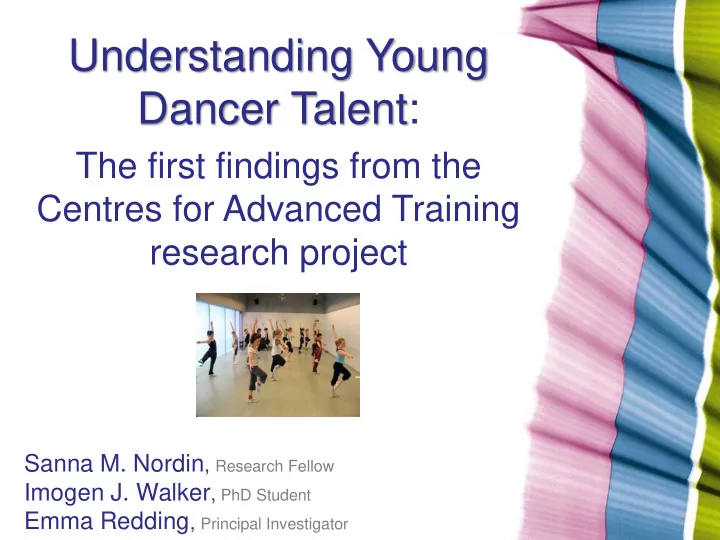
Understanding Young Dancer Talent:

The first findings from the Centres for Advanced Training research project

Sanna M. Nordin, Research Fellow Imogen J. Walker, PhD Student Emma Redding, Principal Investigator

slide-2
SLIDE 2

1: How can dance science inform us about dancer talent? 2: What are CAT dancers like? 3: What kind of team is required to apply these findings in practice? 4: What does the future hold?

slide-3
SLIDE 3
  • Recent research indicates that by

taking a systematic, scientific approach we might better understand

– What talent is

– How it is best developed

  • Talent models & research common in sport:

e.g. increased

– Recognition of the role of psychological and social factors in addition to traditionally emphasised physiological factors – Emphasis on the role of specific forms of deliberate practice over innate talent

1: How can dance science inform us about dancer talent?

slide-4
SLIDE 4
  • E.g. The model of potential talent

predictors in soccer (Williams & Franks,

1998; Williams & Reilly, 2000) includes:

  • Physical Predictors

– e.g. Height, weight, body fat

  • Physiological Predictors

– e.g. Aerobic capacity, anaerobic power

  • Psychological Predictors

– E.g. Perceptual-cognitive skills, personality characteristics

  • Sociological Predictors

– E.g. Parental support, coach-child interaction

1: How can dance science inform us about dancer talent?

slide-5
SLIDE 5

In music, MacNamara & colleagues (2008) took a similar scientific approach, finding that:

“These [psychological characteristics] appear similar to those employed in other performance domains and support increasing empirical evidence of the development of psycho-behavioural characteristics as a core feature of talent development processes.”

(MacNamara et al., 2008, p. 335)

1: How can dance science inform us about dancer talent?

slide-6
SLIDE 6
  • Dance: talent is much talked about

& sought after, but definitions of what & how important it is are

– Varied – Lacking in research / systematic evidence –Traditional dance talent ID based on:

  • Technical skill
  • Physical characteristics (limb lengths, slenderness) & control
  • Other dance-specific criteria: artistic/creative

– Sanders‟ Gifted and Talented Dancers: A Resource Booklet for Teachers deals largely with 2 factors:

  • Psycho-behavioural characteristics
  • Dance-specific criteria: artistic/creative

1: How can dance science inform us about dancer talent?

slide-7
SLIDE 7

Some people seem to think that good dancers are born, but all the good dancers I have known are taught or trained.

(Fred Astaire)

1: How can dance science inform us about dancer talent?

And... Is it innate,

  • r trainable?
slide-8
SLIDE 8

Altogether, it appears that:

  • Using a systematic, scientific

process has helped develop a better understanding of

– talent ID – talent development

in sport and music

  • Aim: further such an understanding in dance

– Collaboration with CAT centres – Unprecedented participation - entire cohort of dancers labelled “talented” / “exceptional potential”

1: How can dance science inform us about dancer talent?

slide-9
SLIDE 9

Overall procedure

  • Profile & screen CAT dancers

– What are they like? – How do they develop?

  • Longitudinal:

– Visit CATs twice yearly – 2.5-year period

  • Interdisciplinary for a holistic view

1: How can dance science inform us about dancer talent?

slide-10
SLIDE 10

Physiology

Adherence

Creativity Psychology Injury

1: How can dance science inform us about dancer talent?

slide-11
SLIDE 11

Specific Research Aims

  • Track CAT dancers across 3 years,

examining which factors in their

–Physicality –Psychology –Background, training

  • Are related to

– Well-being (injury, health) – Performance outcomes (adherence, graduate destinations) – Creativity

… so that eventually, we may better understand how to best develop talent in young dancers

1: How can dance science inform us about dancer talent?

slide-12
SLIDE 12

Data collection 1

  • November – December 2008
  • 324 dancers from all then-active CATs
  • 73.8% female
  • Mixed ethnicities; 78.2% White British
  • 10 – 18 years old (M = 14.47)
  • 1 – 60 months experience of CAT training (M = 14.58)
  • 2 – 29 hours of CAT training per week (M = 3.34)
  • 0 – 35 hours in other dance schools (M = 4.78)

In other words – a mixed cohort!

2: What are CAT dancers like?

slide-13
SLIDE 13

Injury

  • Dance literature: approx. 80% of

pre-professional & professional dancers are injured each year

(e.g. Laws, 2005)

  • In CATs:

– 57.3% had been injured in the past year – 23% reported being injured at the time of screening

2: What are CAT dancers like?

slide-14
SLIDE 14

16.6 32.7 2.3 25.3 23.0

Injury Locations

CAT class Other dance setting Mixed dancing Other physical activity incl sport and PE Outside all physical activity

2: What are CAT dancers like?

Injury

slide-15
SLIDE 15

Injury

  • Dancers injured in the past year:

– Were younger – Had spent LESS time in CAT training

  • In other words - older dancers who spend more time

in CAT training do NOT seem more likely to get injured

Future research will examine whether psychological & physiological characteristics at „baseline‟ may predict injury over time – for instance, does fitness guard against injury?

2: What are CAT dancers like?

slide-16
SLIDE 16

Fitness

  • Indicators include:

– Jump height – Upper body strength – Flexibility – Turnout

  • In general higher scores for:

– Older dancers (except turnout) – Males on jump height & strength – Females on flexibility & turnout

2: What are CAT dancers like?

slide-17
SLIDE 17

Fitness example: Turnout

  • Average 53.0°
  • Range 26.7° – 73.2°
  • No relationship between turnout (average or

discrepancy) and injury In other words, having large or small external hip rotation, or uneven turnout, does not seem to be associated with injury proneness

2: What are CAT dancers like?

slide-18
SLIDE 18

Fitness example: Turnout

  • Favourable comparison to 1st year

undergraduate contemporary dance students:

2: What are CAT dancers like?

50.00 50.50 51.00 51.50 52.00 52.50 53.00 53.50 54.00

Females Males 1st year Undergraduates

Turnout

slide-19
SLIDE 19

Fitness example: Jump height

  • Favourable comparison to contemporary

1st year undergraduate dance students & to contemporary professional dancers:

2: What are CAT dancers like?

10 20 30 40 50 60 70

CAT students 1st year students Professional dancers

Females Males

slide-20
SLIDE 20

Many other women kicked higher, balanced longer,

  • r turned faster.

These are poor substitutes for passion.

(Agnes de Mille)

1: How can dance science inform us about dancer talent?

slide-21
SLIDE 21

Passion

  • 78.7% met criteria for being classified

as passionate about dance

  • Most display an adaptive form of passion – dance fits

into their lives and exists in harmony with other activities

  • Some report a more obsessive passion – dance

threatens to “take over” and become the main focus for their identity

– Previous research suggests such passion is related to injury

Future research will explore potential health implications for different types of passion

2: What are CAT dancers like?

slide-22
SLIDE 22

Self-Esteem

  • Most dancers display healthy levels
  • f self-esteem – comparatively high

scores (M = 3.06 on 1 - 4 scale)

  • Previous literature suggests dancers suffer from

low self-esteem (e.g. Bettle et al., 2001; Buckroyd, 2000)

  • Is this a thing of the past?

Future research will explore what aspects of dance leadership and feedback is related to

  • ptimal levels of self-esteem

2: What are CAT dancers like?

slide-23
SLIDE 23

Motivational Climate

  • Psychological atmosphere in the dance

studio has previously been found to relate to well-being (e.g. Quested & Duda, in press)

  • In CATs, the motivational climate appears very

favourable – and more in line with recommendations for how to structure optimal dance and sports training than

  • CAT dancers‟ other (“home”) dance training

Future research will explore what aspects of the motivational climate is related to health and well- being over time

2: What are CAT dancers like?

slide-24
SLIDE 24
  • Science appears capable of

generating:

– Valid findings – Meaningful relationships between variables

  • Thus, we believe that dance science can be of

assistance in promoting dance health and performance

  • However, it is not a „be-all, end-all‟ approach -

simply a complement to existing teaching and training methods

3: What kind of team is required to apply these findings in practice?

slide-25
SLIDE 25

Translating findings into practice

  • CAT results are fed back /

presented:

– To individual dancers

– To teachers (with dancers‟ consent) – To CATs (as group presentations) – At national & international conferences

  • 8 presentations planned for 2009

– As peer-reviewed journal articles

3: What kind of team is required to apply these findings in practice?

slide-26
SLIDE 26

Translating findings into practice

  • Overall, we advocate a team-based

approach to optimising student performance and well-being, e.g.: – Dancers & CATs – what do you want to know? – Open communication between

  • CATs
  • Therapists
  • Dance science support staff
  • Teachers
  • Research team

keeping all on the same page

3: What kind of team is required to apply these findings in practice?

slide-27
SLIDE 27

Translating findings into practice

– Dance science/Health professional can help

  • interpret research findings
  • support students
  • give talks on relevant topics

– Can use results for

  • goal setting
  • individual training plans
  • Informing pedagogy (e.g. is flexibility improving?)

– Researchers always available for information

  • „Use‟ us to make results applicable to the real-life dance

setting!

3: What kind of team is required to apply these findings in practice?

slide-28
SLIDE 28

Today represents a (very) small

  • verview
  • Findings related to 311 variables...

... Thus, only presented a very small selection here!

  • Many „become interesting‟ over time rather than

now (development & change rather than level)

– E.g. aerobic fitness scores at one point in time say little – changes over time more valuable

4: What does the future hold?

slide-29
SLIDE 29

Today represents a (very) small

  • verview

4: What does the future hold? Background Psychology Physiology Injury Performance- related

Demographics Self-esteem Jump height Type Adherence / Dropout Hours of dance &

  • ther activities

Anxiety Upper body strength Body area Graduate destinations Dance experience Perfectionism Flexibility Location Reasons for leaving Health & injury background Eating attitudes Hypermobility Severity Performance experience Motivational Climate Anthropometry, incl. growth Interruption to dancing Passion Aerobic fitness Treatment Turnout Perceived causes

slide-30
SLIDE 30

Examples of future potential

  • How do talented young

dancers develop across time? E.g.:

  • Does fitness improve?

– Is this related to the type of dance training?

  • Does well-being change over time?

– Is this related to the motivational climate?

4: What does the future hold?

slide-31
SLIDE 31

Examples of future potential

  • Are there discernible differences

between dancers who

– adhere to the training – do well

compared to those prone to unfavourable

  • utcomes, e.g.

– injury – dropout?

4: What does the future hold?

slide-32
SLIDE 32

Examples of future potential

  • Are physical and psychological

health related to creativity?

  • In-depth qualitative research strand to

begin in 2009:

– What are some conceptions of creativity? – Do these differ between students and staff? – Is creativity related to well-being?

4: What does the future hold?

slide-33
SLIDE 33

Examples of future potential

  • Are predictors of favourable
  • utcomes (e.g. progressing well

in dance):

– static characteristics of individuals? – dynamic characteristics of training?

In other words, are there elements of talent that are trainable?

4: What does the future hold?

slide-34
SLIDE 34

Summary

  • Many examples of

favourable results

  • As in most samples, range is

wide, with some students faring excellently and others (a minority) not so well

4: What does the future hold?

  • Future work will help uncover some of

the reasons why this might be so

slide-35
SLIDE 35

CAT Research Project

Sanna Nordin, PhD Imogen Walker, MSc

Thank you for listening! Any Questions?

Sanna Nordin: S.Nordin@laban.org Imogen Walker: I.Walker@trinitylaban.ac.uk Emma Redding: E.Redding@laban.org Photo credits: Belinda Lawley & Mark Pepperall

slide-36
SLIDE 36

CAT Research Project

Sanna Nordin, PhD Imogen Walker, MSc References

  • Bettle, N., Bettle, O., Neumärker, U., and Neumärker, K.J. (2001).

Body image and self-esteem in adolescent ballet dancers. Perceptual and Motor Skills. 93(1), 297-309.

  • Buckroyd, J. (2000). The Student Dancer: Emotional Aspects of the

Teaching and Learning of Dance. London: Dance Books.

  • Laws, H. (2005). Fit to Dance 2: Report of the second national

inquiry into dancers‟ health and injury in the UK. London: Dance UK.

  • MacNamara, A., Holmes, P., & Collins, D. (2008). Negotiating

transitions in musical development: the role of psychological characteristics of developing excellence. Psychology of Music, 36, 335-352.

  • Quested, E. and Duda, J.L. (in press). Perceptions of the

motivational climate, need satisfaction, and indices of well- and ill- being among hip hop dancers. Journal of Dance Medicine and Science.

  • Sanders, L. Gifted and Talented Dancers: A Resource Booklet for
  • Teachers. Commissioned by the Dance Network.
  • Williams, A. M. & Reilly, T. (2000). Talent identification and

development in soccer. Journal of Sports Sciences,18, 657-667.