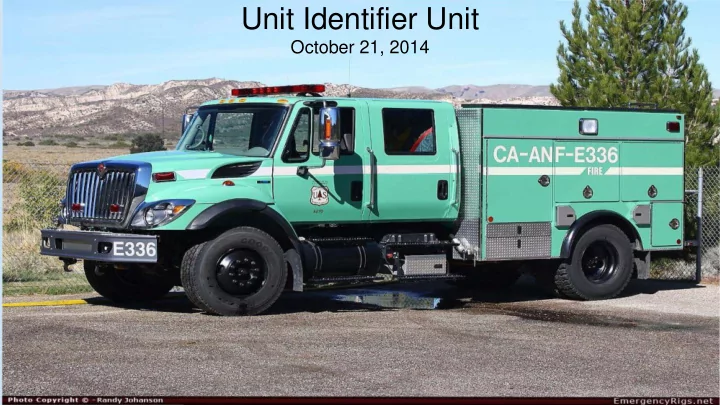
Unit Identifier Unit October 21, 2014 Unit Identifiers Unit Members - - PowerPoint PPT Presentation

unit identifier unit
SMART_READER_LITE
LIVE PREVIEW

Unit Identifier Unit October 21, 2014 Unit Identifiers Unit Members - - PowerPoint PPT Presentation

Unit Identifier Unit October 21, 2014 Unit Identifiers Unit Members Representing Name Email Phone Unit Lead, National Unit Identifier Data Rick Squires rsquires@blm.gov 208-387-5655 Custodian, Non-DOI/Non USDA Federal Agencies


slide-1
SLIDE 1

Unit Identifier Unit

October 21, 2014

slide-2
SLIDE 2

Unit Identifiers Unit Members

Representing Name Email Phone Unit Lead, National Unit Identifier Data Custodian, Non-DOI/Non USDA Federal Agencies Representative Rick Squires rsquires@blm.gov 208-387-5655 Unit Vice Lead, FS and Other USDA Agencies Representative Gina Papke gpapke@fs.fed.us 360-891-5152 Geographic Area Coordination Center Data Custodian Representative Kenan Jaycox kjaycox@fs.fed.us 505-842-3880 BIA Representative John Barborinas john.barborinas@bia.gov 970 903-3499 BLM Representative, DOI - Representing the Department and Bureaus, except BIA, BLM, NPS, or FWS Dianna Sampson dsampson@blm.gov 208-387-5196

slide-3
SLIDE 3

Unit Identifiers Unit Members cont.

Representing Name Email Phone FWS Representative Andrea Olson andrea_olson@fws.gov 208 387-5597 NPS Representative, Unit Identifiers Data Standards Steward (tentative) Dave Niemi David_Niemi@nps.gov 402-661-1762 NASF Representative Mike Lococo mike.lococo@calema.ca.gov 916-642-3825 County and Local Representative Lauren Hickey lhickey@blm.gov 907-356-5680 WFIT Representative Vacant

slide-4
SLIDE 4

History of Unit Identifiers

  • Began in 1984 with national implementation of resource order

form

  • Modeled after CalFire’s three letter unit identifiers
  • Unit Identifiers were maintained by Geo Areas until 1992, then

NICC consolidated Geo Area lists and began to manage

  • List was published in 1993 and avail through the GBK, NFES

2028 and was updated every 1-2 years

slide-5
SLIDE 5

History of Unit Identifiers (continued)

  • 2001: GACC Data Custodians were identified and the NWCG

Project Management Office (PMO) set up a Microsoft Access database to assist with data management

  • 2002: Unit Identifiers were brought under NWCG umbrella &

Information Resource Management (IRM) WT began mgmt & the list was published as Unit Identifiers, PMS 931

  • Data standard was approved as PMS 910 & was one of
  • riginal NWCG data standards established by the newly

formed Data Administration Working Group (DAWG)

slide-6
SLIDE 6

History of Unit Identifiers (continued)

  • 2003: The Unit Identifiers Module was created in the WFMI

system and is still used as the System of Record (SOR) today

  • 2007: The IRM WT was replaced with the Information

Technology Committee & the DAWG was replaced by the Data Standards and Terminology Subcommittee (DSTS)

  • DSTS was responsible for development & maintenance of

data standards but did not oversee implementation of standards (creation, approval & business process)

slide-7
SLIDE 7

History of Unit Identifiers (continued)

  • September 2010: Mtg held to charter group to manage Unit

Identifiers per NWCG PMS-900, “all NWCG products are under the stewardship of specific NWCG groups” and the Change Management Board was created

  • The CMB realized significant issues from no business process
  • r governance since 2007, caused monthly maintenance of

unit identifiers nearly impossible

slide-8
SLIDE 8

History of Unit Identifiers (continued)

  • Plus overwhelming work, lack of support, no signed charter,

responsibility and authority of mgmt of Unit Identifiers was unclear, business process documentation was limited and unknown and data standards for associated data was rudimentary or absent, stacked the deck against the CMB to succeed in their task of managing Unit Identifiers

  • September 2012: NWCG EB issued a tasking memorandum

to create a task team to review and make recommendations to improve management of Unit Identifiers

slide-9
SLIDE 9

zyxwvutsrqponmlkjihgfedcbaZYXWVUTSRQPONMLKJIHGFEDCBA

History of Unit Identifiers (continued)

  • 2013: NWCG Executive Board decommissioned the ITC, the

parent group of the CMB. A new charter was signed creating the Unit Identifier Unit (UIU). The UIU would operate under the Data Management Committee (DMC), continuing to adhere to data standards set by NWCG

  • December 2013, Task Team products delivered: Unit Identifier

Guide: Part I Business Process, PMS 931-1, and Unit Identifier Guide: Part II Data Report, PMS 931-2

slide-10
SLIDE 10

Pl.mnin

E

'911:) ~mcnm

Drnn h

erdi

tiO'n :

.

roup (

Equ1 ipment and

bno

l o~Q

~ B

ra

ncb

[}Jtl

1\T Ml

~; mcnt

'ornmiu

(OMC)

nit ldenUtl r nil ( I )

I

  • i

ni11 •

Br.Lnth

NWCG Organizational Structure

slide-11
SLIDE 11

Roles & Responsibilities of the UIU

  • Final decision authority for approval/denial for new, modified,

removed, or deleted Unit Identifiers & associated information.

  • Business stewardship for all NWCG data standards, business

rules, and processes related to Unit Identifiers and associated information.

  • Ensures NWCG data standards, business rules and process

related to Unit Identifiers and associated information are followed consistently by GACC’s, agencies, and applications.

slide-12
SLIDE 12

zyxwvutsrqponmlkjihgfedcbaZYXWVUTSRQPONMLKJIHGFEDCBA

Roles & Responsibilities (continued)

  • Provide final recommendation for proposed changes to the

designated System Of Record for Unit Identifiers and associated information in consultation with participants.

  • Stewardship for NWCG publication, Unit Identifier Guide: Part

I Business Process, PMS 931-1, and Unit Identifier Guide: Part II Data Report, PMS 931-2.

  • Conducts periodic review and validation of existing Unit

Identifiers and associated information and takes corrective action to maintain data accuracy and integrity.

slide-13
SLIDE 13

zyxwvutsrqponmlkjihgfedcbaZYXWVUTSRQPONMLKJIHGFEDCBA

Unit Identifier Information

  • The Unit Identifier code is the six to eight alpha-numeric

character code, which is used within the interagency incident management community to uniquely identify a particular government or NWCG non-government organizational unit as a cooperator, and to place the unit in a geographical context.

  • The Unit Identifier code is combined with an approved country

code, country subdivision code, and organizational unit code, to form a unique combination that identifies a single, distinct

  • rganizational unit.
slide-14
SLIDE 14

zyxwvutsrqponmlkjihgfedcbaZYXWVUTSRQPONMLKJIHGFEDCBA

Unit Identifier Information (Cont.)

The following figure displays how three data elements, when combined, create a Unit Identifier for a given unit.

slide-15
SLIDE 15

Organizational Unit Code & Name

The organizational unit code is the 3-4 alphanumeric characters, which creates a code for a unit which exists within the agency’s

  • fficial organizational structure, combined with a country and

country subdivision code. The organizational unit code identifies the unit within the interagency incident management community in a common manner. Organizational units are defined as a govt or NWCG approved non-govt administrative unit which provides primary leadership for a jurisdictional area. Government units may be organized at the federal, regional, state, tribal, county, or city level.

slide-16
SLIDE 16

Organizational Unit Requirements

  • Incident host (geographic)
  • Incident host (functional)
  • Resource provider
  • Dispatch/coordination center
  • Training facility
  • Incident supply cache
  • Organizational unit codes should only be issued to the lowest

level necessary as defined by the federal agency or state.

  • The organizational unit code should be assigned in a manner

that makes it generally recognizable and applicable as an abbreviation of the unit’s name.

slide-17
SLIDE 17

Organizational Unit Requirements (continued)

  • Every organizational unit will be assigned a Geographic Area.
  • An organizational unit cannot be assigned more than one

Geographic Area.

  • If the organizational unit resides within multiple Geographic

Areas, or is located within a Geographic Area different from the organizational unit’s headquarters, the Geographic Area code will be based upon the physical location of the

  • headquarters. Headquarters is defined as the center of
  • perations for the organizational unit.
slide-18
SLIDE 18

Organizational Unit Requirements (continued)

  • The organizational unit address will reflect the physical

location of the headquarters. Headquarters is defined as the center of operations for the unit.

  • The organizational unit phone will reflect the phone number for

the main line of the physical location of the headquarters.

slide-19
SLIDE 19

Creating, Modifying and Removing Unit Identifiers

The process for creating, modifying, removing or deleting Unit Identifiers and/or associated information principally follow the same sequence.

  • Unit level submits request to their UIU agency representative.
  • Agency representative ensures criteria is met and forwards

request to the Geographic Area Data Custodian

  • Geographic Area Custodians ensure agency decision making

processes are complete and are responsible for completing timely entries into the SOR

slide-20
SLIDE 20

Creating, Modifying and Removing Unit Identifiers (cont.)

  • The National Data Custodian introduces the requested Unit

Identifiers to the UIU for final approval

  • The UIU provides stewardship for Unit Identifiers and

associated information for the interagency incident management community. Additionally, the UIU reviews and gives final approval for new Unit Identifiers before they are published in PMS 931-2

slide-21
SLIDE 21

Unit Identifier Unit (UIU)

Provides b usin ess s tewards hip F

  • r

U nit Ide ntifiers a nd associa ted in forma tion R espon s ible fo r e n sur i n g agency inte rna l d ecision 1naking process is d ocume nte d a nd a pprop r ia te F inal a p p r oval authority R esolves issues a nd conflic ts

National Data Custodian

Presen ts requeste d c h anges to th e

N W CG U J U for final app rova l

Documents N W CG U I U decis ions for requ este d c h anges Pub lis h es a p proved c h a n ges n1o n thly Dissen1ina tes lis t of

a p proved c h a n ges to app l ication s a nd s takeh o lders

GACC Data Custodians

E n sures documen ted agency i n te rna l

process h as been completed

E n s u res appr o pria te N W CG O rganizatio n a l U nit Codes are

created Con1 p lc tes timel y e ntry in t h e system

  • r

record (SOR)

Agency UIU Representative

D ocun'"lents agen cy i n terna l d ecision

making p rocess Condu cts p rocess a n d e n s u res

c 1 ·itc ria a rc met.

Subn1its ' vrin:e n requests to app ropriate GACC D a ta Custodian Validate and Recommend ror Approval Electronic Data

SubR'Ii ssion

Written Request Submitted

Agency Internal Decision Making Process

Docu n, e ntcd agen cy in tern a l decision making process is followed and decision recorded

Unit L e vel

.... Publish

PMS931

D iscu sses re q uest to create, m odify, remove o r delete U nit Ide ntifiers and/or associated

i n f"

  • rrnation w ith t h eir respect ive U I U agency ·

representative

Diagram of Unit ID Process

slide-22
SLIDE 22

Unit Identifiers Breakdown by Type

  • 1. County and Local: 53.9%
  • 2. Federal: 28.7%
  • 3. State: 11.6%
  • 4. Non-Government: 2.6% (higher now)
  • 5. Interagency: 2.3%
  • 6. Tribes: 1%
slide-23
SLIDE 23

Applications Which Utilize Unit Identifiers

Downstream applications which utilize Unit Identifiers are required to only utilize approved, published Unit Identifiers reflected in the PMS 931-2. If a downstream application observes a needed change, they will contact the UIU agency representative who is associated with that specific Unit Identifier. If a problem is observed and needs immediate attention, the UIU lead and/or vice lead will be responsible for disseminating the modification.

slide-24
SLIDE 24

To-Do List

  • PMS 931-1 is 90% complete, need to finish and post to web
  • Complete review of Unit Identifiers User’s Guide and publish

to web

  • Complete Intent Document
  • Fill vacant positions
slide-25
SLIDE 25

To-Do List (continued)

  • Continue clean-up work in the SOR
  • Research if current platform is adequate or if another platform

should be used

  • Agencies must complete their internal decision making

process for management of Unit Identifiers

slide-26
SLIDE 26

Questions, Comments ?