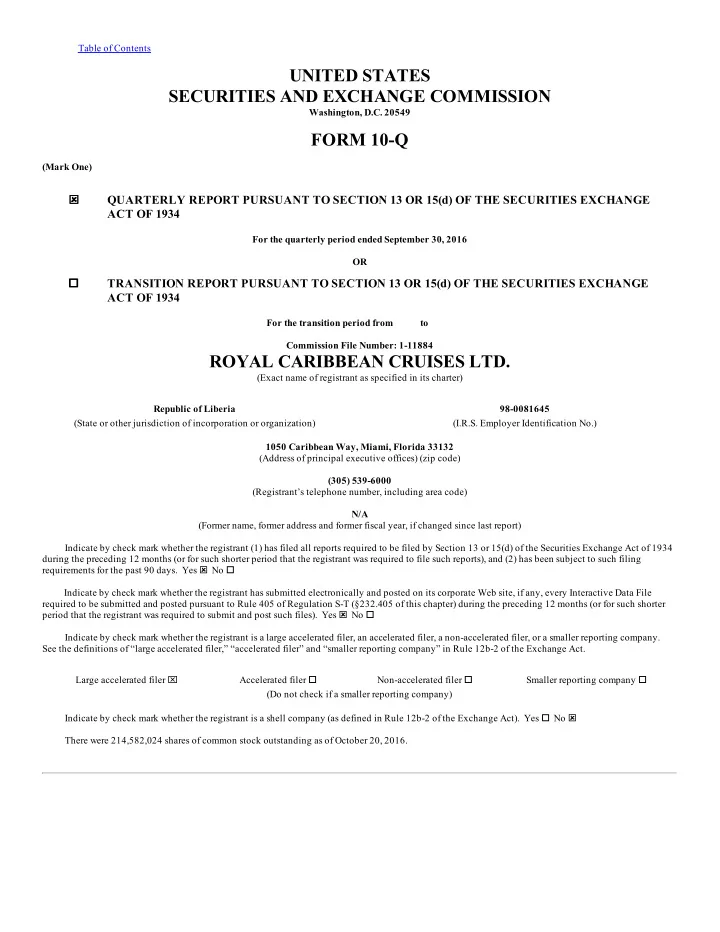
SLIDE 1 Table of Contents
UNITED STATES SECURITIES AND EXCHANGE COMMISSION
Washington, D.C. 20549
FORM 10-Q
(Mark One)
ý ý QUARTERLY REPORT PURSUANT TO SECTION 13 OR 15(d) OF THE SECURITIES EXCHANGE ACT OF 1934
For the quarterly period ended September 30, 2016 OR
- TRANSITION REPORT PURSUANT TO SECTION 13 OR 15(d) OF THE SECURITIES EXCHANGE
ACT OF 1934
For the transition period from to Commission File Number: 1-11884
ROYAL CARIBBEAN CRUISES LTD.
(Exact name of registrant as specified in its charter) Republic of Liberia 98-0081645 (State or other jurisdiction of incorporation or organization) (I.R.S. Employer Identification No.) 1050 Caribbean Way, Miami, Florida 33132 (Address of principal executive offices) (zip code) (305) 539-6000 (Registrant’s telephone number, including area code) N/A (Former name, former address and former fiscal year, if changed since last report) Indicate by check mark whether the registrant (1) has filed all reports required to be filed by Section 13 or 15(d) of the Securities Exchange Act of 1934 during the preceding 12 months (or for such shorter period that the registrant was required to file such reports), and (2) has been subject to such filing requirements for the past 90 days. Yes ý No o Indicate by check mark whether the registrant has submitted electronically and posted on its corporate Web site, if any, every Interactive Data File required to be submitted and posted pursuant to Rule 405 of Regulation S-T (§232.405 of this chapter) during the preceding 12 months (or for such shorter period that the registrant was required to submit and post such files). Yes ý No o Indicate by check mark whether the registrant is a large accelerated filer, an accelerated filer, a non-accelerated filer, or a smaller reporting company. See the definitions of “large accelerated filer,” “accelerated filer” and “smaller reporting company” in Rule 12b-2 of the Exchange Act. Large accelerated filer x Accelerated filer o Non-accelerated filer o Smaller reporting company o (Do not check if a smaller reporting company) Indicate by check mark whether the registrant is a shell company (as defined in Rule 12b-2 of the Exchange Act). Yes o No ý There were 214,582,024 shares of common stock outstanding as of October 20, 2016.
SLIDE 2 Table of Contents ROYAL CARIBBEAN CRUISES LTD. TABLE OF CONTENTS
Page
PART I. FINANCIAL INFORMATION Item 1. Financial Statements 1 Item 2. Management’s Discussion and Analysis of Financial Condition and Results of Operations 25 Item 3. Quantitative and Qualitative Disclosures About Market Risk 44 Item 4. Controls and Procedures 44 PART II. OTHER INFORMATION Item 1. Legal Proceedings 45 Item 1A. Risk Factors 45 Item 2. Unregistered Sales of Equity Securities and Use of Proceeds 45 Item 6. Exhibits 46 SIGNATURES 47
SLIDE 3 Table of Contents PART I. FINANCIAL INFORMATION Item 1. Financial Statements ROYAL CARIBBEAN CRUISES LTD. CONSOLIDATED STATEMENTS OF COMPREHENSIVE INCOME (LOSS) (unaudited; in thousands, except per share data)
Quarter Ended September 30, 2016 2015
Passenger ticket revenues $ 1,899,956 $ 1,873,942 Onboard and other revenues 663,785 649,158 Total revenues 2,563,741 2,523,100 Cruise operating expenses: Commissions, transportation and other 400,933 413,156 Onboard and other 159,887 175,214 Payroll and related 214,081 217,627 Food 125,732 122,124 Fuel 178,772 199,848 Other operating 260,718 259,057 Total cruise operating expenses 1,340,123 1,387,026 Marketing, selling and administrative expenses 257,430 256,060 Depreciation and amortization expenses 229,328 210,742 Impairment of Pullmantur related assets — 411,267 Restructuring charges 1,897 — Operating Income 734,963 258,005 Other income (expense): Interest income 6,472 1,735 Interest expense, net of interest capitalized (82,610) (66,819) Other income (including in 2015 a net deferred tax benefit of $12.0 million related to the Pullmantur impairment) 34,432 35,866 (41,706) (29,218) Net Income $ 693,257 $ 228,787 Earnings per Share: Basic $ 3.23 $ 1.04 Diluted $ 3.21 $ 1.03 Weighted-Average Shares Outstanding: Basic 214,819 219,963 Diluted 215,667 221,137 Comprehensive Income Net Income $ 693,257 $ 228,787 Other comprehensive income (loss): Foreign currency translation adjustments 4,043 (4,191) Change in defined benefit plans (5,051) 3,318 Gain (loss) on cash flow derivative hedges 95,536 (222,492) Total other comprehensive income (loss) 94,528 (223,365) Comprehensive Income $ 787,785 $ 5,422 The accompanying notes are an integral part of these consolidated financial statements. 1
SLIDE 4 Table of Contents ROYAL CARIBBEAN CRUISES LTD. CONSOLIDATED STATEMENTS OF COMPREHENSIVE INCOME (LOSS) (unaudited; in thousands, except per share data)
Nine Months Ended September 30, 2016 2015
Passenger ticket revenues $ 4,794,653 $ 4,688,189 Onboard and other revenues 1,792,145 1,708,832 Total revenues 6,586,798 6,397,021 Cruise operating expenses: Commissions, transportation and other 1,060,391 1,093,409 Onboard and other 399,739 438,558 Payroll and related 671,955 647,788 Food 371,759 361,317 Fuel 531,283 607,689 Other operating 857,161 777,291 Total cruise operating expenses 3,892,288 3,926,052 Marketing, selling and administrative expenses 845,808 817,040 Depreciation and amortization expenses 661,712 617,678 Impairment of Pullmantur related assets — 411,267 Restructuring charges 6,627 — Operating Income 1,180,363 624,984 Other income (expense): Interest income 14,875 8,244 Interest expense, net of interest capitalized (226,803) (213,598) Other income (including a $21.7 million loss related to the 2016 elimination of the Pullmantur reporting lag and including in 2015 a net deferred tax benefit of $12.0 million related to the Pullmantur impairment) 53,867 39,354 (158,061) (166,000) Net Income $ 1,022,302 $ 458,984 Earnings per Share: Basic $ 4.74 $ 2.09 Diluted $ 4.72 $ 2.08 Weighted-Average Shares Outstanding: Basic 215,663 219,835 Diluted 216,575 220,979 Comprehensive Income Net Income $ 1,022,302 $ 458,984 Other comprehensive income (loss): Foreign currency translation adjustments 8,423 (23,994) Change in defined benefit plans (12,148) 5,567 Gain (loss) on cash flow derivative hedges 254,624 (280,968) Total other comprehensive income (loss) 250,899 (299,395) Comprehensive Income $ 1,273,201 $ 159,589 The accompanying notes are an integral part of these consolidated financial statements. 2
SLIDE 5 Table of Contents ROYAL CARIBBEAN CRUISES LTD. CONSOLIDATED BALANCE SHEETS (in thousands, except share data)
As of September 30, December 31, 2016 2015 (unaudited)
Assets Current assets Cash and cash equivalents $ 178,428 $ 121,565 Trade and other receivables, net 273,422 238,972 Inventories 118,849 121,332 Prepaid expenses and other assets 231,442 220,579 Derivative financial instruments 928 134,574 Total current assets 803,069 837,022 Property and equipment, net 20,230,803 18,777,778 Goodwill 288,461 286,764 Other assets 1,127,929 880,479 $ 22,450,262 $ 20,782,043 Liabilities and Shareholders’ Equity Current liabilities Current portion of long-term debt $ 1,298,002 $ 899,542 Accounts payable 259,027 302,072 Accrued interest 95,112 38,325 Accrued expenses and other liabilities 678,874 658,601 Derivative financial instruments 201,877 651,866 Customer deposits 1,967,678 1,742,286 Total current liabilities 4,500,570 4,292,692 Long-term debt 8,419,850 7,627,701 Other long-term liabilities 739,693 798,611 Commitments and contingencies (Note 7) Shareholders’ equity Preferred stock ($0.01 par value; 20,000,000 shares authorized; none outstanding) — — Common stock ($0.01 par value; 500,000,000 shares authorized; 234,589,237 and 233,905,166 shares issued, September 30, 2016 and December 31, 2015, respectively) 2,346 2,339 Paid-in capital 3,316,385 3,297,619 Retained earnings 7,702,260 6,944,862 Accumulated other comprehensive loss (1,077,534) (1,328,433) Treasury stock (20,019,237 and 15,911,971 common shares at cost, September 30, 2016 and December 31, 2015, respectively) (1,153,308) (853,348) Total shareholders’ equity 8,790,149 8,063,039 $ 22,450,262 $ 20,782,043 . The accompanying notes are an integral part of these consolidated financial statements. 3
SLIDE 6 Table of Contents ROYAL CARIBBEAN CRUISES LTD. CONSOLIDATED STATEMENTS OF CASH FLOWS (unaudited; in thousands)
Nine Months Ended September 30, 2016 2015
Operating Activities Net income $ 1,022,302 $ 458,984 Adjustments: Depreciation and amortization 661,712 617,678 Impairment of Pullmantur related assets — 411,267 Net deferred income tax expense (benefit) 1,601 (13,466) Loss on derivative instruments not designated as hedges 6,353 49,607 Changes in operating assets and liabilities: Decrease in trade and other receivables, net 9,823 24,130 Increase in inventories (6,379) (8,377) Decrease (increase) in prepaid expenses and other assets 2,484 (30,649) Decrease in accounts payable (17,313) (22,915) Increase in accrued interest 56,787 34,207 Increase in accrued expenses and other liabilities 23,216 11,558 Increase in customer deposits 197,277 65,511 Dividends received from unconsolidated affiliates 71,370 5,327 Other, net (28,281) 5,074 Net cash provided by operating activities 2,000,952 1,607,936 Investing Activities Purchases of property and equipment (2,313,831) (1,360,637) Cash paid on settlement of derivative financial instruments (172,878) (158,890) Investments in and loans to unconsolidated affiliates (8,611) (54,250) Cash received on loans to unconsolidated affiliates 22,470 122,710 Other, net (1) (44,709) (18,642) Net cash used in investing activities (2,517,559) (1,469,709) Financing Activities Debt proceeds 6,038,560 2,962,501 Debt issuance costs (83,793) (57,146) Repayments of debt (4,818,262) (2,887,237) Purchases of treasury stock (299,959) — Dividends paid (243,557) (197,718) Proceeds from exercise of common stock options 1,782 6,902 Other, net 2,179 1,778 Net cash provided by (used in) financing activities 596,950 (170,920) Effect of exchange rate changes on cash (23,480) (9,129) Net increase (decrease) in cash and cash equivalents 56,863 (41,822) Cash and cash equivalents at beginning of period 121,565 189,241 Cash and cash equivalents at end of period $ 178,428 $ 147,419 Supplemental Disclosure Cash paid during the period for: Interest, net of amount capitalized $ 140,335 $ 151,661 Non-cash Investing Activities Notes receivable issued upon sale of property and equipment $ 213,042 $ —
(1)Amount includes $26.0 million related to cash included in the divestiture of RCHE.
The accompanying notes are an integral part of these consolidated financial statements. 4
SLIDE 7 Table of Contents ROYAL CARIBBEAN CRUISES LTD. NOTES TO THE CONSOLIDATED FINANCIAL STATEMENTS (unaudited) As used in this Quarterly Report on Form 10-Q, the terms “Royal Caribbean,” the “Company,” “we,” “our” and “us” refer to Royal Caribbean Cruises
- Ltd. and, depending on the context, Royal Caribbean Cruises Ltd.’
s consolidated subsidiaries and/or affiliates. The terms “Royal Caribbean International,” “Celebrity Cruises,” “Azamara Club Cruises,” “TUI Cruises,” “Pullmantur,” and “CDF Croisières de France” refer to our cruise brands. However, because TUI Cruises is an unconsolidated investment, our operating results and other disclosures herein do not include TUI Cruises unless otherwise specified. Additionally, prior to August 2016, both Pullmantur and CDF Croisières de France ("CDF") were wholly owned by us. However, in July 2016, we sold 51%
- f our interest in Pullmantur and CDF, therefore, for the period subsequent to the sale, our operating results and other disclosures herein do not include
Pullmantur and CDF unless otherwise specified. In accordance with cruise vacation industry practice, the term “berths” is determined based on double
- ccupancy per cabin even though many cabins can accommodate three or more passengers. This report should be read in conjunction with our Annual
Report on Form 10-K for the year ended December 31, 2015, including the audited consolidated financial statements and related notes included therein. This Quarterly Report on Form 10-Q also includes trademarks, trade names and service marks of other companies. Use or display by us of other parties’ trademarks, trade names or service marks is not intended to and does not imply a relationship with, or endorsement or sponsorship of us by, these other parties other than as described herein. Note 1. General Description of Business We are a global cruise company. As of September 30, 2016, we own and operate three global cruise brands: Royal Caribbean International, Celebrity Cruises and Azamara Club Cruises. We also own a 50% joint venture interest in the German brand TUI Cruises, a 49% interest in the Spanish brand Pullmantur and have minority interests in other smaller regional brands. Prior to August 2016, Royal Caribbean Holdings de Espana ("RCHE"), the parent company of the Pullmantur and CDF brands, was wholly owned by us. Effective July 31, 2016, we sold 51% of our interest in RCHE. We retain a 49% interest in RCHE as well as full ownership of the vessels currently operated by the brands, which are bareboat chartered to RCHE. We account for the bareboat charters of the vessels to RCHE as operating leases. We also provide certain ship management services to RCHE. As a result of the sale of a majority interest in RCHE, we recognized an immaterial gain. In addition, we also continue to retain full ownership of the aircraft, which were not impacted by this sale transaction. Effective August 2016, we no longer consolidate RCHE in our consolidated financial statements and our investment in the company is accounted for under the equity method of accounting. Refer to Note 5. Other Assets for further information on our retained interest in RCHE. The sale did not represent a strategic shift that will have a major effect on our operations and financial results, as we continue to provide similar itineraries to and source passengers from the markets served by the Pullmantur and CDF businesses. Therefore, the sale of RCHE did not meet the criteria for discontinued operations reporting. Due to the change in the nature of the cash flows to be generated by the vessels operated by RCHE, we also reviewed the vessels for impairment. We determined that the undiscounted future cash flows of the vessels exceeded their carrying value; therefore, no impairment was required. Basis for Preparation of Consolidated Financial Statements The unaudited consolidated financial statements are prepared in accordance with accounting principles generally accepted in the United States of America (“GAAP”). Estimates are required for the preparation of financial statements in accordance with these principles. Actual results could differ from these estimates. Refer to Note 2. Summary of Significant Accounting Policies in this Quarterly Report on Form 10-Q and in our Annual Report on Form 10-K for the year ended December 31, 2015 for a discussion of our significant accounting policies. All significant intercompany accounts and transactions are eliminated in consolidation. We consolidate entities over which we have control, usually evidenced by a direct ownership interest of greater than 50%, and variable interest entities where we are determined to be the primary beneficiary. Refer to Note 5. Other Assets for further information regarding our variable interest entities. For affiliates we do not control but over which we have significant influence on financial and operating policies, usually evidenced by a direct ownership interest from 20% to 50%, the investment is accounted for using the equity method. Prior to January 1, 2016, we consolidated the operating results of RCHE on a two-month reporting lag to allow for more timely preparation of our consolidated financial statements. Effective January 1, 2016, we eliminated the two-month reporting lag 5
SLIDE 8 Table of Contents to reflect RCHE's financial position, results of operations and cash flows concurrently and consistently with the fiscal calendar of the Company ("elimination
- f the Pullmantur reporting lag"). The elimination of the Pullmantur reporting lag represented a change in accounting principle which we believed to be
preferable because it provided more current information to the users of our financial statements. A change in accounting principle requires retrospective application, if material. The impact of the elimination of the reporting lag was immaterial to prior periods and is expected to be immaterial for our fiscal year ended December 31, 2016. As a result, we have accounted for this change in accounting principle in our consolidated results for the first nine months of
- 2016. Accordingly, the results of RCHE for November and December 2015 are included in our statement of comprehensive income (loss) for the nine months
ended September 30, 2016. The effect of this change was a decrease to net income of $21.7 million, which has been reported within Other income in our consolidated statements of comprehensive income (loss) for the nine months ended September 30, 2016. Note 2. Summary of Significant Accounting Policies Recent Accounting Pronouncements In May 2014, amended GAAP guidance was issued to clarify the principles used to recognize revenue for all entities. The guidance also requires more detailed disclosures and provides additional guidance for transactions that were not comprehensively addressed in the prior accounting guidance. This guidance must be applied using one of two retrospective application methods and will be effective for our annual reporting period beginning after December 15, 2017, including interim periods therein. Early adoption is permitted for our annual reporting period beginning after December 15, 2016, including interim periods therein. We are currently evaluating the impact, if any, of the adoption of the revenue recognition guidance to our consolidated financial statements and intend to elect the modified retrospective method to all contracts on the date of initial application, January 1, 2018. This will involve applying the guidance retrospectively only to the most current period presented in the financial statements and recognizing the cumulative effect of initially applying the guidance as an adjustment to the January 1, 2018 opening balance of retained earnings at the date of initial application. In August 2014, GAAP guidance was issued requiring management to evaluate, at each annual and interim reporting period, whether there are conditions
- r events that raise substantial doubt about the entity's ability to continue as a going concern within one year after the date the financial statements are issued
and provide related disclosures. This guidance will be effective for our annual reporting period ending after December 15, 2016 and for annual periods and interim periods thereafter. Early adoption is permitted. The adoption of this guidance is not expected to have an impact to our consolidated financial statements. In July 2015, amended GAAP guidance was issued to simplify the measurement of inventory for all entities. The amendments apply to all inventory that is measured using first-in, first-out or average cost. The guidance requires an entity to measure inventory at the lower of cost and net realizable value. The guidance must be applied prospectively and will be effective for our interim and annual reporting periods beginning after December 15, 2016. Early adoption is permitted as of the beginning of an interim or annual reporting period. The adoption of this guidance is not expected to have a material impact to our consolidated financial statements. In November 2015, amended GAAP guidance was issued to simplify the presentation of deferred income taxes. The amendments require that deferred tax liabilities and assets be classified as noncurrent in a classified statement of financial position and eliminates the classification between current and noncurrent amounts. The guidance will be effective for financial statements issued for fiscal years beginning after December 15, 2016 and interim periods within those fiscal years. An entity can elect to adopt the amendments either prospectively or retrospectively. Early adoption is permitted as of the beginning
- f an interim or annual reporting period. The adoption of this guidance is not expected to have a material impact to our consolidated financial statements.
In January 2016, amended GAAP guidance was issued to address certain aspects of recognition, measurement, presentation and disclosure of financial
- instruments. The amendments primarily impact the accounting for certain equity investments, the accounting for financial liabilities subject to the fair value
- ption and the presentation and disclosure requirements for financial instruments. The guidance will be effective for financial statements issued for fiscal
years beginning after December 15, 2017 and interim periods within those fiscal years. Early adoption is permitted for financial statements of fiscal years and interim periods that have not yet been issued or that have not yet been made available for issuance as of the beginning of the fiscal year of adoption. The adoption of this newly issued guidance is not expected to have a material impact to our consolidated financial statements. In February 2016, amended GAAP guidance was issued to increase the transparency and comparability of lease accounting among organizations. For leases with a term greater than 12 months, the amendments require the lease rights and obligations arising from the leasing arrangements, including operating leases, to be recognized as assets and liabilities on the balance sheet. The amendments also expand the required disclosures surrounding leasing
- arrangements. The guidance must be applied using a
6
SLIDE 9 Table of Contents retrospective application method and will be effective for financial statements issued for fiscal years beginning after December 15, 2018 and interim periods within those years. Early adoption is permitted. We are currently evaluating the impact of the adoption of this newly issued guidance to our consolidated financial statements. In March 2016, amended GAAP guidance was issued addressing the effect of derivative contract novations on existing hedge accounting relationships. The amendments clarify that a change in the counterparty to a derivative instrument that has been designated as a hedging instrument does not, in and of itself, require dedesignation of that hedging relationship provided that all other hedge accounting criteria continue to be met. The guidance must be applied using a prospective or modified retrospective application method and will be effective for financial statements issued for fiscal years beginning after December 15, 2016 and interim periods within those fiscal years. Early adoption is permitted, including adoption in an interim period. The adoption of this newly issued guidance is not expected to have a material impact to our consolidated financial statements. In March 2016, amended GAAP guidance was issued addressing contingent put and call options in debt instruments. The amendments clarify the requirements for assessing whether contingent call and put options that can accelerate the payment of principal on debt instruments are clearly and closely related to their debt hosts, or whether the embedded call and put options should be bifurcated from the related debt instrument and accounted for separately as a derivative. The guidance must be applied using a modified retrospective approach and will be effective for financial statements issued for fiscal years beginning after December 15, 2016 and interim periods within those fiscal years. Early adoption is permitted, including adoption in an interim period. The adoption of this newly issued guidance is not expected to have an impact to our consolidated financial statements. In March 2016, amended GAAP guidance was issued to simplify the transition to the equity method of accounting. The amendments eliminate the requirement that when an investment qualifies for use of the equity method as a result of an increase in the level of ownership interest or degree of influence, an investor must adjust the investment, results of operations and retained earnings retroactively on a step-by step basis as if the equity method had been in effect during all previous periods that the investment had been held. The guidance must be applied prospectively and will be effective for financial statements issued for fiscal years beginning after December 15, 2016 and interim periods within those fiscal years. Early adoption is permitted. The adoption
- f this newly issued guidance is not expected to have a material impact to our consolidated financial statements, but could have an impact on our accounting
for equity method investments in the future. In March 2016, amended GAAP guidance was issued to simplify several aspects of the accounting for share-based payment transactions, including the income tax consequences, classification of awards as either equity or liabilities, and classification on the statement of cash flows. The guidance will be effective for annual periods beginning after December 15, 2016 and interim periods within those annual periods. Early adoption is permitted, including adoption in an interim period. The adoption of this newly issued guidance is not expected to have a material impact to our consolidated financial statements. In June 2016, amended GAAP guidance was issued to address expected credit losses on financial instruments and other commitments. The amendment requires financial assets and net investment leases that are currently measured at amortized cost basis be presented at the net amount expected to be collected. The guidance must be applied using the modified-retrospective approach and will be effective for annual periods beginning after December 15, 2019 and interim periods within those annual periods. Early adoption is permitted beginning after December 15, 2018. The adoption of this newly issued guidance is not expected to have a material impact to our consolidated financial statements. In August 2016, amended GAAP guidance was issued to clarify how certain cash receipts and cash payments are presented and classified in the statement
- f cash flows. The amendments are aimed at reducing the existing diversity in practice. The guidance should be applied using a retrospective transition
method to each period presented and will be effective for annual periods beginning after December 15, 2017 and interim periods within those annual periods. Early adoption is permitted, including adoption in an interim period. The adoption of this newly issued guidance is not expected to have a material impact to
- ur consolidated financial statements.
Other Revenues and expenses include port costs that vary with guest head counts. The amounts of such port costs included in Passenger ticket revenues on a gross basis were $158.7 million and $156.8 million for the third quarters of 2016 and 2015, respectively, and $443.1 million and $425.6 million for the nine months ended September 30, 2016 and 2015, respectively. Reclassifications On January 1, 2016, we adopted Accounting Standards Codification ("ASC") 835, Presentation of Debt Issuance Costs, using the retrospective approach. Due to the adoption of ASC 835, $139.8 million of debt issuance costs have been reclassified in the 7
SLIDE 10
Table of Contents consolidated balance sheet, as of December 31, 2015, from Other assets to either Current portion of long-term debt or Long-term debt in order to conform to the current year presentation. For the nine months ended September 30, 2015, $5.3 million has been reclassified in the consolidated statements of cash flows from Other, net to Dividends received from unconsolidated affiliates within Net cash provided by operating activities in order to conform to the current year presentation. Note 3. Earnings Per Share A reconciliation between basic and diluted earnings per share is as follows (in thousands, except per share data): Quarter Ended September 30, Nine Months Ended September 30, 2016 2015 2016 2015 Net income for basic and diluted earnings per share $ 693,257 $ 228,787 $ 1,022,302 $ 458,984 Weighted-average common shares outstanding 214,819 219,963 215,663 219,835 Dilutive effect of stock options, performance share awards and restricted stock awards 848 1,174 912 1,144 Diluted weighted-average shares outstanding 215,667 221,137 216,575 220,979 Basic earnings per share $ 3.23 $ 1.04 $ 4.74 $ 2.09 Diluted earnings per share $ 3.21 $ 1.03 $ 4.72 $ 2.08 There were no antidilutive shares for the quarters and nine month periods ended September 30, 2016 and September 30, 2015. 8
SLIDE 11 Table of Contents Note 4. Property and Equipment In April 2016, we completed the previously announced sale of Splendour of the Seas to TUI Cruises. Concurrent with the acquisition, TUI Cruises leased the ship to Thomson Cruises, an affiliate of TUI AG, our joint venture partner, who will operate the ship. The gain recognized did not have a material effect to
- ur consolidated financial statements.
In June 2016, we entered into an agreement to sell a ship to Thomson Cruises. The sale is scheduled to be completed in March 2017 in order to retain the future revenues to be generated for sailings through that date. We expect to recognize a gain on the sale, which we do not expect will have a material effect to
- ur annual consolidated financial statements.
Note 5. Other Assets A Variable Interest Entity (“VIE”) is an entity in which the equity investors have not provided enough equity to finance the entity’s activities or the equity investors: (1) cannot directly or indirectly make decisions about the entity’s activities through their voting rights or similar rights; (2) do not have the
- bligation to absorb the expected losses of the entity; (3) do not have the right to receive the expected residual returns of the entity; or (4) have voting rights
that are not proportionate to their economic interests and the entity’s activities involve or are conducted on behalf of an investor with a disproportionately small voting interest. We have determined that TUI Cruises GmbH, our 50%-owned joint venture, which operates the brand TUI Cruises, is a VIE. As of September 30, 2016, the net book value of our investment in TUI Cruises was approximately $513.6 million, consisting of $304.3 million in equity and a loan of $209.3 million. The loan, which was made in connection with the sale of Splendour of the Seas in April 2016, accrues interest at a rate of 6.25% per annum and is payable
- ver a 10-year term. This loan is 50% guaranteed by TUI AG, our joint venture partner, and is secured by a first priority mortgage on the ship. Refer to Note 4.
Property and Equipment for further information. As of December 31, 2015, the net book value of our investment in TUI Cruises was approximately $293.8 million, consisting of equity. The majority of these amounts were included within Other assets in our consolidated balance sheets. In addition, we and TUI AG have each guaranteed the repayment of 50% of a bank loan. As of September 30, 2016, the outstanding principal amount of the loan was €121.6 million, or approximately $136.6 million based on the exchange rate at September 30, 2016. While this loan matures in May 2022, the lenders have agreed to release each shareholder's guarantee in 2018. The loan amortizes quarterly and is secured by first mortgages on the Mein Schiff 1 and Mein Schiff 2 vessels. Based on current facts and circumstances, we do not believe potential obligations under our guarantee of this bank loan are probable. Our investment amount, outstanding term loan and the potential obligations under the bank loan guarantee are substantially our maximum exposure to loss in connection with our investment in TUI Cruises. We have determined that we are not the primary beneficiary of TUI Cruises. We believe that the power to direct the activities that most significantly impact TUI Cruises’ economic performance are shared between ourselves and TUI AG. All the significant
- perating and financial decisions of TUI Cruises require the consent of both parties, which we believe creates shared power over TUI Cruises. Accordingly,
we do not consolidate this entity and account for this investment under the equity method of accounting. As of September 30, 2016, TUI Cruises has three newbuild ships on order scheduled to be delivered in each of 2017, 2018 and 2019. TUI Cruises has in place agreements for the secured financing of each of the ships on order for up to 80% of the contract price. The remaining portion of the contract price of the ships is expected to be funded through an existing €150.0 million bank facility and TUI Cruises’ cash flows from operations. The various ship construction and financing agreements include certain restrictions on each of our and TUI AG’s ability to reduce our current ownership interest in TUI Cruises below 37.55% through 2021. We have determined that RCHE, in which we have a 49% noncontrolling interest, is a VIE for which we are not the primary beneficiary, as we do not have the power to direct the activities that most significantly impact the entity's economic performance. Accordingly, subsequent to the sale of our 51% interest in RCHE to Springwater Capital LLC ("Springwater"), we do not consolidate this entity and we account for this investment under the equity method
- f accounting. As of September 30, 2016, the net book value of our investment in RCHE was approximately $25.0 million, consisting of reimbursement
commitments from several RCHE subsidiaries to RCL for fuel hedge costs related to Pullmantur and CDF through the closing date and as a condition of the
- sale. The amount is payable through 2019 and is 51% guaranteed by Springwater. This amount was included within Trade and Other Receivables and Other
assets in our consolidated balance sheets and represents our maximum exposure to loss related to our investment in RCHE. In conjunction with the sale, we provided a non-revolving working capital facility to an RCHE subsidiary in the amount of up to €15.0 million or approximately $16.9 million based on the exchange rate at September 30, 2016. Proceeds of the facility, 9
SLIDE 12 Table of Contents which may be drawn through July 2018, will bear interest at the rate of 6.5% per annum and are payable through 2022. Springwater has guaranteed repayment of 51% of the oustanding amounts under the facility. As of September 30, 2016, no amounts had been drawn on this facility. See Note 1. General for further discussion on the sales transaction. We have determined that Grand Bahama Shipyard Ltd. (“Grand Bahama”), a ship repair and maintenance facility in which we have a 40% noncontrolling interest, is a VIE. This facility serves cruise and cargo ships, oil and gas tankers and offshore units. We utilize this facility, among other ship repair facilities, for our regularly scheduled drydocks and certain emergency repairs as may be required. During the quarter and nine months ended September 30, 2016, we made payments of $2.6 million and $36.0 million, respectively, to Grand Bahama for ship repair and maintenance services. We have determined that we are not the primary beneficiary of this facility as we do not have the power to direct the activities that most significantly impact the facility’s economic
- performance. Accordingly, we do not consolidate this entity and we account for this investment under the equity method of accounting. As of September 30,
2016, the net book value of our investment in Grand Bahama was approximately $45.7 million, consisting of $21.9 million in equity and a loan of $23.8
- million. As of December 31, 2015, the net book value of our investment in Grand Bahama was approximately $51.2 million, consisting of $12.6 million in
equity and a loan of $38.6 million. These amounts represent our maximum exposure to loss related to our investment in Grand Bahama. Our debt agreement with Grand Bahama was amended during the quarter ended March 31, 2016 to extend the maturity by 10 years and increase the applicable interest rate to the lower of (i) LIBOR plus 3.50% and (ii) 5.5%. Interest payable on the loan is due on a semi-annual basis. We continue to classify the loan, as modified, as non- accrual status. The loan balance is included within Other assets in our consolidated balance sheets. During the quarter ended September 30, 2016, no principal payments were made. During the nine months ended September 30, 2016 we received principal payments of approximately $14.8 million. We monitor credit risk associated with the loan through our participation on Grand Bahama’s board of directors along with our review of Grand Bahama’s financial statements and projected cash flows. Based on this review, we believe the risk of loss associated with the outstanding loan is not probable as of September 30, 2016. We have determined that Skysea Holding International Ltd. ("Skysea Holding"), in which we have a 35% noncontrolling interest, is a VIE for which we are not the primary beneficiary, as we do not have the power to direct the activities that most significantly impact the entity's economic performance. Accordingly, we do not consolidate this entity and we account for this investment under the equity method of accounting. In December 2014, we and Ctrip.com International Ltd, which also owns 35% of Skysea Holding, each provided a debt facility to a wholly owned subsidiary of Skysea Holding in the amount of $80.0 million. Interest under these facilities, which mature in January 2030, initially accrues at a rate of 3.0% per annum with an increase of at least 0.5% every two years through maturity. The facilities, which are pari passu to each other, are each 100% guaranteed by Skysea Holding and are secured by first priority mortgages on the ship, Golden Era. In September 2016, we and Ctrip.com International Ltd each provided an additional debt facility to Skysea Holding in the amount of up to $3.8 million. Interest under these facilities, which mature in December 2016, accrues at a rate of 3.0% per annum. As of September 30, 2016, the net book value of our investment in Skysea Holding and its subsidiaries was approximately $95.5 million, consisting of $11.2 million in equity and loans of $84.3 million. As of December 31, 2015, the net book value of our investment in Skysea Holding and its subsidiaries was approximately $99.8 million, consisting of $17.3 million in equity and a loan of $82.4 million. The majority of these amounts were included within Other assets in our consolidated balance sheets and represent our maximum exposure to loss related to our investment in Skysea Holding. The following table sets forth information regarding our investments accounted for under the equity method of accounting, including the entities discussed above, (in thousands):
Quarter Ended September 30, 2016 Quarter Ended September 30, 2015 Nine Months Ended September 30, 2016 Nine Months Ended September 30, 2015
Share of equity income from investments (1) $ 46,539 $ 38,359 $ 94,832 $ 62,183 Dividends received $ 47,491 $ 1,347 $ 71,370 $ 5,327
(1) Our share of equity income from investments are reported within Other income in our consolidated statements of comprehensive income (loss) and
Other, net within Operating Activities in our consolidated statements of cash flows. 10
SLIDE 13 Table of Contents We also provide ship management services to TUI Cruises GmbH, RCHE and Skysea Holding. Additionally, we bareboat charter to Pullmantur the vessels currently operated by its brands, which were retained by us. We recorded the following as it relates to these services in our operating results within our consolidated statements of comprehensive income (loss) (in thousands):
Quarter Ended September 30, 2016 Quarter Ended September 30, 2015 Nine Months Ended September 30, 2016 Nine Months Ended September 30, 2015
Revenues $9,300 $3,940 $17,888 $15,557 Expenses $2,410 $2,606 $8,930 $12,149 Note 6. Long-Term Debt In February 2016, we amended our unsecured term loans for Oasis of the Seas and Allure of the Seas to reduce the margins on those facilities and incorporate certain covenant improvements included in our more recent credit facilities. The interest rate on both the $420.0 million floating rate tranche of the Oasis of the Seas term loan and the $1.1 billion Allure of the Seas term loan was reduced from LIBOR plus 1.85% to LIBOR plus 1.65%. These amendments did not result in the extinguishment of debt. In February 2016, we agreed with the lenders on our €365.0 million unsecured term loan due 2017 to convert €247.5 million, or $273.2 million, of the
- utstanding principal balance from Euro to US dollars. Interest on the new US dollar tranche accrues at a floating rate based on LIBOR plus the applicable
- margin. The balance of the facility of €117.5 million will remain outstanding in Euro and will continue to accrue interest at a floating rate based on
EURIBOR, subject to a 0% floor, plus the applicable margin. The applicable margin varies with our debt rating and was 1.75% as of September 30, 2016. The amendment did not result in the extinguishment of debt. In April 2016, we took delivery of Ovation of the Seas. To finance the purchase, we borrowed $841.8 million under a previously committed unsecured term loan which is 95% guaranteed by Euler Hermes Deutschland AG ("Hermes"), the official export credit agency of Germany. The loan amortizes semi- annually over 12 years and bears interest at LIBOR plus a margin of 1.00%, totaling 1.91% as of September 30, 2016. During 2015, we entered into forward- starting interest rate swap agreements which effectively converted $830.0 million of the loan from the floating rate available to us per the credit agreement to a fixed rate, including the applicable margin, of 3.16% effective from April 2016 through the maturity of the loan. See Note 10. Fair Value Measurements and Derivative Instruments for further information regarding these agreements. In April 2016, we entered into and drew in full on a credit agreement which provides an unsecured term loan in the amount of $200 million. The loan is due and payable at maturity in April 2017. Interest on the loan accrues at a floating rate based on LIBOR plus a margin of 1.30%, totaling 1.82% as of September 30, 2016. The proceeds from this loan were used to repay amounts outstanding under our unsecured revolving credit facilities. In May 2016, we took delivery of Harmony of the Seas. To finance the purchase, we borrowed an unsecured Euro-denominated term loan in the amount
- f €700.7 million, or $787.2 million based on the exchange rate at September 30, 2016, and an unsecured US dollar-denominated term loan in the amount of
$226.1 million under previously committed credit agreements. Both of the facilities are 100% guaranteed by Compagnie Francaise d’Assurance pour le Commerce Extérieur (“COFACE”), the official export credit agency of France. The Euro-denominated term loan amortizes semi-annually over 12 years and bears interest at EURIBOR, subject to a 0% floor, plus the applicable margin of 1.15%, totaling 1.15% as of September 30, 2016. The US dollar-denominated term loan amortizes semi-annually over 12 years and bears interest at a fixed rate of 2.53%. During 2015, we entered into forward-starting interest rate swap agreements which effectively converted €693.4 million, or $779.0 million based on the exchange rate at September 30, 2016, of the Euro-denominated term loan from the floating rate per the credit agreement to a fixed rate, including the applicable margin, of 2.26% effective from May 2016 through the maturity
- f the loan. See Note 10. Fair Value Measurements and Derivative Instruments for further information regarding these agreements.
Note 7. Commitments and Contingencies Ship Purchase Obligations As of September 30, 2016, the aggregate cost of our ships on firm order, not including the TUI Cruises' ships on order and those subject to conditions to effectiveness, was approximately $5.3 billion, of which we had deposited $282.0 million as of such date. Approximately 56.1% of the aggregate cost was exposed to fluctuations in the Euro exchange rate at September 30, 2016. Refer to Note 10. Fair Value Measurements and Derivative Instruments for further information. 11
SLIDE 14 Table of Contents In June 2016, we entered into credit agreements for the unsecured financing of our first two "Project Edge" ships for up to 80% of each ship’s contract price through facilities to be guaranteed 100% by COFACE. The ships are expected to enter service in the fourth quarter of 2018 and the first half of 2020,
- respectively. Under these financing arrangements, we have the right, but not the obligation, to satisfy the obligations to be incurred upon delivery and
acceptance of each vessel under the shipbuilding contract by assuming, at delivery and acceptance, the debt indirectly incurred by the shipbuilder during the construction of each ship. The maximum loan amount under each facility is not to exceed the US dollar equivalent of €622.6 million and €652.6 million, or approximately $699.4 million and $733.1 million, respectively, based on the exchange rate at September 30, 2016, for the first "Project Edge" ship delivery and the second "Project Edge" ship delivery, respectively. The loans will amortize semi-annually and will mature 12 years following delivery of each ship. Interest on the loans will accrue at a fixed rate of 3.23%. In September 2016, we signed conditional agreements with STX France to build a fifth Oasis-class ship expected to be delivered in the second quarter of 2021, and a third and fourth "Project Edge" ship expected to be delivered in the fourth quarter of each of 2021 and 2022. These agreements are contingent upon completion of conditions precedent, including financing. In October 2016, we signed a memorandum of understanding with Meyer Turku to build two ships of a new generation of ships for Royal Caribbean International, known as "Project Icon", which are expected to enter service in the second quarters of 2022 and 2024, respectively. While the design is still being finalized, each ship will likely accommodate approximately 5,000 guests. These orders are contingent upon completion of conditions precedent, including documentation and financing. Litigation In April 2015, the Alaska Department of Environmental Conservation issued Notices of Violation to Royal Caribbean International and Celebrity Cruises seeking monetary penalties for alleged violations of the Alaska Marine Visible Emission Standards that occurred over the past five years on certain of
- ur vessels. We believe we have meritorious defenses to the allegations and we are cooperating with the state of Alaska. We do not believe that the ultimate
- utcome of these claims will have a material adverse impact on our financial condition or results of operations and cash flows.
We are routinely involved in other claims typical within the cruise vacation industry. The majority of these claims are covered by insurance. We believe the outcome of such claims, net of expected insurance recoveries, will not have a material adverse impact on our financial condition or results of operations and cash flows. Other In July 2016, we executed an agreement with Miami Dade County (“MDC”), which was simultaneously assigned to Sumitomo Banking Corporation (“SMBC”), to lease land from MDC and construct a new cruise terminal at PortMiami in Miami, Florida. The terminal is expected to be approximately 170,000 square-feet and will serve as a homeport. During the construction period, SMBC will fund the costs of the terminal’s construction and land lease. Upon completion of the terminal's construction, we will operate and lease the terminal from SMBC for a five-year term. We determined that the lease arrangement between SMBC and us should be accounted for as an operating lease upon completion of the terminal. If any person acquires ownership of more than 50% of our common stock or, subject to certain exceptions, during any 24-month period, a majority of the Board is no longer comprised of individuals who were members of the Board on the first day of such period, we may be obligated to prepay indebtedness
- utstanding under our credit facilities, which we may be unable to replace on similar terms. Our public debt securities also contain change of control
provisions that would be triggered by a third-party acquisition of greater than 50% of our common stock coupled with a ratings downgrade. If this were to
- ccur, it would have an adverse impact on our liquidity and operations.
Note 8. Shareholders’ Equity In September 2016, we declared a cash dividend on our common stock of $0.48 per share which was paid in October of 2016. During the first and second quarters of 2016, we declared and paid a cash dividend on our common stock of $0.375 per share. During the first quarter of 2016, we also paid a cash dividend on our common stock of $0.375 per share which was declared during the fourth quarter of 2015. During the third quarter of 2015, we declared a cash dividend on our common stock of $0.375 per share which was paid in October of 2015. During the first and second quarters of 2015, we declared and paid a cash dividend on our common stock of $0.30 per share. During the first quarter of 2015, we also paid a cash dividend on our common stock of $0.30 per share which was declared during the fourth quarter of 2014. 12
SLIDE 15 Table of Contents In October 2015, our board of directors authorized a common stock repurchase program for up to $500 million that was completed in August 2016. During the first, second and third quarters of 2016, we purchased 2.8 million, 0.6 million and 0.7 million shares, respectively, for a total of $200.0 million, $50.0 million and $50.0 million, respectively, in open market transactions. These transactions were recorded within Treasury stock in our consolidated balance sheet. Our repurchases under this program, including the $200.0 million of stock repurchased during the fourth quarter of 2015, totaled $500.0 million. Note 9. Changes in Accumulated Other Comprehensive Income (Loss) The following table presents the changes in accumulated other comprehensive income (loss) by component for the nine months ended September 30, 2016 and 2015 (in thousands):
Accumulated Other Comprehensive Income (Loss) for the Nine Months Ended September 30, 2016 Accumulated Other Comprehensive Income (Loss) for the Nine Months Ended September 30, 2015 Changes related to cash flow derivative hedges Changes in defined benefit plans Foreign currency translation adjustments Accumulated other comprehensive loss Changes related to cash flow derivative hedges Changes in defined benefit plans Foreign currency translation adjustments Accumulated other comprehensive loss
Accumulated comprehensive loss at beginning
$ (1,232,073) $ (26,447) $ (69,913) $ (1,328,433) $ (826,026) $ (31,207) $ (39,761) $ (896,994) Other comprehensive (loss) income before reclassifications (9,150) (13,521) 8,423 (14,248) (483,946) 4,213 (23,994) (503,727) Amounts reclassified from accumulated
comprehensive loss 263,774 1,373 — 265,147 202,978 1,354 — 204,332 Net current-period
comprehensive income (loss) 254,624 (12,148) 8,423 250,899 (280,968) 5,567 (23,994) (299,395) Ending balance $ (977,449) $ (38,595) $ (61,490) $ (1,077,534) $ (1,106,994) $ (25,640) $ (63,755) $ (1,196,389) The following table presents reclassifications out of accumulated other comprehensive income (loss) for the quarters and nine months ended September 30, 2016 and 2015 (in thousands): Amount of Gain (Loss) Reclassified from Accumulated Other Comprehensive Income (Loss) into Income Details About Accumulated Other Comprehensive Income (Loss) Components Quarter Ended September 30, 2016 Quarter Ended September 30, 2015 Nine Months Ended September 30, 2016 Nine Months Ended September 30, 2015 Affected Line Item in Statements of Comprehensive Income (Loss) (Loss) gain on cash flow derivative hedges: Interest rate swaps $ (11,953) $ (10,276) $ (32,019) $ (27,024) Interest expense, net of interest capitalized Foreign currency forward contracts (2,710) (752) (5,408) (2,153) Depreciation and amortization expenses Foreign currency forward contracts (3,465) (239) (10,206) (715) Other income Foreign currency forward contracts — — (207) — Other operating Foreign currency collar options (601) (568) (1,806) (1,003) Depreciation and amortization expenses Fuel swaps 2,760 — 9,356 — Other income Fuel swaps (64,654) (65,975) (223,484) (172,083) Fuel (80,623) (77,810) (263,774) (202,978) Amortization of defined benefit plans: Actuarial loss (285) (354) (1,373) (1,061) Payroll and related Prior service costs — — — (293) Payroll and related (285) (354) (1,373) (1,354) Total reclassifications for the period $ (80,908) $ (78,164) $ (265,147) $ (204,332)
SLIDE 16
13
SLIDE 17 Table of Contents Note 10. Fair Value Measurements and Derivative Instruments Fair Value Measurements The estimated fair value of our financial instruments that are not measured at fair value, categorized based upon the fair value hierarchy, are as follows (in thousands): Fair Value Measurements at September 30, 2016 Using Fair Value Measurements at December 31, 2015 Using Description
Total Carrying Amount Total Fair Value Level 1(1) Level 2(2)
Level 3(3)
Total Carrying Amount Total Fair Value Level 1(1) Level 2(2) Level 3(3)
Assets: Cash and cash equivalents(4) $ 178,428 $ 178,428 $ 178,428 $ — $ — $ 121,565 $ 121,565 $ 121,565 $ — $ — Total Assets $ 178,428 $ 178,428 $ 178,428 $ — $ — $ 121,565 $ 121,565 $ 121,565 $ — $ — Liabilities: Long-term debt (including current portion of long-term debt)(5) $9,675,483 $10,225,707 $ 1,232,284 $ 8,993,423 $ — $ 8,478,473 $ 8,895,009 $ 1,536,629 $ 7,358,380 $ — Total Liabilities $9,675,483 $10,225,707 $ 1,232,284 $ 8,993,423 $ — $ 8,478,473 $ 8,895,009 $ 1,536,629 $ 7,358,380 $ — (1) Inputs based on quoted prices (unadjusted) in active markets for identical assets or liabilities that we have the ability to access. Valuation of these items does not entail a significant amount of judgment. (2) Inputs other than quoted prices included within Level 1 that are observable for the liability, either directly or indirectly. For unsecured revolving credit facilities and unsecured term loans, fair value is determined utilizing the income valuation approach. This valuation model takes into account the contract terms of our debt such as the debt maturity and the interest rate on the debt. The valuation model also takes into account the creditworthiness of the Company. (3) Inputs that are unobservable. The Company did not use any Level 3 inputs as of September 30, 2016 and December 31, 2015. (4) Consists of cash and marketable securities with original maturities of less than 90 days. (5) Consists of unsecured revolving credit facilities, senior notes, senior debentures and term loans. Does not include our capital lease obligations. Other Financial Instruments The carrying amounts of accounts receivable, accounts payable, accrued interest and accrued expenses approximate fair value at September 30, 2016 and December 31, 2015. 14
SLIDE 18 Table of Contents Assets and liabilities that are recorded at fair value have been categorized based upon the fair value hierarchy. The following table presents information about the Company’s financial instruments recorded at fair value on a recurring basis (in thousands): Fair Value Measurements at September 30, 2016 Using Fair Value Measurements at December 31, 2015 Using Description
Total Level 1(1) Level 2(2) Level 3(3) Total Level 1(1) Level 2(2) Level 3(3)
Assets: Derivative financial instruments(4) $ 36,697 $ — $ 36,697 $ — $ 134,574 $ — $ 134,574 $ — Investments(5) $ 3,669 3,669 — — $ 3,965 3,965 — — Total Assets $ 40,366 $ 3,669 $ 36,697 $ — $ 138,539 $ 3,965 $ 134,574 $ — Liabilities: Derivative financial instruments(6) $ 507,202 $ — $ 507,202 $ — $ 1,044,292 $ — $ 1,044,292 $ — Total Liabilities $ 507,202 $ — $ 507,202 $ — $ 1,044,292 $ — $ 1,044,292 $ — (1) Inputs based on quoted prices (unadjusted) in active markets for identical assets or liabilities that we have the ability to access. Valuation of these items does not entail a significant amount of judgment. (2) Inputs other than quoted prices included within Level 1 that are observable for the asset or liability, either directly or indirectly. For foreign currency forward contracts, interest rate swaps, cross currency swaps and fuel swaps, fair value is derived using valuation models that utilize the income valuation approach. These valuation models take into account the contract terms, such as maturity, as well as other inputs, such as foreign exchange rates and curves, fuel types, fuel curves and interest rate yield curves. Fair value for foreign currency collar options is determined by using standard
- ption pricing models with inputs based on the options’ contract terms, such as exercise price and maturity, and readily available public market data,
such as foreign exchange curves, foreign exchange volatility levels and discount rates. All derivative instrument fair values take into account the creditworthiness of the counterparty and the Company. (3) Inputs that are unobservable. The Company did not use any Level 3 inputs as of September 30, 2016 and December 31, 2015. (4) Consists of foreign currency forward contracts, interest rate swaps and fuel swaps. Please refer to the “Fair Value of Derivative Instruments” table for breakdown by instrument type. (5) Consists of exchange-traded equity securities and mutual funds reported within Other assets in our consolidated balance sheets. (6) Consists of foreign currency forward contracts, interest rate swaps and fuel swaps. Please refer to the “Fair Value of Derivative Instruments” table for breakdown by instrument type. The reported fair values are based on a variety of factors and assumptions. Accordingly, the fair values may not represent actual values of the financial instruments that could have been realized as of September 30, 2016 or December 31, 2015, or that will be realized in the future, and do not include expenses that could be incurred in an actual sale or settlement. We have master International Swaps and Derivatives Association (“ISDA”) agreements in place with our derivative instrument counterparties. These ISDA agreements provide for final close out netting with our counterparties for all positions in the case of default or termination of the ISDA agreement. We have determined that our ISDA agreements provide us with rights of setoff on the fair value of derivative instruments in a gain position and those in a loss position with the same counterparty. We have elected not to offset such derivative instrument fair values in our consolidated balance sheets. As of September 30, 2016 and December 31, 2015, no cash collateral was received or pledged under our ISDA agreements. See Credit Related Contingent Features for further discussion on contingent collateral requirements for our derivative instruments. 15
SLIDE 19 Table of Contents The following table presents information about the Company’s offsetting of financial assets under master netting agreements with derivative counterparties: Gross Amounts not Offset in the Consolidated Balance Sheet that are Subject to Master Netting Agreements As of September 30, 2016 As of December 31, 2015 Gross Amount of Derivative Assets Presented in the Consolidated Balance Sheet Gross Amount
Offsetting Recognized Derivative Liabilities Cash Collateral Received Net Amount of Derivative Assets Gross Amount of Derivative Assets Presented in the Consolidated Balance Sheet Gross Amount
Offsetting Recognized Derivative Assets Cash Collateral Received Net Amount of Derivative Assets (In thousands) Derivatives subject to master netting agreements $ 36,697 $ (34,517) $ — $ 2,180 $ 134,574 $ (129,815) $ — $ 4,759 Total $ 36,697 $ (34,517) $ — $ 2,180 $ 134,574 $ (129,815) $ — $ 4,759 The following table presents information about the Company’s offsetting of financial liabilities under master netting agreements with derivative counterparties: Gross Amounts not Offset in the Consolidated Balance Sheet that are Subject to Master Netting Agreements As of September 30, 2016 As of December 31, 2015 Gross Amount
Liabilities Presented in the Consolidated Balance Sheet Gross Amount
Offsetting Recognized Derivative Assets Cash Collateral Pledged Net Amount
Derivative Liabilities Gross Amount of Derivative Liabilities Presented in the Consolidated Balance Sheet Gross Amount
Offsetting Recognized Derivative Liabilities Cash Collateral Pledged Net Amount
Derivative Liabilities (In thousands) Derivatives subject to master netting agreements $ (507,202) $ 34,517 $ — $ (472,685) $ (1,044,292) $ 129,815 $ — $ (914,477) Total $ (507,202) $ 34,517 $ — $ (472,685) $ (1,044,292) $ 129,815 $ — $ (914,477) Concentrations of Credit Risk We monitor our credit risk associated with financial and other institutions with which we conduct significant business and, to minimize these risks, we select counterparties with credit risks acceptable to us and we seek to limit our exposure to an individual counterparty. Credit risk, including but not limited to counterparty nonperformance under derivative instruments, our credit facilities and new ship progress payment guarantees, is not considered significant, as we primarily conduct business with large, well-established financial institutions, insurance companies and export credit agencies many of which we have long-term relationships with and which have credit risks acceptable to us or where the credit risk is spread out among a large number of counterparties. As of September 30, 2016, we had counterparty credit risk exposure under our derivative instruments of approximately $2.3 million, which was limited to the cost
- f replacing the contracts in the event of non-performance by the counterparties to the contracts, the majority of which are currently our lending banks. As of
December 31, 2015, we had counterparty credit risk exposure under our derivative instruments of approximately $4.8 million, which was limited to the cost
- f replacing the contracts in the event of non-performance by the counterparties to the contracts, the majority of which are currently our lending banks. We
do not anticipate nonperformance by any of our significant counterparties. In addition, we have established guidelines we follow regarding credit ratings and instrument maturities to maintain safety and liquidity. We do not normally require collateral or other security to support credit relationships; however, in certain circumstances this option is available to us. 16
SLIDE 20 Table of Contents Derivative Instruments We are exposed to market risk attributable to changes in interest rates, foreign currency exchange rates and fuel prices. We manage these risks through a combination of our normal operating and financing activities and through the use of derivative financial instruments pursuant to our hedging practices and
- policies. The financial impact of these hedging instruments is primarily offset by corresponding changes in the underlying exposures being hedged. We
achieve this by closely matching the notional amount, term and conditions of the derivative instrument with the underlying risk being hedged. Although certain of our derivative financial instruments do not qualify or are not accounted for under hedge accounting, we do not hold or issue derivative financial instruments for trading or other speculative purposes. We monitor our derivative positions using techniques including market valuations and sensitivity analyses. We enter into various forward, swap and option contracts to manage our interest rate exposure and to limit our exposure to fluctuations in foreign currency exchange rates and fuel prices. These instruments are recorded on the balance sheet at their fair value and the vast majority are designated as
- hedges. We also use non-derivative financial instruments designated as hedges of our net investment in our foreign operations and investments.
At inception of the hedge relationship, a derivative instrument that hedges the exposure to changes in the fair value of a firm commitment or a recognized asset or liability is designated as a fair value hedge. A derivative instrument that hedges a forecasted transaction or the variability of cash flows related to a recognized asset or liability is designated as a cash flow hedge. Changes in the fair value of derivatives that are designated as fair value hedges are offset against changes in the fair value of the underlying hedged assets, liabilities or firm commitments. Gains and losses on derivatives that are designated as cash flow hedges are recorded as a component of Accumulated
- ther comprehensive loss until the underlying hedged transactions are recognized in earnings. The foreign currency transaction gain or loss of our non-
derivative financial instruments and the changes in the fair value of derivatives designated as hedges of our net investment in foreign operations and investments are recognized as a component of Accumulated other comprehensive loss along with the associated foreign currency translation adjustment of the foreign operation. On an ongoing basis, we assess whether derivatives used in hedging transactions are “highly effective” in offsetting changes in the fair value or cash flow
- f hedged items. We use the long-haul method to assess hedge effectiveness using regression analysis for each hedge relationship under our interest rate,
foreign currency and fuel hedging programs. We apply the same methodology on a consistent basis for assessing hedge effectiveness to all hedges within each hedging program (i.e. interest rate, foreign currency and fuel). We perform regression analyses over an observation period of up to three years, utilizing market data relevant to the hedge horizon of each hedge relationship. High effectiveness is achieved when a statistically valid relationship reflects a high degree of offset and correlation between the changes in the fair values of the derivative instrument and the hedged item. The determination of ineffectiveness is based on the amount of dollar offset between the change in fair value of the derivative instrument and the change in fair value of the hedged item at the end
- f the reporting period. If it is determined that a derivative is not highly effective as a hedge or hedge accounting is discontinued, any change in fair value of
the derivative since the last date at which it was determined to be effective is recognized in earnings. In addition, the ineffective portion of our highly effective hedges is immediately recognized in earnings and reported in Other income in our consolidated statements of comprehensive income (loss). Cash flows from derivative instruments that are designated as fair value or cash flow hedges are classified in the same category as the cash flows from the underlying hedged items. In the event that hedge accounting is discontinued, cash flows subsequent to the date of discontinuance are classified within investing activities. Cash flows from derivative instruments not designated as hedging instruments are classified as investing activities. We consider the classification of the underlying hedged item’s cash flows in determining the classification for the designated derivative instrument’s cash flows. We classify derivative instrument cash flows from hedges of benchmark interest rate or hedges of fuel expense as operating activities due to the nature of the hedged item. Likewise, we classify derivative instrument cash flows from hedges of foreign currency risk on our newbuild ship payments as investing activities and derivative instrument cash flows from hedges of foreign currency risk on debt payments as financing activities. Interest Rate Risk Our exposure to market risk for changes in interest rates relates to our long-term debt obligations including future interest payments. At September 30, 2016 and December 31, 2015, approximately 41.4% and 31.2%, respectively, of our long-term debt was effectively fixed. We use interest rate swap agreements to modify our exposure to interest rate movements and to manage our interest expense. 17
SLIDE 21 Table of Contents Market risk associated with our long-term fixed rate debt is the potential increase in fair value resulting from a decrease in interest rates. We use interest rate swap agreements that effectively convert a portion of our fixed-rate debt to a floating-rate basis to manage this risk. At September 30, 2016 and December 31, 2015, we maintained interest rate swap agreements on the following fixed-rate debt instruments: Debt Instrument Swap Notional as of September 30, 2016
(In thousands)
Maturity Debt Fixed Rate Swap Floating Rate: LIBOR plus All-in Swap Floating Rate as of September 30, 2016 Oasis of the Seas term loan $ 192,500 October 2021 5.41% 3.87% 4.78% Unsecured senior notes 650,000 November 2022 5.25% 3.63% 4.45% $ 842,500 These interest rate swap agreements are accounted for as fair value hedges. Market risk associated with our long-term floating rate debt is the potential increase in interest expense from an increase in interest rates. We use interest rate swap agreements that effectively convert a portion of our floating-rate debt to a fixed-rate basis to manage this risk. At September 30, 2016 and December 31, 2015, we maintained interest rate swap agreements on the following floating-rate debt instruments: Debt Instrument Swap Notional as of September 30, 2016
(In thousands)
Maturity Debt Floating Rate All-in Swap Fixed Rate Celebrity Reflection term loan $ 463,604 October 2024 LIBOR plus 0.40% 2.85% Quantum of the Seas term loan 643,125 October 2026 LIBOR plus 1.30% 3.74% Anthem of the Seas term loan 664,583 April 2027 LIBOR plus 1.30% 3.86% Ovation of the Seas term loan 830,000 April 2028 LIBOR plus 1.00% 3.16% Harmony of the Seas term loan (1) 778,966 May 2028 EURIBOR plus 1.15% 2.26% $ 3,380,278
(1) Interest rate swap agreements hedging the Euro-denominated term loan for Harmony of the Seas include EURIBOR zero-floors matching the hedged debt
EURIBOR zero-floor. Amount presented is based on the exchange rate as of September 30, 2016. These interest rate swap agreements are accounted for as cash flow hedges. The notional amount of interest rate swap agreements related to outstanding debt and on our current unfunded financing arrangements as of September 30, 2016 and December 31, 2015 was $4.2 billion and $4.3 billion, respectively. Foreign Currency Exchange Rate Risk Derivative Instruments Our primary exposure to foreign currency exchange rate risk relates to our ship construction contracts denominated in Euros, our foreign currency denominated debt and our international business operations. We enter into foreign currency forward contracts, collar options and cross currency swap agreements to manage portions of the exposure to movements in foreign currency exchange rates. As of September 30, 2016, the aggregate cost of our ships
- n firm order, not including the TUI Cruises' ships on order and those subject to conditions to effectiveness, was approximately $5.3 billion, of which we had
deposited $282.0 million as of such date. At September 30, 2016 and December 31, 2015, approximately 56.1% and 58.2%, respectively, of the aggregate cost of the ships under construction was exposed to fluctuations in the Euro exchange rate. The majority of our foreign currency forward contracts, collar
- ptions and cross currency swap agreements are accounted for as cash flow, fair value or net investment hedges depending on the designation of the related
hedge. On a regular basis, we enter into foreign currency forward contracts and, from time to time, we utilize cross-currency swap agreements to minimize the volatility resulting from the remeasurement of net monetary assets and liabilities denominated in a currency other than our functional currency or the functional currencies of our foreign subsidiaries. During the third quarter of 2016, we maintained an average of approximately $801.9 million of these foreign currency forward contracts. These instruments are not designated as hedging instruments. Changes in the fair value of the foreign currency forward contracts resulted in a loss, of approximately $2.5 million and $32.7 million during the quarters ended September 30, 2016 and September 30, 2015, respectively, and approximately $11.8 million and $49.6 million, during the nine months ended September 30, 2016 and September 30, 2015, respectively, that were recognized in earnings within Other income in our consolidated statements of comprehensive income (loss). 18
SLIDE 22 Table of Contents The notional amount of outstanding foreign exchange contracts including our forward contracts as of September 30, 2016 and December 31, 2015 was $1.4 billion and $2.4 billion, respectively. Non-Derivative Instruments We also address the exposure of our investments in foreign operations by denominating a portion of our debt in our subsidiaries’ and investments’ functional currencies and designating it as a hedge of these subsidiaries and investments. We had designated debt as a hedge of our net investments in TUI Cruises of approximately €290.0 million, or approximately $325.8 million, as of September 30, 2016. Fuel Price Risk Our exposure to market risk for changes in fuel prices relates primarily to the consumption of fuel on our ships. We use fuel swap agreements to mitigate the financial impact of fluctuations in fuel prices. Our fuel swap agreements are accounted for as cash flow hedges. At September 30, 2016, we have hedged the variability in future cash flows for certain forecasted fuel transactions occurring through 2020. As of September 30, 2016 and December 31, 2015, we had the following outstanding fuel swap agreements:
Fuel Swap Agreements As of September 30, 2016 As of December 31, 2015 (metric tons)
2016 231,000 930,000 2017 799,000 854,000 2018 616,000 583,000 2019 521,000 231,000 2020 307,000 —
Fuel Swap Agreements As of September 30, 2016 As of December 31, 2015 (% hedged)
Projected fuel purchases: 2016 68% 65% 2017 60% 59% 2018 45% 40% 2019 36% 15% 2020 20% — At September 30, 2016 and December 31, 2015, $196.2 million and $321.0 million, respectively, of estimated unrealized net loss associated with our cash flow hedges pertaining to fuel swap agreements were expected to be reclassified to earnings from Accumulated other comprehensive loss within the next twelve months. Reclassification is expected to occur as the result of fuel consumption associated with our hedged forecasted fuel purchases. 19
SLIDE 23 Table of Contents The fair value and line item caption of derivative instruments recorded within our consolidated balance sheets were as follows:
Fair Value of Derivative Instruments Asset Derivatives Liability Derivatives Balance Sheet Location As of September 30, 2016 As of December 31, 2015 Balance Sheet Location As of September 30, 2016 As of December 31, 2015 Fair Value Fair Value Fair Value Fair Value
(In thousands) Derivatives designated as hedging instruments under ASC 815-20(1) Interest rate swaps Other assets $ 15,371 $ — Other long-term liabilities $ 139,322 $ 67,371 Foreign currency forward contracts Derivative financial instruments — 93,996 Derivative financial instruments 136 320,873 Foreign currency forward contracts Other assets 6,926 — Other long-term liabilities 7,392 — Fuel swaps Derivative financial instruments — — Derivative financial instruments 183,470 307,475 Fuel swaps Other assets 13,038 — Other long-term liabilities 149,110 325,055 Total derivatives designated as hedging instruments under 815-20 35,335 93,996 479,430 1,020,774 Derivatives not designated as hedging instruments under ASC 815-20 Foreign currency forward contracts Derivative financial instruments $ — $ 32,339 Derivative financial instruments $ — $ — Fuel swaps Derivative financial instruments 928 8,239 Derivative financial instruments 18,271 23,518 Fuel swaps Other Assets 434 — Other long-term liabilities 9,501 — Total derivatives not designated as hedging instruments under 815-20 1,362 40,578 27,772 23,518 Total derivatives $ 36,697 $ 134,574 $ 507,202 $ 1,044,292 (1) Accounting Standard Codification 815-20 “Derivatives and Hedging.” The carrying value and line item caption of non-derivative instruments designated as hedging instruments recorded within our consolidated balance sheets were as follows:
Carrying Value Non-derivative instrument designated as hedging instrument under ASC 815-20 Balance Sheet Location As of September 30, 2016 As of December 31, 2015
(In thousands) Foreign currency debt Current portion of long-term debt $ 65,595 $ — Foreign currency debt Long-term debt 260,191 — $ 325,786 $ — 20
SLIDE 24 Table of Contents The effect of derivative instruments qualifying and designated as hedging instruments and the related hedged items in fair value hedges on the consolidated statements of comprehensive income (loss) was as follows:
Derivatives and Related Hedged Items under ASC 815-20 Fair Value Hedging Relationships Location of Gain (Loss) Recognized in Income on Derivative and Hedged Item Amount of Gain (Loss) Recognized in Income on Derivative Amount of Gain (Loss) Recognized in Income on Hedged Item Quarter Ended September 30, 2016 Quarter Ended September 30, 2015 Nine Months Ended September 30, 2016 Nine Months Ended September 30, 2015 Quarter Ended September 30, 2016 Quarter Ended September 30, 2015 Nine Months Ended September 30, 2016 Nine Months Ended September 30, 2015
(In thousands) Interest rate swaps Interest expense, net of interest capitalized $ 1,737 $ 2,793 $ 6,075 $ 8,640 $ — $ 3,968 $ 7,203 $ 11,775 Interest rate swaps Other income (7,662) 22,341 28,592 21,780 7,423 (20,252) (24,878) (18,245) $ (5,925) $ 25,134 $ 34,667 $ 30,420 $ 7,423 $ (16,284) $ (17,675) $ (6,470) The effect of derivative instruments qualifying and designated as cash flow hedging instruments on the consolidated financial statements was as follows:
Derivatives under ASC 815-20 Cash Flow Hedging Relationships Amount of Gain (Loss) Recognized in Accumulated Other Comprehensive Income (Loss) on Derivative (Effective Portion) Location of Gain (Loss) Reclassified from Accumulated Other Comprehensive Loss into Income (Effective Portion) Amount of Gain (Loss) Reclassified from Accumulated Other Comprehensive Income (Loss) into Income (Effective Portion) Quarter Ended September 30, 2016 Quarter Ended September 30, 2015 Nine Months Ended September 30, 2016 Nine Months Ended September 30, 2015 Quarter Ended September 30, 2016 Quarter Ended September 30, 2015 Nine Months Ended September 30, 2016 Nine Months Ended September 30, 2015
(In thousands) Interest rate swaps $ 6,598 $ (68,956) $ (126,505) $ (75,104) Interest expense, net
$ (11,953) $ (10,276) $ (32,019) $ (27,024) Foreign currency forward contracts 11,405 (619) 22,715 (131,211) Depreciation and amortization expenses (2,710) (752) (5,408) (2,153) Foreign currency forward contracts — — — — Other income (3,465) (239) (10,206) (715) Foreign currency forward contracts — — — — Other operating — — (207) — Foreign currency collar options — 34 — (64,559) Depreciation and amortization expenses (601) (568) (1,806) (1,003) Fuel swaps — — — — Other income 2,760 — 9,356 — Fuel swaps (3,090) (230,761) 94,640 (213,072) Fuel (64,654) (65,975) (223,484) (172,083) $ 14,913 $ (300,302) $ (9,150) $ (483,946) $ (80,623) $ (77,810) $ (263,774) $ (202,978) 21
SLIDE 25 Table of Contents
Derivatives under
ASC 815-20 Cash Flow Hedging Relationships Location of Gain (Loss) Recognized in Income on Derivative (Ineffective Portion and Amount Excluded from Effectiveness Testing) Amount of Gain (Loss) Recognized in Income on Derivative (Ineffective Portion and Amount Excluded from Effectiveness Testing) Quarter Ended September 30, 2016 Quarter Ended September 30, 2015 Nine Months Ended September 30, 2016 Nine Months Ended September 30, 2015
(In thousands) Interest rate swaps Other income 90 (617) (1,152) (395) Foreign currency forward contracts Other income — — (57) — Fuel swaps Other income (8) (2,353) (3,949) (2,771) $ 82 $ (2,970) $ (5,158) $ (3,166) The effect of non-derivative instruments qualifying and designated as net investment hedging instruments on the consolidated financial statements was as follows:
Amount of Gain (Loss) Recognized in Other Comprehensive Income (Loss) (Effective Portion) Non-derivative instruments under ASC 815- 20 Net Investment Hedging Relationships Quarter Ended September 30, 2016 Quarter Ended September 30, 2015 Nine Months Ended September 30, 2016 Nine Months Ended September 30, 2015
(In thousands) Foreign Currency Debt $ (3,382) $ (436) $ 1,313 $ 8,955 $ (3,382) $ (436) $ 1,313 $ 8,955 There was no amount recognized in income (ineffective portion and amount excluded from effectiveness testing) for the quarters and nine months ended September 30, 2016 and September 30, 2015, respectively. The effect of derivatives not designated as hedging instruments on the consolidated financial statements was as follows:
Amount of Gain (Loss) Recognized in Income on Derivatives Derivatives Not Designated as Hedging Instruments under ASC 815-20 Location of Gain (Loss) Recognized in Income on Derivatives Quarter Ended September 30, 2016 Quarter Ended September 30, 2015 Nine Months Ended September 30, 2016 Nine Months Ended September 30, 2015
(In thousands) Foreign currency forward contracts Other income $ (2,464) $ (32,705) $ (11,712) $ (49,607) Fuel swaps Other income (1,172) (76) (1,224) (191) $ (3,636) $ (32,781) $ (12,936) $ (49,798) Credit Related Contingent Features Our current interest rate derivative instruments may require us to post collateral if our Standard & Poor’s and Moody’s credit ratings remain below specified levels. Specifically, if on the fifth anniversary of executing a derivative instrument, or on any succeeding fifth-year anniversary, our credit ratings for our senior unsecured debt were to be rated below BBB- by Standard & Poor’s and Baa3 by Moody’s, then the counterparty may periodically demand that we post collateral in an amount equal to the difference between (i) the net market value of all derivative transactions with such counterparty that have reached their fifth year anniversary, to the extent negative, and (ii) the applicable minimum call amount. The amount of collateral required to be posted following such event will change as, and to the extent, our net liability position increases or decreases by more than the applicable minimum call amount. If our credit rating for our senior unsecured debt is subsequently equal to or above BBB- by Standard & Poor’s or Baa3 by Moody’s, then any collateral posted at such time will be released to us and we will no longer be required to post collateral unless we meet the collateral trigger requirement at the next fifth-year anniversary. Currently, our senior unsecured debt credit rating is BB+ with a stable outlook by Standard & Poor’s and Ba1 with a positive outlook by Moody’s. We currently have seven interest rate derivative hedges that have a term of at least five years. As of September 30, 2016, none of these instruments had reached their fifth anniversary and, accordingly, we were not required to post any collateral as of such date. During the next twelve months, four of our interest rate derivative hedges will reach their fifth anniversary, with the first such anniversary to occur on November 2016. If each of these four interest rate hedges had already reached its fifth anniversary as of September 30, 2016, our maximum collateral exposure would have been $96.8 million. Similarly, our maximum collateral exposure as of December 31, 2015, would have been $14.6 22
SLIDE 26 Table of Contents million if all hedges scheduled to reach their fifth anniversary date within one year had instead reached their fifth anniversary as of December 31, 2015. Note 11. Restructuring Charges Pullmantur Right-sizing Strategy Pullmantur's strategy over the last several years had focused both on its core cruise market in Spain and on expansion throughout Latin America, especially Brazil. However, due to significant and increased challenges facing Pullmantur's Latin American operations, in 2015, we decided to significantly change our strategy from growing the brand through vessel transfers to a right-sizing strategy. This right-sizing strategy included reducing our exposure to Latin America, refocusing on the brand’s core market of Spain and, consequently, reducing the size of Pullmantur’s fleet. The right-sizing strategy activities included the closing of Pullmantur's regional head office in Brazil, the redeployment of Pullmantur’s Empress to the Royal Caribbean International brand and personnel reorganization in Pullmantur's headquarters and CDF's office in France. The closure of the Brazil office and the personnel reorganization resulted in the recognition of a liability for one-time termination benefits during the nine months ended September 30,
- 2016. We also incurred contract termination costs related to the closure of the Brazil office.
As a result of these actions, we incurred restructuring exit costs of $0.3 million and $2.5 million for the quarter and nine months ended September 30, 2016, respectively, which are reported within Restructuring charges in our consolidated statements of comprehensive income (loss). The following table summarizes our restructuring exit costs related to the above strategy (in thousands):
Beginning Balance January 1, 2016 Accruals Payments Ending Balance September 30, 2016 Cumulative Charges Incurred
Termination benefits $ — $ 2,416 $ 2,416 $ — $ 2,416 Contract termination costs — 68 68 — 68 Total $ — $ 2,484 $ 2,484 $ — $ 2,484 In connection with this strategy, we incurred approximately $3.6 million of other costs during the nine months ended September 30, 2016, respectively, that primarily consisted of costs associated with the redeployment of Pullmantur's Empress to the Royal Caribbean International brand that were reported within Cruise operating expenses, Depreciation and amortization expenses and Marketing, selling and administrative expenses in our consolidated statements of comprehensive income (loss). In July 2016, we sold 51% of our interest in RCHE, the parent company of the Pullmantur and CDF brands. In connection with the sale, we incurred approximately $3.3 million of other costs during the quarter and nine months ended September 30, 2016 that were reported within Cruise operating expenses and Marketing, selling and administrative expenses in our consolidated statements of comprehensive income (loss). Refer to Note 1. General for further information regarding this sale transaction. Other Restructuring Initiatives During the second and third quarters of 2016, we moved forward with certain other initiatives, including the closing of an international office in Brazil related to the Royal Caribbean International brand and personnel reorganization in our corporate offices. These initiatives resulted in restructuring costs of $1.5 million and $4.1 million for the quarter and nine months ended September 30, 2016, respectively. The restructuring costs are mainly due to the recognition of a liability for one-time termination benefits. Through the remainder of 2016, we may incur additional immaterial costs as it relates to the restructuring at our corporate and international offices. 23
SLIDE 27 Table of Contents The following table summarizes our restructuring exit costs related to the above initiatives (in thousands):
Beginning Balance January 1, 2016 Accruals Payments Ending Balance September 30, 2016 Cumulative Charges Incurred
Termination benefits $ — $ 4,128 $ 1,584 $ 2,544 $ 4,128 Contract termination costs — 15 15 — 15 Total $ — $ 4,143 $ 1,599 $ 2,544 $ 4,143 24
SLIDE 28 Table of Contents Item 2. Management’s Discussion and Analysis of Financial Condition and Results of Operations Cautionary Note Concerning Forward-Looking Statements The discussion under this caption "Management's Discussion and Analysis of Financial Condition and Results of Operations" and elsewhere in this document includes "forward-looking statements" within the meaning of the Private Securities Litigation Reform Act of 1995. All statements other than statements of historical fact, including statements regarding guidance (including our expectations for the fourth quarter and full year of 2016 and our earnings and yield estimates for 2016 set forth under the heading "Outlook" below), business and industry prospects or future results of operations or financial position, made in this Quarterly Report on Form 10-Q are forward-looking. Words such as "anticipate," "believe," "could," "estimate," "expect," "goal," "intend," "may," "plan," "project," "seek," "should," "will," "driving" and similar expressions are intended to further identify any of these forward- looking statements. Forward-looking statements reflect management's current expectations but they are based on judgments and are inherently uncertain. Furthermore, they are subject to risks, uncertainties and other factors that could cause our actual results, performance or achievements to differ materially from the future results, performance or achievements expressed or implied in those forward-looking statements. Examples of these risks, uncertainties and other factors include, but are not limited to, those discussed in our Annual Report on Form 10-K for the year ended December 31, 2015 and, in particular, the risks discussed under the caption "Risk Factors" in Part I, Item 1A of that report. All forward-looking statements made in this Quarterly Report on Form 10-Q speak only as of the date of this document. Given these risks and uncertainties, readers are cautioned not to place undue reliance on such forward-looking statements. We undertake no obligation to publicly update or revise any forward-looking statements, whether as a result of new information, future events or otherwise. Overview The discussion and analysis of our financial condition and results of operations has been organized to present the following:
- a review of our financial presentation, including discussion of certain operational and financial metrics we utilize to assist us in managing our
business;
- a discussion of our results of operations for the quarter and nine months ended September 30, 2016 compared to the same periods in 2015;
- a discussion of our business outlook, including our expectations for selected financial items for the fourth quarter and full year of 2016; and
- a discussion of our liquidity and capital resources, including our future capital and contractual commitments and potential funding sources.
Critical Accounting Policies For a discussion of our critical accounting policies, refer to Item 7. Management’ s Discussion and Analysis of Financial Condition and Results of Operations within our Annual Report on Form 10-K for the year ended December 31, 2015. Seasonality Our revenues are seasonal based on demand for cruises. Demand is strongest for cruises during the Northern Hemisphere’s summer months and holidays. In order to mitigate the impact of the winter weather in the Northern Hemisphere and to capitalize on the summer season in the Southern Hemisphere, our brands have focused on deployment to the Caribbean, Asia and Australia during that period. Financial Presentation Description of Certain Line Items Revenues Our revenues are comprised of the following: 25
SLIDE 29 Table of Contents
- Passenger ticket revenues, which consist of revenue recognized from the sale of passenger tickets and the sale of air transportation to and from our
ships; and
- Onboard and other revenues, which consist primarily of revenues from the sale of goods and/or services onboard our ships not included in passenger
ticket prices, cancellation fees, sales of vacation protection insurance and pre- and post-cruise tours. Onboard and other revenues also includes revenues we receive from independent third party concessionaires that pay us a percentage of their revenues in exchange for the right to provide selected goods and/or services onboard our ships as well as revenues received for our bareboat charter, procurement and management related services we perform on behalf of our unconsolidated affiliates. Cruise Operating Expenses Our cruise operating expenses are comprised of the following:
- Commissions, transportation and other expenses, which consist of those costs directly associated with passenger ticket revenues, including travel
agent commissions, air and other transportation expenses, port costs that vary with passenger head counts and related credit card fees;
- Onboard and other expenses, which consist of the direct costs associated with onboard and other revenues, including the costs of products sold
- nboard our ships, vacation protection insurance premiums, costs associated with pre- and post-cruise tours and related credit card fees as well as the
minimal costs associated with concession revenues, as the costs are mostly incurred by third-party concessionaires and costs incurred for the procurement and management related services we perform on behalf of our unconsolidated affiliates;
- Payroll and related expenses, which consist of costs for shipboard personnel (costs associated with our shoreside personnel are included in
Marketing, selling and administrative expenses);
- Food expenses, which include food costs for both guests and crew;
- Fuel expenses, which include fuel and related delivery, storage and emission consumable costs and the financial impact of fuel swap agreements;
and
- Other operating expenses, which consist primarily of operating costs such as repairs and maintenance, port costs that do not vary with passenger
head counts, vessel related insurance, entertainment and gains and /or losses related to the sale of our ships, if any. We do not allocate payroll and related expenses, food expenses, fuel expenses or other operating expenses to the expense categories attributable to passenger ticket revenues or onboard and other revenues since they are incurred to provide the total cruise vacation experience. Selected Operational and Financial Metrics We utilize a variety of operational and financial metrics which are defined below to evaluate our performance and financial condition. As discussed in more detail herein, certain of these metrics are non-GAAP financial measures, which we believe provide useful information to investors as a supplement to our consolidated financial statements, which are prepared and presented in accordance with GAAP. The presentation of non-GAAP financial information is not intended to be considered in isolation or as a substitute for, or superior to, the financial information prepared and presented in accordance with GAAP. Adjusted Earnings per Share represents Adjusted Net Income divided by weighted average shares outstanding or by diluted weighted average shares
- utstanding, as applicable. We believe that this non-GAAP measure is meaningful when assessing our performance on a comparative basis.
Adjusted Net Income represents net income excluding certain items that we believe adjusting for is meaningful when assessing our performance on a comparative basis. For the periods presented, these items included the impairment of the Pullmantur related assets, net loss related to the elimination of the Pullmantur reporting lag, the net gain related to the sale of the Pullmantur and CDF brands and related costs, restructuring charges and other initiative costs related to our Pullmantur right-sizing strategy and other restructuring initiatives. 26
SLIDE 30 Table of Contents Available Passenger Cruise Days (“APCD”) is our measurement of capacity and represents double occupancy per cabin multiplied by the number of cruise days for the period. We use this measure to perform capacity and rate analysis to identify our main non-capacity drivers that cause our cruise revenue and expenses to vary. Gross Cruise Costs represent the sum of total cruise operating expenses plus marketing, selling and administrative expenses. Gross Yields represent total revenues per APCD. Net Cruise Costs and Net Cruise Costs Excluding Fuel represent Gross Cruise Costs excluding commissions, transportation and other expenses and
- nboard and other expenses and, in the case of Net Cruise Costs Excluding Fuel, fuel expenses (each of which is described above under the Description of
Certain Line Items heading). In measuring our ability to control costs in a manner that positively impacts net income, we believe changes in Net Cruise Costs and Net Cruise Costs Excluding Fuel to be the most relevant indicators of our performance. A reconciliation of historical Gross Cruise Costs to Net Cruise Costs and Net Cruise Costs Excluding Fuel is provided below under Results of Operations. We have not provided a quantitative reconciliation of projected Gross Cruise Costs to projected Net Cruise Costs and projected Net Cruise Costs Excluding Fuel due to the significant uncertainty in projecting the costs deducted to arrive at these measures. Accordingly, we do not believe that reconciling information for such projected figures would be meaningful. Net Cruise Costs excludes the net gain related to the sale of the Pullmantur and CDF brands and related costs and initiative costs related to our Pullmantur right-sizing strategy and other restructuring initiatives. Net Revenues represent total revenues less commissions, transportation and other expenses and onboard and other expenses (each of which is described above under the Description of Certain Line Items heading). Net Yields represent Net Revenues per APCD. We utilize Net Revenues and Net Yields to manage our business on a day-to-day basis as we believe that it is the most relevant measure of our pricing performance because it reflects the cruise revenues earned by us net of our most significant variable costs, which are commissions, transportation and other expenses and onboard and other expenses. A reconciliation of historical Gross Yields to Net Yields is provided below under Results of Operations. We have not provided a quantitative reconciliation of projected Gross Yields to projected Net Yields due to the significant uncertainty in projecting the costs deducted to arrive at this measure. Accordingly, we do not believe that reconciling information for such projected figures would be meaningful. Net Yields excludes initiative costs related to the sale of the Pullmantur and CDF brands. Occupancy, in accordance with cruise vacation industry practice, is calculated by dividing Passenger Cruise Days by APCD. A percentage in excess of 100% indicates that three or more passengers occupied some cabins. Passenger Cruise Days represent the number of passengers carried for the period multiplied by the number of days of their respective cruises. We believe Net Yields, Net Cruise Costs and Net Cruise Costs Excluding Fuel are our most relevant non-GAAP financial measures. However, a significant portion of our revenue and expenses are denominated in currencies other than the United States dollar. Because our reporting currency is the United States dollar, the value of these revenues and expenses can be affected by changes in currency exchange rates. Although such changes in local currency prices is just one of many elements impacting our revenues and expenses, it can be an important element. For this reason, we also monitor Net Yields, Net Cruise Costs and Net Cruise Costs Excluding Fuel as if the current periods’ currency exchange rates had remained constant with the comparable prior periods’ rates, or on a “Constant Currency” basis. It should be emphasized that Constant Currency is primarily used for comparing short-term changes and/or projections. Changes in guest sourcing and shifting the amount of purchases between currencies can change the impact of the purely currency-based fluctuations. The use of certain significant non-GAAP measures, such as Net Yields, Net Cruise Costs and Net Cruise Costs Excluding Fuel, allows us to perform capacity and rate analysis to separate the impact of known capacity changes from other less predictable changes which affect our business. We believe these non-GAAP measures provide expanded insight to measure revenue and cost performance in addition to the standard United States GAAP based financial
- measures. There are no specific rules or regulations for determining non-GAAP and Constant Currency measures, and as such, there exists the possibility that
they may not be comparable to other companies within the industry. 27
SLIDE 31 Table of Contents Results of Operations Summary Our net income and Adjusted Net Income for the third quarter of 2016 was $693.3 million and $690.9 million, or $3.21 and $3.20 per share on a diluted basis, respectively, as compared to net income and Adjusted Net Income of $228.8 million and $628.1 million, or $1.03 and $2.84 per share on a diluted basis, respectively, for the third quarter of 2015. Our net income and Adjusted Net Income for the nine months ended September 30, 2016 was $1.0 billion and $1.1 billion, or $4.72 and $4.85 per share
- n a diluted basis, respectively, as compared to net income and Adjusted Net Income of $459.0 million and $858.3 million, or $2.08 and $3.88 per share on a
diluted basis, respectively, for the nine months ended September 30, 2015. Significant items for the quarter and nine months ended September 30, 2016 include:
- The effect of changes in foreign currency exchange rates related to our passenger ticket and onboard and other revenue transactions and cruise
- perating expenses denominated in currencies other than the United States dollar, resulted in a decrease to total revenues of $58.8 million and
$154.3 million for the quarter and nine months ended September 30, 2016, respectively, as compared to the same periods in 2015, and a decrease to cruise operating expenses of $10.2 million and $34.2 million for the quarter and nine months ended September 30, 2016, respectively, as compared to the same periods in 2015;
- Total revenues, excluding the unfavorable effect of changes in foreign currency exchange rates, increased $99.5 million and $344.0 million for the
quarter and nine months ended September 30, 2016 as compared to the same periods in 2015. The increases were primarily due to increases in capacity, which are further discussed below.
- Total Cruise operating expenses, excluding the favorable effect of changes in foreign currency exchange rates, decreased $36.7 million and
increased $0.4 million for the quarter and nine months ended September 30, 2016, respectively, as compared to the same periods in 2015. The decrease during the quarter was primarily due to a decrease in fuel expense and the increase during the nine months was primarily due to the increase in capacity, which are further discussed below.
- Effective January 1, 2016, we eliminated RCHE's, the parent company of the Pullmantur and CDF brands, two-month reporting lag to be consistent
with the fiscal calendar of the Company. As a result of this change, the results of RCHE for November and December 2015 are included in our statement of comprehensive income (loss) for the nine months ended September 30, 2016. The effect of this change was a decrease to net income of $21.7 million and this amount is reported within Other income in our consolidated statements of comprehensive income (loss) for the nine months ended September 30, 2016. Refer to Note 1. Financial Statements to our consolidated financial statements for further information on the elimination
- f the Pullmantur reporting lag.
- In July 2016, we sold 51% of our interest in RCHE. We retained a 49% interest in these businesses as well as full ownership of the vessels and
- aircraft. As a result of the sale of a majority interest in these businesses, we recognized an immaterial gain and no longer consolidate these businesses
in our consolidated financial statements effective August 2016. Refer to Note 1. General to our consolidated financial statements for further information. Other Items
- In April 2016, we took delivery of Ovation of the Seas. To finance the purchase, we borrowed $841.8 million under a previously committed 12-year
unsecured term loan, which is 95% guaranteed by Hermes. Refer to Note 6. Long-Term Debt to our consolidated financial statements for further information.
- In May 2016, we took delivery of Harmony of the Seas. To finance the purchase, we borrowed €700.7 million, or $787.2 million based on the
exchange rate at September 30, 2016, and $226.1 million under previously committed unsecured term loans. Both of the facilities are 100% guaranteed by COFACE. Refer to Note 6. Long-Term Debt to our consolidated financial statements for further information.
- In May 2016, TUI Cruises, our 50% joint venture, took delivery of Mein Schiff 5.
- In June 2016, we entered into an agreement to sell a ship to Thomson Cruises. The sale is scheduled to be completed in March 2017 in order to
retain the future revenues to be generated for sailings through that date. We expect to recognize a gain on the sale, which we do not expect will have a material effect to our annual consolidated financial statements. 28
SLIDE 32 Table of Contents Operating results for the quarter and nine months ended September 30, 2016 compared to the same period in 2015 are shown in the following table (in thousands, except per share data): Quarter Ended September 30, Nine months ended September 30, 2016 2015 2016 2015 % of Total Revenues % of Total Revenues % of Total Revenues % of Total Revenues Passenger ticket revenues $ 1,899,956 74.1 % $ 1,873,942 74.3 % $ 4,794,653 72.8 % $ 4,688,189 73.3 % Onboard and
663,785 25.9 % 649,158 25.7 % 1,792,145 27.2 % 1,708,832 26.7 % Total revenues 2,563,741 100.0 % 2,523,100 100.0 % 6,586,798 100.0 % 6,397,021 100.0 % Cruise operating expenses: Commissions, transportation and other 400,933 15.6 % 413,156 16.4 % 1,060,391 16.1 % 1,093,409 17.1 % Onboard and
159,887 6.2 % 175,214 6.9 % 399,739 6.1 % 438,558 6.9 % Payroll and related 214,081 8.4 % 217,627 8.6 % 671,955 10.2 % 647,788 10.1 % Food 125,732 4.9 % 122,124 4.8 % 371,759 5.6 % 361,317 5.6 % Fuel 178,772 7.0 % 199,848 7.9 % 531,283 8.1 % 607,689 9.5 % Other operating 260,718 10.2 % 259,057 10.3 % 857,161 13.0 % 777,291 12.2 % Total cruise
expenses 1,340,123 52.3 % 1,387,026 55.0 % 3,892,288 59.1 % 3,926,052 61.4 % Marketing, selling and administrative expenses 257,430 10.0 % 256,060 10.1 % 845,808 12.8 % 817,040 12.8 % Depreciation and amortization expenses 229,328 8.9 % 210,742 8.4 % 661,712 10.0 % 617,678 9.7 % Impairment of Pullmantur related assets — — % 411,267 16.3 % — — % 411,267 6.4 % Restructuring charges 1,897 0.1 % — — 6,627 0.1 % — — Operating Income 734,963 28.7 % 258,005 10.2 % 1,180,363 17.9 % 624,984 9.8 % Other income (expense): Interest income 6,472 0.3 % 1,735 0.1 % 14,875 0.2 % 8,244 0.1 % Interest expense, net of interest capitalized (82,610) (3.2)% (66,819) (2.6)% (226,803) (3.4)% (213,598) (3.3)% Other income 34,432 1.3 % 35,866 1.4 % 53,867 0.8 % 39,354 0.6 % (41,706) (1.6)% (29,218) (1.2)% (158,061) (2.4)% (166,000) (2.6)% Net Income $ 693,257 27.0 % $ 228,787 9.1 % $ 1,022,302 15.5 % $ 458,984 7.2 % Diluted Earnings per Share $ 3.21 $ 1.03 $ 4.72 $ 2.08 29
SLIDE 33 Table of Contents Adjusted Net Income and Adjusted Earnings per Share were calculated as follows (in thousands, except per share data): Quarter Ended September 30, Nine Months Ended September 30, 2016 2015 2016 2015 Net Income $ 693,257 $ 228,787 $ 1,022,302 $ 458,984 Adjusted Net income 690,911 628,070 1,050,031 858,267 Net Adjustments to Net Income- (Decrease) Increase $ (2,346) $ 399,283 $ 27,729 $ 399,283 Adjustments to Net Income: Impairment of Pullmantur related assets(1) $ — $ 399,283 $ — $ 399,283 Net loss related to the elimination of the Pullmantur reporting lag — — 21,656 — Net gain related to the sale of the Pullmantur and CDF Croisières de France brands (3,834) — (3,834) — Restructuring charges 1,897 — 6,627 — Other initiative costs (409) — 3,280 — Net Adjustments to Net Income- (Decrease) Increase $ (2,346) $ 399,283 $ 27,729 $ 399,283 Basic: Earnings per Share $ 3.23 $ 1.04 $ 4.74 $ 2.09 Adjusted Earnings per Share $ 3.22 $ 2.86 $ 4.87 $ 3.90 Diluted: Earnings per Share $ 3.21 $ 1.03 $ 4.72 $ 2.08 Adjusted Earnings per Share $ 3.20 $ 2.84 $ 4.85 $ 3.88 Weighted-Average Shares Outstanding: Basic 214,819 219,963 215,663 219,835 Diluted 215,667 221,137 216,575 220,979
(1) Includes a net income tax benefit of $12.0 million related to the Pullmantur impairment.
Selected statistical information is shown in the following table: Quarter Ended September 30, Nine Months Ended September 30, 2016 2015 2016(1) 2015 Passengers Carried 1,558,224 1,403,650 4,365,144 4,053,451 Passenger Cruise Days 10,727,918 10,176,750 30,367,048 28,856,742 APCD 9,766,482 9,465,368 28,503,681 27,284,750 Occupancy 109.8% 107.5% 106.5% 105.8%
(1) Does not include November and December 2015 amounts related to the elimination of the Pullmantur reporting lag.
30
SLIDE 34
Table of Contents Gross Yields and Net Yields were calculated as follows (in thousands, except APCD and Yields): Quarter Ended September 30, Nine Months Ended September 30, 2016 2016 On a Constant Currency Basis 2015 2016 2016 On a Constant Currency Basis 2015 Passenger ticket revenues $ 1,899,956 $ 1,952,378 $ 1,873,942 $ 4,794,653 $ 4,934,937 $ 4,688,189 Onboard and other revenues 663,785 670,195 649,158 1,792,145 1,806,124 1,708,832 Total revenues 2,563,741 2,622,573 2,523,100 6,586,798 6,741,061 6,397,021 Less: Commissions, transportation and other 400,933 410,399 413,156 1,060,391 1,086,888 1,093,409 Onboard and other 159,887 160,036 175,214 399,739 401,285 438,558 Net Revenues including other initiative costs 2,002,921 2,052,138 1,934,730 5,126,668 5,252,888 4,865,054 Less: Other initiative costs included within Net Revenues (1,843) (1,790) — (1,843) (1,790) — Net Revenues $ 2,004,764 $ 2,053,928 $ 1,934,730 $ 5,128,511 $ 5,254,678 $ 4,865,054 APCD 9,766,482 9,766,482 9,465,368 28,503,681 28,503,681 27,284,750 Gross Yields $ 262.50 $ 268.53 $ 266.56 $ 231.09 $ 236.50 $ 234.45 Net Yields $ 205.27 $ 210.30 $ 204.40 $ 179.92 $ 184.35 $ 178.31 31
SLIDE 35 Table of Contents Gross Cruise Costs, Net Cruise Costs and Net Cruise Costs Excluding Fuel were calculated as follows (in thousands, except APCD and costs per APCD): Quarter Ended September 30, Nine Months Ended September 30, 2016 2016 On a Constant Currency Basis 2015 2016 2016 On a Constant Currency Basis 2015 Total cruise operating expenses $ 1,340,123 $ 1,350,295 $ 1,387,026 $ 3,892,288 $ 3,926,447 $ 3,926,052 Marketing, selling and administrative expenses 257,430 260,471 256,060 845,808 856,941 817,040 Gross Cruise Costs 1,597,553 1,610,766 1,643,086 4,738,096 4,783,388 4,743,092 Less: Commissions, transportation and other 400,933 410,399 413,156 1,060,391 1,086,888 1,093,409 Onboard and other 159,887 160,036 175,214 399,739 401,285 438,558 Net Cruise Costs including other initiative costs 1,036,733 1,040,331 1,054,716 3,277,966 3,295,215 3,211,125 Less: Other initiative costs included within cruise operating expenses and marketing, selling and administrative expenses (2,252) (2,157) — 1,073 1,240 — Net gain related to the sale of Pullmantur and CDF Croisières de France brands included within other operating expenses (3,834) (3,834) — (3,834) (3,834) — Net Cruise Costs 1,042,819 1,046,322 1,054,716 3,280,727 3,297,809 3,211,125 Less:
Fuel(1)
178,772 178,742 199,848 530,859 531,836 607,689 Net Cruise Costs Excluding Fuel $ 864,047 $ 867,580 $ 854,868 $ 2,749,868 $ 2,765,973 $ 2,603,436 APCD 9,766,482 9,766,482 9,465,368 28,503,681 28,503,681 27,284,750 Gross Cruise Costs per APCD $ 163.58 $ 164.93 $ 173.59 $ 166.23 $ 167.82 $ 173.84 Net Cruise Cost per APCD $ 106.78 $ 107.13 $ 111.43 $ 115.10 $ 115.70 $ 117.69 Net Cruise Costs Excluding Fuel per APCD $ 88.47 $ 88.83 $ 90.32 $ 96.47 $ 97.04 $ 95.42
(1) For the nine months ended September 30, 2016, amount does not include fuel expense of $0.4 million included within other initiative costs associated
with the redeployment of Pullmantur’s Empress to the Royal Caribbean International brand. 32
SLIDE 36 Table of Contents 2016 Outlook The company does not make predictions about fuel pricing, interest rates or currency exchange rates but does provide guidance about its future business
- activities. On October 28, 2016, we announced the following fourth quarter and full year 2016 guidance based on the then current fuel pricing, interest rates
and currency exchange rates: Full Year 2016 As Reported Constant Currency Net Yields 1.7% to 2.0% 4.0% or better Net Cruise Costs per APCD
- Approx. (2.0%)
- Approx. (1.5%)
Net Cruise Costs per APCD, Excluding Fuel
- Approx. 0.5%
- Approx. 1.0%
Capacity Increase 3.3% Depreciation and Amortization $890 to $900 million Interest Expense, net $287 to $292 million Fuel Consumption (metric tons) 1,371,000 Fuel Expenses $720 million Percent Hedged (fwd consumption) 68% Impact of 10% change in fuel prices $4 million 1% Change in Currency $4 million 1% Change in Net Yield $15 million 1% Change in NCC x Fuel $8 million 1% Change in LIBOR $12 million Adjusted Earnings per Share-Diluted $6.00 to $6.10 Fourth Quarter 2016 As Reported Constant Currency Net Yields
- Approx. 4.5%
- Approx. 6.0%
Net Cruise Costs per APCD
(1.0%) to (1.5%) Net Cruise Costs per APCD, Excluding Fuel
- Approx. (2.0%)
- Approx. (1.5%)
Capacity Increase (0.2%) Depreciation and Amortization $230 to $235 million Interest Expense, net $75 to $80 million Fuel Consumption (metric tons) 340,000 Fuel Expenses $189 million Percent Hedged (fwd consumption) 68% Impact of 10% change in fuel prices $4 million 1% Change in Currency $4 million 1% Change in Net Yield $15 million 1% Change in NCC x Fuel $8 million 1% Change in LIBOR $12 million Adjusted Earnings per Share-Diluted
Adjusted Earnings per Share estimates for the Full Year and Fourth Quarter of 2016 are presented in lieu of US GAAP earnings per share estimates due to uncertainty in projecting the amounts adjusted to arrive at this measure, such as uncertainty in the amount and timing of restructuring charges and other initiative costs that we will absorb in the remainder of 2016, the amount of which is expected to be immaterial. Refer to Note 11. Restructuring Charges in
- ur consolidated financial statements under Item 1. Financial Statements for further information on our restructuring charges and other initiative costs and to
the definition for Adjusted Earnings per Share herein. For the quarter and nine months ended September 30, 2016, we incurred restructuring charges and other initiative costs of $1.5 million and $9.9 million, respectively. V
- latility in foreign currency exchange rates affects the US dollar value of our earnings. Based on our highest net exposure for each quarter and the full
year 2016, the top five foreign currencies are ranked below. For example, the Australian Dollar is the 33
SLIDE 37 Table of Contents most impactful currency in the first and fourth quarters of 2016. The first, second and third quarters of 2016 rankings are based on actual results. Rankings for the fourth quarter and full year are based on estimated net exposures. Ranking Q1 Q2 Q3 Q4 FY 2016 1 AUD GBP GBP AUD GBP 2 CAD AUD CNH GBP AUD 3 GBP CAD EUR CAD CAD 4 CNH CNH CAD EUR CNH 5 BRL MXN AUD CNH EUR The currency abbreviations above are defined as follows: Currency Abbreviation Currency AUD Australian Dollar BRL Brazilian Real CAD Canadian Dollar CNH Chinese Yuan EUR Euro GBP British Pound MXN Mexican Peso Quarter Ended September 30, 2016 Compared to Quarter Ended September 30, 2015 In this section, references to 2016 refer to the quarter ended September 30, 2016 and references to 2015 refer to the quarter ended September 30, 2015. Revenues Total revenues for 2016 increased $40.6 million, or 1.6%, from 2015. Passenger ticket revenues comprised 74.1% of our 2016 total revenues. Passenger ticket revenues for 2016 increased by $26.0 million, or 1.4%, from
- 2015. The increase was primarily due to
- a 3.2% increase in capacity, which increased passenger ticket revenues by $59.6 million; and
- an increase of $18.8 million in ticket prices primarily driven by Harmony of the Seas and Ovation of the Seas, as well as higher pricing on Alaska
and Caribbean sailings. The increase was partially offset by an approximate $52.4 million unfavorable effect of changes in foreign currency exchange rates related to our passenger ticket revenue transactions denominated in currencies other than the United States dollar. The remaining 25.9% of 2016 total revenues was comprised of onboard and other revenues, which increased $14.6 million, or 2.3%, to $663.8 million in 2016 from $649.2 million in 2015. The increase in onboard and other revenues was primarily due to:
- a $19.9 million increase attributable to the 3.2% increase in capacity noted above; and
- an $8.9 million increase in onboard revenue attributable to higher spending on a per passenger basis primarily due to our ship upgrade programs and
- ther revenue enhancing initiatives, including various beverage and gaming initiatives, the promotion of specialty restaurants and the increased
revenue associated with internet and other telecommunication services partially offset by a decrease in port activities revenue mainly due to itinerary changes. The increase was partially offset by: 34
SLIDE 38 Table of Contents
- a $7.8 million decrease in other revenues primarily due to our travel agency business that was sold in 2015, which is mostly offset by the related
decrease in travel agency expenses discussed below; and
- an approximate $6.4 million unfavorable effect of changes in foreign currency exchange rates related to our onboard and other revenue transactions
denominated in currencies other than the United States dollar. Onboard and other revenues included concession revenues of $86.6 million in 2016 and $98.9 million in 2015. Cruise Operating Expenses Total cruise operating expenses for 2016 decreased $46.9 million, or 3.4%, from 2015. The decrease was primarily due to:
- a $27.5 million decrease in fuel expense, excluding the impact of the increase in capacity. Our cost of fuel (net of the financial impact of fuel swap
agreements) for 2016 decreased 11.3% per metric ton compared to 2015;
- a $10.5 million decrease in payroll and related expenses primarily due to changes in our payroll structure;
- an approximate $10.2 million favorable effect of changes in foreign currency exchange rates related to our cruise operating expenses denominated
in currencies other than the United States dollar;
- an $8.6 million decrease in shore excursion expense attributable to lower contractual costs incurred and the decrease in port activities revenue
discussed above;
- a $7.1 million decrease in other expenses primarily related to our travel agency business that was sold in 2015, which mostly offsets the related
decrease in travel agency revenues discussed above;
- a $5.8 million decrease in vessel and hotel maintenance primarily due to the timing of scheduled drydocks; and
- a $5.8 million decrease in air expense primarily due to the decrease in air transportation sales and lower costs.
The decrease was partially offset by a $43.6 million increase attributable to the 3.2% increase in capacity noted above. Marketing, Selling and Administrative Expenses Marketing, selling and administrative expenses for 2016 remained consistent compared to 2015. Depreciation and Amortization Expenses Depreciation and amortization expenses for 2016 increased $18.6 million, or 8.8%, to $229.3 million from $210.7 million in 2015. The increase was primarily due to the addition of Ovation of the Seas and Harmony of the Seas into our fleet, and to a lesser extent, new shipboard additions associated with
- ur ship upgrade projects.
Impairment of Pullmantur related assets During 2015, we recognized an impairment charge of $411.3 million to write down Pullmantur's goodwill to its implied fair value and to write down trademarks and trade names and certain long-lived assets, consisting of three aircraft owned and operated by Pullmantur Air and two ships owned and
- perated by Pullmantur, to their fair value.
Restructuring Charges We incurred restructuring charges of $1.9 million during 2016. Refer to Note 11. Restructuring Charges to our consolidated financial statements for further information on our restructuring activities. 35
SLIDE 39 Table of Contents Other Income Interest expense, net of interest capitalized for 2016 increased $15.8 million, or 23.6%, to $82.6 million from $66.8 million in 2015. The increase was due to a higher average debt level attributable to the financing of Ovation of the Seas and Harmony of the Seas and higher interest rates in 2016 compared to 2015. Other income in 2016 was $34.4 million compared to $35.9 million in 2015. The decrease in income of $1.4 million was primarily due to a $12.0 million deferred tax benefit recognized in 2015 due to the impairment of Pullmantur related assets discussed above. The decrease was partially offset by income of $46.5 million from our equity method investments in 2016 compared to income of $38.4 million in 2015. Net Yields Net Yields remained consistent compared to 2015. Net Yields increased 2.9% in 2016 compared to 2015 on a Constant Currency basis primarily due to the increase in passenger ticket and onboard and other revenues discussed above. Net Cruise Costs Net Cruise Costs decreased 1.1% in 2016 compared to 2015 and Net Cruise Costs per APCD decreased 4.2% in 2016 compared to 2015 primarily due to the decrease in operating expenses discussed above. Net Cruise Costs per APCD on a Constant Currency basis decreased 3.9% in 2016 compared to 2015. Net Cruise Costs Excluding Fuel Net Cruise Costs Excluding Fuel per APCD decreased 2.0% in 2016 compared to 2015 and decreased 1.6% in 2016 compared to 2015 on a Constant Currency basis. Other Comprehensive Income (Loss) Other comprehensive income in 2016 was $94.5 million compared to Other comprehensive loss of $223.4 million in 2015. The change of $317.9 million was primarily due to the Gain on cash flow derivative hedges in 2016 of $95.5 million compared to the Loss on cash flow derivative hedges of $222.5 million in 2015. Nine Months Ended September 30, 2016 Compared to Nine Months Ended September 30, 2015 In this section, references to 2016 refer to the nine months ended September 30, 2016 and references to 2015 refer to the nine months ended September 30, 2015. Revenues Total revenues for 2016 increased $189.8 million, or 3.0%, to $6.6 billion from $6.4 billion in 2015. Passenger ticket revenues comprised 72.8% of our 2016 total revenues. Passenger ticket revenues for 2016 increased by $106.5 million, or 2.3%, from
- 2015. The increase was primarily due to:
- a 4.5% increase in capacity, which increased passenger ticket revenues by $209.4 million; and
- an increase of $37.3 million in ticket prices primarily driven by Harmony of the Seas, Ovation of the Seas and, to a lesser extent, Anthem of the Seas,
as well as higher pricing on Alaska and Caribbean sailings. The increase in ticket prices was partially offset by lower pricing on Mediterranean and Asia sailings. The increase was partially offset by an approximate $140.3 million unfavorable effect of changes in foreign currency exchange rates related to our passenger ticket revenue transactions denominated in currencies other than the United States dollar. The remaining 27.2% of 2016 total revenues was comprised of onboard and other revenues, which increased $83.3 million, or 4.9%, in 2016 from
- 2015. The increase in onboard and other revenues was primarily due to:
- a $73.6 million increase attributable to the 4.5% increase in capacity noted above; and
36
SLIDE 40 Table of Contents
- a $58.7 million increase in onboard revenue attributable to higher spending on a per passenger basis primarily due to our ship upgrade programs and
- ther revenue enhancing initiatives, including various beverage and gaming initiatives, the promotion of specialty restaurants and the increased
revenue associated with internet and other telecommunication services partially offset by a decrease in port activities revenue mainly due to itinerary changes. The increase was partially offset by:
- a $34.0 million decrease in other revenues primarily related to our travel agency business that was sold in 2015, which is mostly offset by the related
decrease in travel agency expenses discussed below; and
- an approximate $14.0 million unfavorable effect of changes in foreign currency exchange rates related to our onboard and other revenue
transactions denominated in currencies other than the US dollar. Onboard and other revenues included concession revenues of $240.8 million in 2016 and $245.4 million in 2015. Cruise Operating Expenses Total cruise operating expenses decreased $33.8 million, or 0.9%. The decrease was primarily due to:
- a $102.5 million decrease in fuel expense, excluding the impact of the increase in capacity. Our cost of fuel (net of the financial impact of fuel swap
agreements) for 2016 decreased 12.6% per metric ton compared to 2015;
- an approximate $34.2 million favorable effect of changes in foreign currency exchange rates related to our cruise operating expenses denominated
in currencies other than the United States dollar;
- a $26.2 million decrease in other expenses primarily related to our travel agency business that was sold in 2015, which mostly offsets the related
decrease in travel agency revenues discussed above;
- a $17.2 million decrease in shore excursion expense attributable to lower contractual costs incurred and the decrease in port activities revenue
discussed above; and
- a $14.8 million decrease in air expense primarily due to the decrease in air transportation sales and lower costs.
The decrease was mostly offset by a $173.0 million increase attributable to the 4.5% increase in capacity noted above. Marketing, Selling and Administrative Expenses Marketing, selling and administrative expenses increased $28.8 million, or 3.5%, to $845.8 million from $817.0 million in 2015. The increase was primarily due to an increase in payroll and benefits primarily due to an increase in headcount and merit increases, an increase in advertising spending mainly relating to our initiatives in the North American market and an increase in other initiative costs associated with our restructuring activities. Refer to Note.11 Restructuring Charges to our consolidated financial statements for further information on our restructuring activities. Depreciation and Amortization Expenses Depreciation and amortization expenses for 2016 increased $44.0 million, or 7.1%, to $661.7 million from $617.7 million in 2015. The increase was primarily due to the addition of Ovation of the Seas and Harmony of the Seas in the second quarter of 2016 into our fleet and the addition of Anthem of the Seas in the second quarter of 2015 and, to a lesser extent, new shipboard additions associated with our ship upgrade projects. Impairment of Pullmantur related assets During 2015, we recognized an impairment charge of $411.3 million to write down Pullmantur's goodwill to its implied fair value and to write down trademarks and trade names and certain long-lived assets, consisting of three aircraft owned and operated by Pullmantur Air and two ships owned and
- perated by Pullmantur, to their fair value.
Restructuring Charges 37
SLIDE 41
Table of Contents We incurred restructuring charges of $6.6 million in 2016. Refer to Note 11. Restructuring Charges to our consolidated financial statements for further information on our restructuring activities. Other Income Interest expense, net of interest capitalized, for 2016 increased $13.2 million, or 6.2%, to $226.8 million from $213.6 million in 2015. The increase was due to a higher average debt level attributable to the financing of Ovation of the Seas and Harmony of the Seas, partially offset by lower pricing on debt refinanced in 2015. Other income in 2016 was $53.9 million compared to $39.4 million in 2015. The increase in income of $14.5 million was primarily due to income of $94.8 million from our equity method investments in 2016 compared to income of $62.2 million in 2015. The increase in other income was partially offset by the net loss of $21.7 million related to the elimination of the Pullmantur reporting lag. Net Yields Net Yields increased 0.9% in 2016 compared to 2015 primarily due to the increase in passenger ticket and onboard and other revenues discussed above. Net Yields increased 3.4% in 2016 compared to 2015 on a Constant Currency basis. Net Cruise Costs Net Cruise Costs increased 2.2% in 2016 compared to 2015 primarily due to the increase in capacity, partially offset by the decrease in fuel, which are further discussed above. Net Cruise Costs per APCD decreased 2.2% in 2016 compared to 2015 primarily due to the decrease in fuel. Net Cruise Costs per APCD on a Constant Currency basis decreased 1.7% in 2016 compared to 2015. Net Cruise Costs Excluding Fuel Net Cruise Costs Excluding Fuel per APCD increased 1.1% in 2016 compared to 2015 and increased 1.7% in 2016 compared to 2015 on a Constant Currency basis. Other Comprehensive Income (Loss) Other comprehensive income in 2016 was $250.9 million compared to Other comprehensive loss o f $299.4 million in 2015. The change of $550.3 million was primarily due to a Gain on cash flow derivative hedges in 2016 of $254.6 million compared to a Loss on cash flow derivative hedges of $281.0 million in 2015. 38
SLIDE 42 Table of Contents Future Application of Accounting Standards Refer to Note 2. Summary of Significant Accounting Policies to our consolidated financial statements for further information on Recent Accounting Pronouncements. Liquidity and Capital Resources Sources and Uses of Cash Cash flow generated from operations provides us with a significant source of liquidity. Net cash provided by operating activities increased $0.4 billion to $2.0 billion for the first nine months in 2016 compared to $1.6 billion for the same period in 2015. The increase in cash provided by operating activities was primarily attributable to an increase in proceeds from customer deposits and a decrease in fuel costs during the first nine months in 2016 compared to the same period in 2015. Additionally, dividends received from unconsolidated affiliates increased by $66.0 million. Net cash used in investing activities increased $1.0 billion to $2.5 billion for the first nine months in 2016 compared to $1.5 billion for the same period in 2015. The increase was primarily attributable to an increase in capital expenditures of $953.2 million for the first nine months in 2016 compared to the same period in 2015 primarily due to the deliveries of Ovation of the Seas and Harmony of the Seas in 2016. Additionally, cash received on loans to our unconsolidated affiliates decreased $100.2 million during the first nine months of 2016 compared to the same period in 2015. Net cash provided by financing activities was $0.6 billion for the first nine months in 2016 compared to net cash used in financing activities of $0.2 billion for the same period in 2015. The increase in cash provided by financing activities was primarily attributable to an increase in debt proceeds of $3.1 billion during the first nine months of 2016, partially offset by an increase in repayment of debt of $1.9 billion, stock repurchases of $0.3 billion that did not
- ccur during the same period in 2015 and an increase in dividends paid of $45.8 million during the first nine months of 2016. The increase in debt proceeds
was primarily due to the $841.8 million unsecured term loan borrowed in April 2016 to finance Ovation of the Seas, the €700.7 million and $226.1 million unsecured term loans borrowed in May 2016 to finance Harmony of the Seas, the $200.0 million unsecured term loan borrowed in April 2016 and higher drawings on our revolving credit facilities during the first nine months of 2016 compared to the $742.1 million unsecured term loan borrowed in April 2015 to finance Anthem of the Seas. The increase in repayment of debt was primarily due to higher payments on our revolving credit facilities. 39
SLIDE 43 Table of Contents Future Capital Commitments Capital Expenditures As of September 30, 2016, our brands, including our 50% joint venture, TUI Cruises, had eight ships on firm order. The expected dates that these ships will enter service and their approximate berths are as follows:
Ship Expected to Enter Service Approximate Berths
Royal Caribbean International — Quantum-class: Unnamed 2nd Quarter 2019 4,150 Unnamed 4th Quarter 2020 4,150 Oasis-class: Unnamed 2nd Quarter 2018 5,450 Celebrity Cruises — Project Edge Unnamed 4th Quarter 2018 2,900 Unnamed 1st Half 2020 2,900 TUI Cruises (50% joint venture) Mein Schiff 6 2nd Quarter 2017 2,500 Unnamed 2nd Quarter 2018 2,850 Unnamed 2nd Quarter 2019 2,850 Total Berths 27,750 In September 2016, we signed conditional agreements with STX France to build a fifth Oasis-class ship expected to be delivered in the second quarter of 2021, and a third and fourth "Project Edge" ship expected to be delivered in the fourth quarter of each of 2021 and 2022. These agreements are contingent upon completion of conditions precedent, including financing. Additionally, in October 2016, we signed a memorandum of understanding with Meyer Turku to build two ships of a new generation of ships for Royal Caribbean International, known as "Project Icon", which are expected to enter service in the second quarters of 2022 and 2024, respectively. While the design is still being finalized, each ship will likely accommodate approximately 5,000 guests. These orders are contingent upon completion of conditions precedent, including documentation and financing. Our future capital commitments consist primarily of new ship orders. As of September 30, 2016, the aggregate cost of our ships on firm order, not including the TUI Cruises' ships on order and those subject to conditions to effectiveness, was approximately $5.3 billion, of which we had deposited $282.0 million as of such date. Approximately 56.1% of the aggregate cost was exposed to fluctuations in the Euro exchange rate at September 30, 2016. Refer to Note 10. Fair Value Measurements and Derivative Instruments to our consolidated financial statements under Item 1. Financial Statements for further information. As of September 30, 2016, we anticipate overall full year capital expenditures, excluding the above mentioned ship orders subject to conditions to effectiveness and TUI Cruises' ships on order, will be approximately $2.4 billion for 2016, $0.5 billion for 2017, $2.6 billion for 2018, $1.5 billion for 2019 and $2.0 billion for 2020. 40
SLIDE 44 Table of Contents Contractual Obligations As of September 30, 2016, our contractual obligations were as follows (in thousands):
Payments due by period Less than 1-3 3-5 More than Total 1 year years years 5 years
Operating Activities: Operating lease obligations(1) $ 232,661 $ 21,300 $ 31,792 $ 25,659 $ 153,910 Interest on long-term debt(2) 1,358,964 284,590 433,451 291,739 349,184 Other(3) 834,220 172,938 340,044 180,954 140,284 Investing Activities: Ship purchase obligations(4) 4,063,001 37,944 2,655,244 1,369,813 — Financing Activities: Long-term debt obligations(5) 9,475,483 1,090,558 2,870,327 2,417,486 3,097,112 Capital lease obligations(6) 42,369 7,444 7,614 7,865 19,446 Other(7) 60,413 19,676 28,589 11,263 885 Total $ 16,067,111 $ 1,634,450 $ 6,367,061 $ 4,304,779 $ 3,760,821 (1) We are obligated under noncancelable operating leases primarily for offices, warehouses and motor vehicles. Amounts represent contractual
- bligations with initial terms in excess of one year.
(2) Long-term debt obligations mature at various dates through fiscal year 2028 and bear interest at fixed and variable rates. Interest on variable-rate debt is calculated based on forecasted debt balances, including the impact of interest rate swap agreements using the applicable rate at September 30, 2016. Debt denominated in other currencies is calculated based on the applicable exchange rate at September 30, 2016. (3) Amounts primarily represent future commitments with remaining terms in excess of one year to pay for our usage of certain port facilities, marine consumables, services and maintenance contracts. (4) Amounts do not include potential obligations which remain subject to cancellation at our sole discretion. In addition, amounts do not include the conditional agreements with STX France for the fifth Oasis-class ship and the third and fourth "Project Edge" ships and the conditional orders with Meyer Turku for the two "Project Icon" ships. (5) Amounts represent debt obligations with initial terms in excess of one year. (6) Amounts represent capital lease obligations with initial terms in excess of one year. (7) Amounts represent fees payable to sovereign guarantors in connection with certain of our export credit debt facilities and facility fees on our revolving credit facilities. As a normal part of our business, depending on market conditions, pricing and our overall growth strategy, we continuously consider opportunities to enter into contracts for the building of additional ships. We may also consider the sale of ships or the purchase of existing ships. We continuously consider potential acquisitions and strategic alliances. If any of these were to occur, they would be financed through the incurrence of additional indebtedness, the issuance of additional shares of equity securities or through cash flows from operations. Off-Balance Sheet Arrangements We and TUI AG have each guaranteed repayment of 50% of a bank loan provided to TUI Cruises which is due 2022. Notwithstanding this, the lenders have agreed to release each shareholder’s guarantee in 2018. As of September 30, 2016, €121.6 million, or approximately $136.6 million based on the exchange rate at September 30, 2016, remains outstanding. Based on current facts and circumstances, we do not believe potential obligations under this guarantee are probable. TUI Cruises has entered into various ship construction and credit agreements that include certain restrictions on each of our and TUI AG’s ability to reduce our current ownership interest in TUI Cruises below 37.55% through 2021. In July 2016, we executed an agreement with Miami Dade County (“MDC”), which was simultaneously assigned to Sumitomo Banking Corporation (“SMBC”), to lease land from MDC and construct a new cruise terminal at PortMiami in Miami, Florida. The terminal is expected to be approximately 170,000 square feet and will serve as a homeport. During the construction period, SMBC will fund the costs of the terminal’s construction and land lease. Upon completion of the terminal's construction, we will 41
SLIDE 45 Table of Contents
- perate and lease the terminal from SMBC for a five-year term. We determined that the lease arrangement between SMBC and us should be accounted for as
an operating lease upon completion of the terminal. Some of the contracts that we enter into include indemnification provisions that obligate us to make payments to the counterparty if certain events
- ccur. These contingencies generally relate to changes in taxes, increased lender capital costs and other similar costs. The indemnification clauses are often
standard contractual terms and are entered into in the normal course of business. There are no stated or notional amounts included in the indemnification clauses and we are not able to estimate the maximum potential amount of future payments, if any, under these indemnification clauses. We have not been required to make any payments under such indemnification clauses in the past and, under current circumstances, we do not believe an indemnification
As of September 30, 2016, other than the items described above, we are not party to any other off-balance sheet arrangements, including guarantee contracts, retained or contingent interest, certain derivative instruments and variable interest entities, that either have, or are reasonably likely to have, a current or future material effect on our financial position. Funding Needs and Sources We have significant contractual obligations of which our debt service obligations and the capital expenditures associated with our ship purchases represent our largest funding needs. As of September 30, 2016, we had approximately $1.6 billion in contractual obligations due through September 30, 2017, of which approximately $1.1 billion relates to debt maturities, $284.6 million relates to interest on long-term debt and $37.9 million relates to progress payments on our ship purchases. We have historically relied on a combination of cash flows provided by operations, drawdowns under our available credit facilities, the incurrence of additional debt and/or the refinancing of our existing debt and the issuance of additional shares of equity securities to fund these
As of September 30, 2016, we had on firm order two Quantum-class ships and one Oasis-class ship for our Royal Caribbean International brand and our first two "Project Edge" ships for our Celebrity brand, each of which has committed unsecured bank financing arrangements which include sovereign financing guarantees. Refer to Note 7. Commitments and Contingencies to our consolidated financial statements for further information. We had a working capital deficit of $3.7 billion and $3.5 billion as of September 30, 2016 and December 31, 2015, respectively. Included within our working capital deficit is $1.3 billion and $899.5 million of current portion of long-term debt, including capital leases, as of September 30, 2016 and December 31, 2015, respectively. Similar to others in our industry, we operate with a substantial working capital deficit. This deficit is mainly attributable to the fact that, under our business model, a vast majority of our passenger ticket receipts are collected in advance of the applicable sailing date. These advance passenger receipts remain a current liability until the sailing date. The cash generated from these advance receipts is used interchangeably with cash on hand from other sources, such as our revolving credit facilities and other cash from operations. The cash received as advanced receipts can be used to fund
- perating expenses for the applicable future sailing or otherwise, pay down our revolving credit facilities, invest in long term investments or any other use of
- cash. In addition, we have a relatively low-level of accounts receivable and rapid turnover results in a limited investment in inventories. We generate
substantial cash flows from operations and our business model, along with our unsecured revolving credit facilities, has historically allowed us to maintain this working capital deficit and still meet our operating, investing and financing needs. We expect that we will continue to have working capital deficits in the future. As of September 30, 2016, we had liquidity of $1.1 billion, consisting of approximately $178.4 million in cash and cash equivalents and $898.0 million available under our unsecured credit facilities. We anticipate that our cash flows from operations and our current financing arrangements, as described above, will be adequate to meet our capital expenditures and debt repayments over the next twelve-month period. In October 2015, our board of directors authorized a common stock repurchase program for up to $500 million that was completed in August 2016. During the nine months ended September 30, 2016, we purchased a total of $300.0 million of our common stock through open market transactions. Our repurchases under this program, including the $200.0 million of stock repurchased during the fourth quarter of 2015, totaled $500.0 million. If any person acquires ownership of more than 50% of our common stock or, subject to certain exceptions, during any 24-month period, a majority of the Board is no longer comprised of individuals who were members of the Board on the first day of such period, we may be obligated to prepay indebtedness
- utstanding under our credit facilities, which we may be unable to replace on similar terms. Our public debt securities also contain change of control
provisions that would be triggered by a third-party 42
SLIDE 46
Table of Contents acquisition of greater than 50% of our common stock coupled with a ratings downgrade. If this were to occur, it would have an adverse impact on our liquidity and operations. Debt Covenants Certain of our financing agreements contain covenants that require us, among other things, to maintain minimum net worth of at least $7.1 billion, a fixed charge coverage ratio of at least 1.25x and limit our net debt-to-capital ratio to no more than 62.5%. The fixed charge coverage ratio is calculated by dividing net cash from operations for the past four quarters by the sum of dividend payments plus scheduled principal debt payments in excess of any new financings for the past four quarters. Our minimum net worth and maximum net debt-to-capital calculations exclude the impact of Accumulated other comprehensive loss o n Total shareholders’ equity . We were well in excess of all debt covenant requirements as of September 30, 2016. The specific covenants and related definitions can be found in the applicable debt agreements, the majority of which have been previously filed with the Securities and Exchange Commission. 43
SLIDE 47 Table of Contents Item 3. Quantitative and Qualitative Disclosures About Market Risk For a discussion of our market risks, refer to Part II, Item 7A. Quantitative and Qualitative Disclosures About Market Risk in our Annual Report on Form 10-K for the year ended December 31, 2015. There have been no significant developments or material changes since the date of our Annual Report. Item 4. Controls and Procedures Evaluation of Disclosure Controls and Procedures Our management, with the participation of our Chairman and Chief Executive Officer and Chief Financial Officer, conducted an evaluation of the effectiveness of our disclosure controls and procedures, as such term is defined in Exchange Act Rule 13a-15(e), as of the end of the period covered by this
- report. Based upon such evaluation, our Chairman and Chief Executive Officer and Chief Financial Officer concluded that those controls and procedures are
effective to provide reasonable assurance that information required to be disclosed by us in the reports that we file or submit under the Exchange Act is accumulated and communicated to management, including our Chairman and Chief Executive Officer and our Chief Financial Officer, as appropriate, to allow timely decisions regarding required disclosure and are effective to provide reasonable assurance that such information is recorded, processed, summarized and reported within the time periods specified by the SEC’s rules and forms. Changes in Internal Control Over Financial Reporting There were no changes in our internal control over financial reporting identified in connection with the evaluation required by Exchange Act Rule 13a- 15(d) during the quarter ended September 30, 2016 that have materially affected, or are reasonably likely to materially affect, our internal control over financial reporting. Inherent Limitations on Effectiveness of Controls Readers are cautioned that any system of controls, however well designed and operated, can provide only reasonable, and not absolute, assurance that the objectives of the system will be met. In addition, the design of any control system is based in part upon certain assumptions about the likelihood of future
- events. Because of these and other inherent limitations of control systems, there is only reasonable assurance that our controls will succeed in achieving their
goals under all potential future conditions. 44
SLIDE 48 Table of Contents PART II. OTHER INFORMATION Item 1. Legal Proceedings There were no material developments to the pending legal proceedings reported in our Annual Report on Form 10-K for the year ended December 31, 2015 and our Quarterly Report on Form 10-Q for the quarter ended March 31, 2016. Refer to Note 7. Commitments and Contingencies to our consolidated financial statements for a description of currently pending legal proceedings. Item 1A. Risk Factors The risk factors that affect our business and financial results are discussed in “Item 1A. Risk Factors” in the Annual Report on Form 10-K for the year ended December 31, 2015 and there has been no material change to these risk factors since previously disclosed. We wish to caution the reader that the risk factors discussed in “Item 1A. Risk Factors” in our 2015 Annual Report on Form 10-K, and those described elsewhere in this report or other SEC filings, could cause future results to differ materially from those stated in any forward-looking statements. Item 2. Unregistered Sales of Equity Securities and Use of Proceeds Share Repurchases The following table presents the total number of shares of our common stock that we repurchased during the quarter ended September 30, 2016:
Period Total number of shares purchased Average price paid per share Total number of shares purchased as part of publicly announced plans or programs(1) Approximate dollar value of shares that may yet be purchased under the plans or programs July 1, 2016 - July 31, 2016 — — — $50,000,000 August 1, 2016 - August 31, 2016 706,715 $70.60 706,715 $— September 1, 2016 - September 30, 2016 — — — $— Total 706,715 706,715
(1)In October 2015, our board of directors authorized a common stock repurchase program for up to $500 million that was completed in August 2016. For further information on
- ur stock repurchase transactions, please refer to Note 8. Shareholders' Equity to our consolidated financial statements.
45
SLIDE 49
Table of Contents Item 6. Exhibits 31.1 Certification of the Chairman and Chief Executive Officer pursuant to Rule 13a-14(a) of the Securities Exchange Act of 1934* 31.2 Certification of the Chief Financial Officer pursuant to Rule 13a-14(a) of the Securities Exchange Act of 1934* 32.1 Certifications of the Chairman and Chief Executive Officer and the Chief Financial Officer pursuant to Rule 13a-14(b) of the Securities Exchange Act of 1934 and Section 1350 of Chapter 63 of Title 18 of the United States Code** * Filed herewith ** Furnished herewith Interactive Data File 101 The following financial statements of Royal Caribbean Cruises Ltd. for the quarter ended September 30, 2016, formatted in XBRL are filed herewith: (i) the Consolidated Statements of Comprehensive Income (Loss) for the quarter and nine months ended September 30, 2016 and 2015; (ii) the Consolidated Balance Sheets at September 30, 2016 and December 31, 2015; (iii) the Consolidated Statements of Cash Flows for the nine months ended September 30, 2016 and 2015; and (iv) the Notes to the Consolidated Financial Statements, tagged in summary and detail. 46
SLIDE 50
Table of Contents SIGNATURES Pursuant to the requirements of the Securities Exchange Act of 1934, the registrant has duly caused this report to be signed on its behalf by the undersigned thereunto duly authorized. ROYAL CARIBBEAN CRUISES LTD. (Registrant) /s/ JASON T. LIBERTY Jason T. Liberty Chief Financial Officer October 28, 2016 (Principal Financial Officer and duly authorized signatory) 47
SLIDE 51 Exhibit 31.1 CERTIFICATIONS I, Richard D. Fain, certify that:
- 1. I have reviewed this quarterly report on Form 10-Q of Royal Caribbean Cruises Ltd.;
- 2. Based on my knowledge, this report does not contain any untrue statement of a material fact or omit to state a material fact necessary to make the
statements made, in light of the circumstances under which such statements were made, not misleading with respect to the period covered by this report;
- 3. Based on my knowledge, the financial statements, and other financial information included in this report, fairly present in all material respects the
financial condition, results of operations and cash flows of the registrant as of, and for, the periods presented in this report;
- 4. The registrant’s other certifying officer and I are responsible for establishing and maintaining disclosure controls and procedures (as defined in
Exchange Act Rules 13a-15(e) and 15d-15(e)) and internal control over financial reporting (as defined in Exchange Act Rules 13a-15(f) and 15d-15(f)) for the registrant and have: a) Designed such disclosure controls and procedures, or caused such disclosure controls and procedures to be designed under our supervision, to ensure that material information relating to the registrant, including its consolidated subsidiaries, is made known to us by others within those entities, particularly during the period in which this report is being prepared; b) Designed such internal control over financial reporting, or caused such internal control over financial reporting to be designed under our supervision, to provide reasonable assurance regarding the reliability of financial reporting and the preparation of financial statements for external purposes in accordance with generally accepted accounting principles; c) Evaluated the effectiveness of the registrant’s disclosure controls and procedures and presented in this report our conclusions about the effectiveness of the disclosure controls and procedures, as of the end of the period covered by this report based on such evaluation; and d) Disclosed in this report any change in the registrant’s internal control over financial reporting that occurred during the registrant’s most recent fiscal quarter (the registrant’s fourth fiscal quarter in the case of an annual report) that has materially affected, or is reasonably likely to materially affect, the registrant’s internal control over financial reporting; and
- 5. The registrant’s other certifying officer and I have disclosed, based on our most recent evaluation of internal control over financial reporting, to the
registrant’s auditors and the audit committee of the registrant’s board of directors (or persons performing the equivalent functions): a) All significant deficiencies and material weaknesses in the design or operation of internal control over financial reporting which are reasonably likely to adversely affect the registrant’s ability to record, process, summarize and report financial information; and b) Any fraud, whether or not material, that involves management or other employees who have a significant role in the registrant’s internal control
Date: October 28, 2016 /s/ RICHARD D. FAIN Richard D. Fain Chairman and Chief Executive Officer (Principal Executive Officer)
SLIDE 52 Exhibit 31.2 CERTIFICATIONS I, Jason T. Liberty, certify that:
- 1. I have reviewed this quarterly report on Form 10-Q of Royal Caribbean Cruises Ltd.;
- 2. Based on my knowledge, this report does not contain any untrue statement of a material fact or omit to state a material fact necessary to make the
statements made, in light of the circumstances under which such statements were made, not misleading with respect to the period covered by this report;
- 3. Based on my knowledge, the financial statements, and other financial information included in this report, fairly present in all material respects the
financial condition, results of operations and cash flows of the registrant as of, and for, the periods presented in this report;
- 4. The registrant’s other certifying officer and I are responsible for establishing and maintaining disclosure controls and procedures (as defined in
Exchange Act Rules 13a-15(e) and 15d-15(e)) and internal control over financial reporting (as defined in Exchange Act Rules 13a-15(f) and 15d-15(f)) for the registrant and have: a) Designed such disclosure controls and procedures, or caused such disclosure controls and procedures to be designed under our supervision, to ensure that material information relating to the registrant, including its consolidated subsidiaries, is made known to us by others within those entities, particularly during the period in which this report is being prepared; b) Designed such internal control over financial reporting, or caused such internal control over financial reporting to be designed under our supervision, to provide reasonable assurance regarding the reliability of financial reporting and the preparation of financial statements for external purposes in accordance with generally accepted accounting principles; c) Evaluated the effectiveness of the registrant’s disclosure controls and procedures and presented in this report our conclusions about the effectiveness of the disclosure controls and procedures, as of the end of the period covered by this report based on such evaluation; and d) Disclosed in this report any change in the registrant’s internal control over financial reporting that occurred during the registrant’s most recent fiscal quarter (the registrant’s fourth fiscal quarter in the case of an annual report) that has materially affected, or is reasonably likely to materially affect, the registrant’s internal control over financial reporting; and
- 5. The registrant’s other certifying officer and I have disclosed, based on our most recent evaluation of internal control over financial reporting, to the
registrant’s auditors and the audit committee of the registrant’s board of directors (or persons performing the equivalent functions): a) All significant deficiencies and material weaknesses in the design or operation of internal control over financial reporting which are reasonably likely to adversely affect the registrant’s ability to record, process, summarize and report financial information; and b) Any fraud, whether or not material, that involves management or other employees who have a significant role in the registrant’s internal control
Date: October 28, 2016 /s/ JASON T. LIBERTY Jason T. Liberty Chief Financial Officer (Principal Financial Officer)
SLIDE 53 Exhibit 32.1 In connection with the quarterly report on Form 10-Q for the quarterly period ended September 30, 2016 as filed by Royal Caribbean Cruises Ltd. with the Securities and Exchange Commission on the date hereof (the “Report”), Richard D. Fain, Chairman and Chief Executive Officer, and Jason T. Liberty, Chief Financial Officer, each hereby certifies pursuant to 18 U.S.C. Section 1350, as adopted pursuant to Section 906 of the Sarbanes-Oxley Act of 2002, that to his knowledge:
- 1. the Report fully complies with the requirements of Section 13(a) or 15(d) of the Securities Exchange Act of 1934, and
- 2. the information contained in the Report fairly presents, in all material respects, the financial condition and results of operations of Royal
Caribbean Cruises Ltd. Date: October 28, 2016 By: /s/ RICHARD D. FAIN Richard D. Fain Chairman and Chief Executive Officer (Principal Executive Officer) By: /s/ JASON T. LIBERTY Jason T. Liberty Chief Financial Officer (Principal Financial Officer)
SLIDE 54