User evaluation of custom moulded earplug with communications in - PowerPoint PPT Presentation
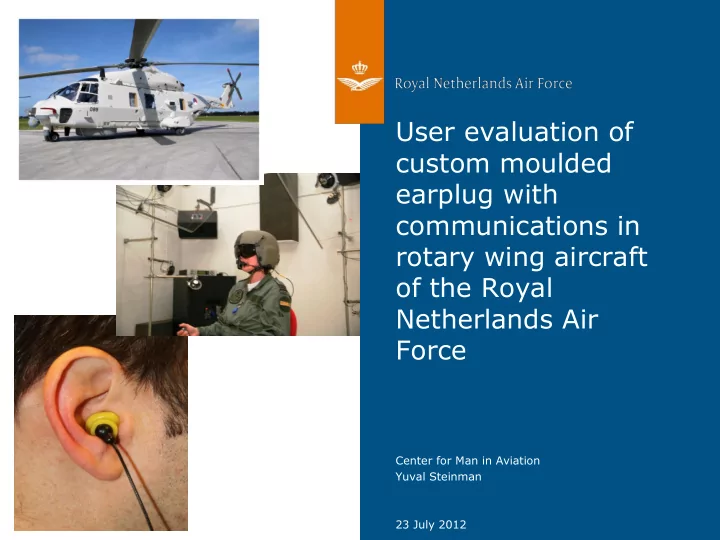
User evaluation of custom moulded earplug with communications in rotary wing aircraft of the Royal Netherlands Air Force Center for Man in Aviation Yuval Steinman 23 July 2012 Presentation contents Introduction Phase 1 Phase 2
User evaluation of custom moulded earplug with communications in rotary wing aircraft of the Royal Netherlands Air Force Center for Man in Aviation Yuval Steinman 23 July 2012
Presentation contents • Introduction • Phase 1 • Phase 2 • Phase 3 • Conclusions • Recommendations • Remarks Royal Netherlands Air Force 2 23 July 2012
Introduction Royal Netherlands Air Force 3 23 July 2012
Introduction Communications Ear Plug (f-CEP) • Introduced in 2003 • Use of the original model (CEP199-C01) • 3 sizes of foam tips used • Standard • Slim • Short Advantages of CEP • Improved noise attenuation • Improved speech intelligibility Royal Netherlands Air Force 4 23 July 2012
Introduction I Problems with the f-CEP (survey results) • 26% rate f-CEP comfort as poor • Irritation • Pressure in ear canal – pain • Further decrease in comfort after 2 hours use • Falls out • Rigid cables • Foam tips don’t fit (one size doesn’t fit all) • Proper insertion takes too long • Hygiene Negative influence on aircrew performance Royal Netherlands Air Force 5 23 July 2012
Introduction II Custom moulded earplugs • Tailor made to match the contour of the ear • Soft • Flexible • Comfortable • Easy to insert Are custom moulded earplugs the solution for our CEP problems??? Royal Netherlands Air Force 6 23 July 2012
Phase I method • Introduction of custom moulded earplugs for the CEP (c-CEP) • Standard CEP (CEP199-C01) • Importance of instructions to the user • Two groups Instructions vs. no instructions • • Attenuation test • f-CEP vs. c-CEP • Real Ear At Threshold (REAT) method Royal Netherlands Air Force 7 23 July 2012
Phase I method I 20 aircrew • Minimal one year of experience with f-CEP Questionnaire ( Likert scale, open questions ) • Fit • Comfort • Ease of use • Insertion ease • Speech intelligibility • Subjective attenuation • Pressure build up • Comparison with foam tips Royal Netherlands Air Force 8 23 July 2012
Phase I results Questionnaire • 15 received • 8 instruction group • 7 non instruction group Attenuation test • 10 subjects Royal Netherlands Air Force 9 23 July 2012
Phase I results I General results c-CEP Aspect Unsatisfactory Poor Satisfactory Good Excellent Fit 2 9 4 Comfort 2 3 9 1 Ease of use 3 10 2 Insertion 1 2 10 2 ease Speech 8 7 intelligibility Subjective 1 7 7 attenuation Royal Netherlands Air Force 10 23 July 2012
Phase I results II Comparison with foam tips Aspect Much worse Worse No difference Better Much better Fit 1 13 Comfort 5 6 4 Ease of use 3 2 10 Speech 4 11 intelligibility Subjective 4 11 attenuation c-CEP sticks further out the ear then f-CEP Royal Netherlands Air Force 11 23 July 2012
Phase I results III Comparison with foam tips – instructions group only Aspect Much worse Worse No difference Better Much better Fit 1 7 Comfort 2 3 3 Ease of use 1 7 Speech 1 7 intelligibility Subjective 2 6 attenuation Royal Netherlands Air Force 12 23 July 2012
Phase I results IV Pressure build up in ear • 7 temporary pressure in ear • 8 constant pressure in ear • 5 reported influence on performance • 3 reported choosing the f-CEP over the c-CEP till pressure build up issue is resolved Royal Netherlands Air Force 13 23 July 2012
Phase I results V Assumed protection values (APV) Gentex HGU-56/P Condition 125 Hz 250 Hz 500 Hz 1 kHz 2 kHz 4 kHz 8 kHz HGU-56/P 16 13 18 27 34 41 48 HGU-56/P 28 25 33 29 42 53 54 + f-CEP HGU-56/P 27 24 32 29 41 54 53 + c-CEP Significant difference in attenuation variance • In frequencies between 125 – 500 Hz Royal Netherlands Air Force 14 23 July 2012
Phase I summery Positive results • Fit • Comfort • Attenuation • Speech intelligibility Issues to solve • Pressure build up • CEP sticks to far out of ear • Instructions for the user Royal Netherlands Air Force 15 23 July 2012
Phase II method • Introduction of new CEP CEP505-C11V • Vented CEP (c-vCEP) CEP199-C01 • Introduction of new earplug • CEP deeper in plug • Lower silicone softness (40 to 60 Shore) Royal Netherlands Air Force 16 23 July 2012
Phase II method II • 20 aircrew • 10 participated in phase I • 10 new subjects with minimal one year of experience with f- CEP • Attenuation test • c-CEP vs. c-vCEP • Real Ear At Threshold (REAT) method • Fast ascent and descent tests hypobaric chamber • 1000 - 3000 feet per minute • Instructions to all participants Royal Netherlands Air Force 17 23 July 2012
Phase II method III Comparison questionnaire of c-vCEP with f-CEP and c- CEP • Fit • Comfort • Ease of use • Insertion ease • Speech intelligibility • Subjective attenuation • Pressure build up Royal Netherlands Air Force 18 23 July 2012
Phase II results I 20 questionnaires received • Performance of the c-vCEP same as c-CEP and better then f-CEP in the following aspects: • Insertion ease • Ease of use • Subjective attenuation • Speech intelligibility c-vCEP no longer sticks out to far out of ear • No pressure build up in ear canal • During operational flights • During hypobaric chamber tests Royal Netherlands Air Force 19 23 July 2012
Phase II results II Performance of the c-vCEP less then the c-CEP and f- CEP in the aspects: • Fit • Comfort • Earplug too hard Cause: Decrease in silicone softness (40 to 60 shore) Royal Netherlands Air Force 20 23 July 2012
Phase II results III Assumed protection values (APV) Gentex HGU-56/P Condition 125 Hz 250 Hz 500 Hz 1 kHz 2 kHz 4 kHz 8 kHz HGU-56/P 16 13 18 27 34 41 48 HGU-56/P 27 24 32 29 41 54 53 + c-CEP HGU-56/P 22 24 31 29 42 55 53 + c-vCEP No significant difference in attenuation variance Royal Netherlands Air Force 21 23 July 2012
Summery phase II Problems solved • Pressure build up • Sticks to far out of ear New problem • Earplug too rigid Royal Netherlands Air Force 22 23 July 2012
Phase III method • Introduction of new earplug • Softer silicone (60 to 40 Shore) • Slight change in design Royal Netherlands Air Force 23 23 July 2012
Phase III method I 18 aircrew • 8 participated in phase II • 10 new subjects with minimal one year of experience with f- CEP (no phase 1 or 2) Comparison questionnaire c-vCEP version 1 and f-CEP • Fit • Comfort • Ease of use • Insertion ease • Speech intelligibility • Subjective attenuation • Pressure build up Royal Netherlands Air Force 24 23 July 2012
Phase III results I New participants (no participation in phase 1 or 2) • Improvement in comparison with f-CEP • Fit • Comfort • Ease of use • Insertion ease • Dunning the helmet (some) Participants phase 2 • Improvement in comparison with c-vCEP (phase 2) • Fit • Comfort Royal Netherlands Air Force 25 23 July 2012
Summery Custom moulded vs. foam Aspect Custom moulded Foam Fit + - Comfort + - Ease of use + - Insertion ease + - Speech + + intelligibility Attenuation + + Pressure build up + + Royal Netherlands Air Force 26 23 July 2012
Recommendations Provide all helicopter aircrew of the Royal Netherlands Air Force with custom moulded earplugs for CEP. Implementation: 2012-2013 Royal Netherlands Air Force 27 23 July 2012
Remarks • Importance of proper instructions en demonstration for the user • Refitting the helmet when introducing a new system • Adaptation period • Custom moulded earplugs are hand made • Constantly working with manufacturer to further improve product Royal Netherlands Air Force 28 23 July 2012
Royal Netherlands Air Force 29 23 July 2012
Recommend
More recommend
Explore More Topics
Stay informed with curated content and fresh updates.