Using Paretos Rule for Explain the 80/20 rule as a tool for Focused - - PowerPoint PPT Presentation

using pareto s rule for
SMART_READER_LITE
LIVE PREVIEW

Using Paretos Rule for Explain the 80/20 rule as a tool for Focused - - PowerPoint PPT Presentation

Agenda Using Paretos Rule for Explain the 80/20 rule as a tool for Focused Problem Solving: focusing improvement efforts on the The 80/20 Rule vital few. Case Example October 11, 2018 Brainstorm for other places you might


slide-1
SLIDE 1

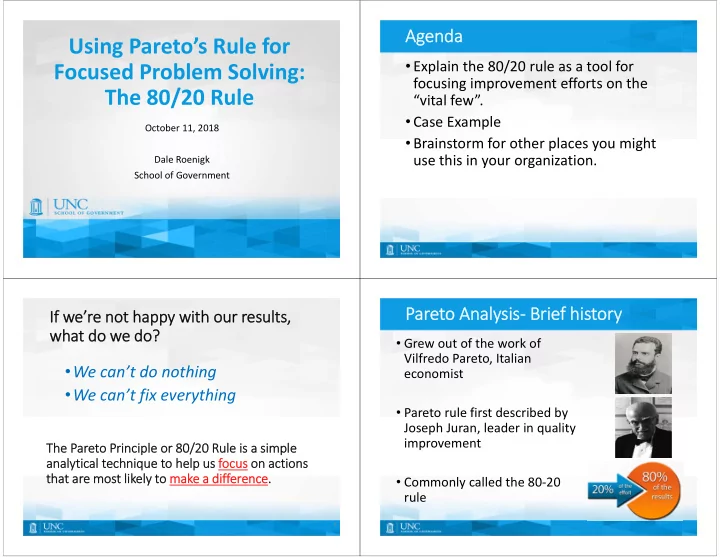
Using Pareto’s Rule for Focused Problem Solving: The 80/20 Rule

October 11, 2018 Dale Roenigk School of Government

Agenda

  • Explain the 80/20 rule as a tool for

focusing improvement efforts on the “vital few”.

  • Case Example
  • Brainstorm for other places you might

use this in your organization.

If we’re not happy with our results, what do we do?

  • We can’t do nothing
  • We can’t fix everything

3

The Pareto Principle or 80/20 Rule is a simple analytical technique to help us focus on actions that are most likely to make a difference.

Pareto Analysis‐ Brief history

  • Grew out of the work of

Vilfredo Pareto, Italian economist

  • Pareto rule first described by

Joseph Juran, leader in quality improvement

  • Commonly called the 80‐20

rule

slide-2
SLIDE 2

A small fraction of efforts will produce a large share of results.

0% 10% 20% 30% 40% 50% 60% 70% 80% 90% 100%

Causes/Efforts Effects/Results

Possible examples of the Pareto Principle in government.

  • A large portion of crime is committed by a small

number of people.

  • Most of the financial issues come from a small

number of bills or payors.

  • Most of the breaks in a water system will come

from a small portion of the system.

  • Most of our service costs are for a small number
  • f clients.

6

1 2 3 4 5 6 7 8 9 1 1 1 1 2 1 3 1 4 1 5 1 6

Focus on the vital few that are the biggest cause of problems.

Vital Few Useful Many

What do you do when you have data?

  • Slice and dice data by subcategories
  • Time
  • Cause Type
  • Geography
  • Organizational Unit
  • Other?
  • Look at data by different measures of results.
  • Numbers of cases
  • Dollars
  • Severity
  • Degree of lateness

8

slide-3
SLIDE 3

The case of the Late Payables Accounts

  • Vendors providing services and products to the

City of Dogwood Acres have been complaining about how long it takes the city to pay its bills. They are threatening to drop the city as a client.

  • Some of these payments are taking over three

months to pay after receipt.

  • Finance Director William Overdue says “my staff

is working hard but we haven’t made progress in bringing down how long it takes. We’ve tried different ideas but no success so far. Maybe I need more staff.”

  • What could we do to help Mr. Overdue fix this

problem?

Dogwood Acres Late Accounts Payables

  • The Finance Director decided that any bill that took

more than 30 days would be considered late.

  • 220 bills from the last fiscal year were “late”.
  • On average it took 66 days to pay these bills.
  • The shortest was 31 days and the longest was 98 days.
  • These late payments were associated with all ten of

the city’s departments and covered all ten of the key payables categories.

  • What should the Finance Director do?

Vague problem statements risk producing vague results.

  • Take a systems or big picture view. What can

we do to help focus the effort to fix the problem and improve the late payments?

  • Slice and dice the data to drill down.
  • What factors might we look at to help

Dogwood Acres focus their improvement efforts?

The number of late payments per month doesn’t show a clear trend, averaging about 18 late bills per month.

slide-4
SLIDE 4

The average days late for late payments has not been changing despite efforts to fix the problem. Payments for contracts, fleet parts, and communications dominate the late payments. Department C has nearly one‐third of the late payments but also note Depts D, B, and I. Looking at Department and Purpose together we see a vital few areas where the problem is concentrated.

Departments

A B C D E F G H I J Grand Total Contracts 2 16 5 19 1 2 1 3 19 4 72 Fleet Parts 2 1 54 2 1 2 1 1 2 66 Communications 2 4 4 5 2 5 4 4 2 3 35 Fuel 1 3 1 5 2 1 2 15 Utilities 3 3 1 2 1 1 1 1 13 Office Supplies 3 2 1 1 1 8 Uniforms 1 1 1 1 4 Janitorial 3 1 4 Misc Purpose 1 1 2 Other Supplies 1 1 Grand Total 13 27 67 37 7 15 5 10 26 13 220

Targeted efforts to fix the problem.

  • 1. Work with Dept C on Fleet Parts
  • 2. Work with Depts B, D, and I on Contracts
  • 3. Work with everyone on Communications
slide-5
SLIDE 5

What do you do if you don’t have data to start today but need to do something now?

  • Collect a sample, put together a tally sheet.
  • Dirty 30 (or 50)

Date Critical Event Person Affected Resolution Cause for Incident Tally Hazardous Condition lllll Inadequate Staff lll Poor Training lllllllllll Client Error llll Other llllllll

What do you do if you don’t have data to start today and are willing to wait?

  • Start tracking with an error log going

forward.

Date Critical Event Person Affected Resolution

No data and you can’t wait? Create a cause‐effect diagram and make your best judgement as to the critical causes not currently addressed.

20

Cause and Effect Diagram for what causes bad service in a dentist’s office

Consider a priority action matrix as a way to select projects by probable impact but also feasibility.

Root Cause Action Feasibility

  • r Cost

(1‐5) Impact (1‐5) Root 1 Act 1 3 5 Root 2 Act 2 5 2 Root 3 Act 3 2 2 1 2 3 4 5 6 1 2 3 4 5 6 Impact Feasibility

Priority Matrix

High Low

slide-6
SLIDE 6

Put together an action plan and follow up with monitoring.

Action What will we do? What are the key steps? Who will be lead? What resources are needed? What is the time frame? Monitoring Plan Action 1 Description Steps John Doe None 2 weeks Monthly control chart Action 2 Description Steps Sandra Jones New software 3 months Part of weekly reporting Action 3 Description Steps Kendra Smith Finance Support 3 weeks Monthly Finance Update

Where might you use the 80/20 rule to help focus your improvement efforts?

  • Take a couple of minutes and

brainstorm with the people sitting next to you on problem areas in your department or your jurisdiction that might benefit from using the 80/20 rule to focus problem solving?

Use the Pareto Rule to focus your improvement efforts.

  • Find the “Vital Few” that cause the most

problems.

  • Base this on actual data whenever possible.
  • Make and implement a plan to address these vital

few.

  • Monitor to see if you have fixed them.
  • Repeat again and again for continual

improvement.

24

Contact information for follow up.

  • Dale Roenigk
  • 919‐843‐8927
  • roenigk@sog.unc.edu