Very High-Energy Gamma-ray Astronomy Thomas P.H. Tam (National Tsing - - PowerPoint PPT Presentation

very high energy gamma ray astronomy
SMART_READER_LITE
LIVE PREVIEW

Very High-Energy Gamma-ray Astronomy Thomas P.H. Tam (National Tsing - - PowerPoint PPT Presentation

Very High-Energy Gamma-ray Astronomy Thomas P.H. Tam (National Tsing Hua Univ) University of Hong Kong, Your Logo 21 st June 2010 References Aharonian et al. 2008 (review in 2008) Hinton and Hofmann 2010 (ARA&A) Voelk and


slide-1
SLIDE 1

Your Logo

Very High-Energy Gamma-ray Astronomy

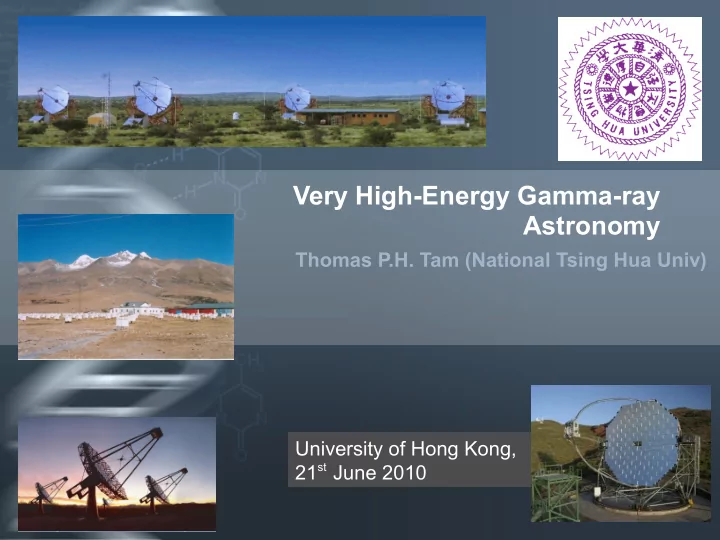
Thomas P.H. Tam (National Tsing Hua Univ) University of Hong Kong, 21st June 2010
slide-2
SLIDE 2

 Page 2

References

  • Aharonian et al. 2008 (review in 2008)
  • Hinton and Hofmann 2010 (ARA&A)
  • Voelk and Bernloehr (Experimental Astronomy, 25:173-191, 2009,

arXiv:0812.4198)

  • Online catalogs, e.g. TeVCat
  • My biased, personal collection of some VHE highlights....
slide-3
SLIDE 3

 Page 3

Contents

  • The questions in VHE (>100 GeV) astronomy
  • VHE observation techniques
  • Galactic objects: pulsar wind nebulae (PWNe) and

shell-type SNRs

  • Extragalactic objects: AGN, radio galaxies
  • GRBs
  • Globular clusters
  • Future VHE experiments
slide-4
SLIDE 4

 Page 4

The questions in VHE Astronomy

  • Astrophysics
  • Probing the physics and the environment of “cosmic

accelerators”: neutron stars, SNRs, massive stars, supermassive black hole, jets, etc.

  • Origin of cosmic rays
  • Astroparticle Physics
  • Indirect search for dark matter
  • Search for energy dependence of the speed of light:

break of “Lorentz invariance” or not?

  • Cosmology
  • Indirect measure of the Extragalactic Background light:

Help us to understand star formation history

  • Non-thermal content of galaxy clusters
slide-5
SLIDE 5

 Page 5

The ‘Non-Thermal Windows’

Energy Flux (ν Fν) Stars Dust Detectors? Radio Infra-red X-rays γ-rays

  • Tracers for ultra-relativistic

electrons and hadrons

  • Non-thermal windows
  • Radio (low energy electrons)
  • Hard X-ray
  • γ-ray

Satellites Cherenkov Telescopes Inverse Compton Scattering Synchrotron Emission π0 decay Photon Energy Optical, UV, Soft X-ray – Heavily absorbed

slide-6
SLIDE 6

 Page 6

The detectors

slide-7
SLIDE 7

 Page 7

A family of (selected) γ-ray detectors

Swift/BAT Fermi/LAT H.E.S.S.

100 keV 100 TeV 100 GeV 100 MeV

Tibet-ARGO

slide-8
SLIDE 8

 Page 8

MAGIC-II H.E.S.S. VERITAS Current major IACT experiments

slide-9
SLIDE 9

 Page 9

Performance of Fermi/LAT and IACTs

Gamma-ray detectors in space and on ground Advantages of IACTs over Fermi: (a) collection area higher by a factor of 104 ; (b) better angular resolution; (c) much lower background photons for sources located at the Galactic plane. Disadvantages of IACTs over Fermi: (a) Lower duty cycle; (b) smaller field of view.

slide-10
SLIDE 10

 Page 10

Effective collection area & sensitivity of H.E.S.S.

Aharonian, et. al. (H.E.S.S. Collaboration), 2006

slide-11
SLIDE 11

 Page 11

Observation principle

slide-12
SLIDE 12

 Page 12

Air shower and Cherenkov light

A γ-ray image in one of the cameras

Pair production

  • γ → e+ e-

Bremsstrahlung

  • e- + (γ) → e- + γ

Cascade develops

  • Cherenkov light

~10 ns light ‘flash’ 1° angle at 10 km height → 100 m radius ‘light- pool’

slide-13
SLIDE 13

 Page 13

Disentangle γ-ray showers from that of cosmic rays

Voelk & Bernloehr, 2009

slide-14
SLIDE 14

 Page 14

Stereo technique

slide-15
SLIDE 15

 Page 15

Stereo technique

X 2

slide-16
SLIDE 16

 Page 16

Stereo technique

Reconstruct the source position in the camera

X 4 =

slide-17
SLIDE 17

 Page 17

What have we seen?

slide-18
SLIDE 18

 Page 18

slide-19
SLIDE 19

 Page 19

slide-20
SLIDE 20

 Page 20

  • I. Galactic sources
slide-21
SLIDE 21

 Page 21

Chaves+ @ ICRC 2009

H.E.S.S. galactic plane survey (2003-2009)

slide-22
SLIDE 22

 Page 22

Selected Galactic VHE sources

Hinton and Hofmann (2010)

slide-23
SLIDE 23

 Page 23

Pulsar Wind Nebulae: Vela X

  • Spectral curvature : ν Fν peaks in

VHE, first clear indication

  • “VHE observations of inverse Compton

scattering of the CMBR allow direct inference of the spatial and spectral distribution of non-thermal electrons”

  • PWN spatially displaced from the pulsar
  • Environmental effects, e.g. nearby

molecular clouds

Aharonian, et al. (H.E.S.S. collaboration), 2006

slide-24
SLIDE 24

 Page 24

MAGIC detection of the Crab pulsar above 25 GeV

Aliu, et al. (MAGIC collaboration), 2008, Science

slide-25
SLIDE 25

 Page 25

Origin of Cosmic-ray

Cosmic-ray spectrum

slide-26
SLIDE 26

 Page 26

Resolved supernova-remnant: RX J1713.7-39.46

Color: HESS excess image Contour: ASCA 1-5 keV smoothed

Aharonian et al., (H.E.S.S. collaboration), 2005, Nature

  • Cosmic-rays up to 1015 eV has long been believed to come from Galactic

supernova remnants

  • Direct evidence hard to obtain: charge particles -> direction unknown
  • Gamma-rays can be used to trace particle acceleration sites
slide-27
SLIDE 27

 Page 27

Have we seen the site of cosmic-ray acceleration?

  • Both electrons and protons can radiate gamma-rays
  • To distinguish hadronic models against leptonic models, detailed

modeling is needed

  • Fermi/LAT results should give a more definitive answer

γ-ray spectrum of RX J1713.7-3946 (David Berge, PhD thesis)

slide-28
SLIDE 28

 Page 28

SN 1006: recently discovered in VHE γ-rays

Aharonian, et al. (H.E.S.S. collaboration), 2010, accepted by A&A, arXiv: 1004.2124

slide-29
SLIDE 29

 Page 29

H.E.S.S. upper limits on 47 Tucanae

slide-30
SLIDE 30

 Page 30

  • II. Extragalactic sources
slide-31
SLIDE 31

 Page 31

PKS 2155-304 in 2006: extremely bright flares

Doubling time scale ~ 3min suggests Lorentz factor > a few

Aharonian, et al. (H.E.S.S. collaboration), 2006 PKS2155-304: 200<E<800 GeV PKS2155-304: E>800 GeV

No differences (time-lags) between light-curves in different energy ranges was found

MQG > 7% Planck mass

slide-32
SLIDE 32

 Page 32

Radio-galaxies: emission region compatible with radio core

Cen A, Aharonian, et al. (2010)

HESS 99.9% CL limit HESS 95% CL limit

Science 314 (2006) 1424

Cen A flux (E>250 GeV) = 0.8% Crab

M87 flux =

variable (day-scale)

1% to 5% Crab

slide-33
SLIDE 33

 Page 33

Constraint on Extragalactic Background Light

Based on blazar spectra measurements of 1ES1102-232 and H2356-306 After correcting for the absorption, the spectrum at the source must have a spectral index > 1.5 suggests a low level of EBL

Aharonian, et al. (H.E.S.S. collaboration), 2006, Nature

slide-34
SLIDE 34

 Page 34

GeV emission from GRBs

GRB 940217 Hurley et al., Nature, 1994 GRB 080916C Abdo et al., Science, 2009 5-σ detection @ 200-1400 s

GRB 090902B, Abdo et al. 2009

slide-35
SLIDE 35

 Page 35

Simultaneous Obs of GRB 060602B by H.E.S.S.

GRB060602B occurred in the H.E.S.S. FoV during the prompt phase Complete coverage First kind of its type:

a burst in gamma-ray (15-150 keV)

  • bserved with an air Cherenkov

instrument

T90 = 9 sec No detection

H.E.S.S. Events in the proximity of burst time window (Aharonian et al., H.E.S.S. collaboration, 2009)

H.E.S.S. has observed over 40 GRBs but no detection yet..

slide-36
SLIDE 36

 Page 36

Obs of GRB 050713A by MAGIC: fast-slewing

Albert, et al. (MAGIC collaboration), 2006

slide-37
SLIDE 37

 Page 37

A plan of a future IACT experiment

slide-38
SLIDE 38

 Page 38

Cherenkov telescope array (CTA)

slide-39
SLIDE 39

 Page 39

CTA sensitivity

Crab 10% Crab 1% Crab Fermi MAGIC H.E.S.S.

CTA

10

  • 14

10

  • 13

10

  • 12

10

  • 11

10 100 1000 10

4

10

5

E x F(>E) [TeV/cm

2 s]

E [GeV]

4× 600m2 (0.08°/ 5°) + 85× 100m2 (0.16°/ 7°) 39x 37m2 (0.25°/ 7°)

slide-40
SLIDE 40

 Page 40

Summary

  • VHE astronomy is a well-established field of astronomy: spectrum,

images, light curves

  • One can do cosmology, astroparticle physics with VHE detectors
  • MAGIC-II, H.E.S.S.-II, VERITAS, CTA (future)
  • Number VHE sources is approaching 100
  • Galactic sources include PWN, SNR, helps our understanding of the
  • rigin of cosmic rays
  • Extragalactic sources include AGN and radio galacties (and starburst

galaxies), GRBs are yet to be detected

  • Still waiting for detection on Globular clusters...