Vision ``to know what is where, by looking. CMSC 426: Image - - PDF document

vision
SMART_READER_LITE
LIVE PREVIEW

Vision ``to know what is where, by looking. CMSC 426: Image - - PDF document

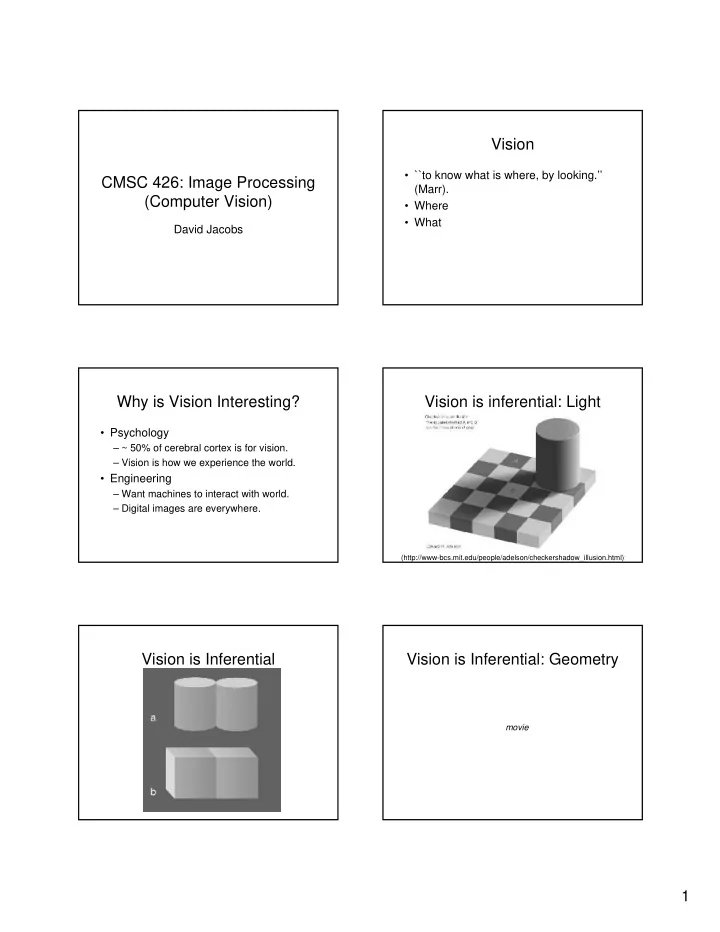
Vision ``to know what is where, by looking. CMSC 426: Image Processing (Marr). (Computer Vision) Where What David Jacobs Why is Vision Interesting? Vision is inferential: Light Psychology ~ 50% of cerebral cortex is


slide-1
SLIDE 1

1

CMSC 426: Image Processing (Computer Vision)

David Jacobs

Vision

  • ``to know what is where, by looking.’’

(Marr).

  • Where
  • What

Why is Vision Interesting?

  • Psychology

– ~ 50% of cerebral cortex is for vision. – Vision is how we experience the world.

  • Engineering

– Want machines to interact with world. – Digital images are everywhere.

Vision is inferential: Light

(http://www-bcs.mit.edu/people/adelson/checkershadow_illusion.html)

Vision is Inferential Vision is Inferential: Geometry

movie

slide-2
SLIDE 2

2

Vision is Inferential: Prior Knowledge Vision is Inferential: Prior Knowledge Computer Vision

  • Inference

Computation

  • Building machines that see
  • Modeling biological perception

A Quick Tour of Computer Vision Boundary Detection: Local cues Boundary Detection: Local cues

slide-3
SLIDE 3

3

Boundary Detection

http://www.robots.ox.ac.uk/~vdg/dynamics.html (Sharon, Balun, Brandt, Basri)

Boundary Detection

Finding the Corpus Callosum (G. Hamarneh, T. McInerney, D. Terzopoulos)

slide-4
SLIDE 4

4

Texture

Photo Pattern Repeated

Texture

Computer Generated Photo

Tracking

(Comaniciu and Meer)

Tracking

(www.brickstream.com)

Tracking Tracking

slide-5
SLIDE 5

5

Tracking Tracking Stereo

http://www.ai.mit.edu/courses/6.801/lect/lect01_darrell.pdf

Stereo

http://www.magiceye.com/

Stereo

http://www.magiceye.com/

Motion

http://www.ai.mit.edu/courses/6.801/lect/lect01_darrell.pdf

slide-6
SLIDE 6

6

Motion - Application

(www.realviz.com)

Pose Determination

Visually guided surgery

Recognition - Shading

Lighting affects appearance

Classification

(Funkhauser, Min, Kazhdan, Chen, Halderman, Dobkin, Jacobs)

slide-7
SLIDE 7

7

Vision depends on:

  • Geometry
  • Physics
  • The nature of objects in the world

(This is the hardest part).

Approaches to Vision

Modeling + Algorithms

  • Build a simple model of the world

(eg., flat, uniform intensity).

  • Find provably good algorithms.
  • Experiment on real world.
  • Update model.

Problem: Too often models are simplistic

  • r intractable.

Bayesian inference

  • Bayes law: P(A|B) = P(B|A)*P(A)/P(B).
  • P(world|image) =

P(image|world)*P(world)/P(image)

  • P(image|world) is computer graphics

– Geometry of projection. – Physics of light and reflection.

  • P(world) means modeling objects in world.

Leads to statistical/learning approaches. Problem: Too often probabilities can’t be known and are invented.

Engineering

  • Focus on definite tasks with clear

requirements.

  • Try ideas based on theory and get

experience about what works.

  • Try to build reusable modules.

Problem: Solutions that work under specific conditions may not generalize.

Marr

  • Theory of Computation
  • Representations and algorithms
  • Implementations.
  • Primal Sketch
  • 2½D Sketch
  • 3D Representations

Problem: Are things really so modular?

slide-8
SLIDE 8

8

The State of Computer Vision

  • Science

– Study of intelligence seems to be hard. – Some interesting fundamental theory about specific problems. – Limited insight into how these interact.

The State of Computer Vision

  • Technology

– Interesting applications: inspection, graphics, security, internet…. – Some successful companies. Largest ~100-200 million in revenues. Many in- house applications. – Future: growth in digital images exciting.

Related Fields

  • Graphics. “Vision is inverse graphics”.
  • Visual perception.
  • Neuroscience.
  • AI
  • Learning
  • Math: eg., geometry, stochastic processes.
  • Optimization.

Contact Info

Prof: David Jacobs Office: Room 4421, A.V. Williams Building (Next to CSIC). Phone: (301) 405-0679 Email: djacobs@cs.umd.edu Homepage: http://www.cs.umd.edu/~djacobs TA: Hyoungjune Yi Email: aster@umiacs.umd.edu

Tools Needed for Course

  • Math

– Calculus – Linear Algebra (can be picked up).

  • Computer Science

– Algorithms – Programming, we’ll use Matlab.

  • Signal Processing (we’ll teach a little).

Rough Syllabus

slide-9
SLIDE 9

9

Course Organization

  • Reading assignments in Forsyth & Ponce,

plus some extras.

  • ~6-8 Problem sets
  • Programming and paper and pencil
  • Two quizzes, Final Exam.
  • Grading: Problem sets 30%, quizzes: first quiz

10%; second quiz 20%; final 40%.

  • Web page:

www.cs.umd.edu/~djacobs/CMSC426/CMSC426.htm

slide-10
SLIDE 10

This document was created with Win2PDF available at http://www.daneprairie.com. The unregistered version of Win2PDF is for evaluation or non-commercial use only.