W HEN DO WE MOVE TO FULL RING , SELF - CONSISTENT SIMULATIONS ? JR - - PowerPoint PPT Presentation

w hen do we move to full ring self consistent simulations
SMART_READER_LITE
LIVE PREVIEW

W HEN DO WE MOVE TO FULL RING , SELF - CONSISTENT SIMULATIONS ? JR - - PowerPoint PPT Presentation

Optical Society of Americas Image of the week, 20180409 W HEN DO WE MOVE TO FULL RING , SELF - CONSISTENT SIMULATIONS ? JR Cary 20180509 1 SIMULATIONS EMPOWERING YOUR INNOVATIONS Self-consistent, full-ring simulations What do know about


slide-1
SLIDE 1

JR Cary

WHEN DO WE MOVE TO FULL RING,

SELF-CONSISTENT SIMULATIONS?

SIMULATIONS EMPOWERING YOUR INNOVATIONS 1 20180509

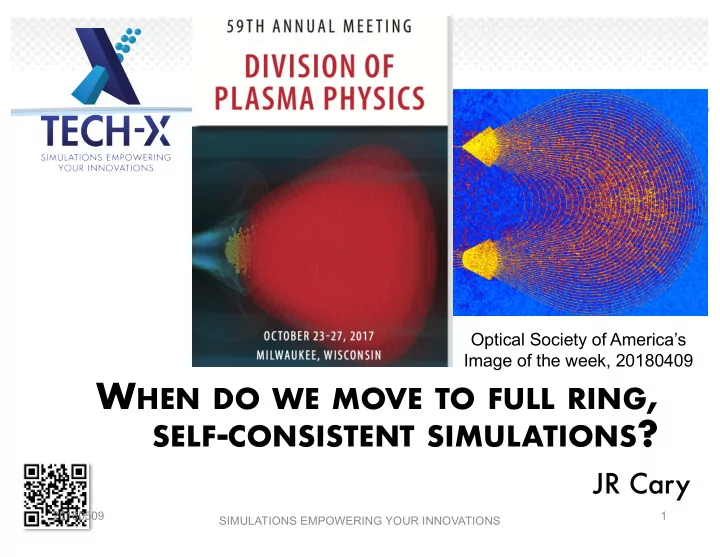
Optical Society of America’s Image of the week, 20180409
slide-2
SLIDE 2

Self-consistent, full-ring simulations

  • What do know about self-consistent beam equilibria
  • Faster computing
  • What can we do in the meantime?

20180509 SIMULATIONS EMPOWERING YOUR INNOVATIONS 2

BTW

  • J. R. Cary and I. Doxas, "An

Explicit Symplectic Integration Scheme for Plasma Simulations," J.

  • Comp. Phys. 107 (1) 98-104 (1993)
slide-3
SLIDE 3

Time-scale hierarchy

  • Equilibrium
  • Lasts for moderate

times (Is it stable?)

  • How long will it last?

(transport)

20180509 SIMULATIONS EMPOWERING YOUR INNOVATIONS 3

slide-4
SLIDE 4

Field has analogies with 3D plasma equilibria of 60’s, 70’s

  • Toroidal magnetic field lines
  • Perturbation theory (Lyman Spitzer,

1958) indicated that equilibria existed

  • Grad (67) pointed out that equilibria

might not exist, even in vacuum

  • Model-C stellarator diagnosed by

electron beam, horrible surfaces of section

  • Stellarator dropped in favor of

tokamak

  • (Harbinger of chaotic dynamics -

rapid loss)

20180509 SIMULATIONS EMPOWERING YOUR INNOVATIONS 4

Are we here?

slide-5
SLIDE 5

What is an equilibrium?

  • Lund: an equilibrium is a

solution to the dynamics with distribution having periodicity

  • f the lattice
  • Courant-Snyder
  • KV
  • Nonlinear with space

charge?

20180509 SIMULATIONS EMPOWERING YOUR INNOVATIONS 5

𝛾(𝑡)

slide-6
SLIDE 6

How to calculate an equilibrium?

  • Distribution a function of the

invariants (in involution)

  • In involution: both are action

like, so single-valued functions

  • Need not be two invariants if
  • ne is confining
  • Except: J’s cannot generally

be found

20180509 SIMULATIONS EMPOWERING YOUR INNOVATIONS 6

𝑔(𝐾', 𝐾)) 𝐾' 𝑦, 𝑧, 𝑞-, 𝑞.

slide-7
SLIDE 7

Without space charge, high confidence of invariants

  • Antipov et al, JINST 12

20180509 SIMULATIONS EMPOWERING YOUR INNOVATIONS 7

To be an equilibrium, collect particles to have constant amplitude

slide-8
SLIDE 8

An equilibrium necessary for beam initialization, matching

  • Distribution a function of

the invariants

  • Need not be two

invariants

  • Self consistency gives an

integro-differential equation

  • Except: J’s cannot

generally be found

20180509 SIMULATIONS EMPOWERING YOUR INNOVATIONS 8

𝑔(𝐾', 𝐾)) 𝐾' 𝑦, 𝑧, 𝑞-, 𝑞. 𝐾/ 𝜚 −𝛼)𝜚 = 4 𝑒)𝑞𝑔(𝐾', 𝐾))

6

slide-9
SLIDE 9

Approaches to finding equilibria

  • Perturbative: space charge and

nonlinearity expansion

  • Envelope model (Ryne, earlier)
  • Principal orbits (Lund)

20180509 SIMULATIONS EMPOWERING YOUR INNOVATIONS 9

All of these approaches are asymptotic. No proofs of existence. Should we care?

slide-10
SLIDE 10

Are there equilibria with space charge? Simulations indicate not, chaotic diffusion

  • Amundson: (@CERN) beam expands
  • Kesting: PIC noise dominant
  • Bruhwiler (2 years ago, 18 IPAC): beam is
  • expanding. Important rate or curiosity?
  • If there is a beam equilibrium, then it relies on
  • invariants. To test, the integration method must

capture the invariants.

20180509 SIMULATIONS EMPOWERING YOUR INNOVATIONS 10

slide-11
SLIDE 11

However, simulations cannot distinguish bad initial condition and good with growth

  • Courant-Snyder
  • Lack of equilibrium
  • Phase mixing
  • Beam growth until

saturation.

  • MUST HAVE THEORY

OF EQUILIBRIUM

20180509 SIMULATIONS EMPOWERING YOUR INNOVATIONS 11

slide-12
SLIDE 12

Could it be that there is no equilibrium?

  • How would we know?
  • Need some sort of algorithm (perturbation theory,

principal orbits)

  • Continuously refine (higher-order terms, more

principal orbits, …)

  • If refinements diverge, no equilibrium?
  • If attributed to single-particle chaos, should be seeing

fractal dynamics

  • Claim: we cannot answer the question of chaotic

diffusion, beam expansion until we have a theory of

  • equilibria. Any motion can be attributed to relaxation.

20180509 SIMULATIONS EMPOWERING YOUR INNOVATIONS 12

slide-13
SLIDE 13

Assuming we build the codes to compute equilibria, now what do we do?

  • Build IOTA1
  • Build IOTA2
  • OR
  • Simulate

20180509 SIMULATIONS EMPOWERING YOUR INNOVATIONS 13

slide-14
SLIDE 14

How do we expect loss to occur?

  • Expect breakage of KAM surfaces

farther from axis

  • 1.5DoF: trajectories are “sticky”

(Karney), held up by turnstiles (Meiss), act as if diffusing in space of fractal dimension (Hanson)

  • Need work in 2.5 DoF, but similar

expected.

20180509 SIMULATIONS EMPOWERING YOUR INNOVATIONS 14

  • Meiss - Thirty Years of Turnstiles and

Transport, arXiv:1501.04364 (2015)

  • Hanson et al, Algebraic Decay in Self-

Similar Markov Chains, 1985

  • Zotos, “An overview of the escape

dynamics in the Henon-Heiles Hamiltonian system”, 2017 Power law decay

slide-15
SLIDE 15

Conjecture: contraction, not expansion?

  • Assume matched, so no halo particles created

by core oscillations, good surfaces without self fields.

  • Self-fields increasingly create chaos moving
  • utwards, with some regions of denser KAM

surface.

  • Trajectories at edge in highly chaotic region

connected to the wall, so particles lost rapidly.

  • Particles fill region out to where KAM surfaces

are dense (period of expansion, but asymptotes to given size, not diffusive).

  • Particles in edge chaotic region slowly cross last

fairly good surface, then are rapidly lost to wall.

  • Particle loss in edge chaotic region causes

decrease in RMS beam size.

20180509 SIMULATIONS EMPOWERING YOUR INNOVATIONS 15

J1 J2 Ji are “best possible actions”

Last curve of low transport, good KAM surfaces. Rapid loss outside.

slide-16
SLIDE 16

Stellarator equilibrium existence never answered mathematically, but well enough

  • Shown how to eliminate

chaotic regions

  • Targets identified for equilibria

u Quasihelical u Omnigenous

  • Codes developed for finding

equilibria assuming magnetic surfaces

  • Wendelstein 7-x built using
  • mnigenity
  • First plasma Dec 2015 (40

years after PPPL gave up on Stellarator)

20180509 SIMULATIONS EMPOWERING YOUR INNOVATIONS 16

slide-17
SLIDE 17

If self-consistent beam dynamics follows similar path…

üFind vacuum fields with invariants (MacMillen,

Cary, Danilov).

  • Find general conditions (analogous to quasihelicity,
  • mnigenity) for non-chaotic trajectories.
  • Develop methods (even asymptotic) for computing

equilibria with above properties.

  • Initialize with matched (equilibrium) beams.
  • Measure transport to understand quality of solution.

20180509 SIMULATIONS EMPOWERING YOUR INNOVATIONS 17

slide-18
SLIDE 18

Questions?

20180509 SIMULATIONS EMPOWERING YOUR INNOVATIONS 18