Wavescalar Assembly: Dataflow Winter 2006 CSE 548 - Dataflow - - PowerPoint PPT Presentation

wavescalar assembly dataflow
SMART_READER_LITE
LIVE PREVIEW

Wavescalar Assembly: Dataflow Winter 2006 CSE 548 - Dataflow - - PowerPoint PPT Presentation

Wavescalar Assembly: Dataflow Winter 2006 CSE 548 - Dataflow Machines 1 Wavescalar Assembly: Format Wavescalar is an extension of the Alpha ISA RISC (more or less) Register to register becomes PE to PE


slide-1
SLIDE 1

Winter 2006 CSE 548 - Dataflow Machines 1
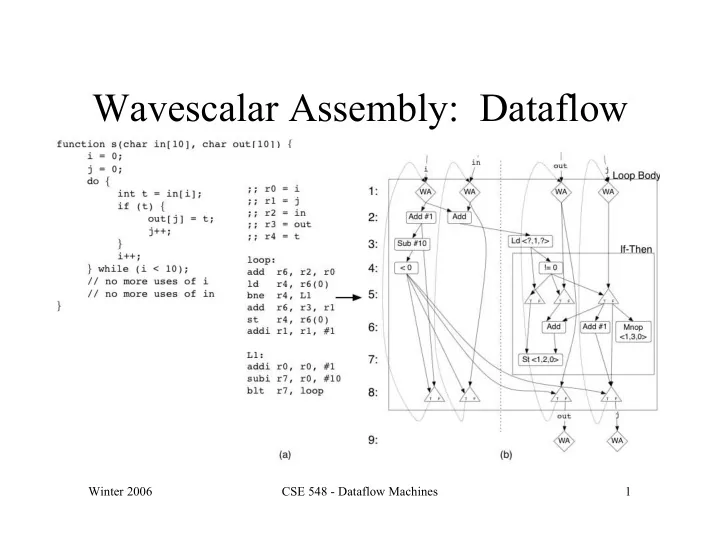
Wavescalar Assembly: Dataflow

slide-2
SLIDE 2

Winter 2006 CSE 548 - Dataflow Machines 2

Wavescalar Assembly: Format

  • Wavescalar is an extension of the Alpha ISA

– RISC (more or less) – “Register to register” becomes “PE to PE” – Tagged-tokens

  • Instructions have a basic format
  • perand {outputs}, {inputA}, {inputB}, {inputC}

– Each port may hold a list of inputs or outputs – Some instructions have less inputs – The curly braces are optional

slide-3
SLIDE 3

Winter 2006 CSE 548 - Dataflow Machines 3

Referring to Arcs

  • Named arcs

– You have infinite “registers” ldq a, addr, 0 ldq b, addr, 8 addq c, a, b

  • Use labels

– The linker resolves symbols (if possible) L0: ldq { }, addr, 0 ldq ^L1:2, addr, 8 L1: addq c, ^L0:0, { }

slide-4
SLIDE 4

Winter 2006 CSE 548 - Dataflow Machines 4

Wavescalar Assembly: Instructions

Alpha-based

  • Computation
  • Memory

– Ordered interface – Unordered

Wavescalar Specific

  • Control

– Branches/Joins

  • Tag management

– Wavescalar is dynamic dataflow

  • Synchronization

For a list of all instructions and formats, run: lc-devel/src/drip/printInsts

slide-5
SLIDE 5

Winter 2006 CSE 548 - Dataflow Machines 5

Alpha-based Instructions

http://www.cs.cmu.edu/afs/cs.cmu.edu/academic/class/15740- f98/public/doc/alpha-guide.pdf

  • Arithmetic

– add, sub, mul, div, … – Long word (32 bit) arithmetic addl {outputs}, {inputAs}, {inputBs} – Quad word (64 bit) arithmetic addq {outputs}, {inputAs}, {inputBs}

  • Comparison

– cmple, cmpeq, …

  • Logical

– and, bis, xor, …

slide-6
SLIDE 6

Winter 2006 CSE 548 - Dataflow Machines 6

Using Immediates

  • Almost all instructions have immediate forms

– AddI, sll_I, s4subq_I, … Addi {outputs}, {inputs}, immediate

  • Otherwise, create a constant and send it

– cnst creates an immediate when a trigger is received cnst {outputs}, {triggers}, immediate

slide-7
SLIDE 7

Winter 2006 CSE 548 - Dataflow Machines 7

Accessing Memory

Ordered

  • ldq, stq, mnop, …
  • The system

manages dependences

– Store buffer

  • Memory operations

are tagged

– Wave-ordered memory

Unordered

  • ldq_U, stq_U
  • The programmer

manages dependences

– Dataflow firing rule

  • Stores have an
  • utput arc

– Reports when store completes

slide-8
SLIDE 8

Winter 2006 CSE 548 - Dataflow Machines 8

Wave-Ordered Memory

  • Programs are partitioned into

DAGs (“waves”)

  • Memory operations are given

“sequence numbers”

– <previous, current, next>.ripple ld {outputs}, {address}, immediate <p, c, n>.r

  • No-ops may be required to

totally order operations

slide-9
SLIDE 9

Winter 2006 CSE 548 - Dataflow Machines 9

Ripples

  • A sequence of loads

need not be ordered

– The hazards are RAW, WAR, WAW

  • Fully ordering loads

decreases parallelism

  • Add a “ripple number”

– The previous store’s sequence number

slide-10
SLIDE 10

Winter 2006 CSE 548 - Dataflow Machines 10

Tagged Tokens

  • Wavescalar is a tagged-token architecture

– Each token has two components

  • A value
  • A tag

– Each tag has two components

  • A thread number
  • A wave number
  • Tags allow re-entrant code

– The dataflow firing rule is modified An instruction executes when all of its operands for a given thread and wave have arrived.

slide-11
SLIDE 11

Winter 2006 CSE 548 - Dataflow Machines 11

Re-entering a Wave

  • Each dynamic wave is assigned a wave

number

  • Tokens entering a wave are tagged with

that wave number

– Wave advance (wa)

  • Increments the wave number on a token

– Canonical wave advance (cwa)

  • Increments the wave number
  • Creates a new memory ordering for that

wave

  • Multiple memory orderings can

exist…but talk to us first

slide-12
SLIDE 12

Winter 2006 CSE 548 - Dataflow Machines 12

Ordered and Unordered

slide-13
SLIDE 13

Winter 2006 CSE 548 - Dataflow Machines 13

Control: Token Steering

  • No branch instructions
  • Two control instructions

– rho (split): conditional rho {T-output}, {F-output}, {value}, {predicate} – phi (join): speculative phi {output}, {T-value}, {F-value}, {predicate}

+ predicate T path F path value + predicate T path F path value

slide-14
SLIDE 14

Winter 2006 CSE 548 - Dataflow Machines 14

Steering Example

slide-15
SLIDE 15

Winter 2006 CSE 548 - Dataflow Machines 15

Control: Jumps

  • Sometimes, destinations must be resolved dynamically

– Indirect send, indirect receive – Dynamic resolution is fairly slow

  • Macros will be provided for function calls and returns
slide-16
SLIDE 16

Winter 2006 CSE 548 - Dataflow Machines 16

Control: Wave Management

  • Wave advance is an optimization

– Only increments wave numbers

  • Wave number manipulation is used to pass

values around loops or complex control

– Wave-to-data (wtd): outputs the wave number wtd {wave-as-output}, {input} – Data-to-wave (dtw): sets a wave number dtw {output}, {new-wave-input}, {value-input}

slide-17
SLIDE 17

Winter 2006 CSE 548 - Dataflow Machines 17

Control: Thread Management

  • Values can be passed between threads by

altering the tags

– Thread-to-data (ttd): outputs the thread id ttd {thread-as-output}, {input} – Data-to-thread (dtt): sets the thread id dtt {output}, {new-thread-input}, {value-input} – dttw: sets the thread id and wave number dttw {output}, {thread}, {wave}, {value}

slide-18
SLIDE 18

Winter 2006 CSE 548 - Dataflow Machines 18

Concerns about Thread Management

  • Sending values to a new thread is equivalent to an

indirect send

– Each thread has its own set of instructions – Destinations are resolved when the thread id is received

  • Two kinds of threads exist

– Light: unordered (or no) memory

  • Easy to create, requires very little support

– Heavy: requires memory ordering support

  • If you want multiple memory orderings, talk to us first
  • Thread ids should be unique across the system

– Operating system concern

slide-19
SLIDE 19

Winter 2006 CSE 548 - Dataflow Machines 19

Synchronization

  • For lightweight threads, lightweight

synchronization is needed

– Thread Coordinate (tc): implements a m-structure

  • Requires a different firing rule