Web Search Engines Chapter 27, Part C Based on Larson and Hearsts - - PDF document

web search engines
SMART_READER_LITE
LIVE PREVIEW

Web Search Engines Chapter 27, Part C Based on Larson and Hearsts - - PDF document

Web Search Engines Chapter 27, Part C Based on Larson and Hearsts slides at UC-Berkeley http://www.sims.berkeley.edu/courses/is202/f00/ Database Management Systems, R. Ramakrishnan 1 Search Engine Characteristics Unedited anyone


slide-1
SLIDE 1

Database Management Systems, R. Ramakrishnan 1

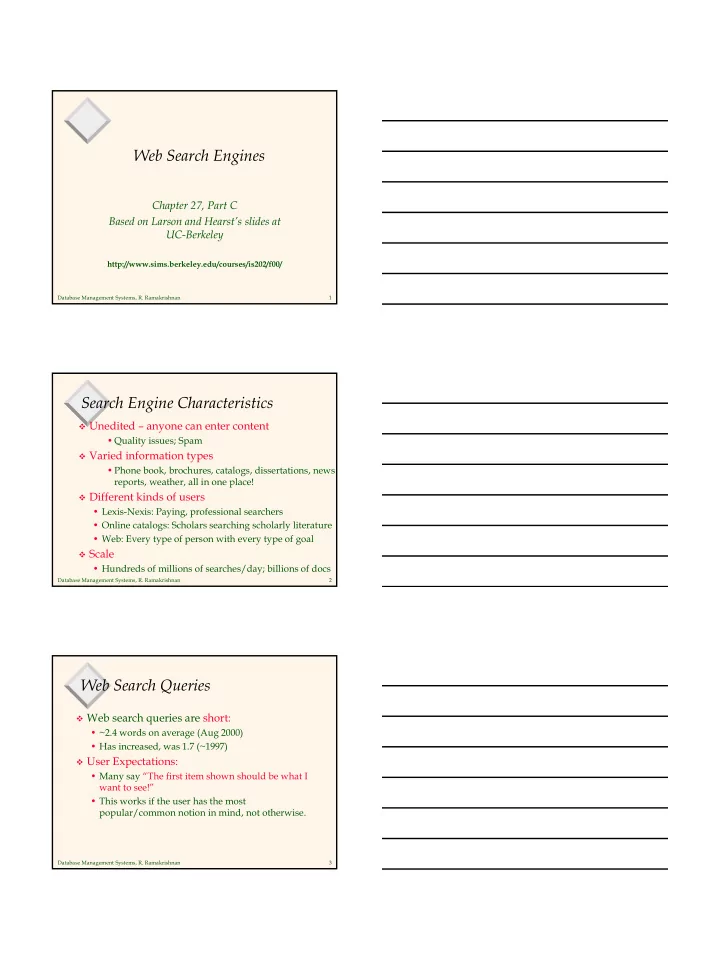
Web Search Engines

Chapter 27, Part C Based on Larson and Hearst’s slides at UC-Berkeley

http://www.sims.berkeley.edu/courses/is202/f00/

Database Management Systems, R. Ramakrishnan 2

Search Engine Characteristics

Unedited – anyone can enter content

  • Quality issues; Spam

Varied information types

  • Phone book, brochures, catalogs, dissertations, news

reports, weather, all in one place!

Different kinds of users

  • Lexis-Nexis: Paying, professional searchers
  • Online catalogs: Scholars searching scholarly literature
  • Web: Every type of person with every type of goal

Scale

  • Hundreds of millions of searches/day; billions of docs

Database Management Systems, R. Ramakrishnan 3

Web Search Queries

Web search queries are short:

  • ~2.4 words on average (Aug 2000)
  • Has increased, was 1.7 (~1997)

User Expectations:

  • Many say “The first item shown should be what I

want to see!”

  • This works if the user has the most

popular/common notion in mind, not otherwise.

slide-2
SLIDE 2

Database Management Systems, R. Ramakrishnan 4

Directories vs. Search Engines

Directories

  • Hand-selected sites
  • Search over the

contents of the descriptions of the pages

  • Organized in

advance into categories

Search Engines

  • All pages in all sites
  • Search over the

contents of the pages themselves

  • Organized in

response to a query by relevance rankings or other scores

Database Management Systems, R. Ramakrishnan 5

What about Ranking?

Lots of variation here

  • Often messy; details proprietary and fluctuating

Combining subsets of:

  • IR-style relevance: Based on term frequencies,

proximities, position (e.g., in title), font, etc.

  • Popularity information
  • Link analysis information

Most use a variant of vector space ranking to

combine these. Here’s how it might work:

  • Make a vector of weights for each feature
  • Multiply this by the counts for each feature

Database Management Systems, R. Ramakrishnan 6

Relevance: Going Beyond IR

Page “popularity” (e.g., DirectHit)

  • Frequently visited pages (in general)
  • Frequently visited pages as a result of a query

Link “co-citation” (e.g., Google)

  • Which sites are linked to by other sites?
  • Draws upon sociology research on bibliographic

citations to identify “authoritative sources”

  • Discussed further in Google case study
slide-3
SLIDE 3

Database Management Systems, R. Ramakrishnan 7

Web Search Architecture

Database Management Systems, R. Ramakrishnan 8

Standard Web Search Engine Architecture

crawl the web create an inverted index Check for duplicates, store the documents

Inverted index Search engine servers

user query

Show results To user

DocIds

Database Management Systems, R. Ramakrishnan 9

Inverted Indexes the IR Way

slide-4
SLIDE 4

Database Management Systems, R. Ramakrishnan 10

How Inverted Files Are Created

Periodically rebuilt, static otherwise. Documents are parsed to extract

  • tokens. These are saved with the

Document ID.

Now is the time for all good men to come to the aid

  • f their country

Doc 1 It was a dark and stormy night in the country

  • manor. The time

was past midnight Doc 2

Term Doc # now 1 is 1 the 1 time 1 for 1 all 1 good 1 men 1 to 1 come 1 to 1 the 1 aid 1

  • f

1 their 1 country 1 it 2 was 2 a 2 dark 2 and 2 stormy 2 night 2 in 2 the 2 country 2 manor 2 the 2 time 2 was 2 past 2 midnight 2 Database Management Systems, R. Ramakrishnan 11

How Inverted Files are Created

After all documents

have been parsed the inverted file is sorted alphabetically.

Term Doc # a 2 aid 1 all 1 and 2 come 1 country 1 country 2 dark 2 for 1 good 1 in 2 is 1 it 2 manor 2 men 1 midnight 2 night 2 now 1

  • f

1 past 2 stormy 2 the 1 the 1 the 2 the 2 their 1 time 1 time 2 to 1 to 1 was 2 was 2 Term Doc # now 1 is 1 the 1 time 1 for 1 all 1 good 1 men 1 to 1 come 1 to 1 the 1 aid 1

  • f

1 their 1 country 1 it 2 was 2 a 2 dark 2 and 2 stormy 2 night 2 in 2 the 2 country 2 manor 2 the 2 time 2 was 2 past 2 midnight 2 Database Management Systems, R. Ramakrishnan 12

How Inverted Files are Created

Multiple term

entries for a single document are merged.

Within-

document term frequency information is compiled.

Term Doc # Freq a 2 1 aid 1 1 all 1 1 and 2 1 come 1 1 country 1 1 country 2 1 dark 2 1 for 1 1 good 1 1 in 2 1 is 1 1 it 2 1 manor 2 1 men 1 1 midnight 2 1 night 2 1 now 1 1

  • f

1 1 past 2 1 stormy 2 1 the 1 2 the 2 2 their 1 1 time 1 1 time 2 1 to 1 2 was 2 2 Term Doc # a 2 aid 1 all 1 and 2 come 1 country 1 country 2 dark 2 for 1 good 1 in 2 is 1 it 2 manor 2 men 1 midnight 2 night 2 now 1

  • f

1 past 2 stormy 2 the 1 the 1 the 2 the 2 their 1 time 1 time 2 to 1 to 1 was 2 was 2

slide-5
SLIDE 5

Database Management Systems, R. Ramakrishnan 13

How Inverted Files are Created

Finally, the file can be split into

  • A Dictionary or Lexicon file

and

  • A Postings file

Database Management Systems, R. Ramakrishnan 14

How Inverted Files are Created

Dictionary/Lexicon Postings

Term Doc # Freq a 2 1 aid 1 1 all 1 1 and 2 1 come 1 1 country 1 1 country 2 1 dark 2 1 for 1 1 good 1 1 in 2 1 is 1 1 it 2 1 manor 2 1 men 1 1 midnight 2 1 night 2 1 now 1 1

  • f

1 1 past 2 1 stormy 2 1 the 1 2 the 2 2 their 1 1 time 1 1 time 2 1 to 1 2 was 2 2 Doc # Freq 2 1 1 1 1 1 2 1 1 1 1 1 2 1 2 1 1 1 1 1 2 1 1 1 2 1 2 1 1 1 2 1 2 1 1 1 1 1 2 1 2 1 1 2 2 2 1 1 1 1 2 1 1 2 2 2 Term N docs Tot Freq a 1 1 aid 1 1 all 1 1 and 1 1 come 1 1 country 2 2 dark 1 1 for 1 1 good 1 1 in 1 1 is 1 1 it 1 1 manor 1 1 men 1 1 midnight 1 1 night 1 1 now 1 1

  • f

1 1 past 1 1 stormy 1 1 the 2 4 their 1 1 time 2 2 to 1 2 was 1 2

Database Management Systems, R. Ramakrishnan 15

Inverted indexes

Permit fast search for individual terms For each term, you get a list consisting of:

  • document ID
  • frequency of term in doc (optional)
  • position of term in doc

(optional)

These lists can be used to solve Boolean queries:

  • country -> d1, d2
  • manor -> d2
  • country AND manor -> d2

Also used for statistical ranking algorithms

slide-6
SLIDE 6

Database Management Systems, R. Ramakrishnan 16

Inverted Indexes for Web Search Engines

Inverted indexes are still used, even though

the web is so huge.

Some systems partition the indexes across

different machines. Each machine handles different parts of the data.

Other systems duplicate the data across many

machines; queries are distributed among the machines.

Most do a combination of these.

Database Management Systems, R. Ramakrishnan 17

From description of the FAST search engine, by Knut Risvik http://www.infonortics.com/searchengines/sh00/risvik_files/frame.ht m In this example, the data for the pages is partitioned across

  • machines. Additionally,

each partition is allocated multiple machines to handle the queries. Each row can handle 120 queries per second Each column can handle 7M pages To handle more queries, add another row.

Database Management Systems, R. Ramakrishnan 18

Cascading Allocation of CPUs

A variation on this that produces a cost-

savings:

  • Put high-quality/common pages on many

machines

  • Put lower quality/less common pages on fewer

machines

  • Query goes to high quality machines first
  • If no hits found there, go to other machines
slide-7
SLIDE 7

Database Management Systems, R. Ramakrishnan 19

Web Crawling

Database Management Systems, R. Ramakrishnan 20

Web Crawlers

How do the web search engines get all of the

items they index?

Main idea:

  • Start with known sites
  • Record information for these sites
  • Follow the links from each site
  • Record information found at new sites
  • Repeat

Database Management Systems, R. Ramakrishnan 21

Web Crawling Algorithm

More precisely:

  • Put a set of known sites on a queue
  • Repeat the following until the queue is empty:
  • Take the first page off of the queue
  • If this page has not yet been processed:
  • Record the information found on this page
  • Positions of words, links going out, etc
  • Add each link on the current page to the queue
  • Record that this page has been processed

Rule-of-thumb: 1 doc per minute per crawling

server

slide-8
SLIDE 8

Database Management Systems, R. Ramakrishnan 22

Web Crawling Issues

Keep out signs

  • A file called norobots.txt lists “off-limits” directories
  • Freshness: Figure out which pages change often, and

recrawl these often.

Duplicates, virtual hosts, etc.

  • Convert page contents with a hash function
  • Compare new pages to the hash table

Lots of problems

  • Server unavailable; incorrect html; missing links;

attempts to “fool” search engine by giving crawler a version of the page with lots of spurious terms added ...

Web crawling is difficult to do robustly!

Database Management Systems, R. Ramakrishnan 23

Google: A Case Study

Database Management Systems, R. Ramakrishnan 24

Google’s Indexing

The Indexer converts each doc into a collection

  • f “hit lists” and puts these into “barrels”,

sorted by docID. It also creates a database of “links”.

  • Hit: <wordID, position in doc, font info, hit type>
  • Hit type: Plain or fancy.
  • Fancy hit: Occurs in URL, title, anchor text, metatag.
  • Optimized representation of hits (2 bytes each).

Sorter sorts each barrel by wordID to create the

inverted index. It also creates a lexicon file.

  • Lexicon: <wordID, offset into inverted index>
  • Lexicon is mostly cached in-memory
slide-9
SLIDE 9

Database Management Systems, R. Ramakrishnan 25

wordid #docs wordid #docs wordid #docs Lexicon (in-memory) Postings (“Inverted barrels”, on disk) Each “barrel” contains postings for a range of wordids.

Google’s Inverted Index

Sorted by wordid Docid #hits Hit, hit, hit, hit, hit Docid #hits Hit Docid #hits Hit Docid #hits Hit, hit, hit Docid #hits Hit, hit Barrel i Barrel i+1

Sorted by Docid

Database Management Systems, R. Ramakrishnan 26

Google

Sorted barrels = inverted index Pagerank computed from link structure; combined with IR rank IR rank depends on TF, type of “hit”, hit proximity, etc. Billion documents Hundred million queries a day AND queries

Database Management Systems, R. Ramakrishnan 27

Link Analysis for Ranking Pages

Assumption: If the pages pointing to this

page are good, then this is also a good page.

  • References: Kleinberg 98, Page et al. 98

Draws upon earlier research in sociology and

bibliometrics.

  • Kleinberg’s model includes “authorities” (highly

referenced pages) and “hubs” (pages containing good reference lists).

  • Google model is a version with no hubs, and is

closely related to work on influence weights by Pinski-Narin (1976).

slide-10
SLIDE 10

Database Management Systems, R. Ramakrishnan 28

Link Analysis for Ranking Pages

Why does this work?

  • The official Toyota site will be linked to by lots of
  • ther official (or high-quality) sites
  • The best Toyota fan-club site probably also has

many links pointing to it

  • Less high-quality sites do not have as many high-

quality sites linking to them

Database Management Systems, R. Ramakrishnan 29

PageRank

Let A1, A2, …, An be the pages that point to

page A. Let C(P) be the # links out of page P. The PageRank (PR) of page A is defined as:

PageRank is principal eigenvector of the link

matrix of the web.

Can be computed as the fixpoint of the above

equation.

PR(A) = (1-d) + d ( PR(A1)/C(A1) + … + PR(An)/C(An) )

Database Management Systems, R. Ramakrishnan 30

PageRank: User Model

PageRanks form a probability distribution over web

pages: sum of all pages’ ranks is one.

User model: “Random surfer” selects a page, keeps

clicking links (never “back”), until “bored”: then randomly selects another page and continues.

  • PageRank(A) is the probability that such a user visits A
  • d is the probability of getting bored at a page

Google computes relevance of a page for a given

search by first computing an IR relevance and then modifying that by taking into account PageRank for the top pages.

slide-11
SLIDE 11

Database Management Systems, R. Ramakrishnan 31

Web Search Statistics

Database Management Systems, R. Ramakrishnan 32

Searches per Day

Database Management Systems, R. Ramakrishnan 33

Web Search Engine Visits

slide-12
SLIDE 12

Database Management Systems, R. Ramakrishnan 34

Percentage of web users who visit the site shown

Database Management Systems, R. Ramakrishnan 35

Search Engine Size (July 2000)

Database Management Systems, R. Ramakrishnan 36

Does size matter? You can’t access many hits anyhow.

slide-13
SLIDE 13

Database Management Systems, R. Ramakrishnan 37

Increasing numbers of indexed pages, self- reported

Database Management Systems, R. Ramakrishnan 38

Web Coverage

Database Management Systems, R. Ramakrishnan 39

From description of the FAST search engine, by Knut Risvik http://www.infonortics.com/searchengines/sh00/risvik_files/frame.htm

slide-14
SLIDE 14

Database Management Systems, R. Ramakrishnan 40

Directory sizes