
SLIDE 1
WELCOME
Conserving butterflies will improve
- ur
whole environment for wildlife and enrich the lives
- f
people now and in the future.
- Butterfly
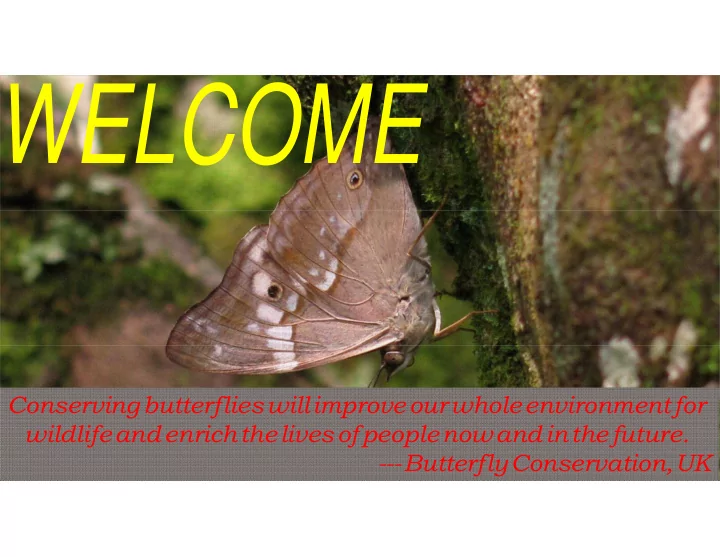
WELCOME Conserving butterflies will improve our whole - - PowerPoint PPT Presentation
WELCOME Conserving butterflies will improve our whole environment for wildlife and enrich the lives of people now and in the future. --- Butterfly Conservation, UK BUTTERFLIES IN TSIRANG DISTRICT, BHUTAN AND THE NEED FOR
Irungbam Jatishwor Singh & Meenakshi Singh Chib Department of Science Mendrelgang Middle Secondary School, Tsirang (Bhutan)
BUTTERFLIES IN TSIRANG DISTRICT, BHUTAN AND THE NEED FOR CONSERVATION
./ The present study was initiated by Department of Science, Mendrelgang Middle Secondary
School in the year 2011.
./ Review of literatures reveals that study on lepidoptera fauna of Tsirang is not yet done so
./
The primary objectives of the study was;
investigation.
foundation for research on lepidoptera.
./
The secondary objective of the study was;
the insects.
ptera = wings).
Y The scientific name of the order, Lepidoptera, is derived from one of their main characteristics, namely their having wings covered in tiny scales (from the Greek lepidos = scale and pteron = wing). Indeed, it is these coloured scales which give them their patterns. These scales are specially modified flattened hairs. Y The Lepidoptera undergo complete metamorphosis, i.e. ova (egg), from which emerge larvae (caterpillars), which become the quiescent pupae (chrysalis) from which emerge the imago (winged adult). This lifecycle can take anywhere between a few weeks to more than a year, depending upon the species. Y Lepidoptera are 'typical' insects, in that they have 2 pair of wings, 3 pair of legs, 1 pair of antennae and a body divided into 3 sections - a head, thorax and abdomen. The leg and wings are attached to the thorax. Y In a few species of moths, the females have evolved to become wingless. Y Most butterflies and moths feed through a specialised tube formed by some of the mouthparts, known as a proboscis. Nectar is the usual food for adults.
Source: http://www.amentsoc.org/insects/fact-files/orders/lepidoptera.html
Y Sense organs on the feet can taste certain food substances with a greater sensitivity than the human tongue. Y The wings consist of an upper and lower membrane supported by a system of hollow veins. Y Most Lepidoptera larvae feed exclusively on plant matter, but a few are carnivorous for at least part of their life. Some species feed on a wide variety of plants, whilst others are willing to accept only one or two. Y The larvae moult several times, usually 4, 5 or 6 depending upon the species. Y The final moult reveals the pupa, which can be attached to part of the food plant or other nearby item, unattached amongst debris such as leaf litter, or in a silk lined chamber underground. Y Survival strategies of butterflies and their earlier stages include camouflage, toxic defence such as being distasteful/harmful or mimicking species that are distasteful/harmful.
Source: http://www.amentsoc.org/insects/fact-files/orders/lepidoptera.html
dy
DIFFERENCES BETWEEN BUTTERFLY & MOTHS
BUTTERFLY (RHOPALOCERA)
./ Active during the day (diurnal) ./ Bright colors ./ Wings rest together and upright ./ Straight and clubbed antennae
./ Thin body
MOTH (HETEROCERA)
./ Active at night (nocturnal) ./ Dull colors ./ Wings rest at their sides ./ Feathered or pointed antennae ./ Thick body
Superfamily : Papilionoidea (True Butterflies) Superfamily : Hesperioidea (The Skippers)
Papilionidae (Swallowtails) Pieridae (Whites & Yellows) Nymphalidae (Brush-footed)
Hesperiidae (Skippers) Lycaenidae (Blues)
Source: Kehimkar, 2008
./
Among insects, butterflies are best known group to humans.
./
Butterflies are beautiful flying insects with striking colours and patterns on their wings.
./
Most of the butterflies are diurnal in nature.
./
Distributed throughout the world except in the polar regions.
./ Butterflies as adult are short-lived insects, few weeks (Blues), 2 to 4 weeks (whites
& yellows) and up to 8 months (Brush-footed butterflies & Swallowtails).
./
Most of the butterflies are found in both Dry and Wet season forms.
./ Butterflies are used by conservational biologist as indicator species to identify
habitats that are critical and need to be protected.
./
Butterflies are also monitored to indicate climate change and environmental degradation.
./
Most important pollinator and plays a very important role in ecosystem restoration.
./ Provides food for predators and plays an important part of food web, particularly as
larvae for birds, reptiles , spiders and predatory insects.
./ Good
indicators
anthropogenic disturbance, habitat loss, climate & environmental changes and the ecological quality of a habitat.
./
Used as a model insect group in the conservation of tropical forests.
./
It can help in development of rural economy through eco-tourism.
./ Bhutan is regarded as 10th richest biological hotspot, but we have very less knowledge on butterfly diversity. ./ Bhutan do not have a comprehensive data
butterfly fauna so far. ./ There are about 18,000 species of butterflies in the world. (Kehimkar 2008) ./ Old publications on Bhutan’s fauna are found in Bingham (1905), Talbot (1939, 1947), Evans (1927, 1932), Yazaki & Kanmuri (1985), Harada (1987); recent publications on Bhutan’s fauna Poel & Wangchuk (2007), Poel (2010), UWICE (2010), Harada et al. (2012), Singh (2012), Wangdi et al. (2012, 2013), Singh & Chib (2014) were conducted at different locations of Bhutan and data are not comprehensive. ./ Bhutan is expected to have around 700 to 800 species of Butterflies. (Poel & Wangchuk 2007). ./ Bhutan has reported 670 species of butterflies (Singh & Chib 2015), comprising of, ./ Papilionidae (55 species), ./ Pieridae (51 species), ./ Nymphalidae (265 species), ./ Lycaenidae (160 species), and ./ Hesperiidae (139 species).
the Bhutan Himalaya.
ranges from 400 m to 2000 m towards north.
pine forest.
protected area.
Sarpang at south and east; and Dagana at west.
altitudes and temperate forest towards the north.
species and chirpine species.
SAMPLING SITES IN STUDY AREA
Burichu (#S1) – (27° 1' 56.291'' N & 90° 4' 30.712'' E, altitude 341 m a.s.l.); Barsong (#S4) – (26° 56' 21.03'' N & 90° 4' 51.909'' E, altitude 788 m a.s.l.); Beteni (#S8) – (26° 56' 47.944'' N & 90° 10' 16.172'' E, altitude 1670 m a.s.l); Damphu (#S12) –(27° 0' 30.672'' N & 90° 7' 16.654'' E, altitude 1549 m a.s.l.); Darachu (#S7) – (26° 56' 39.455'' N & 90° 12' 14.014'' E, altitude 1980 m a.s.l.); DNCF (#S16) – (26° 57' 9.371'' N & 90° 5' 24.082'' E, altitude 1024 m a.s.l.); Kikhorthang (#S13) –(27° 0' 23.706'' N & 90° 6' 54.619'' E, 1627 m a.s.l.); Manidara (#S3) – (26° 56' 36.658'' N & 90° 6' 23.007'' E, 1304 m a.s.l.); Sankosh (#S5) - (26° 56' 37.18'' N & 90° 3' 52.678'' E, 506 m a.s.l.); Salami (#S10) – (27° 0' 39.035'' N & 90° 7' 55.261" E, 1377 m a.s.l.); Semjong (#S15) – (27° 1' 33.859'' N & 90° 9' 6.375'' E, 861 m a.s.l.); Tashipang (#S2) – (26° 57' 0.504'' N & 90° 6' 50.795'' E, 1233m a.s.l.); Thangray (#S6) – (26° 56' 58.135'' N & 90° 11' 46.107'' E, 1922m a.s.l.); Tsholingkhar (#S14) –(27° 0' 55.544'' N & 90° 6' 37.933'' E, 1239 m a.s.l.); Tsirangtoe (#S9) - (27° 1' 56.377'' N & 90° 7' 48.298'' E, 1099 m a.s.l.); Upper Salami (#S11) - (27° 0' 36.162'' N & 90° 9' 22.683" E, 1342 m a.s.l.).
., Lycaenidae 8 sp. and Hesperiidae 3 sp.) are
BUTTERFLIES RECORDED FROM TSIRANG
Y Tsirang district – Total 241 species of butterflies in 5 families.
./Papilionidae – 20 species. ./Pieridae – 32 species. ./Nymphalidae – 104 species. ./Lycaenidae – 49 species. ./Hesperiidae – 36 species.
Y Of which, Total 33 sp. (Pieridae 4 sp., Nymphalidae 18 sp protected under different schedules of Indian Wildlife (Protection) Act (IWPA) 1972 (amended in 2002). Y But none of these butterfly species are protected under Forest and Nature Conservation Act of Bhutan 2006. (RGoB, MoA 2006)
OVERVIEW OF PROTECTED SPECIES OF BUTTERFLIES FROM TSIRANG
Sl. no. Family Total No.
Protected sp. under IWPA 1972 Total protected sp. Sch. I
1 Papilionidae 19 2 Pieridae 31 3 1 4 3 Nymphalidae 106 3 13 2 18 4 Lycaenidae 49 3 5 8 5 Hesperiidae 36 1 2 3 241 6 22 5 33
1 HABITAT LOSS
5 ILLEGAL TRADES OF WILDLIFE
2 CLIMATE CHANGE
4 NON- IMPLEMENTATION OF LAWS
3 BIOTIC PRESSURE
./ Fragmentation and deterioration of habitat due to human exploitation of forestry, Agricultural practices,
and other resources.
./ Climate change affects range, distribution and abundance of butterfly. It also affects in their survival,
fecundity, developmental rates, and condition of larval and adults food plant.
./ Agricultural practices, pastureland development, urbanization also affects in butterfly population. ./ Non- forest activities - mining , road laying, industrial activities , clearing large forest areas for construction
./ Ditching and draining of wet forests, Swamps and bogs in the forest landscape. ./ Forest plantation practices such as cutting of broad leaved forests and plantations of exotic plant species. ./ Illegal collection and trades could also leads to reducing the population of butterflies and even extinction of
endangered species.
./ Especially when rare or protected butterflies are collected from wild, can have influence on species
sustainability.
An integrative approach to the maintenance of biodiversity that uses appropriate principles and experiences from basic biological fields such as genetics and ecology; from natural resource management fields such as wildlife management; and from social sciences such as anthropology, sociology, philosophy, and economics. (Meffe et al., 1997) PARTNERSHIPS
SCIENTIFIC RESEARCH & MONITORING
EDUCATION & OUTREACH FUNDING CONSERVATION ACTIONS
./ Partnerships
Formulate the Conservation Plan, Entities compiled information, developed conservation measures, and recommended actions, in collaboration with national and international organizations. ./ Scientific Research and Monitoring 1.Enhance understanding
biology.
2.
Conduct research to fill information gaps and inform management.
3.
Assess how land management practices affect the butterfly’s abundance and distribution. ./ Education & Outreach
appreciation, and support of the challenge.
in reforestation activities.
butterflies.
1.
PAPILIONIDAE (SWALLOWTAILS)
Troides helena Papilio demoleus Papilio polytes Pachlopta aristolochiae Graphium antiphates Papilio memnon Papilio paris Papilio helenus Papilio nephelus Papilio alcmenor Papilio protenor Papilio bianor
PIERIDAE (WHITES & YELLOWS)
Pontia daplidice Appias paulina Cepora nadina Pieris cannidia Appias lyncida Pieris brassicae Hebomoia glaucippe Delias acalis Delias descombesi Eurema laeta Eurema blanda Ixias pyrene Cepora nerissa Appias lalage Colias fieldi
NYMPHALIDAE (BRUSH-FOOTED)
Euthalia lubentina Euthalia sahadeva Euthalia durga Apatura ambica Apatura sordida Argyrius hyperbius Parasarpa zyla Sumalia zulema Herona marathus Junonia orithya Lethe kansa Lethe sinorix Stibochiona nicea Polyura athamas Athyma cama
LYCAENIDAE (BLUES)
Remalana jangala Rapala nissa Pseudozizeeria maha Acytolepis puspa Prosotas nora Castilius rosimon Catapacilma major Abisara fylla Zemeros flegyas Abisara chela Arhopala eumolphus Celastrina argiolus Taraka hamada Heliophorus epicles Leptotes plinius
HESPERIIDAE (SKIPPERS)
Pelopidas subochracea Matapa sasiarna Iambrix salsala Halpe homolea Pelopidas subochracea Pseudocoladenia dan Udaspes folus Oriens goloides Notocrypta curvifascia Coladenia indrani Pelopidas assamensis Tagiades litigiosa Potanthus nesta ? Oriens gola Pelopidas sp.
the study area which have conservation importance.
covering biology, host plant preferences, ecological requirements etc.
species and promoting ecotourism in Bhutan.
found in this region are necessary for adopting appropriate conservation strategies.
Principal Investigator
Co-Investigator
Team advisor & Lepidoptera Expert Yam Bahadur Bista Student Bikram Gajmer Student Kailash Wakley Student
to the team for the successful conduct of the project.
is thankful to CORRB, Ministry of Forest and Parks for granting necessary permits for the study and collection of the specimens in the study area.
the expert scientist from different parts of the world who have rendered their expertise and suggestions during the conduct of the project namely: Mr. Peter Smetacek, Butterfly Research Centre, Bhimtal, India; Mr. Saito Motoki, Butterfly Society of Japan, Tokyo, Japan and Mr. Isaac Kehimkar, Bombay Natural History Society, Mumbai, India.