Where do Landfills Fit In The Changing Paradigm of Circular - - PowerPoint PPT Presentation

where do landfills fit in the changing paradigm of
SMART_READER_LITE
LIVE PREVIEW

Where do Landfills Fit In The Changing Paradigm of Circular - - PowerPoint PPT Presentation

Where do Landfills Fit In The Changing Paradigm of Circular Economy- Resource Recovery and Social Aspects By Aditi Podder 1 , Debra Reinhart 2 and Ramesh Goel 3 1,3 Department of Civil & Environmental Engineering, University of Utah 2


slide-1
SLIDE 1

Where do Landfills Fit In The Changing Paradigm

  • f Circular Economy-

Resource Recovery and Social Aspects

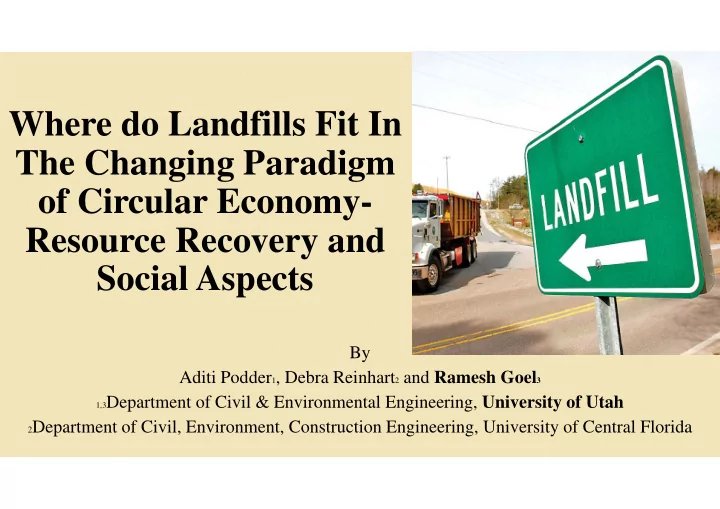
By Aditi Podder1, Debra Reinhart2 and Ramesh Goel3

1,3Department of Civil & Environmental Engineering, University of Utah

2Department of Civil, Environment, Construction Engineering, University of Central Florida

slide-2
SLIDE 2

Liquid Waste-streams in Urban Environment

Ref: SPUHLER (2010)

Solid Waste

Wastewater Treatment Plant Landfill

Leachate

  • All the waste-streams are contaminated
  • Contaminants of concerns are mainly

Carbon, Nitrogen and Phosphorus

  • Industrial Wastewater and liquid

generated from solid waste also contains metals and toxic chemicals

HOW CAN WE ACHIEVE ENVIRONMENTAL SUSTAINABILITY??

slide-3
SLIDE 3

Two Urban Waste streams rich in resources

Filtrate/Centrate/Reject water

URBAN WASTESTREAM

  • High Ammonia Content
  • Sent back to Biological Treatment Train
  • Increases Ammonia Load inside Bioreactor

Anaerobic Digester Sludge Dewater Landfill Solid Waste

Leachate

DUMPED INTO WWTP

  • High Ammonia Content
  • Low Phosphorus Content
  • High Toxicity
  • Low BOD/COD ratio
  • High recalcitrant matters
  • High dissolved methane

COMPLEX WASTESTREAM Parameter Composition COD (mg/L) 100~400 NH4

+-N (mg/L)

400~1000 TN (mg/L) vairable TP (mg/L) 200~400 Characteristics of Typical Filtrate

slide-4
SLIDE 4

Liquid waste Treatment (Carbon management)

Different Aerobic Reactors Performance (Renou et al., 2008 )

Figure: (a) Activated Sludge Process, SUEZ's degremont, water handbook; (b)SBR, Beun et al.,1988; (c)MBBR, Colloide Engineering,ENVIROPRO; (d)Trickling Filter

(a) (c) (d) (b)

slide-5
SLIDE 5

Liquid Waste Treatment (Carbon management)

Different Anaerobic Reactors Performance (Renou et al., 2008, Fernandez et al., 2000 )

Figure: Anaerobic Digester

Source: A Primer on Anaerobic Filters, Fundamentals & Applications

slide-6
SLIDE 6

The need to integrate “recover” with “removal”

  • Landfill leachate is rich in N and C, and handled

separately.

  • The current management schemes focus on removal

which is also threatened by the presence of recalcitrant and toxic chemicals in landfill leachate

  • Wastage of C, N and P
  • Dumped into WWTP

Current paradigm Circular Metabolism

  • Recognizes the fact that waste streams contain

valuable resources

  • Most important ones are nitrogen and phosphorus
  • Provides a much reduced burden to stakeholders

and the environment

slide-7
SLIDE 7

Overcome P limitations by mixing two concentrated streams

BOD5 (mg/L) 58_5 COD (mg/L) 1435_10 Ammonia (mg/L) as N 457_5 Phosphorus (mg/L) 7.6_2 Nitrate as N (mg/L) <0.01 Nitrite as N (mg/L) <0.01 TOC (mg/L) 280_5 BOD5 (mg/L) 79_5 COD (mg/L) 450_25 Ammonia (mg/L) 485_15 Phosphorus (mg/L) 400±25 Nitrate as N (mg/L) 1.2 _ 0.2 Nitrite as N (mg/L) TOC (mg/L) 128_12 BOD5 76_5 COD(mg/L) 547_10 Ammonia (mg/L) 435_10 Phosphorus (mg/L) 250±35 Nitrate as N(mg/L) <0.01 Nitrite as N (mg/L) <001 Characteristics of Leachate Characteristics of Mixture (20%Leachate+80% Filtrate) Characteristics of Filtrate + + + + + + + + + + + + +

Final concentration depends upon the ration two waste streams are mixed

slide-8
SLIDE 8

Implementation of Circular Metabolism

Environmental Issues Economical Issues Societal Issues  Environmental Sustainability can be achieved with a proportional balance of these THREE issues

Recovering Nutrients Provide Environmental Sustainability

  • Recovering useful nutrients make the

nutrients available for further use which boosts economy

  • Generated methane gas can be used in

electricity generation in wastewater treatment plants

  • Composts generated from landfills and

from biosolids can be sold in market for agricultural purpose

  • Reused/ reclaimed water can also

contribute in economy

  • If prior to dumping the nutrients into

water bodies, they can be recovered, the risk of algal bloom can be reduced

  • Instead of dumping the organics and

nutrients, if they are treated and recovered, additional source of chemicals in treatment of water can be reduced

  • A green environment can be expected if

the treated water (rich in nutrients) can be used for agricultural purpose

  • Water reuse will ensure the balance in

fresh water resources for future generation

  • Recovered nutrients will need to

be processed for downstream uses which might increase job

  • pportunity
  • When the concept of scarcity and

limited availability of resources will be widespread, more public participation is accepted, which will also provide job opportunity
slide-9
SLIDE 9

Challenges-Leachate Characteristics

SLVSWMF Leachate Sampling, American West Analytical Laboratories (2016)

Huan‐jung et al. (2006) Raghab et al. (2013) Robinson et al. (2017) Zazouli et al. (2012)

BOD5 (mg/L) 58 20-57000 3400 7.6 48 COD (mg/L) 1590 140-15200 8250 1900 3960 NH4

+ (mg/L) as N

168 50-2200 3745 1200 532 Phosphorus (mg/L) 1.9 0.1-23 1308 7.83 21 Nitrate as N (mg/L) <0.01 nd 3.95 1800 nd Nitrite as N (mg/L) <0.01 nd nd 1.05 nd TOC (mg/L) 280 30-29000 nd 776 nd

  • Low Biodegradable Organics present
  • High in ammonia nitrogen but low in phosphorus
  • Due to low P, strategies like struvite precipitation not feasible
slide-10
SLIDE 10

Challenges and solutions

  • Variable characteristics of leachate make it difficult to

develop a single management option.

  • High ammonia and low phosphorus leaves plenty of

ammonia nitrogen P in the liquid waste even after nutrient recovery

  • Hence, integrated approaches are needed to manage

leachate.

slide-11
SLIDE 11

Proposed Integrated approach Approach

RECOVER NUTRIENTS REUSE WATER TREAT WATER

slide-12
SLIDE 12

Microbial Protein Production-for excess ammonia

  • Promising alternative in promoting Circular Economy

Low value recovered resources High quality feed

  • NH4

+-N + CO2

High quality edible microbial protein

Crude protein content on CDW basis of the microbial biomass produced under CR configuration by the Sulfuricurvum spp. dominated culture compared with other microbial protein (bacterial meal), animal protein (fishmeal) and vegetable protein (soybean meal) (Matassa et al., 2016) Electrochemical Ammonia Recovery from Source Separated Urine for Microbial Protein Production (Christiaens et al., 2017)

H2 oxidizing Bacteria

  • Supports a shift from resource dissipation to resource

recovery

  • Can be used as a suitable substitute for conventional

feed sources such as fishmeal or soybean meal

From Effluent of Wastewater Treatment Plant From Biogas produced during Anaerobic Digestion From Green Energy Sources such as Wind & Solar Energy powered Water Electrolysis

RESOURCE RECOVERY UNDER CIRCULAR ECONOMY

slide-13
SLIDE 13

Optimization of pH and Mg: P ratio during struvite precipitation

Struvite Precipitation in Recovery of Phosphorus

NH4

+

Mg2+

PO4

3-

NH4

+

Mg2+

PO4

3-

pH = 9

P:Mg = 1:1.2 MAXIMIZES PRECIPITATION

slide-14
SLIDE 14

Phase I Phase II Phase III

COD removal percentages in granular reactor

Knocking down Carbon in Granular Reactor

  • Granular Sludge Technology is a

Novel Approach in simultaneous removal of Organics, Nitrogen and Phosphorus

(a) Conditions inside granules (b) Microorganisms abundance in flocs (Winkler et al., 2012) (a) (b)

  • 08. 22. 2017
  • 12. 15. 2017
  • 02. 27. 2018

FEEDING WITH REAL LEACHATE CHANGES THE MORPHOLOGY OF GRANULES

slide-15
SLIDE 15

Phase I Phase II Phase III

Ammonia nitrogen removal percentages in granular reactor

Treatment of Ammonia- Nitrogen in Granular Reactor

Low Energy Cost <60% of BNR

v

Low Carbon Footprint <40% of BNR Simultaneous P and N Removal Microbial Diversity High Settle- ability Effective for high strength WW

AEROBIC GRANULES

slide-16
SLIDE 16

Phase I Phase II

Ammonia nitrogen removal percentages in PN/A reactor

Phase III

Treatment of Ammonia- Nitrogen in Single Stage PN/A

Proces s es Nitrification- denitrification Nitritation- denitritation PN/A O2 demand (kg O2/kg NH4

+-N)

4.57 3.43 1.95 Alkalinity demand (mg CaCO3/mg NH4

+-N)

7.07 N/A 4.6 BOD demand (kg BOD/kg NH4

+-N)

~ 3.5 ~ 2.1 Biomas s yield (kg DS/kg NH4

+-N)

~ 0.8 ~ 0.5 ~ 0.1

  • Benefits of PN/A

Stoichiometry:

NH4

 1.32NO2  0.066HCO3  0.13H   0.066CH2O0.5N0.15 1.02N2 0.26NO3  2.03H2O

NH4

 1.146NO2  0.07HCO3  0.057H   0.071CH1.74O0.31N0.20 0.986N2 0.161NO3  2.002H2O

NH

4 +

NO

2

  • N2

Partial nitritation

Anammox

PN/A=

(a) Suspended Growth Granular Anammox (Jian-Tang et al.,2013) (b) ANITA

TMmox, Veolia Water Technologies

(a) (b)

ANaerobic AMMonium Oxidation (Anammox)

slide-17
SLIDE 17

Integrated Approach in Treatment of Landfill Leachate

INFLUENT EFFLUENT

RECOVER NUTRIENTS

REUSE WATER FERTILIZER

STRUVITE PRECI- PITATION PARTIAL NITRITATION /ANAMMOX GRANULAR ACTIVATED SLUDGE PROCESS

Org-NH4

+

PO4

3--P

rbCOD Org-NH4

+

PO4

3--P

rbCOD Org-NH4

+

PO4

3--P

rbCOD Org-NH4

+

PO4

3--P

rbCOD

TEAM GREEN

slide-18
SLIDE 18

Conclusions

  • There is a need to think beyond the conventional treatment

paradigm and incorporate recovery and innovative processes.

  • Single management approach may not be suitable due to

constantly changing leachate characteristics.

  • Leachate cannot be considered as a separate “one” liquid waste
  • stream. It should be considered under the broader spectrum of

urban circular metabolism.

  • Our integrated approach incorporating struvite recovery, granular

activiated sludge process and single stage anaerobic ammonia

  • xidation showed good promise.
slide-19
SLIDE 19

THANK YOU

Contact Information

  • Dr. Ramesh Goel (ram.goel@utah.edu)

Aditi Podder (aditi.podder@utah.edu) Department of Civil and Environmental Engineering University of Utah

Questions??

slide-20
SLIDE 20

Recoverables from urban waste-streams

Linear metabolsim vs cicrcular metabolism in recovery of useful resources (Wielemaker et al., 2018)

There are two issues in recovery of nutrients

  • Nutrient Sources
  • Global nutrient imbalance

Environmental Input of Nutrients

  • Removing BOD from UWW
  • RemovingN from UWW
  • Utilizing C:N ratio in UWW
  • Harvesting carbon from UWW
  • Harvesting energy from UWW

High Input and Limited Recycling Adds Lots of NUTRIENTS to the Environment

Environment al Imbalance in Nutrients!!

slide-21
SLIDE 21

Solid waste Landfill Leachate

  • Leachate is one of the concentrated

urban waste streams

  • Environmental threat
  • Complex blend of contaminants
  • Current approaches rely on “removal”

Landfill Leachate-a waste or a resource

  • Lots of nitrogen, carbon and phosphorus
  • How can we recover and treat using innovative approaches?
slide-22
SLIDE 22

Municipal Solid Waste Generation

(a) Municipal waste generation and treatment in the EU Member States, 2015 (in kg per person) (b) Total Municipal solid waste generation and per capita waste generation in United States (USEPA, 2016) Generation of Municipal Solid Waste is increasing every year with CONSTANT facilities for Solid Waste Management!!

slide-23
SLIDE 23

Different components of our approach

Reject water Leachate Step 1: Nutrient recovery @ different pHs Step 2: Granular activated sludge process to remove carbon. Unlike in flocculated activated sludge processes, dense granules will be able to tackle toxics: Alternative: Use anaerobic process to recover carbon Step 3: Partial nitrification coupled with anaerobic ammonia

  • xidation to remove remaining nitrogen
slide-24
SLIDE 24

Recovery of Ammonia

  • N:P ratio in the mixture of leachate and centrate is GREATER

than 40

  • Most of the Phosphorus from the mixture can be recovered

from Struvite Precipitation

  • Lots of Ammonia is left in the system to deal with.
  • Ammonia is highly Soluble which makes it difficult for Ion

Exchange Process

  • There are several ways to treat and recover the rest of the

Ammonia-nitrogen in the system

  • Microbial Protein Production

Ammonium High quality feed for livestock

  • Simultaneous Nitrification-Denitrification

Ammonium Nitrite Nitrate Nitrogen Gas

  • Anaerobic Ammonium Oxidation

Ammonium+ Nitrite Nitrogen Gas

Recovery of Ammonia in terms of Microbial Protein leading towards CIRCULAR ECONOMY(Source: power to PROTEIN)