Why to Barcode A. mellifera of SA: Population structure may be - - PDF document

why to barcode a mellifera of sa
SMART_READER_LITE
LIVE PREVIEW

Why to Barcode A. mellifera of SA: Population structure may be - - PDF document

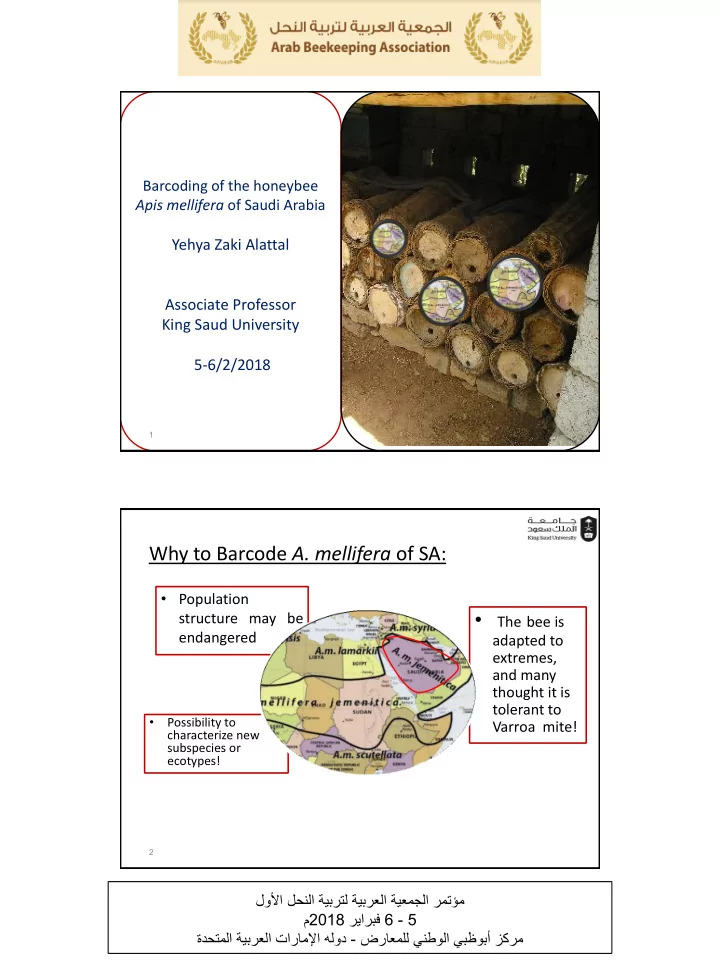
Barcoding of the honeybee Apis mellifera of Saudi Arabia Yehya Zaki Alattal Associate Professor King Saud University 5-6/2/2018 1 Why to Barcode A. mellifera of SA: Population structure may be The bee is endangered adapted to


slide-1
SLIDE 1

لولؤا لحنلا ةيبرتل ةيبرعلا ةيعمجلا رمتؤم 5-6 رياربف2018م ضراعملل ينطولا يبظوبأ زكرم-ةدحتملا ةيبرعلا تاراملئا هلود Barcoding of the honeybee Apis mellifera of Saudi Arabia Yehya Zaki Alattal Associate Professor King Saud University 5-6/2/2018

1

Why to Barcode A. mellifera of SA:

  • The bee is

adapted to extremes, and many thought it is tolerant to Varroa mite!

  • Population

structure may be endangered

  • Possibility to

characterize new subspecies or ecotypes!

2

slide-2
SLIDE 2

لولؤا لحنلا ةيبرتل ةيبرعلا ةيعمجلا رمتؤم 5-6 رياربف2018م ضراعملل ينطولا يبظوبأ زكرم-ةدحتملا ةيبرعلا تاراملئا هلود

Are you really Mediterranean?. Maybe Ethiopian or Somalian! Are you originally Asian or African?

Do Do you know who I a am?

Who I am:

3

it was first thought to be A. c. indica But Ruttner (1975) correctly identified these bees as small Apis mellifera and called Apis mellifra yemenitica He collected samples from Sabia, Riyadh, Alhassa, (Saudi Arabia), Oman, yemen,

  • Sudan. (1975).

2.2 m-km, highly diverted with extremes Historical Background Since then, Many Saudi researchers worked on its morphometry, biology and behaviour.

4

slide-3
SLIDE 3

لولؤا لحنلا ةيبرتل ةيبرعلا ةيعمجلا رمتؤم 5-6 رياربف2018م ضراعملل ينطولا يبظوبأ زكرم-ةدحتملا ةيبرعلا تاراملئا هلود

: However

  • Samples taken by Prof. Rutter (1975) were

not representative to whole SA (N=2(

  • Morphological characteristics which, although it

is very important in this aspect, is not well suited to characterize honeybee subspecies and study phylogenetic relations. (Frank et al., 2000).

  • New approaches are available and more data is

now available to study honeybee populations.

  • Lack of reference genetic data for this

subspecies in the gene banks.

5

Sample collection: Comprehensive (198 colonies, 1980 bee worker, 45000 readings) Approaches:

  • Morphometry (24 characters)

(Ruttner 1988)

  • Genetic ( mtDNA COI-COII)

Sequences (N=179) . ( Cornuet and

Garnery, 1991)

Microsatellite Analysis (195 native + 10 imported)

(Estoup et al., 1995), (Garnery et al., 199S) (Michel et al., 2003)

: Approach

6

slide-4
SLIDE 4

لولؤا لحنلا ةيبرتل ةيبرعلا ةيعمجلا رمتؤم 5-6 رياربف2018م ضراعملل ينطولا يبظوبأ زكرم-ةدحتملا ةيبرعلا تاراملئا هلود

Eight specific microsatellite markers (A7, A24, A28, A88, A113, B124) (Estoup et al., 1995), Ap43 (Garnery et al., 1998), Ap81 (Solignac et al., 2003) previously reported as polymorphic

  • Morph. and Geometric Analysis

mtDNA Analysis (COI-COII) Microsatellite Analysis Garnery et al., 1992 Ruttner, 1988

7 Relation of Factor one (Size and latitude along the Saudi red sea cost. Green triangles: cluster one, red crosses: cluster two, and blue dots: cluster three Principal factor analysis scores plotted using k means groupings. Factor one associated with size and factor two associated with

  • pigmentation. Cluster 1 includes colonies from (north) Cluster two

includes colonies from (Central). Cluster three includes colonies from (south-west coast).

: Results

Alghamdi et al., 2012; Alattal et al., 2014: B. Insectology

Discriminant analysis of the Saudi honey bees based on seven reference subspecies. (24 characters)

8

slide-5
SLIDE 5

لولؤا لحنلا ةيبرتل ةيبرعلا ةيعمجلا رمتؤم 5-6 رياربف2018م ضراعملل ينطولا يبظوبأ زكرم-ةدحتملا ةيبرعلا تاراملئا هلود

: Results

Alattal et al., 2014 : Zoology in the Middle East

Bees from Saudi Arabia clustered with the Reference Yemeni samples (Arabian yemenitica) (24 characters + 9 wing angels) Squared Euclidian distances between Z-standarized character group fro Saudi Arabia (Sa) and the Arabian reference samples of A. m. jemenitica from the respective reference subspecies.

9

: Results

Alattal et al., 2014: B. Insectology In silico DraI restriction analysis revealed seven different haplotypes; six of them belonged to the O lineage, and one belonged to the A lineage. Three of these haplotypes were novel

10

slide-6
SLIDE 6

لولؤا لحنلا ةيبرتل ةيبرعلا ةيعمجلا رمتؤم 5-6 رياربف2018م ضراعملل ينطولا يبظوبأ زكرم-ةدحتملا ةيبرعلا تاراملئا هلود

: Results

Alattal et al., 2014: B. Insectology

Maximum Parsimony phylogenic tree based on COI-COII intergenic region sequences. Higher similarity with the Syrian than with the Yemeni. Saudi Samples Reference Samples

11

Population structure obtained by Structure Analysis of 215 individuals representing 7 populations. Each of the individuals is represented by a thin vertical line that is divided to green (Land Race) and Orange (Imported) representing the individuals membership in the cluster of the corresponding

  • color. (Bayesian model-based clustering ) (FIS = 0.123, Fst = 0.009, Fit=0.13).

: Results

Alattal et al., 2014: J. Entomol. 12

slide-7
SLIDE 7

لولؤا لحنلا ةيبرتل ةيبرعلا ةيعمجلا رمتؤم 5-6 رياربف2018م ضراعملل ينطولا يبظوبأ زكرم-ةدحتملا ةيبرعلا تاراملئا هلود

Summary – morphometry:

  • Bees of Saudi Arabia resemble Yemeni bees A. m. jemenitica
  • Results indicate significant morphometric variation and a cline
  • f factor one (characters associated with body size) from the

north (cluster one) to the south (cluster three).

  • Most Saudi honey bee samples clustered with Apis mellifera

jemenitica reference group, but few were more similar to Apis mellifera litorea reference group.

  • Morphometric variation among the clusters of this study

exceeds the variation between the Syrian and the Yemeni Honeybee reference samples (RUTTNER 1988)

  • Socotran sample clusterd with the litorea group

13

Summary of Molecular part:

  • Eighteen

new and clearly separated haplotypes were characterized for the first time, three of then were novel.

  • Sixteen haplotypes belonged to the O lineage

and are very close to the Syrian haplotypes.

  • Two haplotypes belonged to the A lineage but

clearly different from the Ethiopian haplotypes of A.m. jemenitica

  • Two groups can be distinguished with high

level of introgression between imported and native subspecies.

14

slide-8
SLIDE 8

لولؤا لحنلا ةيبرتل ةيبرعلا ةيعمجلا رمتؤم 5-6 رياربف2018م ضراعملل ينطولا يبظوبأ زكرم-ةدحتملا ةيبرعلا تاراملئا هلود

Conclusion

  • Both the morphometric and genetic analyses provide evidence that the

Saudi honey bee population from the Arabian Peninsula belongs to the O lineage

  • Presence of overlapping and transitional state between the Syrian and the

Yemeni Honeybees.

  • Geometric results confirmed that samples from Saudi Arabia are very

similar to the samples from the subspecies A. m. jemenitica (Ruttner, 1967). previously described from Oman, Yemen and Saudi Arabia. However molecular results goes with the Syrian.

  • Hybridization of the local bee race with other bee races should be

considered.

  • Similarities with the Syrian sequences and high genetic diversity in the

mtDNA COI–COII region should be discussed.

  • Intensive hybridization entail urgent conservation strategy of the native

honeybee to be implemented.

15

ًليزج ًاركش

Thank you

16

slide-9
SLIDE 9

لولؤا لحنلا ةيبرتل ةيبرعلا ةيعمجلا رمتؤم 5-6 رياربف2018م ضراعملل ينطولا يبظوبأ زكرم-ةدحتملا ةيبرعلا تاراملئا هلود

Alattal et al., 2014: B. Insectology

: Results

17