Wind Resistance of Green Roof Systems in Florida Developing A - - PowerPoint PPT Presentation

wind resistance of green roof systems in florida
SMART_READER_LITE
LIVE PREVIEW

Wind Resistance of Green Roof Systems in Florida Developing A - - PowerPoint PPT Presentation

University of Florida Research Wind and Plant Performance Studies for Green Roof Systems in FL Wind Resistance of Green Roof Systems in Florida Developing A Wind Test Protocol Principal Investigator: David O. Prevatt, Ph.D., P .E. (MA)


slide-1
SLIDE 1

SLIDE

1 ¡ ¡

University of Florida Research Wind and Plant Performance Studies for Green Roof Systems in FL
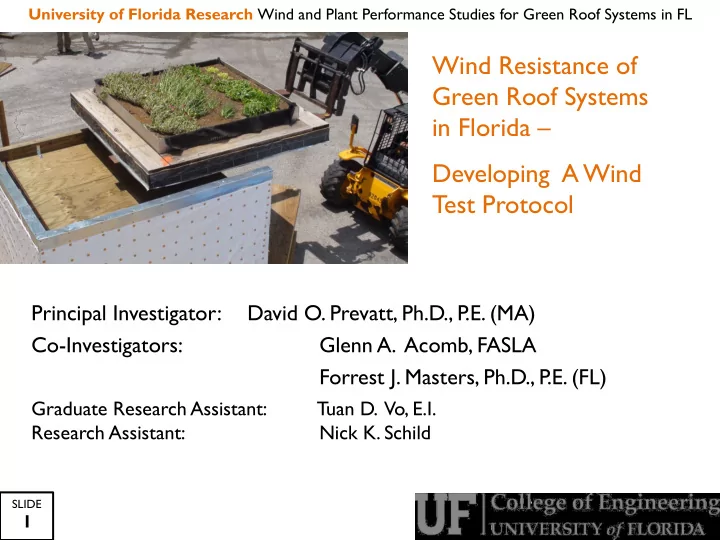
Wind Resistance of Green Roof Systems in Florida – Developing A Wind Test Protocol

Principal Investigator: David O. Prevatt, Ph.D., P .E. (MA) Co-Investigators: Glenn A. Acomb, FASLA Forrest J. Masters, Ph.D., P .E. (FL)

Graduate Research Assistant: Tuan D. Vo, E.I. Research Assistant: Nick K. Schild

slide-2
SLIDE 2

SLIDE

2 ¡ ¡

University of Florida Research Wind and Plant Performance Studies for Green Roof Systems in FL

Research Scope and Objectives

  • Task 2: Investigate the performance of vegetative roof systems

appropriate to Florida building for performance in hurricane wind and rain conditions.

– (a) Capture and present the most recent research on vegetative roofs in the public domain. Catalogue and compare the vegetative roof systems (in Florida), their (wind) anchorage to the roof structures and installation and design criteria. – Approximately 12 million sq. ft. of green roofing systems in the US. – Nearly one-third of these are in southeastern U.S. (including Texas). Less than 2% of US green roofs are installed in Florida. – UF Report UF04-11 (September 2011): extensive literature review. – No Verification Test Protocol Exists for Wind Uplift Performance

slide-3
SLIDE 3

SLIDE

3 ¡ ¡

University of Florida Research Wind and Plant Performance Studies for Green Roof Systems in FL

FM I-35

Green Roof Design Guidelines

German FLL: Green Roofing Guideline (FLL, 2008) German FLL ANSI/SPRI RP-14: Wind Design Standard for Vegetative Roofing Systems (SPRI, 2010) FM Global I-35: Green Roof Systems (Factory Mutual Insurance Company, 2007) RP-14 ANSI/SPRI VF-1: External Fire Design Standard for Vegetative Roofs (SPRI, 2010) VF-1

ASTM-E2396: Saturated Water Permeability of Granular Drainage Media ASTM-E2397: Determination of Dead/Live Loads on Green Roof Systems ASTM-E2398: Water Capture and Media Retention of Geocomposite Drain Layers ASTM-E2399: Maximum Media Density for Dead Load Analysis ASTM-E2400: Selection, Installation, and Maintenance of Plants for Green Roof Systems Guide

slide-4
SLIDE 4

SLIDE

4 ¡ ¡

University of Florida Research Wind and Plant Performance Studies for Green Roof Systems in FL

  • FLL site condition checklist:

– Climate and weather-dependent factors – Structure-dependent factors – Plant-specific factors for design & maintenance (not selection)

  • FM Global 1-35: most conservative guide

– 100 mph limit = restricts green roofs in FL – Commercial roofs on metal or concrete decks

  • RP-14: Prescriptive wind design guide and tables

– Unprotected media limit of 5” diameter (influences plant selection) – Design tables per ASCE 7-05 wind maps

Green Roof Standards/Guidelines

Recommendation: Florida Green Roof Design Guide should develop from a combination of the FLL, RP-14, VF-1 and FM 1-35.

slide-5
SLIDE 5

SLIDE

5 ¡ ¡

University of Florida Research Wind and Plant Performance Studies for Green Roof Systems in FL

Wind Load on Green Roof Sytems

Critical wind load: corner and roof edges

slide-6
SLIDE 6

SLIDE

6 ¡ ¡

University of Florida Research Wind and Plant Performance Studies for Green Roof Systems in FL

Research Scope and Objectives

  • Phase 2

Tasks:

– (b) Conduct wind uplift tests on full scale “Florida-appropriate” green roof systems and develop preliminary understanding of the performance in high winds. Evaluate minimum biomass loss, scouring characteristics, and plant damage for moderate, strong and extreme winds. Determine effect of rain on wind performance. Assess the rate of recovery of vegetation and effect of multiple wind storms. – (c) Conduct parametric studies of factors affecting uproot resistance and plant breakage strength of plants used in vegetative roof systems, and scour resistance for green roof systems. Develop a standardized test procedure for evaluating green roofs hurricane wind related performance and submit protocol to ASTM and the Green Roof Council to initiate national consensus standards development.

slide-7
SLIDE 7

SLIDE

7 ¡ ¡

University of Florida Research Wind and Plant Performance Studies for Green Roof Systems in FL

Experimental Design

  • Full-scale wind uplift tests on green roofs systems (6 ft by 6 ft)
  • Evaluate three growth media depths: 4 in., 6 in. and 8 in.
  • Simulate modular tray and built-in-place green roof systems
  • Identify appropriate plants suited to the Florida climate.
  • Determine effect of water-soaked growth media on

performance

  • Develop test methods to evaluate wind uplift capacity of roots
slide-8
SLIDE 8

SLIDE

8 ¡ ¡

University of Florida Research Wind and Plant Performance Studies for Green Roof Systems in FL

Phase 1 Test Setup

  • 6 tests of modular tray roofs
  • 3 tests 4 in. depth, 3 test 8 in. depth
  • 9 trays per test, incl. 1 unprotected module
  • Wind speeds, 30, 40, 50, 70, 90 120 mph
  • 5 minutes each test
  • Wind azimuth 90 degrees
  • 12 in. high parapet
  • 6 plant varieties mixed
slide-9
SLIDE 9

SLIDE

9 ¡ ¡

University of Florida Research Wind and Plant Performance Studies for Green Roof Systems in FL

20 mph 30 mph 50 mph 70 mph 90 mph 120 mph

4 in. module test at 120 mph

slide-10
SLIDE 10

SLIDE

10 ¡ ¡

University of Florida Research Wind and Plant Performance Studies for Green Roof Systems in FL

Phase 1 Test Matrix

Phase 1: Modular Tray Green Roof Test Matrix

Test ID Wind Testing Date Establish ment Period Plant Height Parapet Configuration Unprotected Module Location 4” – T1 08/18/2011 3 months Mixed Encompassing 9 4” – T2 08/18/2011 3 months Mixed Encompassing 5 4” – T3 08/18/2011 3 months Mixed Encompassing 1 8” – T1 08/18/2011 3 months Mixed Encompassing 7 8” – T2 10/20/2011 5 months Mixed Encompassing 8 8” – T3 02/16/2011 9 months Mixed Back wall removed 8

Module Location Identification

Observation: Severe scour at corners in unprotected module trays. 8 in. depth growth media trays produce robust plants but severe dieback

  • ccurs in dry winter
slide-11
SLIDE 11

SLIDE

11 ¡ ¡

University of Florida Research Wind and Plant Performance Studies for Green Roof Systems in FL

Examples: Scour at Roof Corner and Edges

Phase 2: Test Trial T7, windward corner Phase 1: Test Trial 1, leeward corner

slide-12
SLIDE 12

SLIDE

12 ¡ ¡

University of Florida Research Wind and Plant Performance Studies for Green Roof Systems in FL

Phase 1 Conclusions

  • 8” better for plant health than 4” (irrigation needed)
  • Protection provided by parapets (but movement of media on roof)
  • Dormant woody plants a fire hazard in winter unless fuel removed
  • Wind speed under 70 mph not damaging in short term tests
  • Limitation of test (simulator produces low turbulence wind flow ~5% TI)

which is likely far less damaging than real winds

slide-13
SLIDE 13

SLIDE

13 ¡ ¡

University of Florida Research Wind and Plant Performance Studies for Green Roof Systems in FL

Phast 2 Test Setup

slide-14
SLIDE 14

SLIDE

14 ¡ ¡

University of Florida Research Wind and Plant Performance Studies for Green Roof Systems in FL

Phase 2 Test Setup

slide-15
SLIDE 15

SLIDE

15 ¡ ¡

University of Florida Research Wind and Plant Performance Studies for Green Roof Systems in FL

Phase 2 Test Setup

  • 16 Trials; 45 degree wind azimuth; no parapets (conservative)
  • 8 tests built-in-place green roof assemblies (normal vs. saturated)
  • 8 tests module trays; 4 repeated and 4 6-month old
  • Wind speed:100 mph; held for 10 minutes and 20 minutes
  • Trays planted in short plant species and tall species (in 6 month old trays)
slide-16
SLIDE 16

SLIDE

16 ¡ ¡

University of Florida Research Wind and Plant Performance Studies for Green Roof Systems in FL

Phase 2 Test Matrix

Phase 2: Built-in-Place Green Roof Test Matrix

Test ID Plant Date W i n d Testing Date Establishment Period Moisture Plant Height 20 min. test (Y/N ?) N-S1 04/25/2012 06/12/2012 7 weeks Normal Short No N-S2 04/25/2012 06/13/2012 7 weeks Normal Short No N-T1 04/25/2012 06/12/2012 7 weeks Normal Tall No N-T2 04/25/2012 06/13/2012 7 weeks Normal Tall No S-S1 04/28/2012 06/13/2012 6.5 weeks Wet Short No S-S2 04/28/2012 06/13/2012 6.5 weeks Wet Short No S-T1 04/28/2012 06/19/2012 7.5 weeks Wet Tall Yes* S-T2 04/28/2012 06/19/2012 7.5 weeks Wet Tall Yes*

Phase 2: Modular Tray Green Roof Test Matrix

Test ID Wind Testing Date Establishment Period Media Depth Plant Height Continued Testing? T2 06/18/2012 13 months 4” Mixed No T3 06/18/2012 13 months 4” Mixed No T5 06/20/2012 13 months 8” Mixed No T6 06/20/2012 13 months 8” Mixed No T7 06/21/2012 6 months 4” Tall Yes T8 06/20/2012 6 months 4” Short No T10 06/22/2012 6 months 8” Tall Yes T11 06/22/2012 6 months 8” Short No

slide-17
SLIDE 17

SLIDE

17 ¡ ¡

University of Florida Research Wind and Plant Performance Studies for Green Roof Systems in FL

Results: Short versus Tall Plants, & Duration

  • RECOMMENDATION:

Moisture content was not a major factor Coverage ratio reduces with time, therefore significant loss in plant coverage in a “normal” hurricane.

Key: Top: Moisture content Bottom: Change in weight

10 Minute Modular Tray Green Roof Test (T11 – short plant) 20 Minute Modular Tray Green Roof Test (T10 – tall plant)

slide-18
SLIDE 18

SLIDE

18 ¡ ¡

University of Florida Research Wind and Plant Performance Studies for Green Roof Systems in FL

Green Roof Anchorage

Case 1: No Internal ties Case 2: Internal ties provided

RECOMMENDATION: – Anchorage is required for all green roofs to the structure/substrate Unprotected growth media susceptible to scour – Parapets and sufficient dead load of green roof may minimize failure

slide-19
SLIDE 19

SLIDE

19 ¡ ¡

University of Florida Research Wind and Plant Performance Studies for Green Roof Systems in FL

Deeper Media Depth = Healthier Plants

4 in. deep module trays 8 in. deep module trays

RECOMMENDATION: Assume 6 in. minimum growth media depth for Florida 1. Decreases heat flux effect on roots 2. Greater dead load mitigates chance of green roof displacement

slide-20
SLIDE 20

SLIDE

20 ¡ ¡

University of Florida Research Wind and Plant Performance Studies for Green Roof Systems in FL

Plant Height

  • RECOMMENDATION: Use low-lying plants (horizontal stem spread) to

minimize wind uplift forces.

Lantana “wet” 94% ¡ 68% ¡ Portulaca “wet” 98% ¡ 79% ¡ Short, Portulaca species prior to testing Short, Portulaca species after testing Tall, Lantana species prior to testing Tall, Lantana species after testing

slide-21
SLIDE 21

SLIDE

21 ¡ ¡

University of Florida Research Wind and Plant Performance Studies for Green Roof Systems in FL

Root Uplift Test Device

6” Linear Actuator 200 lb Load Cell Rubber Padded Steel Plates

slide-22
SLIDE 22

SLIDE

22 ¡ ¡

University of Florida Research Wind and Plant Performance Studies for Green Roof Systems in FL

Typical Force vs. Displacement Plots

Typical curve denoting 6” upheaval of binded growth media Typical curve denoting stem/root breakage

slide-23
SLIDE 23

SLIDE

23 ¡ ¡

University of Florida Research Wind and Plant Performance Studies for Green Roof Systems in FL

Uproot Resistance

  • Root network minimizes scour potential of growth media
  • Roots fully bound the media in 6 mo. and 12 mo. modules
  • Lantana species showed highest uproot resistance, showing only 1 sign
  • f stem breakage. Delosperma performed the worst.
  • Uproot test results suggest that given sufficient establishment, wind

damage does not affect uproot resistance of a plant

slide-24
SLIDE 24

SLIDE

24 ¡ ¡

University of Florida Research Wind and Plant Performance Studies for Green Roof Systems in FL

Green Roof Plant Species for Florida

  • Considerations:
  • 1. Plants must tolerate extreme heat and drought
  • 2. Plant root system habit and depth must be understood
  • 3. Plants must be hardy and low-maintenance
  • 4. Irrigation is needed
  • 5. Origin of plants should be within the region and grown to

match the roof conditions

  • 6. Plant form and leaf area should limit uplift
  • 7. Plants should achieve coverage quickly
slide-25
SLIDE 25

SLIDE

25 ¡ ¡

University of Florida Research Wind and Plant Performance Studies for Green Roof Systems in FL

Plant Selection Performance

  • Of the selected plant species, none failed excessively in

comparison to each other.

  • Taller plant species were more susceptible to bending and root

lodging, and resulted in higher amounts of media exposure.

  • The originally planted Lantana and Salvia experienced extreme

stress after Phase 1, due to sporadic irrigation in the winter months and suffered many losses.

  • Succulents perform better in surviving heat and dry extremes, as

well as wind desiccation

slide-26
SLIDE 26

SLIDE

26 ¡ ¡

University of Florida Research Wind and Plant Performance Studies for Green Roof Systems in FL

Summary

  • Major conclusions

– Avoid using tall plants in significant proportions – reduced wind stresses – Vegetation coverage and root networks helpful to reduce scour – A minimimum test period of 20 minute recommended (more is better) – Root uplift tests useful but need to be calibrated to wind uplift tests. – Studies are needed using high turbulence wind flows 9 (15%-25%)

  • Future recommendations

– ASTM E60 Subcommittee: Will review report for inclusion in their work – Wind Load on Green Roof at CitiesAlive Conference Chicago 2012 – Currently 3 scientific papers in preparation on the work

slide-27
SLIDE 27

SLIDE

27 ¡ ¡

University of Florida Research Wind and Plant Performance Studies for Green Roof Systems in FL

Thank you for Your Attention! Comments/Questions? David O. Prevatt dprev@ufl.edu 352-672-2660

slide-28
SLIDE 28

SLIDE

28 ¡ ¡

University of Florida Research Wind and Plant Performance Studies for Green Roof Systems in FL

Phase 2: Modular Tray Green Roof Systems

  • Measured losses

show uniform media loss across the roof surface as

  • pposed to Phase

1’s redistribution

  • Coverage ratio

losses were lower in modular trays than built-in-place assemblies

  • Modular tray green roofs display

localized scour patterns

77% ¡ 70% ¡

  • Lack of a parapet allowed for

uplift to occur for extensive green roof modules

slide-29
SLIDE 29

SLIDE

29 ¡ ¡

University of Florida Research Wind and Plant Performance Studies for Green Roof Systems in FL

Phase 2: Built-in-Place Green Roof Systems

Portulaca “wet” Aptenia “dry” 98% ¡ 79% ¡ 96% ¡ 81% ¡

slide-30
SLIDE 30

SLIDE

30 ¡ ¡

University of Florida Research Wind and Plant Performance Studies for Green Roof Systems in FL

Phase 2: Built-in-Place Green Roof Systems

Lantana “wet” Bulbine “wet” 94% ¡ 68% ¡ 47% ¡ 35% ¡

slide-31
SLIDE 31

SLIDE

31 ¡ ¡

University of Florida Research Wind and Plant Performance Studies for Green Roof Systems in FL

Green Roof Anchorage

  • Therefore, through the observed movement in Phase 1 and failures in

Phase 2, as well as UCF’s documented wind-induced failure, the investigators identified that for adequate system anchorage, it was necessary to implement one (or a combination) of the following

  • ptions:

– Install green roof systems with sufficient dead load to resist uplift with proper maintenance and vegetation to provide scour resistance – Mechanically attach the green roof system to the roof deck – Utilize a parapet of sufficient height to prevent wind flow from reaching the underside of a loosely laid green roof system