Women in the workplace: how better data can lead to systemic change - - PowerPoint PPT Presentation

women in the workplace how better data can lead to
SMART_READER_LITE
LIVE PREVIEW

Women in the workplace: how better data can lead to systemic change - - PowerPoint PPT Presentation

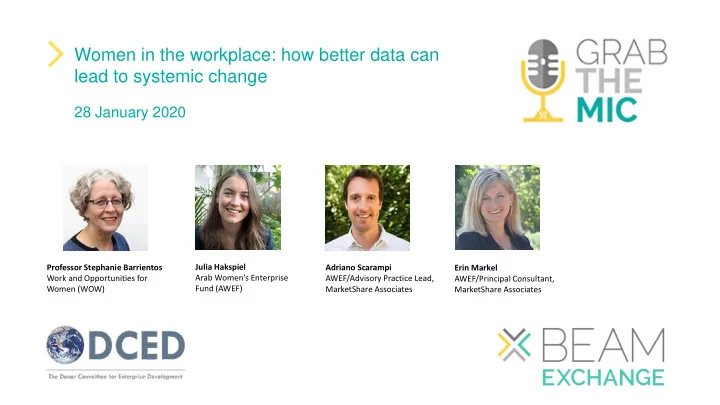
Women in the workplace: how better data can lead to systemic change 28 January 2020 Julia Hakspiel Professor Stephanie Barrientos Adriano Scarampi Erin Markel Work and Opportunities for Arab Womens Enterprise AWEF/Advisory Practice Lead,


slide-1
SLIDE 1

Women in the workplace: how better data can lead to systemic change

28 January 2020

Professor Stephanie Barrientos Work and Opportunities for Women (WOW) Julia Hakspiel Arab Women’s Enterprise Fund (AWEF) Adriano Scarampi AWEF/Advisory Practice Lead, MarketShare Associates Erin Markel AWEF/Principal Consultant, MarketShare Associates

slide-2
SLIDE 2

Gender and Work in Global Value Chains: Capturing the Gains?

Stephanie Barrientos Global Development Institute, University of Manchester BEAM Webinar – January 2020

slide-3
SLIDE 3

2

About Work and Opportunities for Women (WOW)

What is WOW?

  • DFID’s flagship programme on women’s economic empowerment
  • Five-year programme that aims to enhance the economic empowerment of

300,000 women working in global value chains and work with 35 DFID economic development programmes to increase the numbers of women beneficiaries

How will WOW achieve its goal?

1. Supporting businesses, organisations and programmes that are ready and willing to act on women’s economic empowerment (WEE); 2. Enabling players across the supply chain ecosystem to drive change; and 3. Influencing the UK and global agenda on women’s economic empowerment.

slide-4
SLIDE 4

3 | Gender and Work in Global Value Chains

How does WOW work?

WOW is being delivered by a consortium of global experts, across four key

  • utputs:

Business Partnerships

Partnerships with business to improve women’s participation in supply chains

Helpdesk

Increased knowledge and support for delivering women's economic empowerment through economic development programmes

WOW Fund

Support to multiple partnerships and initiatives that respond to the recommendations of the UN HLP report on Women’s Economic Empowerment report

Research

Partnerships with business to improve data and transparency on women’s work in supply chains

slide-5
SLIDE 5

4 | Document Title

Global Value Chain & Market Systems Approaches

Inputs

Production Distribution Retail

Cotton India

RMG Bangladesh Shipping

(Panamanian) via Rotterdam

Sold in UK

BEE Country 1

BEE Country 2 BEE Countries 3 & 4

BEE Country 5

Global Value Chain (GVC):

  • Consumer focused
  • Buyer driven and coordinated
  • Governance:
  • Quality Standards
  • Cost (price points)
  • Consistency – JIT

Market Systems Development (MSD):

  • Pro-poor focused
  • Producer market access driven
  • Business enabling environment (BEE):
  • Local actors/governments
  • Market support services
  • Crowding in – scaling up
slide-6
SLIDE 6

Global Value Chains (GVC) and Workers

Source: World Development Report 2020

(In)visibility of women workers:

  • In 40 OECD and middle-

income economies est. 453 million jobs in GVCs

  • 42% female (ILO 2015)
  • But excludes:
  • Lower income countries
  • Lower GVC tiers
  • Casual, seasonal,

informal workers

  • Smallholder contributing

family labour

slide-7
SLIDE 7

Inputs Production Distribution Retailer Customer

*LLM

GVC Governance

Gender Analysis of GVCs

Standards Compliance

*LLM = Locally Embedded Labour Markets

Unpaid Reproductive/Care Work

World Development Report 2020 – GVC firms vs. non-GVC firms:

  • Deliver better jobs, but employment complex
  • Employ more women
  • Contribute to poverty reduction by raising incomes

But

  • GVC gains distributed unequally within and between countries
  • Gender glass ceiling predominant

*LLM *LLM *LLM

slide-8
SLIDE 8

7 | Document Title

Commercialisation of Household Work

Lower GVC tiers Higher GVC tiers

slide-9
SLIDE 9

CATEGORY Processing/ manufacture Agriculture Intermediary/ agents Logistics Retailer Customer Consumer Board Senior management Labour contractor Smallholders/ homeworkers Temporary/ part-time Supervisors/ permanent

M M M M M M M M M M M M M M M/F M/F M/F M/F M F F M/F M F M/F M M/F F Men (>55%) Men/women (45–55%) Women (>55%) M/F

Illustrative Gender Mapping of Agri-food Value Chain

Source: Barrientos, S. (2019) Gender and Work in Global Value Chains: Capturing the Gains? Cambridge University Press

slide-10
SLIDE 10

9 | Document Title

Data Gaps: (In)Visibility of Women workers in GVCs

  • Data Sources:
  • Supplier HR
  • Buyer sourcing
  • Social Compliance
  • Gender

Initiatives/M&E

  • ILO/OECD TiVA

Collection Gaps

  • Supplier data

confidential

  • Sourcing team gaps
  • Audit data hidden &
  • verwritten
  • Data discrepancies

Recording: Fragmented

  • Supplier confidentiality
  • Buyer reporting aggregated
  • Social compliance confidential
  • Initiatives/ M&E variable or

gender data not requested

Reporting:: Poor

slide-11
SLIDE 11

Social compliance:

  • Failed on gender discrimination/harassment
  • BUT potential source of aggregate gender data

Company Data Access

  • Data systems/availability varies by company
  • Gender mappings informative + gaps, discrepancies identified

Garment GGVC Mapping

  • Innovation, shifting gender ratios
  • Leadership ‘pipeline’ blockages

Agrifood GGVC Mapping

  • Gender (in)visibility at smallholder level
  • Leverage potential to enhance visibility (beans/tea)

10 | Document Title

WOW Data Sources and Learning

slide-12
SLIDE 12
  • Gender (in)visibility and data gaps – critical problem
  • Systemic gender glass ceiling across GVCs invisible
  • Companies beginning to recognize and tackle issue
  • Some companies committed to promoting women in GVCs
  • Scaling Up – Cohesion and Collaboration
  • Common indicators e.g. Gender Data and Impact Framework

(BSR, ISEAL etc.)

  • Collaboration building across companies and wider stakeholders
  • Good for Business, Women and Sustainable Development
  • Risk, Resilience, Reporting of companies
  • Enhances women’s well-being and economic empowerment
  • Promotes and informs wider policy strategies e.g. UNGP and SDGs

11 | Document Title

Enhancing Gender Visibility in GVCs Critical

slide-13
SLIDE 13

“This document is an output from a project funded by UK aid from the UK government. However, the views expressed and information contained in it are not necessarily those of or endorsed by the UK government who can accept no responsibility for such views or information or for any reliance placed on them. This publication has been prepared for general guidance on matter of interest only, and does not constitute professional advice. The information contained in this publication should not be acted upon without obtaining specific professional advice. No representation or warranty (express or implied) is given as to the accuracy or completeness of the information contained in this publication, and, to the extent permitted by law, no organisation or person involved in producing this document accepts or assumes any liability, responsibility or duty of care for any consequences of anyone acting, or refraining to act, in reliance on the information contained in this publication or for any decision based on it.”

slide-14
SLIDE 14
slide-15
SLIDE 15

2

About the Arab Women’s Enterprise Fund (AWEF)

Where?

  • Middle East and

North Africa (MENA) is a region with lowest econ participation of women in the world

Why?

  • Increase economic
  • pportunities for

150,000 poor women in Jordan and Egypt by 2020

How?

  • Use a market

systems approach to address barriers women face in target markets

  • Measure impact

through increased access and agency

slide-16
SLIDE 16

3

  • Identify constraints and opportunities for

business and women in the target sectors

Analyze

  • Monitor and pivot interventions in response to

emerging results

Monitor & Learn

  • Document results that can encourage replication

within the market

Document the Business Case

  • Capture systemic change within the market

Measure

How AWEF uses data

slide-17
SLIDE 17

4

  • Identify constraints and opportunities for

business and women in the target sectors

Analyze

  • Monitor and pivot interventions in response to

emerging results

Monitor & Learn

  • Document results that can encourage replication

within the market

Document the Business Case

  • Capture systemic change within the market

Measure

How AWEF uses data

slide-18
SLIDE 18

5

SECTOR OVERVIEW ▪ Ready Made Garments (RMG) is a strategic sector for the national economy contributing 2.25% of GDP. ▪ Women’s workforce participation in the sector stands only at 45% as compared to the global benchmark of 80%. KEY CONSTRAINTS ▪ Low productivity (assessed at average 52% of potential) is a leading constraint and barrier to Egyptian RMG sector expanding its global share. ▪ The under-representation of women in the Egyptian RMG workforce is one

  • f the leading causes of this low productivity

▪ Poor treatment at work is the number one reason women leave RMG jobs.

Egypt RMG Sector –Key Constraints

slide-19
SLIDE 19

6

Creation of new formal gender-sensitive recruitment channels for blue collar women workers. Gender-Sensitive Recruitment Access to supervisory skills training (SST) by RMG sector firms to improve supervisor treatment of workers. Supervisory Skills Training Choosing the right partner:

  • Arafa Holdings is one of the largest RMG exporters and employers in the country.
  • Approximately 3,000 women are employed in both factories, and Arafa is viewed as the market

standard within the industry.

  • CEO of Arafa is female and management showed strong interest in addressing low recruitment &

retention of women

AWEF RMG Interventions

slide-20
SLIDE 20

7

RMG – Documenting the Business Case

Improved turnover & absenteeism

1720 workers recruited through referrals

Improved levels of workers satisfaction & motivation

Improved productivity & quality of work

Product quality improvement for 42% of trained supervisors Reduced time spent in conflict resolution

Improved performance in audits

Arafa more likely to retain contracts and increase sales

slide-21
SLIDE 21

8

AWEF Practitioner Learning Brief

  • Brief builds on AWEF experience

and 17 case studies from wider practitioner community

  • Download at:

https://beamexchange.org/resou rces/1240/

slide-22
SLIDE 22

9

  • Identify constraints and opportunities for

business and women in the target sectors

Analyze

  • Monitor and pivot interventions in response to

emerging results

Monitor & Learn

  • Document results that can encourage replication

within the market

Document the Business Case

  • Capture systemic change within the market

Measure

How AWEF uses data – Jordan

slide-23
SLIDE 23

10

Jordan – using data to identify constraints and opportunities

18% female labour force participation 40% of population works informally 2,029t per annum 80-90% produced informally at home 33.6% of women own bank accounts

slide-24
SLIDE 24

11

Jordan – using data to learn and pivot strategies for greater impact

AWEF facilitates introduction

  • f new

licensing process for home-based businesses

WHY?

Low licensing uptake ➢ Low awareness

  • f potential of

licensing process ➢ Fear of formalisation and taxation ➢ Fear of losing social security benefits Intervention 3: Partnership with Ministry

  • f Social Development

Intervention 1: Role models intervention Intervention 2: Partnership with tax authority

slide-25
SLIDE 25

12

Jordan – Using data to drive systemic change

Informal rules/expect ations Impact for women Market actor change/Scale

slide-26
SLIDE 26

13

AWEF Lessons Learnt

Importance of a flexible MRM system Being comfortable with monitoring can take time Don’t rush to define the informal rules