
SLIDE 1
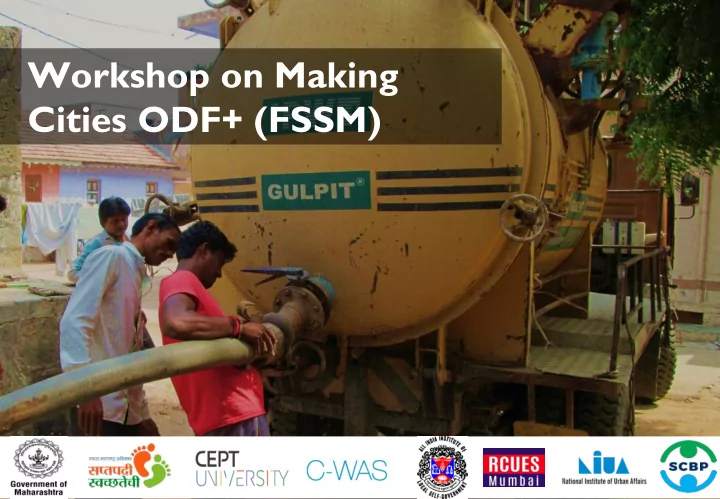
Workshop on Making Cities ODF+ (FSSM) Session 1: ODF+ (FSSM) Need - - PowerPoint PPT Presentation
Workshop on Making Cities ODF+ (FSSM) Session 1: ODF+ (FSSM) Need of the hour 2 High dependence on Onsite systems in Urban India!! Based on the PAS-SLB data by 6 states covering 907 cities, 2016-17 6 Urban states in India 796 100%
2
0% 10% 20% 30% 40% 50% 60% 70% 80% 90% 100% Fully Sewage cities Fully onsite sanitation system Mixed sanitation system
Based on the PAS-SLB data by 6 states covering 907 cities, 2016-17
3
Only 3 cities in Gujarat are reported to have 100% sewerage system Nearly 800 cities have fully onsite sanitation systems
796 108 3
6 Urban states in India (PAS-SLB data 2016-17)
Status of waste water treatment in Maharashtra
4
Source: PAS-SLB 2016-17
35 14 3 53 153 127
50 100 150 200 250 300 350 400
With STP STP proposed under AMRUT Without STP Number of cities 9
MC & Class A Class B Class C NP
340
Treatment facility
7
“Faecal sludge is the solid or settled contents
Faecal sludge (FS) comes from onsite sanitation system such as pit latrines, non-sewered public ablution blocks, septic tanks, aqua privies, and dry toilets.”
6
Source : http://amrut.gov.in/writereaddata/FSSM_Policy_Report_23Feb.pdf
“Septage is the liquid and solid material that is pumped from a septic tank, cesspool, or such onsite treatment facility after it has accumulated over a period of time. Septage is the combination of scum, sludge, and liquid that accumulates in septic tanks”.
Facilities like septic tanks, dry latrines, community toilets, or other types
accumulate fecal sludge
Septage needs to be removed periodically. If this septage is not properly
managed, negative impacts on the urban environment and on public health may result
Pollution of groundwater and surface water sources caused by effluents
from household or community toilet septic tanks that are not desludged regularly
Improper handling of septage regenerates the risks of faecal matter re-entering
the domestic environment
7
Source : Advisory note on septage management in urban India, MoUD January 2013
1 tr 1 truc uck of k of Fae aeca cal Sl Slud udge ge and and Septa Septage ge ca carelessl elessly y du dumpe mped = 5,00 = 5,000 pe 0 peop
le shitting shitting in in th the e op
en!
Source : Chary, Srinivas, (2017), “City Wide Approach to Sanitation : Operationalizing FSM Regulations A Case study of Warangal City” at Ujjain Workshop by Water Aid, ASCI (mimeo)
Why is Faecal Sludge and Septage Management (FSSM) important ! ! !
9
Low – on Service Provider Medium – on Households Low – on Households
CONVENTIONAL SEWERAGE FSSM
Water Requirement Capital Costs O & M Costs Maintenance requirement Technical Expertise Required capacity to
High (>135lpcd) Low High Low
High – on Service Provider
High Low
High- Conveyance High - Treatment Low – Conveyance Low –
Treatment
High Low
Implementation challenges
High Low
SBM focus on having sanitary toilets and eradicating Manual scavenging
Post SBM context - Toilets are being constructed but need to think beyond that . . .
National Policy on FSSM by MoHUA, GoI
States beginning to roll out similar policies
National declaration on Septage Management by MoHUA, GoI
One of the major thrust areas of AMRUT – Financial allocations
Primer on septage Management and Rapid Assessment tool for estimating budget requirements for FSSM
National ODF+ and ODF++ protocol
10
Swachh Maharashtra Mission, Urban
15th May 2015
A near impossible task achieved in a short time…
“Move beyond toilets” – concept of ODF, ODF+, ODF++ cities - GoM GR dated 17th
Emphasis on quality – discouraging prefab toilets & contractor constructed toilets - GoM
GR dated 20th November 2015 – Septic tanks with toilets
12
80% HHs have access to individual toilets and rest dependent on CTs
Citywide FSSM Plan
13
ODF+ after declaring Urban Maharashtra ODF
resolutions, directing to move towards ODF+ and to utilize Incentive grant and 14th FC funds for ODF+ activities GR on ODF,ODF+ and ODF++ framework
GR on use of Incentive Funds
Chief Minister Speech on occasion of declaring Urban Maharashtra ODF on 2nd October 2017
15
State is going to provide training to ULBs for preparing ODF+ plans State to follow up with ULBs regarding : Whether cities have done an assessment for preparing FSSM plan Whether cities have developed an FSSM plan
Emptying plan Treatment plan
Have cities allocated land for construction of FSTP Have cities allocated funds for financing capital and O&M of FSSM services By when does the city plan to implement the FSSM plan Timeline of all these activities
16
17
Access
Containment
Conveyance Treatment Reuse/Disposal
Describes type
facilities the user accesses. Describes ways
sometimes treating the faecal waste generated by the users. Describes transport of waste from collection to the treatment / disposal site Describes way in which waste is treated Describes the way in which waste reused / disposed off
User interface Containment Conveyance and Transport Treatment Use or Disposal On-site sanitation technology Faecal Sludge Management
19
Pour flush latrines Existing Pit and Septic tank with drain field Open / covered drains / soak pits No treatment of fecal sludge No conveyance system in new developments Dumping along with solid waste Into river or natural drain
User interface Collection Conveyance Treatment Reuse /Disposal
Lack of 100% coverage
Lack of treatment facility Lack of scientific disposal of septage Old city area - Inadequate primary treatment but good conveyance through open drains New developments - Improved primary treatment through septic tanks but no drains
Missing links in Sanitation value chain in a city Water
body
Suction truck
20
Septic tanks are below the toilets and don’t have access covers Inaccessible septic tanks with sealed tops Septic tanks located near drains and sealed from the top Single pit toilets Oversized septic tanks Toilets directly connected to drains
No monitoring mechanism for informal sector
Cleaning cycle greater than 8-10 years against recommended cycle of 2-3 years
Due to infrequent cleaning, septage begins to solidify in tanks and septic tank fills up, fecal matter along with effluents is released into the drains
Services mainly provided by city governments Unsafe handling of septage Informal Private sector
Emptying when the tank is full
Disposal of septage at dump site Disposal of septage in open land Disposal of septage in water bodies
22
NO TREATMENT OF FECAL SLUDGE & SEPTAGE
Source : Chary, Srinivas, (2017), “City Wide Approach to Sanitation : Operationalizing FSM Regulations A Case study of Warangal City” at Ujjain Workshop by Water Aid, ASCI (mimeo)
ce
t
Reuse Access Collection Conveyance Treatment Disposal / Reuse
Pour flush toilets Septic tanks Suction emptier truck No treatment facility Disposed off on dumping site Pour flush toilets Septic tanks Suction emptier trucks Treatment facility Revenue from compost
Current Situation Proposed Approach
without treatment
manhole covers
standard size
tanks for properties
tanks cleaned annually
sludge treatment
treated fecal matter and/or the sale of septage at a fixed rate to nearby farms or agro-businesses
manhole covers to allow regular cleaning
properties with septic tanks
emptying of septic tanks
registrations and monitoring of private emptier
taxes using escrow mechanisms
facility for the treatment of septage
unimproved toilets to improved toilets
access to improved toilets
for all properties
access to improved toilets
data base on toilets for properties
23
Councils signed to implement FSM plans 1st cities in India to execute scheduled desludging Built FSTP for treating septage Private sector participation for emptying services Escrow account to minimize payment risks for private
Funding through Sanitation tax levied on all properties
25
26
Access
Containment
Conveyance Treatment Reuse/Disposal
Describes type
facilities the user accesses. Describes ways
sometimes treating the faecal waste generated by the users. Describes transport of waste from collection to the treatment / disposal site Describes way in which waste is treated Describes the way in which waste reused / disposed off
User interface Containment Conveyance and Transport Treatment Use or Disposal On-site sanitation technology Faecal Sludge Management
Single pit toilet Twin pit toilet 2-3 chambered Septic tank Biogas Composting toilet Bio-digestor
No monitoring mechanism for informal sector
Cleaning cycle greater than 8-10 years against recommended cycle of 2-3 years by GoI advisory on Septage Management
Due to infrequent cleaning, septage begins to solidify in tanks and septic tank fills up, faecal matter along with effluents is released into the drains
Services mainly provided by city governments Unsafe handling of septage Informal Private sector
Emptying when the tank is full
“Prohibition of Insanitary Latrines and Employment and Engagement for cleaning of Sewers or Septic Tanks as Manual Scavenger
Prohibition of Employment as Manual Scavengers and their Rehabilitation Act, 2013
Came into force on Dec 6, 2013 Local authorities to survey Insanitary latrines and provide Sanitary community latrines. Survey of manual scavengers in urban areas by Municipalities. Duty of local authorities and
mechanical technology for cleaning of sewers and
Prohibition of Activity Rehabilitation Rehabilitation of persons identified as Manual Scavengers by a Municipality. Housing and Financial Assistance to be given.
In India: the Central Public Health Engineering and Environmental Organization (CPHEEO) suggests:
“Yearly desludging
septic tank is desirable, but if it is not feasible or economical, then septic tanks should be cleaned at least once in two - three years, provided the tank is not overloaded due to use by more than the number of persons for which it is designed”
Pg 9-22, CPHEEO Manual
“When the pit is Full”. Often a tank is emptied when it is full. There is a tendency to use/build oversized septic tanks to avoid frequent emptying. It is important to assess how often a septic tank is emptied. Such information will need to be gathered through a household surveys.
Example
Sketch adopted from compendium of sanitation systems and technologies, Eawag
Demand desludging Scheduled desludging V/S Planning Decision
The ULBs operates the trucks (either owned or borrowed) when the demand arises. Each town will require an additional number of trucks to meet service standards (which can be operated by a private player) Households generally pay a certain amount once in >8-10 years to get tanks cleaned during the time of
Local taxes levied by the ULB will be used to recover the operating expenses for regular cleaning. Scheduled Practice On-Demand Basis Cleaning is done on-call by the household, who do not see the need for regular cleaning The cleaning services of the ULB are currently treated as a complaint redressal system for
cleaning and maintenance service. Septic tanks will be cleaned on a pre- determined schedule. Regulations and penalties will be set in place to ensure periodic cleaning Awareness generation activities will educate households about the need for regular cleaning
HHs call emptying service when system is full Provide service and charge the HHs
If non-regulated,
environmental and health risk
charge higher
disposal
Plan for Regulated Demand based emptying services
Dakar Model
Septic tank cleaning cycle
To maintain a cycle of 3 years, roughly 2800 septic tanks need to be cleaned annually Each vehicle needs to make 4 to 5 trips daily Roughly 300 Working Days are required To clean 2800 septic tanks, 2-3 nos of suction emptier trucks
required
2-3 nos of trucks of 5000 litre capacity are required for cleaning HHs and non- residential septic tanks
Year Zones
annually (no)
required Year 1 Zone 1 1889 201 Zone 2 947 101 Total 2836 302 Year 2 Zone 2 1262 135 Zone 3 1582 169 Total 2844 303 Year 3 Zone 3 2762 294 Total 2762 294
Zone 2 Zone 1 Zone 3
Divide the city into zones and prepare a yearly plan
Equitable services - all households / properties are covered by services Pricing – Services are offered at lower prices, due to efficiency gains Behavior change - Contribution to ODF sustainability as toilet usage can increase Manual scavenging - Removal of need for manual scavenging due to regular
emptying
Infrastructure optimization - More predictable loads for treatment facility and
route optimization of trucks
Environmental benefits - Likely reduction in BOD and coliform in septic tank
effluent, as well as lower likelihood of septic tank overflows
Distance of treatment site Access to site Characteristics of septage Road Width
i. iii iv. ii.
Size of septic tanks/pits
v.
Traffic congestion
vi.
Fuel requirement and its implication in opex
vii
Financial budget of emptying services
viii
? ?
For septic tanks which have proper access roads, a larger vehicle maybe used
Conventional Vacuum Tanker
For septic tanks located in narrow lanes or those that do not have proper access roads, smaller vehicles maybe used
Mini-Vacuum Tanker (Vacutug)
Smaller mechanized tricycle/ motorcycle mounted collection tanks of 20–40 litres capacity with gulper or smaller vacuum pumps at the primary level backed by a secondary transport system may work in the informal slum settlements.
Gulper
Licensing of septage transporters
Septage Transporter Permit for _________ Municipality
In accordance with all the terms and conditions of the current _______ Municipality’s Rates, Rules and Regulations, the special permit conditions accompanying this permit, and all applicable rules, laws or regulations of Government of Maharashtra, permission is hereby granted to: NAME OF PERMITTEE: _________________________________________________________________ ADDRESS:___________________________________________________________________________ For the disposal of septage from domestic septic tank or commercial holding tank at the___________________ treatment facility. This Permit is based on information provided in the Septage Transporter Permit application which constitutes the Septage Management Hauled Permit. This Permit is effective for the period set forth below, may be suspended or revoked for Permit Condition Non Compliance and is not transferable. The original permit shall be kept on file in the Permittee’s office. A copy of this Permit shall be carried in every registered vehicle used by the permittee. EFFECTIVE DATE: EXPIRATION DATE: ____ CHECK IF RENEWED PERMIT Permit is liable to be cancelled in case of violations of any Acts, Rules and Regulations relating to the
permitted disposals.
Sample licensing format Emptying services by ULB or by private agencies: management
and license private septage transporters to de-sludge and transport waste to the designated treatment facility.
Emptying service provision through licensing/contracting
Septic tank emptying tender document
Contracting the service to private sector
The service for de-sludging and transport of septage can be contracted out to private sector for a predefined period of time and cost of the service. A detailed tender document should be made detailing out all the necessary terms and conditions
Safety Gears Use of safety gears by a sanitation worker
work through trainings.
protective gear.
Helmet Safety goggles Mask Suit with apron Rubber gloves T
Gum boots
Banners Flyers Video Awareness activities such as:
can be planned with a detailed schedule using different material… Facebook page Awareness material should focus on importance of emptying, details of scheme, precautions to be taken etc.
Source: Operative guidelines for septage management for urban and rural local bodies in Tamil Nadu.(2014)
Monitoring of emptying service is required to:
Different stakeholders such as Municipal Council, private service provider, citizens, treatment plant operator etc. can benefit from a robust monitoring process
Use of mobile based applications for monitoring the emptying process
Municipal Council’s copy Property holder’s copy Emptying service provider’s copy Treatment plant’s copy
Daily report formats to monitor emptying process. These records can be linked to the payment of private emptying service provider
Urban Local Body
not conform to standards
disposal
equipment
Private sector
and knowhow
Win-Win situation
services and standards
competitive prices
support and encourage PSP in urban infrastructure projects
Existing resources to guide PSP in large scale sanitation projects, but need for guidance on engaging contractors in small-scale sanitation projects based on the FSSM approach.
Private sector investment in trucks has significant benefits for the ULB
Ease of procurement: ULB procurement of the truck would require floating a tender, inviting, evaluating and negotiating bids. This is likely to be time consuming, and involve transaction costs that can be avoided if the private player purchases the truck. Aligns private sector incentives: Private sector investment in trucks incentivizes the player to use and maintain the truck well. Allows investment in quality: ULBs are often bound to minimize cost, while the private sector can invest in quality trucks with longer lifecycles and additional features like water jets. Benefits to public sector Facilitates access to finance: Having a contract from the ULB can make it easier for the private player to raise capital for the truck and negotiate better financing terms. Provides a platform for business expansion: A contract with the ULB serves as a low-risk platform for private sector players to scale by providing access to guaranteed demand to recoup investment in a truck. Benefits to private sector
T ypical opportunities for PSP across sanitation chain
Access Collection Conveyance Treatment Disposal/ Reuse
Improper onsite systems Inadequate suction trucks, manpower No treatment facility Unsafe disposal
access manhole covers and are not
systems cleaned annually
faecal sludge treatment
the open without treatment Regular emptying of onsite systems to ensure that 1/3 of the onsite systems in the town/city are cleaned every year as per GOI guidelines1 1 Regular refurbishment of the onsite systems which includes providing access manhole covers to allow regular emptying, and repair of onsite system (if needed) 2 Construction of Septage Treatment Facility (STFs) for the treatment of faecal sludge 3 Regular reuse / disposal of treated sludge and cleaning
4
Note: (i) As per MoUD guidelines, a household onsite system/onsite system must be emptied every 3 years hence 33% of all onsite systems/ onsite systems should be emptied annually
Access Collection Conveyance Treatment Disposal / Reuse Pour flush toilets Septic tanks Suction emptier trucks Treatment facility Revenue from treated septage Proposed value chain
fixed rate to nearby farms or agro- businesses
septic tanks with access manhole covers
septic tanks along a regulated schedule
treatment facility
maintenance of treatment facility Activities required A B C D E Labor contractors for septic tank cleaning Septic tank cleaning companies Pure-play treatment players Integrated faecal sludge management providers Small scale players (<10 employees) Medium scale enterprises (>10-50 employees) 1 2 3 4 Buyers of septage Organic Farming Association Agro-based industries Local farmers and growers associations
ULB can invite Expression of interest (EoI) to scope possible players
Operational role of the private contractor 1
Bundled or Unbundled contract? Who should invest in capital assets? What is the appropriate payment structure for the private player? What is the appropriate contract duration for private and ULB ? Revenue stream enough to meet private players’ return expectations? How to address the major risks for the private player and the ULB ?
Source of revenue 2
Selecting an appropriate PSP Option
Investment /ownership
asset 3 Payment structure 4 Contract length and value 5 Risk mitigation and allocation 6
MODEL TENDER covering this aspects is AVAILABLE for FSSM
Following this process bid documents have been rolled out in few cities of Maharashtra Septic tank emptying T ender document Model T ender document is available
Financial Requirement
Suction Emptier Trucks
Potential Sources of Fund
Central/state Grants Private sector/PPP Local government fund
Financial Requirement
Operation of Emptier trucks
Potential Sources of Fund
Sanitation Tax/ Other tax User charge (Emptying fees)
Identify revenue sources….
Scheduled Desludging through Sanitation Tax
Basis - a) sanitation tax collected from owners of OSSs, and b) mandatory scheduled desludging of tanks/pits. Sanitation tax is collected by the local authority either as a percentage of property tax or by the public utilities as a surcharge on water bills.
Emptying Transport Treatment User Interface
FS Flow Diagram Proposed tariff flow
Private truck operator FSTP (ULB or PPP) Sanitation Tax Household Local government Capital and O&M Budget support Contract fees Disposal/ Reuse Sale of treated Septage & water Revenue
Levied differential tax on all properties for financing FSSM
services
City level resolution for taxation
Differential taxation rates Residential Properties with / without toilets–
Non Residential Properties with toilets –
Non-residential properties without toilets–
Demand Based Desludging through emptying charge
Basis - Requires setting up a call center or a customer help center managed by the local authorities which acts as a network orchestrator linking users of OSSs with vacuum truck operators. The truck operators register with the call center for a fixed annual fee which can also double up as a license or permit. Users of OSSs call the help center when their septic tanks or pits are full.
Emptying Transport Treatment User Interface
FS Flow Diagram Proposed tariff flow
Private truck
FSTP (ULB or PPP) Household Local government Capital and O&M Budget support Licensing fee Disposal/ Reuse Sale of treated Septage & water Revenue
Emptying charge
Request emptying service through call centre
Disposal fees
53
Participants will plan for Emptying infrastructure that is required for implementing a FSSM plan for a city.
Part 1 - Prepare FSSM plan for a city
FSSM PLAN Sr.No Description No. Input details A Total number of Septic tanks in the city (no) B Average volume of septic tanks (cum) C Septic tank cleaning cycle (Years) D
E
Number of septic tanks to be emptied daily
Number of septic tanks to be emptied daily = Total number of Septic tanks in the city (Septic tank cleaning cycle * No. of working days in an year) = ______daily
Number of trucks required (Nos.)
Number of trucks required = Number of septic tanks to be emptied daily Number of trips possible per truck per day = _____ nos
Volume of septage to be treated (cum/day) Average volume of septic tanks x number of septic tanks emptied per day
= ___ cum/day
O& M cost for schedule septic tank emptying service
1 Fuel cost for schedule emptying service = (Number of septic tank to be emptied daily X Number of working days in a year X Average distance X 2 X (Fuel price / Fuel efficiency))
2 Repair and maintenance cost = (Number of suction emptier truck requirement X months in a year X avg repair and maintenance cost per month)
3 Establishment expenses = ((Number of suction emptier truck requirement X 12 X No of manpower X Monthly Salary)
4 O&M cost per year Sub-total = (1+2+3) 5 Overhead + Insurance + other Miscellaneous cost = Sub-total(4) X 10%
6 –A Total O&M cost for schedule septic emptying service = (4+5) (Per year)
6-B
Sanitation Tax (per property per year)
= Total O&M cost (6-A) / Total number of properties in city
57
Access
Containment
Conveyance Treatment Reuse/Disposal
Describes type
facilities the user accesses. Describes ways
sometimes treating the faecal waste generated by the users. Describes transport of waste from collection to the treatment / disposal site Describes way in which waste is treated Describes the way in which waste reused / disposed off
User interface Containment Collection and Transport Treatment Use or Disposal On-site sanitation technology Faecal Sludge Management
59
Source : Advisory note on Septage management in Urban India, MoUD Jan 2013 & CPHEEO Manual 2013, chapter-5
Physical and chemical characteristics of Fecal Sludge
Parameter Fecal Sludge characteristics Wastewater characteristics Range Average
BOD
440-78,600 6,480 250
COD
1500-703,000 31,900 425
T
1,132-130,745 34,106 637
T
353-71,400 23,100 262.5
T
310-93,378 12,862 375
T
66-1,060 588 50
Ammonia Nitrogen
3-116 97 32.5
T
20-760 210 7.1
60
Septage samples must be collected from:
Public Toilets
Period of desludging must be considered. Samples with long desludging frequency (7-8 years) and samples with shorter desludging frequency (2-3 years) must be considered for selecting the samples
Volume of Septic tank Per capita generation Standard
each property (residential, community, commercial, institutional)
collection system
litres/capita/year (GOI septage guidelines)
population*230
Typologies of Cities Typology 1 (24 cities)
Corporation
planned sewer network with STP under AMRUT or any
Typology 2 (20 cities)
Council
planned sewer network with STP under AMRUT or any
Typology 3 (45 cities)
co-treatment
planned sewer network, however, proximity to city with STP
Typology 4 (63 cities)
Above 50,000
planned sewer system
Typology 5 (232 cities)
Below 50,000
planned sewer system
Sewered Cities Cities reliant on FSSM / Co-treatment No FSTP required Co-treatment
with nearby STP Require independent
FSTP
63
Co-treatment with STP
(GR by Maharashtra government)
Co-treatment with SWM
64
Cities within 20 km vicinity of nearby city with STP can explore this option
upstream of the sewage treatment plant, and substantial dilution of septage occurs prior to it reaching the sewage treatment plant, depending on the volume of sewage flowing in the sewer.
the screening and grit removal processes. It is economical because of the very simple receiving station design (As shown in figure) and also allows the wastewater treatment plant staff to have control of the septage discharge
Schematics of Septage receiving station
drying beds: Dewater septage or sludge can be
added to sludge drying bed of STP. The liquid fraction from sludge or septage can be directed to the STPs.
66
existing sewerage treatment plant
KLD
capacity
Effluent Sludge Effluent
Sludge Drying Bed : 8 beds Sewerage Treatment Plant: 15 MLD Settling thickening tank : 50 KLD Screen Channels: 2 No.
Effluent
67
Co-treatment with STP
(GR by Maharashtra government)
Co-treatment with SWM
Septage Organic Waste Dewatering unit Windrow/ Drum Composting
Solid in ratio
1:3
Facultative pond Liquid Chlorination tank
Reuse / Disposal Drying Reuse / Disposal Septage Organic Waste Bio- Methanation
Liquid Chlorination tank
Reuse / Disposal Drying Reuse / Disposal
Solid
Planted Gravel filter
for effluent treatment
69
Waste to Energy through Co-fermentation of Organic Waste and Septage in Nashik
The Waste to Energy Project in Nashik, is a project of Nashik Municipal Corporation in cooperation with GIZ as implementation partner. The plant is treating biodegradable waste and septage generated in the city and generates energy through biogas for feeding it into the Maharashtra power grid. It is
attempt to showcase a viable business model for implementation of waste to energy projects through a Public Private Partnership (PPP) and is built on a comprehensive financial and operational model. Daily 10 to 15 tons of food and vegetable waste from approximately 500 restaurants and 10 to 20 tons of septage from 400 community toilets are collected by trucks and delivered to the plant. The organic waste from hotels is segregated at the collection points. In a first step, organic waste and septage will be treated separately. The organic waste will once more be cleared from any foreign matter, fed to a crusher and then mixed with septage to form a slurry. The slurry is continuously agitated and forwarded to the digester. Option of pasteurization of septage using excess heat is kept open for further use of excess digest-ate to produce organic fertiliser. The co-fermentation process takes place in the bio-digester producing approx. 2,500m3 biogas per day
Source: https://www.international-climate- initiative.com/fileadmin/Dokumente/2017/171201_WtE_Brochure.pdf
70
Bansberia, West Bengal
Capacity: 50cum/day Land: 27000 sq.mt Commissioned: 2009 Capital cost: NA O&M: Rs 13.5 lakh/year
Composting
Sand Drying bed and co-composting with SWM
71
Co-treatment with STP
(GR by Maharashtra government)
Co-treatment with SWM
Reliability of electricity
ii.
It is also important to assess the availability and reliability of electricity if treatment technology has mechanical
Climatic conditions
iii.
Assessment of existing climatic conditions on site like rainfall pattern, average temperature, prone to flooding, is always recommended as it may directly affect selection of technology
plan.
echnology assessment is based on site specific criteria.
Land availability
Projects are
because of non- availability or high price of land. Treatment technology depends on parcel on land available. If huge land is available then non-mechanized technology can be adopted; while in shortage of land, city has to go for mechanized treatment technology.
i.
Assessment of capital cost and O&M cost is always recommended as it may affect selection of technology option that are financially viable.
Funds
iv.
Septage from septic tank
Planted Sludge Drying Bed Liquid Reuse / Disposal
Platform for Drying Reuse / Disposal
Solid
Septage from septic tank Planted Sludge Drying Bed Platform for drying Reuse/ Disposal Reuse/ Disposal Screen/ Grit removal Screen/ Grit removal ABR Horizontal Planted Gravel filter Anaerobic Baffle Reactor (ABR)
Horizontal Planted Gravel filter Collection tank + chlorination
Collection tank + chlorination
74
Advantages:
Disadvantages:
required sheds during rainy season which increase capital cost Examples: Leh FSTP
Capacity: 12 cum/day Land: 720 sq.mt Capital cost: Rs 52 lakhs O&M: Rs 10 lakh/year Commissioned: 2017
Septage from septic tank
Unplanted Sludge Drying Bed Liquid
Reuse / Disposal Platform for Drying Reuse / Disposal
Solid
Septage from septic tank Unplanted Sludge Drying Bed Platform for drying Reuse/ Disposal Reuse/ Disposal Settling tank with screen Screen/ Grit removal Settling tank ABR Horizontal Planted Gravel filter Anaerobic Baffle Reactor (ABR)
Horizontal Planted Gravel filter Polishing pond
Polishing Pond
76
Settling thickening tank with screening : 2 No. Anaerobic Baffled Reactor: 2 No. SDB: 10 No. Horizontal Planted Gravel Filter: 2 No. Polishing Pond: 1 No.
Effluent Effluent Effluent
Septage from septic tank Reuse/ Disposal Anaerobic digester ABR Chlorination tank Reuse/ Disposal Sludge Drying Bed Planted Gravel Filter Septage from septic tank
Liquid Chlorination tank
Reuse / Disposal Reuse / Disposal
Solids
Anaerobic bio- gas Digester
Sludge Drying Bed Filtrate
Anaerobic Baffle Reactor (ABR) Planted Gravel filter
for effluent treatment
Collection tank Collection tank
Biogas collection chamber Biogas collection chamber
78
Advantages:
Disadvantages:
construction Examples: Devanahalli FSTP
Capacity: 6 cum/day Land: 520 sq.mt Capital cost: Rs 67 lakhs O&M: Rs 6 lakh/year Commissioned: 2015
Septage from septic tank
Warangal, T elangana
Capacity: 15 cum/day Land: 1000 sq mt Capital cost: Rs 1.2 cr O&M: Rs 10-15 lakh/year Commissioned: 2017 Planned with sanitation resource park Capacity: 70 cum/day Land: 1200 sq mt Capital cost: Rs 1.8 cr O&M: Rs 24 lakh/year Under construction
Wai, Maharashtra
81
82
83
Capacity: 70 cum/day Land: 1547 sq.mt Capital cost: Rs 1.63 cr O&M: Rs 8.3 lakh/year Under technical sanction Capacity: 100 cum/day Land: 1200 sq mt Capital cost: Rs 2.75 cr O&M: 24-30 lakh/year Commissioned: 2015
Sinnar, Maharashtra Cochin, Kerala
Sr. N
T echnology Land Requirement Energy Requirement Climatic condition Examples Estimated Capex Cost (Rs. In lakhs/ cum) O&M Cost
(Rs. in lakhs/ Year)
1
Sludge drying bed (SDB) + Oxidation pond High Nil-low Low - Medium rainfall Leh, Punjab, West Bengal
0.75 - 1
10-12
2
Anaerobic Digester + ABR+PGF High Nil-low Low - Medium rainfall Devanahalli, Trichy
1.5-2
10-12
3
Dewatering unit+ co-treatment with SWM (windrow composting/ bio-methanation)+ Oxidation pond/PGF for liquid treatment High-Medium Medium Nil Nashik, Ganga basin cities (Mughalsarai and
Gangaghat), Ghana
1.5-2
12.3-12.8
4
Geobag+ Oxidation pond for liquid treatment Medium Medium Nil Malaysia
2-2.5
10-12
5
Pyrolysis Low High Nil Wai, Warangal, Narsapur
2.5-3
10-20
6
UASB/MBBR/SBR Low High Nil Sinnar, Kohima, Cochin, Periyanaicken- palayam
2.5-5
8-15
Fecal sludge treatment service through DBOT T ender
constructing as well as operation and maintenance for the first few years before the responsibility of the facility is transferred to the ULB
echnology neutral tender; Performance based contracts
their septage treatment facility
document
innovative technologies DBOT T ender document This has been done for
elengana
design and details of financing the project for FSSM in the city prepared by an
which includes construction and preferably operation and maintenance for fixed duration
Fecal sludge treatment service through DPR based T ender
Operation of Treatment Facility- Salary, electricity , pumps
replacement, etc
Sanitation Tax/Other Taxes Sale of Compost
Treatment Facility- Land and construction cost 14th Finance Funds and ODF incentive funds CSR, Donor grants ULB own resources Central and State schemes Private Sector/PPP
Dewatered septage/sludge use as a
fertilizer in agriculture , should satisfy criteria of Class A Bio-solids of US EPA :
Faecal coliform density < 1000 MPN/g total dry
solids
Salmonella sp. Density < 3MPN/4g total dry
solids
Helminth egg concentration < 1/g total dry
solids (WHO, 2006)
E – Coli of 1000/g total solids (WHO, 2006)
Source : Advisory note on Septage management in Urban India, MoUD Jan 2013
As per MSW Rules, 2000 compost quality should not exceed the prescribed limit as below:
Properly treated sludge can be reused to reclaim parched land by application as soil conditioner, and/or as a fertilizer. Deteriorated land areas, which cannot support the plant vegetation due to lack of nutrients, soil organic matter, low pH and low water holding capacity, can be reclaimed and improved by the application of treated septage
Landscape Assessment of Reuse Market
Possible market demand
Social Factors - Assess their willingness to reuse the treated Septage and water
Assess reuse potential market –Identify nearby industries and agriculture land Assess willingness and demand to reuse Assess willingness to pay for reuse
90
with STP , Co-treatment with SWM or independent treatment plant)
treatment plant?
plant?
services?
O& M cost for septage treatment facility
1 Energy cost for Septage treatment facilities = (Energy cost per month * 12) Energy cost
2 Repair and maintenance cost = (Avg. Repair & maintenance cost * 12)
3 Establishment expenses = (No. of manpower*Monthly Salary *12)
4 Sub-total = (1+2+3) 5 Overhead + Insurance + other Miscellaneous cost = (4*X%)
6-B Total O&M cost for managing Septage treatment facility = (4+5)
93
94
Decide mode of Emptying services
Decide the treatment technology Decide source of financing the project (capex and opex of emptying and treatment) Pass council resolution for implementation of FSSM
95
treatment services
96
Timeline
1 Assessment of onsite sanitation systems (Septic tanks, pit toilets) in your city? 2 FSSM plan for your city and its timeline for implementation 2.a Decide mode of Emptying services
2.b Decide Fecal Sludge treatment option
3 Council resolution for implementation of FSSM plan (timeline) 4 Source of financing for Emptying and Treatment?
5 City allocates land for treatment plant? (timeline) 6 City implements the FSSM plan (timeline) 7 What all Awareness activities city plans to undertake?__________________________________________________________ 8 What type of Monitoring mechanism will city setup for emptying and treatment? __________________________________
Website: www.cwas.org.in | Email: pas@cept.ac.in Contact Persons: aasim.mansuri@cept.ac.in; upasana.yadav@cept.ac.in; dhanshree.zende@cept.ac.in